Best Pharma Marketing Automation Tools in India (2026)
There is no shortage of marketing automation software. There is a serious shortage of marketing automation software that survives contact with Indian pharma.
A digital marketing head at an Indian pharmaceutical company evaluating this category will find two kinds of content. The first is global martech listicles that rank Marketo, HubSpot and Braze without once mentioning WhatsApp, the Uniform Code for Pharmaceutical Marketing Practices, or the fact that a large share of Indian doctors will never open a marketing email. The second is pharma-specific comparisons — genuinely good ones — that compare Veeva, IQVIA and Aktana at enterprise price points and never mention India at all.
We checked this rather than assuming it. One of the most thorough 2026 comparisons of AI-enabled HCP engagement platforms covers Aktana, OptimizeRx, Veeva Vault CRM and Pegasystems in detail, with named case studies and dated product announcements. It contains no India-specific vendors whatsoever. That is not a criticism of the analysis — it is an accurate reflection of a category that has been built for the United States and Western Europe.
So the digital marketing head is left doing the translation herself: which of these tools handles a WhatsApp-first channel mix, which will survive a Data Protection Board complaint after 13 November 2026, which can be afforded on an Indian brand budget, and which will simply automate the errors already sitting in her CRM. This article does that translation.
For most Indian pharmaceutical companies, the right answer is not one platform. It is a channel layer that handles WhatsApp properly, a consent layer that will stand up under the DPDP Rules 2025, and a decisioning layer that decides what to send to which doctor — sitting on top of doctor data that has actually been verified. Veeva and IQVIA win where budget and global alignment allow. Indian engagement platforms such as WebEngage, MoEngage, CleverTap and Netcore win on channel and price but were built for consumer marketing, not for HCP compliance. The most common expensive mistake is buying a decisioning layer before fixing the data underneath it — automation applied to a 57% error rate simply delivers the wrong message faster.
What is pharma marketing automation, and how is it different from ordinary martech?
Pharma marketing automation is software that plans, personalises, approves, delivers and measures communication to healthcare professionals and patients across channels — without a human triggering each message. It differs from ordinary marketing automation in four specific ways: the audience is a licensed professional rather than a consumer, every asset must pass medico-legal review before it can be sent, the promotional code of practice governs what may be said, and the identity data underneath it is unusually hard to keep accurate because doctors move institutions constantly.
Those four differences are why a tool that is excellent at e-commerce retention marketing can still be the wrong purchase. Sending a discount code to a lapsed shopper carries no regulatory consequence if it is slightly wrong. Sending an unapproved claim to a cardiologist does.
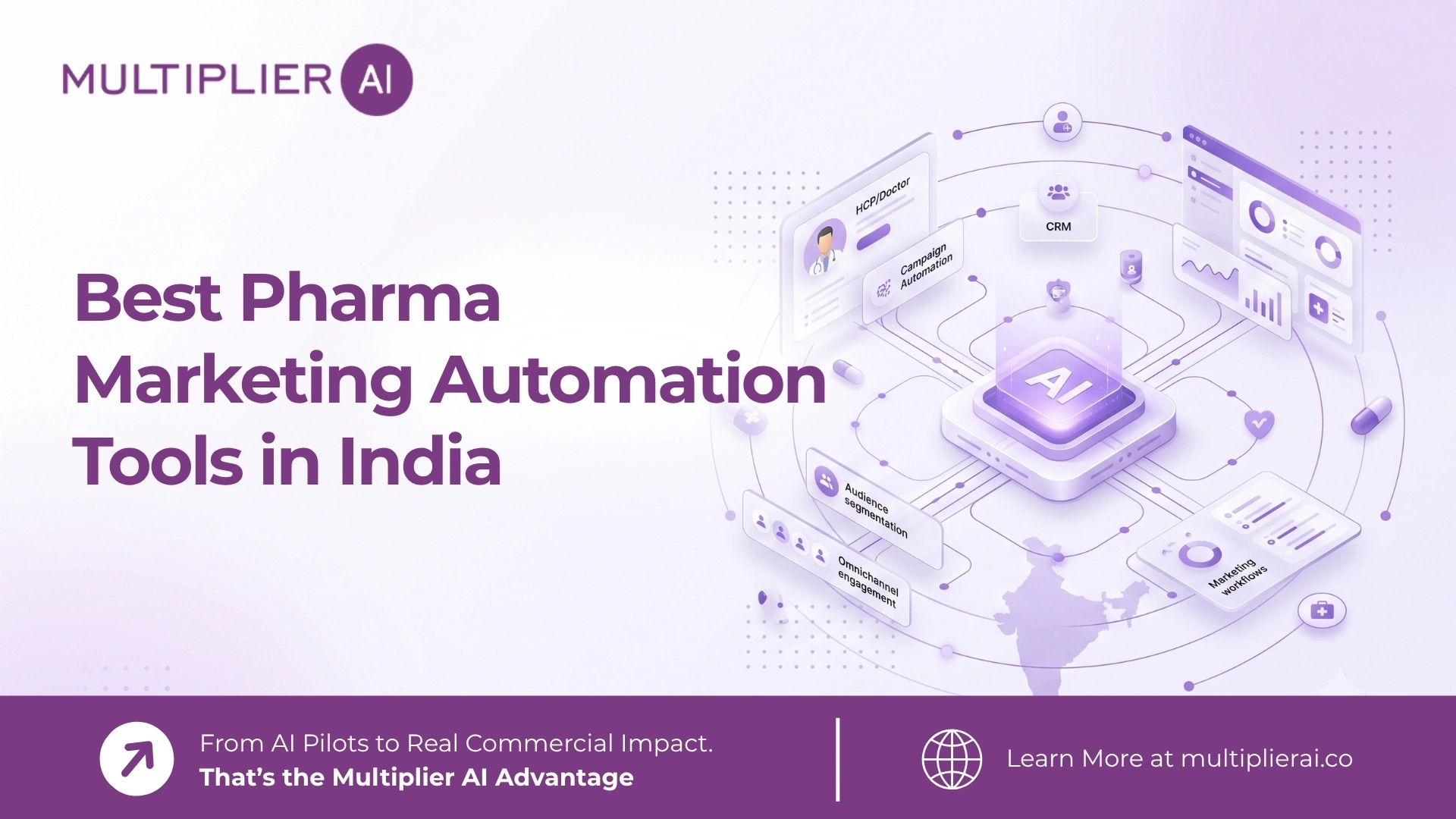
The five layers people mean when they say "marketing automation"
Most confusion in this category comes from vendors describing five different products with the same phrase. It is worth separating them, because you will almost certainly buy from more than one row.
| Layer | What it actually does | Who sells it well |
|---|---|---|
| Data layer | Holds and verifies the doctor and patient records everything else runs on — identity, specialty, institution, consent state | Doctor-data providers and master-data platforms. Rarely the same vendor as the campaign tool |
| Consent layer | Captures, timestamps, stores and honours permission per channel, and cascades a withdrawal across every downstream system | Specialist consent platforms and consent managers. The layer most often missing entirely |
| Content layer | Creates, modularises and routes assets through medico-legal review, then serves the approved variant | Content and DAM platforms, MLR-aware content automation |
| Decisioning layer | Decides which doctor gets which message on which channel at what moment — next best action | Aktana, ZS, Veeva, Salesforce, IQVIA, and increasingly agentic AI vendors |
| Delivery layer | Actually sends it — WhatsApp, email, SMS, voice, in-app, rep detail aid | Channel providers and engagement platforms. In India this is where WhatsApp lives |
A tool that claims to do all five is either an enterprise suite at enterprise pricing, or it is doing three of them badly. Read any vendor's pitch against this table and the gap usually becomes obvious in about a minute.
Why does most global marketing automation break in Indian pharma?
Five structural reasons, in the order they usually cause trouble.
- 1. The primary channel is WhatsApp, and Western martech treats it as an add-on
Global marketing automation platforms are architected around email, with SMS and push as secondary channels. In Indian pharma, that ordering is close to inverted for doctor engagement. WhatsApp is not a channel you bolt on — it has its own permission model, its own template approval process, its own message categories and its own per-message economics.
The commercial consequence is concrete. WhatsApp Business messaging is billed by template category — marketing, utility, authentication and service — and the categories are not priced alike. Utility messages typically cost 50 to 70% less than marketing messages, and a message that mixes the two is billed at the marketing rate. As one Indian provider's published guidance puts it, if your "order shipped" message also says "and here is 10% off your next order", Meta bills it as marketing, not utility.
For a pharma team, that single rule reshapes campaign design. An appointment reminder, a therapy-adherence nudge and a report-ready notification are all utility. A brand message is marketing. A platform that cannot classify and route those correctly does not merely annoy your compliance team — it inflates your channel cost by a multiple, every month, silently.
A pricing note, labelled honestly You will see per-message rates quoted for India — one provider publishes ₹1.20 per marketing message and ₹0.30 per utility or authentication message on a bundled plan, or ₹0.10 per message on a plan where Meta's conversation charge is billed to you directly. Those are one reseller's published rates, not Meta's official pricing, and they will differ across providers and volume tiers. Treat them as an order-of-magnitude guide for budgeting, not as the number you will pay. Ask any shortlisted vendor to show you the split between their platform fee and Meta's pass-through charge — the vendors who show it readily are usually the ones charging fairly for it. |
- 2. Consent in India is not the same object as consent in Europe
Teams that have already built for GDPR sometimes assume they are covered. They are not, and the difference is operational rather than philosophical.
Under the DPDP framework, consent must be verifiable — a website checkbox, a keyword reply, a click-to-WhatsApp advertisement, a checkout confirmation — and every record must carry a timestamp and a source. Buying a database does not constitute consent, however the seller describes it. One-tap unsubscribe must work. And a withdrawal has to cascade: a doctor who opts out of WhatsApp must actually stop receiving WhatsApp, in every downstream system, immediately.
That last requirement is where most stacks fail, and it is the reason we wrote separately about why pharma CRMs fail at consent tracking. A CRM that stores a single opt-in flag cannot represent a doctor who has consented to educational WhatsApp content, declined promotional email, and never been asked about SMS. Most of them store exactly one flag.
- 3. The code of practice restricts what automation is allowed to say
The Uniform Code for Pharmaceutical Marketing Practices, in force since 2024, governs promotional conduct toward healthcare professionals in India. Automation raises the stakes rather than lowering them: a manual error reaches one doctor, an automated error reaches every doctor on the segment before anyone notices.
This is why the content layer and the decisioning layer cannot be bought independently of each other. A decisioning engine that can select any asset from a library is only safe if every asset in that library has passed review — which is a workflow problem, not an AI problem. We covered the mechanics of that in AI-generated pharma content and MLR compliance.
- 4. The doctor data underneath is worse than anyone expects
This is the failure mode we see most often, and it is the most expensive because it is invisible until scale exposes it.
Across our own client CRM audits, roughly 57% of doctor records carry at least one discrepancy — a stale institution, a duplicated entity, a wrong specialty, a dead mobile number, an outdated consent state. Automation does not fix any of that. It multiplies it. A campaign engine running at 57% record error does not send 57% fewer messages; it sends the full volume, and roughly half of it lands wrong, damaging the sender reputation and the doctor relationship simultaneously.
The sequencing lesson is uncomfortable but consistent: validate the data before you automate the outreach. We set out the method in doctor data validation for pharma and the maintenance cadence in how often pharma teams should refresh their HCP database.
- 5. The pricing is denominated for a different market
Enterprise pharma suites are priced against US and European commercial budgets. For a top-ten Indian pharmaceutical company with a global footprint, that is affordable and often already contracted. For an Indian mid-cap running twelve brands and a 400-person field force, the entry cost of a full pharma-native suite frequently exceeds the entire digital budget for the year.
That is not an argument against those platforms. It is an argument for being honest about which bracket you are in before you take the demo, because the demo will be excellent regardless.
The compliance deadline that should decide your timeline
The DPDP Rules 2025 were notified on 13 November 2025. Enforcement is phased. On 13 November 2026, Consent Manager registration opens and — critically — the Act's enforcement and penalty provisions become operative. On 13 May 2027, full compliance lands: notice requirements, consent frameworks, breach notification, retention limits, children's data and cross-border conditions all become enforceable. Penalties reach ₹250 crore per contravention, assessed per contravention rather than per organisation.
| Date | What changes | What it means for a marketing automation purchase |
|---|---|---|
| 13 Nov 2025 | Rules notified. Data Protection Board constituted and operational | Complaints can already be filed. The absence of a compliance deadline was never the absence of a regulator |
| 13 Nov 2026 | Consent Manager registration opens. Enforcement and penalty provisions become operative — six months before full compliance is required | This is the date that should govern your procurement timeline. A platform selected after this point is being selected under live penalty exposure |
| 13 May 2027 | Full compliance. Notice, consent, breach notification, retention, children's data and cross-border transfer conditions all enforceable | No grace period has been indicated. The eighteen-month runway was itself the transition period |
Read against a normal enterprise software timeline, this is tighter than it looks. A pharma marketing automation selection, security review, contracting, integration and consent-migration cycle rarely completes in under six to nine months. A team starting the evaluation today is already choosing a platform it will be operating under enforcement.
The practical consequence for this comparison is that consent architecture stops being a nice-to-have feature row and becomes a disqualifier. A platform that cannot store consent per channel with a timestamp and a source, and cannot cascade a withdrawal, is not a cheaper option — it is a liability with a subscription fee. We have written the compliance detail separately in the DPDP Act explained for pharma marketing teams and in DPDP-compliant consent collection across email, WhatsApp and ads.
How we compared these tools
Stating the method matters more than usual here, because most listicles in this category rank by brand recognition and call it research.
- Six evaluation criteria, weighted for India. WhatsApp capability, consent architecture under DPDP, pharma compliance awareness including UCPMP and MLR workflow, doctor-data handling, decisioning sophistication, and total cost realism for an Indian brand budget.
- Only dated, verifiable product claims. Every capability attributed to a third-party vendor traces to that vendor's own announcement or to published comparative research, with the date stated in the source table.
- Category before ranking. These tools are not substitutes for one another. Ranking a WhatsApp API provider against Veeva Vault CRM would be meaningless, so tools are grouped by the layer they occupy and compared within it.
- Explicit exclusions. We left out general-purpose CRM, pure email service providers with no healthcare positioning, and agencies that resell someone else's platform under their own name. The exclusion list is at the end with reasons.
The twelve tools, compared
Read the layer column first. Tools in different layers are complements, not alternatives.
| Tool | Layer | Strongest at | DPDP / consent | Realistic Indian buyer | |
|---|---|---|---|---|---|
| Veeva Vault CRM | Decisioning + content + delivery | Full pharma-native suite. 125+ companies live as of 2024; AI Agents rolling out from Dec 2025 | Via partners | Strong governance, built for global codes | Top-tier Indian pharma with global operations |
| IQVIA OCE | Decisioning + delivery | Deep commercial data heritage and analytics integration | Via partners | Strong | Large pharma already using IQVIA data |
| Salesforce (Life Sciences Cloud / Marketing Cloud) | Decisioning + delivery | Ecosystem breadth and integration flexibility | Via partners | Configurable, not pharma-default | Enterprises with existing Salesforce estate |
| Aktana | Decisioning | Next-best-action for field teams. Explainable AI over a large historical tactic base | No | Not its function | Ask about roadmap — acquired by PharmaForceIQ in Jan 2026 |
| Indegene | Content + services | MLR-aware content operations at scale, with Indian delivery presence | Partner-led | Services-led governance | Pharma needing content operations more than software |
| Adobe Marketo Engage | Delivery + decisioning | Mature B2B campaign orchestration and lead workflow | Add-on | Configurable, no pharma defaults | Pharma with a marketing-ops team to run it |
| HubSpot | Delivery | Fast to deploy, genuinely usable without specialists | Add-on | Generic consent, not DPDP-shaped | Small pharma or device firms starting out |
| WebEngage | Delivery + engagement | Strong India channel mix, journey builder, good WhatsApp support | Native | Consumer-grade, not pharma-shaped | Patient programmes more than HCP promotion |
| MoEngage | Delivery + engagement | Behavioural segmentation and cross-channel journeys at scale | Native | Consumer-grade | Patient engagement and adherence programmes |
| CleverTap | Delivery + engagement | Retention and lifecycle analytics | Native | Consumer-grade | Patient apps and D2C healthcare |
| Netcore | Delivery + engagement | India-first channel breadth including WhatsApp and RCS | Native | Consumer-grade | High-volume patient communication |
| Multiplier AI | Data + consent + content + decisioning | Doctor-data verification underneath campaign automation; DPDP and UCPMP built in; WhatsApp-first | Native | Built for DPDP and UCPMP | Indian pharma mid-caps and emerging-market operations |
How to read that table honestly The right-hand column is doing more work than the feature columns. Almost every tool here is good at what it was built for — the failures we see are not products underperforming, they are products bought for a job they were never designed to do. WebEngage and MoEngage are excellent consumer engagement platforms. Used for a patient adherence programme they are a strong choice. Used for HCP promotional campaigns under UCPMP they will leave the compliance work to you, because that was never their brief. Equally, Veeva Vault CRM is the most complete pharma platform in the category. For an Indian mid-cap, that completeness is often the reason it does not get bought. |
Category A — Pharma-native suites
Category A — Pharma-native suites
Built for life sciences from the ground up. Strongest compliance posture in the category, and the highest cost of entry.
Veeva Vault CRM
The reference point everyone else is measured against, and reasonably so. Vault CRM unifies sales, marketing and medical on one life-sciences-specific platform, with closed-loop marketing controls, CLM detailing with audit trails, and native HCP master data through Veeva OpenData.
What changed recently and matters. Veeva announced AI Agents across Vault applications in October 2025, with phased availability running from December 2025 through December 2026 — covering call-note summarisation, pre-call planning, voice transcription and interactive question answering. As of 2024, 125 or more companies were live on Vault CRM, including GSK, Bayer and Moderna.
Where it wins in India. A top-tier Indian pharmaceutical company with US or European operations, an existing Veeva estate, and a global commercial model to align to. In that situation the argument is close to settled.
Where it does not. Everywhere the entry cost exceeds the digital budget, which in the Indian mid-cap segment is most of the time. WhatsApp also runs through partners rather than natively, which matters more here than it does in Boston.
IQVIA Orchestrated Customer Engagement
Strongest where the commercial data heritage is the point. If you already license IQVIA data and run IQVIA analytics, keeping decisioning inside the same estate removes a class of integration problems that are otherwise expensive to solve.
Where it does not win. As a standalone purchase without the surrounding IQVIA relationship, the value proposition thins considerably, and the same India-specific channel and consent gaps apply.
Aktana
A genuinely good next-best-action engine — explainable recommendations built over a very large base of historical tactics, with real adoption evidence including 86% rep adoption at Almirall and a vaccine launch case showing 22% higher target attainment among AI users.
A material change you should raise in the first call Aktana was acquired by PharmaForceIQ in January 2026, positioned as creating an integrated field-plus-marketing orchestration platform. Acquisitions of this kind are usually good for the product eventually and disruptive to the roadmap in the interim. If Aktana is on your shortlist, ask directly: what is the integration timeline, which product line is the strategic one, what happens to the existing contract terms, and who owns your renewal in eighteen months. A vendor that answers those questions cleanly is a safer bet than one that deflects them. We wrote a fuller treatment of the alternatives in this space in the Aktana comparison referenced below. |
Where it does not fit India. Aktana is a decisioning layer, not a delivery layer, and it assumes a mature CRM and a well-maintained HCP universe beneath it. Neither assumption holds automatically in an Indian mid-cap.
Indegene
Services-led rather than software-led, and worth considering precisely for that reason. For pharma teams whose real constraint is content operations and medico-legal throughput rather than campaign technology, buying capability rather than a licence is often the better trade. Indian delivery presence is a genuine practical advantage on time zones and cost.
Category B — Global martech suites
Powerful, mature, and built for a different audience. Usable in pharma with configuration and discipline.
Adobe Marketo Engage
Still one of the strongest B2B campaign orchestration engines available — sophisticated journey logic, lead lifecycle management and reporting depth. In pharma it is most often used for congress programmes, medical education and long-cycle HCP nurture.
The honest caveat. Marketo assumes a marketing-operations function. Companies that buy it without one end up using perhaps a fifth of it, which is an expensive way to send email. WhatsApp is an add-on rather than a first-class channel, and there are no pharma compliance defaults — every UCPMP and MLR control is something you configure and maintain yourself.
Salesforce Marketing Cloud and Life Sciences Cloud
The ecosystem argument is the real one. If the commercial organisation already runs Salesforce, the integration surface is large and well understood, and Life Sciences Cloud has narrowed the pharma-specific gap considerably.
Where it does not win. As a greenfield purchase for an Indian mid-cap with no existing Salesforce estate, the total cost of ownership including implementation partner fees is frequently underestimated by a wide margin.
HubSpot
Deliberately included because it is genuinely the right answer for part of this market. A small pharmaceutical company, a medical device firm or a diagnostics business starting its first structured HCP programme will get further in ninety days with HubSpot than with an enterprise suite it cannot staff.
Where it stops. Consent handling is generic rather than DPDP-shaped, WhatsApp is an add-on, and there is no MLR workflow. It is a good first platform and a poor last one.
Category C — Indian engagement platforms
This is the group global comparisons omit entirely, and the group most Indian pharma teams actually end up evaluating.
WebEngage, MoEngage, CleverTap and Netcore are all credible, well-engineered platforms with strong Indian channel coverage — WhatsApp as a first-class channel, SMS, RCS, push, in-app and email in one journey builder, priced for the Indian market. On channel capability and cost they beat the global suites for this geography, and it is not close.
The distinction that decides whether they fit They were built for consumer marketing — e-commerce, fintech, media, travel — not for regulated HCP promotion. That makes them a strong fit for patient-facing work: adherence programmes, appointment and refill reminders, therapy education, care follow-up, post-discharge communication. All of it high-volume, utility-category, and genuinely well served by these platforms. It makes them a weaker fit for HCP promotional work, where UCPMP applies, where every asset needs medico-legal approval, and where consent must be recorded per channel and per purpose. None of that is impossible on these platforms — but none of it is provided either. You will be building the compliance layer yourself, and you will own it when it is audited. A reasonable pattern we see working: an Indian engagement platform for the patient side, a pharma-aware layer for the HCP side. Two tools, clean separation, and the compliance surface concentrated where the regulator is actually looking. |
Category D — The WhatsApp and channel layer
Worth understanding as a separate decision, because you are buying it whether or not you realise it.
Every platform above that offers WhatsApp is reselling access to the WhatsApp Business Platform, with their own margin on top. What differs between providers is the platform fee, the transparency of the Meta pass-through charge, template approval support, and how well they handle category classification — which, as established earlier, is where the cost is actually determined.
Three questions separate good providers from expensive ones. Do they show the split between their fee and Meta's charge, or quote one blended number? Do they classify templates correctly into utility versus marketing, or default everything to marketing? Do they manage template approval as a service, or leave you to resubmit rejected templates yourself?
We covered the channel mechanics in more depth in WhatsApp marketing for healthcare and pharma in India, including the opt-in patterns that survive an audit.
Where Multiplier AI fits — and where it does not
Placed here deliberately rather than at the top. Our position in this category is narrow and specific, and overstating it would make the rest of this comparison worth less.
What we built. Campaign automation for Indian and emerging-market pharma, sitting on top of doctor data we verify ourselves, with DPDP consent handling and UCPMP awareness built into the workflow rather than configured on afterwards. WhatsApp is a first-class channel, not an add-on. The content layer produces per-doctor variants and routes them through medico-legal review before anything sends.
Why we built it that way. Because the failure we kept being called in to fix was never the campaign engine. It was a good campaign engine running on a database where 57% of records carried a discrepancy, with a single consent flag that could not represent a doctor who had said yes to education and no to promotion. Fixing the engine does not fix that. So we built downward into the data and the consent layer instead of outward into more channels.
Where Multiplier AI is not the right choice
Specific situations, named plainly.
| If this is your situation | Buy this instead | Why |
|---|---|---|
| You are a global top-20 pharma with an existing Veeva estate and a global commercial model | Veeva Vault CRM | Alignment with the global model is worth more than any India-specific advantage we offer. Fighting a working global standard is a bad trade |
| Your commercial organisation already runs on Salesforce and IT has standardised on it | Salesforce Life Sciences Cloud | The integration cost of adding a separate stack usually exceeds the capability gain |
| You license IQVIA data and run IQVIA analytics | IQVIA OCE | Keeping decisioning in the same estate as the data removes a whole class of integration problems |
| Your programme is patient-facing at high volume — adherence, reminders, refill, post-discharge | WebEngage, MoEngage, CleverTap or Netcore | They are built for exactly this, priced for it, and better at it than we are. We would be a worse and more expensive answer |
| You are a small device or diagnostics firm running your first HCP programme | HubSpot | You will get further in ninety days. Come back when compliance and doctor-data quality become the constraint |
| Your real bottleneck is medico-legal content throughput, not campaign technology | Indegene or a similar content-operations partner | You need capacity, not another licence |
| You need a mature, evidence-backed next-best-action engine for a large field force today | Aktana or ZS | They have longer track records and published adoption evidence in this specific function — though do ask Aktana about the PharmaForceIQ roadmap |
Where we genuinely are the strongest option is narrower than our marketing would like: Indian and emerging-market pharma companies where doctor-data quality is the binding constraint, WhatsApp is the primary channel, DPDP and UCPMP compliance has to be demonstrable rather than claimed, and the budget will not stretch to a global pharma suite. That is a real and large segment. It is not every segment.
Which marketing automation tool is best for pharma?
There is no single best tool, and any list that names one is measuring brand recognition rather than fit. The right answer depends on three questions in this order: are you promoting to doctors or communicating with patients, is your doctor data verified, and what is your realistic annual budget in rupees. Answer those three and the shortlist reduces to two or three options every time.
| Your situation | Shortlist | First thing to fix |
|---|---|---|
| Indian mid-cap · HCP promotion · WhatsApp-led · budget-constrained | Multiplier AI · Indian engagement platform plus a consent layer | Doctor data quality — validate before you automate |
| Indian large-cap with global operations · HCP promotion | Veeva Vault CRM · IQVIA OCE · Salesforce Life Sciences Cloud | Global alignment. Decide the standard before you buy locally |
| Patient adherence or support programme · high volume | WebEngage · MoEngage · CleverTap · Netcore | Template category discipline — utility versus marketing |
| Congress, medical education, long-cycle HCP nurture | Marketo · Salesforce Marketing Cloud | Whether you have a marketing-ops function to run it |
| Small pharma, device or diagnostics · first structured programme | HubSpot | Get something running. Optimise in year two |
| Field-force next-best-action for a large sales team | Aktana · ZS · Veeva | CRM data completeness. NBA on bad data is worse than no NBA |
Agentic AI versus automation — what is the difference?
Automation executes rules a human wrote in advance: if the doctor opens the email twice, send the follow-up on day three. Agentic AI is given an objective and decides the steps itself: increase engagement with cardiologists in Tier 2 cities this quarter — then plans, selects channel and content, executes, observes the result and adjusts. The practical difference is who decides the sequence. Automation follows a path you designed. An agent designs the path.
This distinction is showing up in buying conversations because vendors have started labelling both as the same thing. For an Indian pharma buyer, three points matter.
- Agentic systems need better data than rule-based ones, not worse. A rule engine failing on bad data produces a wrong message. An agent failing on bad data produces a wrong strategy, executed at scale, with a plausible explanation attached. The data prerequisite goes up, not down.
- Regulated environments need reversibility and approval gates. An agent that can select and send content autonomously is not deployable under UCPMP without a human approval step on anything promotional. The vendors doing this well build the gate in; the ones doing it badly describe the gate as a limitation.
- Most Indian pharma teams should automate before they agentify. If appointment reminders, consent capture and content approval are still manual, an agentic layer is solving a problem you do not yet have. The sequence is: clean data, then rules, then agents.
We treated this at length in agentic AI use cases in pharma, including which deployments are actually shipped versus described.
What to automate first — the build order that works
This sequence comes from implementations that went well and, more usefully, from ones that did not. It is deliberately unglamorous at the start.
- Validate the doctor database. Deduplicate, verify institution and specialty, confirm mobile numbers are live, and record the last-verified date per record. Nothing downstream is worth building on an unverified universe, and this is the step teams skip because it is not visible in a demo.
- Build the consent layer before the campaign layer. Consent per channel and per purpose, with timestamp and source, and a withdrawal that cascades. Given the 13 November 2026 date, this is now the highest-urgency item in the list rather than the most boring one.
- Automate utility communication first. Appointment reminders, report-ready notifications, refill and adherence nudges, care follow-up. Lowest compliance risk, lowest channel cost, fastest measurable return, and it teaches the team the operating rhythm before the stakes rise.
- Then automate content approval, not content creation. The bottleneck in almost every pharma marketing team is medico-legal throughput, not writing speed. Automating creation while review stays manual just lengthens the queue.
- Then add segmentation and personalisation. Once the data is clean and consent is reliable, per-doctor variants become safe. Before that, personalisation is precision applied to the wrong target.
- Then add decisioning. Next best action, channel optimisation, timing models. This is the layer everyone wants to buy first and should buy fifth.
- Then consider agents. Only once the previous six are running and instrumented.
The pattern behind the order Every step assumes the one before it is working. That is the whole logic, and it is why the expensive failures in this category are almost always sequencing failures rather than product failures. The most common version we are called in to fix: a company buys a decisioning engine in step six while step one has never been done. The engine works exactly as designed. It makes confident, well-reasoned decisions about doctors whose specialty is wrong, whose institution changed two years ago, and who never consented to the channel it selected. Nothing in the software is broken. The output is still worthless. |
What does pharma marketing automation actually cost in India?
Nobody in this category publishes pricing, which is why the question is asked in every first call. What follows are honest planning bands rather than quotes — validate each against an actual proposal.
| Cost element | Planning band | What drives it |
|---|---|---|
| Global pharma suite (Veeva, IQVIA, Salesforce LSC) | Enterprise contracting, typically well beyond an Indian mid-cap's annual digital budget | User count, module selection, implementation partner fees. Implementation is routinely underestimated by the widest margin |
| Global martech (Marketo, Salesforce MC) | Mid to high six figures in rupees per year, plus implementation | Contact volume and module tier. Add a marketing-ops salary to the true cost |
| Indian engagement platform | Low to mid six figures in rupees per year | Monthly active users or message volume. Genuinely affordable at Indian scale |
| WhatsApp channel cost | Per message, category-dependent. One provider publishes ₹1.20 marketing / ₹0.30 utility on a bundled plan — one reseller's rate card, not Meta's official pricing | Volume, template category mix, and whether your provider classifies templates correctly. Category discipline is the single biggest lever |
| Doctor data verification | Priced per record, per refresh cycle | Universe size and refresh cadence. Usually the smallest line and the one that determines whether the rest works |
| Content and MLR operations | Per asset or retained capacity | Volume and review complexity. Often the real bottleneck rather than software |
Two observations worth carrying into a budget conversation. The channel cost is more controllable than it looks — a team that classifies utility versus marketing correctly can reduce WhatsApp spend substantially without sending fewer messages. And the cheapest line item usually determines whether the expensive ones work, because data verification sits underneath everything else.
Disclosure — read this before the comparison
Multiplier AI sells in this category. We build campaign automation, personalised HCP content and doctor-data products for pharmaceutical companies, so we are a competitor to several tools listed below.
We have written this the way we write every comparison in this series: we do not rank ourselves first, we name the specific situations where a competitor is the better buy, and there is a section near the end titled Where Multiplier AI is not the right choice that names those situations plainly.
Every product claim about a third party is dated and traceable to the vendor's own announcement or to published research, listed in the source table at the end. Where a figure comes from one vendor's published rate card rather than from an independent source, we say so on the line.
Frequently Asked Questions For Pharma Marketing Automation Tools
There is no single answer, and the honest response is a question back: are you promoting to doctors or communicating with patients? For patient programmes, the Indian engagement platforms — WebEngage, MoEngage, CleverTap, Netcore — are strong, well priced and built for exactly that volume and channel mix. For HCP promotion under UCPMP, you need pharma-aware consent and content governance, which those platforms do not provide by default. For a large-cap with global operations, Veeva Vault CRM or IQVIA OCE will usually win on alignment alone.
Yes, with configuration, and many companies do. Both are capable platforms. What you should know going in is that neither has pharma compliance defaults — every UCPMP control, every medico-legal gate and every DPDP consent requirement is something you build and maintain yourself. Marketo also assumes a marketing-operations function; without one, most teams use a fraction of what they pay for. HubSpot is genuinely the right first platform for a small pharma, device or diagnostics business, and genuinely the wrong last one.
Substantially, and on a fixed timetable. The Rules were notified on 13 November 2025. Enforcement and penalty provisions become operative on 13 November 2026, and full compliance lands on 13 May 2027, with penalties reaching ₹250 crore per contravention. Practically, your platform must store consent per channel and per purpose with a timestamp and a source, must honour a one-tap unsubscribe, and must cascade a withdrawal across every downstream system immediately. A purchased database does not constitute consent. Any platform that cannot demonstrate all of that should be treated as disqualified rather than cheaper.
Yes, within the rules — and it is the dominant channel in practice. Three constraints apply. You need verifiable opt-in with a timestamp and a source, not a bought list. Your message templates must be approved and correctly categorised, because a promotional line inside a utility message reclassifies the whole message as marketing and prices it accordingly. And the content itself must comply with UCPMP like any other promotional material. The combination of high open rates and strict permissioning is exactly why WhatsApp rewards teams with a real consent layer and punishes teams without one.
Yes, and it is the single most consequential sequencing decision in this article. Across our own client CRM audits, roughly 57% of doctor records carry at least one discrepancy. Automation does not correct that — it distributes it. A campaign engine on an unverified universe sends the full volume and lands a large share of it wrong, damaging sender reputation and doctor relationships at the same time. Validation is also usually the cheapest line in the budget, which makes skipping it a poor trade in every direction.
A CRM is the system of record for the customer relationship — who the doctor is, what has been discussed, what the field team committed to. Marketing automation is the execution layer that plans and delivers communication across channels. They are complementary and frequently confused because enterprise suites sell both. The practical test: if it tells you who and what happened, it is CRM. If it decides what to send next and sends it, it is automation.
It should change your questions rather than remove them from the list. Aktana was acquired by PharmaForceIQ in January 2026, positioned as building an integrated field-plus-marketing orchestration platform. Acquisitions in this category tend to be good for the product over two to three years and disruptive to the roadmap in between. Ask directly about integration timeline, which product line is strategic, contract continuity and renewal ownership. A vendor that answers cleanly under acquisition is often a better partner than one that has nothing to explain.
Several, almost certainly, and treating that as a failure is the mistake. The five layers — data, consent, content, decisioning, delivery — are rarely all best-in-class from one vendor at a price an Indian pharma company will pay. A realistic stack is three or four components with clean integration between them. The integration quality matters more than the individual product choices, which is why the consent layer deserves more scrutiny than the campaign builder: it is the one that has to talk to everything else.
Let's Discuss Your Requirements