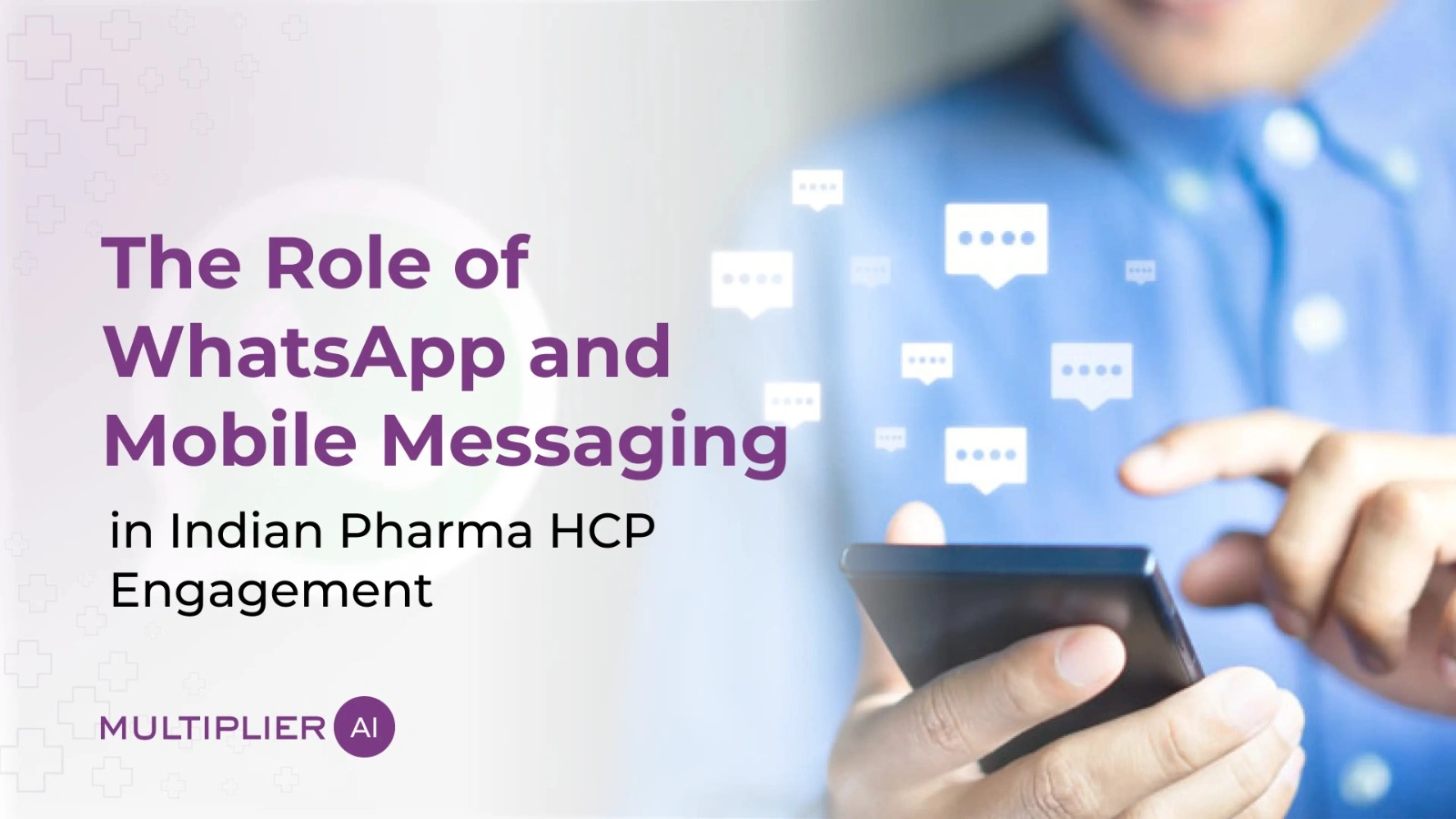
The Role of WhatsApp and Mobile Messaging in Indian Pharma HCP Engagement
If you look at how pharma engagement has evolved in India over the last decade, one shift stands out clearly. Access to doctors has become more difficult, attention has become more fragmented, and traditional channels are no longer sufficient on their own. This is why WhatsApp pharma HCP engagement in India has become an important part of mobile-first communication strategies.
Field visits still play an important role, but they are constrained by time, availability, and increasing pressure on doctors' schedules. Email, while widely used in global markets, has not achieved the same level of effectiveness in India, especially among busy practitioners who prioritize quicker and more accessible forms of communication.
At the same time, mobile usage has exploded. Doctors are increasingly using smartphones not just for communication, but also for accessing medical information, participating in discussions, and staying updated on clinical developments. A Doctor Mobile and Email Platform helps pharma teams build this mobile-first engagement foundation by giving them access to reliable doctor contact data and verified communication channels across India.
This shift has created a new reality. The most effective channel for reaching doctors in India is often the one that fits naturally into their daily workflow. This is where WhatsApp and mobile messaging come in. For Indian pharma teams, mobile messaging for HCP engagement works best when it is relevant, consent-based, and connected with field and digital workflows.
What Is WhatsApp-Based HCP Engagement in Indian Pharma?
WhatsApp-based HCP engagement in Indian pharma means using consented mobile messaging to share timely, relevant, and approved communication with doctors through a channel they already use in their daily professional workflow. It can support field follow-ups, clinical education, event reminders, digital content sharing, and personalized engagement when connected with doctor data and consent controls.
In simple terms, WhatsApp should not be used as a broadcast channel. It should be used as a relevant, permission-based, mobile-first touchpoint inside a broader HCP engagement journey.
Why Traditional Channels Are Losing Ground in India
Traditional HCP engagement in India has depended heavily on field visits, conferences, and relationship-led communication. These channels still matter, but they are no longer enough on their own. Doctors are busier, access windows are shorter, and multiple pharma companies compete for the same limited attention.
Email also has limitations in the Indian context. A formal email may work for detailed information, but it can be missed by busy practitioners who are more likely to notice brief, mobile-friendly communication. This does not make email irrelevant. It means email needs to work alongside more immediate channels such as WhatsApp, mobile messaging, field follow-up, and digital content.
The core challenge is not choosing one channel over another. It is designing a channel strategy that reflects how doctors actually consume information.
Why WhatsApp Works in the Indian HCP Context
WhatsApp is not just another communication tool in India. It is deeply embedded in both personal and professional interactions. Doctors use it to communicate with peers, coordinate with staff, and sometimes even interact with patients. It is immediate, familiar, and does not require additional effort to access.
This makes it fundamentally different from email or traditional digital platforms.
| Channel | Strength in Indian Pharma | Limitation |
WhatsApp / mobile messaging |
Immediate, familiar, easy to access, useful for brief follow-ups |
High risk of fatigue or compliance issues if overused |
|
Useful for formal information and longer content |
Often lower attention among busy Indian practitioners |
Field visit |
Strong for relationship-building and deeper discussion |
Limited by doctor availability and rep time |
Webinar / digital event |
Good for education and scale |
Needs strong follow-up to maintain engagement |
Digital ads |
Useful for awareness and reinforcement |
Weak if not connected to HCP behavior or consent strategy |
When a message is received on WhatsApp, it is more likely to be seen. The barrier to engagement is lower. There is no need to log into a system or navigate through a cluttered inbox.
However, the effectiveness of WhatsApp is not just about visibility. It is about context. Messages delivered through WhatsApp feel more direct and personal. They are part of an ongoing stream of communication rather than a separate activity. This makes it easier for doctors to engage, provided the content is relevant.
How WhatsApp Fits into Omnichannel HCP Engagement
WhatsApp should not be viewed as a standalone channel. Its effectiveness increases significantly when it is integrated into a broader engagement strategy.
For example, a doctor might first encounter a topic through a field visit. A follow-up WhatsApp message can reinforce key points and provide additional resources. This creates continuity.
Similarly, WhatsApp can be used to support digital campaigns. If a doctor engages with content online, a targeted message can provide further information or invite them to explore related topics. This helps maintain momentum.
The key is to ensure that each interaction is connected. AI in omni channel marketing for pharmaceuticals helps teams connect WhatsApp, field visits, digital content, and CRM workflows into one coordinated HCP journey.
When WhatsApp is used as part of a coordinated approach, it enhances the overall experience rather than competing with other channels. This is the same principle behind omni channel customer engagement in healthcare, where every touchpoint should support a consistent and connected experience.
| Use Case | How WhatsApp Can Help |
Post-rep visit follow-up |
Share a brief approved summary or relevant resource |
Webinar reminder |
Send a concise reminder to registered HCPs |
Clinical content sharing |
Share approved short-form content based on doctor interest |
Event follow-up |
Send key takeaways or next-step resources |
Re-engagement |
Test brief mobile outreach when email response is low |
Field coordination |
Help reps continue a conversation after a meeting |
Patient education support |
Share approved educational material where permitted |
WhatsApp Should Support, Not Replace, Field Engagement
WhatsApp should not be treated as a replacement for medical representatives or relationship-led engagement. In Indian pharma, field teams continue to play an important role in building trust, answering questions, and maintaining long-term HCP relationships.
The best use of WhatsApp is as a support layer. It can reinforce a field discussion, share a short approved resource, remind a doctor about an event, or continue a conversation after a meeting. When used this way, WhatsApp improves continuity without overwhelming the doctor.
The goal is not to shift all communication to mobile. The goal is to make mobile messaging part of a connected HCP journey where field, digital, and content touchpoints work together.
The role of AI in scaling mobile engagement
While WhatsApp is inherently simple, managing it at scale requires more advanced capabilities. AI plays an important role in this context.
It helps identify which doctors are most likely to engage through mobile messaging and what type of content is most relevant for each individual. By analyzing engagement patterns, AI can determine the optimal timing and frequency of messages. A GenAI Doctor Data Platform can strengthen this decision-making by connecting doctor data, CRM activity, real-time doctor insights, and preferred-channel signals into one HCP intelligence layer.
This allows organizations to move from broadcast communication to targeted engagement. Instead of sending the same message to a large group, teams can tailor communication based on behavior and preferences. This improves both efficiency and effectiveness. Strong doctor data in pharma is the foundation for understanding which HCPs prefer WhatsApp, which content they value, and when mobile follow-up is appropriate.
AI also helps manage volume. As the number of interactions increases, it becomes difficult to maintain consistency manually. Automated systems ensure that communication remains aligned and relevant.
| Signal | How AI Uses It |
Past WhatsApp response |
Identifies whether mobile messaging works for the doctor |
Email engagement |
Decides whether WhatsApp should reinforce or replace email |
Field visit notes |
Helps tailor follow-up messaging |
Content interest |
Matches message topic to doctor preference |
Timing patterns |
Finds when the doctor is most likely to respond |
Channel fatigue |
Reduces unnecessary mobile messages |
Consent status |
Ensures only permitted messaging is recommended |
Specialty / therapy focus |
Aligns message content with clinical relevance |
How Multiplier AI Supports WhatsApp and Mobile HCP Engagement
Multiplier AI helps pharma teams use WhatsApp and mobile messaging as part of a connected, consent-aware HCP engagement strategy. The platform brings together doctor data, mobile and email information, CRM activity, digital behavior, content intelligence, and consent status into one practical engagement layer.
This allows teams to identify which doctors are suitable for WhatsApp communication, what message is relevant, when to send it, and when to avoid overcommunication. It also helps field teams use WhatsApp as a follow-up channel after meetings while keeping messaging aligned with approved content and compliance rules.
By combining doctor data, hyper-personalized content, and DPDP-compliant engagement workflows, Multiplier AI helps pharma teams move from generic broadcasts to relevant mobile-first HCP engagement.
GET ACTIONABLE AI AND HEALTHCARE INSIGHTS THAT HELP YOU STAY AHEAD IN A FAST-CHANGING PHARMA WORLD
Compliance, Consent, and Privacy in WhatsApp HCP Engagement
Using WhatsApp for HCP engagement requires strong compliance discipline because mobile messaging can feel informal and immediate. Pharma teams should treat WhatsApp communication with the same level of control as email, CRM outreach, or field follow-up.
Before sending messages, teams should confirm whether the doctor has opted in to receive communication through WhatsApp or mobile messaging. They should also track channel preferences, opt-outs, approved communication purposes, and message frequency. A DPDP-Compliant HCP Marketing framework helps pharma teams manage explicit consent, channel permissions, purpose limitation, data minimisation, and audit-ready WhatsApp engagement workflows.
Only approved content should be shared. Messages should avoid unsupported claims, off-label communication, or informal statements that would not pass medical, legal, or regulatory review. If a doctor opts out, that preference should be updated across CRM, field workflows, and digital campaign systems. WhatsApp engagement can become risky when pharma CRMs fail at consent tracking, because opt-outs and channel permissions may not update across field and digital workflows.
Doctors should have the option to opt in to receive messages, and their preferences should be respected. DPDP-compliant consent collection across email, WhatsApp, and ads is essential before pharma teams scale mobile messaging for HCP engagement.
A compliant WhatsApp strategy should include consent tracking, purpose limitation, data minimisation, audit trails, approved content libraries, and role-based access. This ensures that mobile engagement remains useful, respectful, and defensible. Consent-based WhatsApp communication helps pharma teams protect HCP trust while improving mobile engagement quality.
Making Mobile Engagement Actionable for Field Teams
For WhatsApp to be effective, it needs to be integrated into the workflows of field teams. Reps should be able to use it as an extension of their interactions rather than as a separate activity.
For example, after a meeting, a rep can send a brief follow-up message that reinforces key points. This keeps the conversation active and provides additional value.
However, this needs to be done thoughtfully. Messages should be purposeful and aligned with the overall engagement strategy. Overuse can reduce effectiveness, while underuse can limit impact.
Training plays an important role here. Reps need to understand how to use mobile messaging effectively, including best practices for content, timing, and tone.
Practical WhatsApp Message Framework for Pharma Teams
A practical WhatsApp message for HCP engagement should be short, relevant, approved, and linked to a clear purpose. Pharma teams can use a simple structure: context, value, and next step.
The context explains why the doctor is receiving the message. The value gives one useful piece of information, such as a resource, reminder, or follow-up point. The next step makes it easy for the doctor to respond, access content, or continue the conversation if they are interested. Modular content for pharma marketing can make WhatsApp engagement easier by allowing approved short-form content blocks to be reused across mobile, email, and field follow-up journeys.
For example, after a rep visit, a message could briefly refer to the discussion topic and share an approved resource. After a webinar registration, a reminder message could include the time and access link. After content engagement, a follow-up could offer related information without pushing too frequently.
| Message Element | What It Should Do | Example |
Context |
Explain why the doctor is receiving the message |
Following up on our discussion about the therapy update |
Value |
Provide one useful resource or reminder |
Sharing the approved clinical summary for reference |
Next step |
Make response or action easy |
Let me know if you would like the full resource or a discussion |
Control |
Respect consent and opt-out preferences |
Send only through permitted channels |
Measuring the Impact of WhatsApp Engagement
Evaluating the effectiveness of WhatsApp requires a different approach compared to traditional channels. Metrics such as message delivery and read rates provide some insight, but they do not capture the full picture.
What matters is how mobile engagement influences overall behavior. This includes looking at follow-up interactions, engagement with other channels, and changes in prescribing patterns. By analyzing these outcomes, organizations can understand the true impact of WhatsApp.
| Metric | Why It Matters |
Delivery rate |
Confirms technical reach |
Read rate |
Shows visibility but not full impact |
Response rate |
Measures active engagement |
Follow-up action |
Shows whether the message led to useful interaction |
Rep continuation rate |
Measures whether WhatsApp supports field engagement |
Opt-out rate |
Indicates fatigue or poor relevance |
Content click-through |
Shows whether the shared resource was useful |
Consent-safe engagement |
Confirms messaging followed approved permissions |
It is also important to consider qualitative feedback. Doctors may not always express their preferences directly, but their behavior provides valuable signals. Understanding these patterns helps refine strategies over time.
Why This Channel Will Continue to Grow in India
The increasing role of mobile messaging in India is not a temporary trend. It reflects broader changes in how professionals communicate and access information. As smartphones become more central to daily activities, channels like WhatsApp will continue to gain importance.
For pharma companies, this represents both an opportunity and a challenge. Those who adapt quickly will be able to engage doctors more effectively and build stronger relationships. Those who continue to rely solely on traditional channels may find it increasingly difficult to maintain attention.
The key is not just adopting mobile messaging, but using it strategically.
Conclusion
WhatsApp and mobile messaging can become powerful HCP engagement channels when they are relevant, consent-aware, and connected with field and digital workflows. Multiplier AI helps pharma teams unify doctor data, personalize mobile-ready content, manage consent, and coordinate WhatsApp engagement as part of a broader HCP journey in India.
WhatsApp and mobile messaging have become essential components of HCP engagement in India. Their effectiveness lies in their ability to deliver timely, relevant, and accessible communication.
However, success requires more than simply sending messages. It involves understanding the context in which doctors use these platforms, integrating mobile messaging into a broader strategy, and ensuring that communication is both relevant and compliant.
When used effectively, WhatsApp can enhance engagement, improve continuity, and support stronger relationships. For pharma teams looking to stay relevant in a rapidly changing landscape, this is a channel that cannot be ignored.
Frequently Asked Questions For WhatsApp and Mobile Messaging for Pharma HCP Engagement in India
WhatsApp is important because many Indian doctors use mobile messaging daily for professional and personal communication, making it a familiar and accessible channel for brief, relevant updates.
Yes, pharma companies can use WhatsApp for HCP engagement when communication is consent-based, approved, relevant, and aligned with compliance requirements.
WhatsApp may be more immediate and visible than email in many Indian settings, but it should not replace email or field engagement. It should be used as part of a coordinated channel strategy.
Short, approved, relevant messages work best, such as event reminders, post-meeting follow-ups, links to approved resources, webinar updates, and concise educational content.
Teams should avoid long messages, frequent broadcasts, generic content, unsupported claims, off-label communication, and messaging doctors without proper consent.
WhatsApp can help reps reinforce key points after a meeting, share approved resources, send reminders, and continue relevant conversations in a concise format.
AI can help identify which doctors prefer mobile messaging, what content is relevant, when to send messages, how often to communicate, and when to pause outreach.
Pharma teams need consent tracking, opt-out management, channel permissions, approved content libraries, audit trails, purpose limitation, data minimisation, and role-based access.
Teams should measure delivery, read rate, response rate, follow-up actions, content clicks, opt-outs, rep continuation, and consent-safe engagement.
Multiplier AI helps pharma teams unify doctor data, personalize mobile content, track engagement behavior, manage consent-aware workflows, and coordinate WhatsApp with field and digital channels.
GET ACTIONABLE AI AND HEALTHCARE INSIGHTS THAT HELP YOU STAY AHEAD IN A FAST-CHANGING PHARMA WORLD
Let's Discuss Your Requirements