Patient Engagement in Pharma: The AI-Powered Playbook for Patient Support Programs
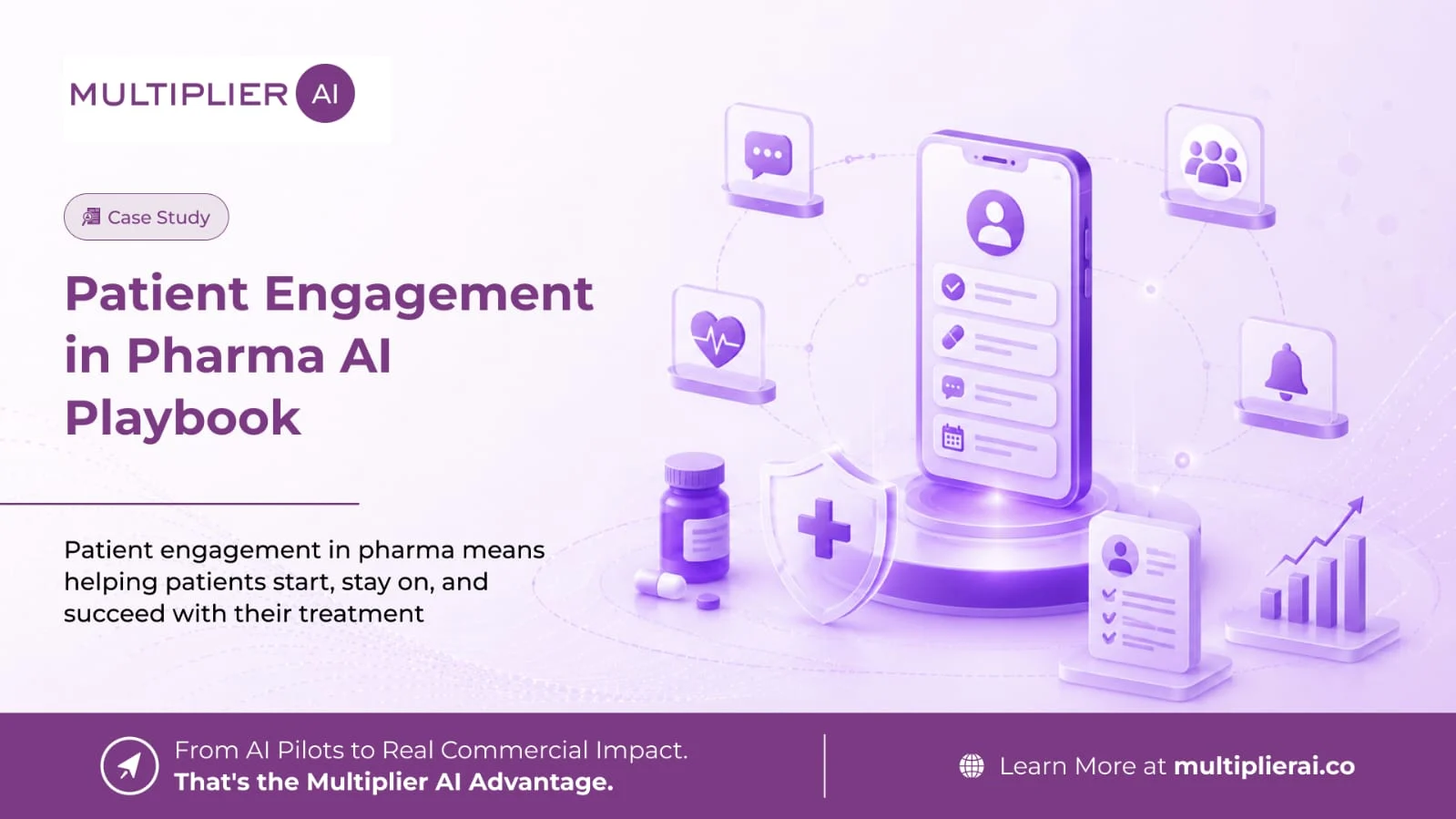
Patient engagement in pharma means helping patients start, stay on, and succeed with their treatment — through education, reminders, support, and a better experience at every step. The problem it solves is huge: roughly half of patients with chronic conditions do not take their medicines as prescribed. AI now makes it possible to fix this at scale, with personalized patient support programs that lift adherence, improve outcomes, and even help find patients who need treatment but have not started it.
This guide explains patient engagement in pharma in plain English. You will learn what it is, why adherence is such a costly problem, how AI transforms patient support programs, the use cases that work, the metrics to track, and how to stay compliant while doing it.
Patient engagement in pharma is how a brand supports a patient across their whole journey — awareness, diagnosis, onboarding, adherence, and outcomes. AI strengthens every stage with personalization, predictive reminders, chatbots, and next-best-action, turning one-size-fits-all programs into tailored support that improves both health results and commercial performance.
What is patient engagement in pharma?
Patient engagement in pharma is the set of activities a pharmaceutical company uses to inform, support, and stay connected with patients — so they understand their condition, begin the right treatment, and follow it correctly over time.
It is different from HCP engagement, which targets doctors. Patient engagement focuses on the person taking the medicine. The two are linked: when patients are supported, doctors see better results, and the brand earns trust on both sides.
Good patient engagement runs across the whole patient journey, not just one moment:
- Awareness — helping people recognise symptoms and seek care
- Diagnosis — supporting the path from first visit to confirmed diagnosis
- Onboarding — helping a patient start treatment with confidence
- Adherence — keeping the patient on therapy correctly
- Outcomes — tracking results and improving the experience
Patient engagement vs patient support program (PSP)
People use these terms together, so let's be clear. Patient engagement is the broad goal. A patient support program (PSP) is the structured service that delivers it — covering onboarding, education, financial assistance, reminders, nurse support, and follow-up for a specific therapy.
Why patient engagement in pharma matters now
The reason is simple: patients do not take their medicines as prescribed, and it costs lives and money.
- The World Health Organization estimates that adherence to long-term therapy averages only about 50% in chronic disease.
- Around 30% of patients never even fill their first prescription.
- In the US alone, studies put the cost of non-adherence at $250–300 billion a year, with up to a quarter of hospitalisations linked to it.
For a pharma brand, poor adherence means lost outcomes for patients and lost value for the business. A patient who stops therapy early is a patient who does not benefit — and a prescription that does not refill. This is exactly the gap that AI-driven patient engagement closes.
Traditional PSP vs AI-driven patient engagement
Most patient support programs were built for an older era — call centres, printed leaflets, and the same message for everyone. AI changes the model from generic and reactive to personalized and predictive.
| # | Dimension | Traditional PSP | AI-Driven Patient Engagement |
| 1 | Personalization | One-size-fits-all | Tailored to each patient's needs and history |
| 2 | Timing | Fixed schedule | Predictive — reaches out before a patient drops off |
| 3 | Channels | Phone and print | Omnichannel: app, WhatsApp, chatbot, web, nurse |
| 4 | Support hours | Business hours | 24/7 via AI assistants, with human escalation |
| 5 | Insight | Manual reports | Real-time risk scoring and next-best-action |
| 6 | Scale | Limited by headcount | Scales to thousands of patients at once |
| 7 | Cost to serve | High per patient | Lower — AI filters routine queries |
Takeaway: AI does not replace the human touch in a PSP. It frees nurses and counsellors to spend time on the patients who need them most.
How AI improves patient engagement: 8 use cases
Here are the practical ways AI strengthens patient engagement in pharma today. Each one is in use across the industry.
- Personalized onboarding. AI tailors the first few weeks of therapy to the patient — their condition, language, and worries — so they start with confidence instead of confusion.
- Smart adherence reminders. Instead of a generic daily ping, AI times reminders to each patient's routine and flags when a dose is likely to be missed.
- Conversational chatbots. AI assistants answer common questions about side effects, dosing, and storage at any hour, and escalate clinical issues to a human.
- Predictive drop-off detection. Models score which patients are at risk of stopping therapy, so the team can step in early — the single biggest lever on adherence.
- Next-best-action for patients. The system recommends the right nudge for each person — a call, a refill reminder, or a financial-assistance offer.
- Access and affordability navigation. AI guides patients to copay support, financial aid, and enrolment, removing cost as a reason to quit.
- Caregiver support. Many patients rely on a family member. AI extends education and reminders to caregivers, who often drive adherence.
- Finding new patients. AI analyses real-world signals to spot undiagnosed or untreated patients and supports awareness and referral — turning engagement into patient acquisition.
The eighth use case is where engagement meets growth. Multiplier AI's platform for driving new patients helps brands reach the right patients with compliant, location-aware campaigns that increase footfall and treatment starts.
AI across the patient journey
The strongest programs apply AI at every stage, not just adherence. This table maps the patient need to the AI role.
| Journey stage | Patient need | AI role |
| Awareness | "Is this a problem I should act on?" | Targeted education; symptom-checkers; reach undiagnosed patients |
| Diagnosis | "What is happening and what next?" | Guidance to the right specialist; appointment support |
| Onboarding | "How do I start safely?" | Personalized onboarding; expectation-setting; chatbot Q&A |
| Adherence | "How do I stay on track?" | Predictive reminders; risk scoring; next-best-action |
| Outcomes | "Is it working?" | Symptom tracking; feedback analysis; program optimization |
When AI connects these stages, the patient feels supported by one consistent program rather than a series of disconnected messages.
Channels for digital patient engagement
Patients are not all the same, so a modern patient engagement platform meets them where they are. The most effective programs blend several channels and let AI choose the best one for each person.
- Mobile app — for engaged patients who want tracking and reminders
- WhatsApp and messaging — high open rates, ideal for India and emerging markets
- AI chatbot — instant answers, day or night
- Web portal — resources, enrolment, and financial assistance
- Nurse and contact centre — human support for complex needs
- SMS and IVR — reliable reach for low-connectivity patients
The goal is not to use every channel. It is to use the right channel for each patient and keep the experience consistent across all of them.
Patient engagement in India: what's different
Patient engagement in pharma looks different in India, and a global playbook rarely fits. Brands that adapt to local reality earn trust faster and keep patients on therapy longer.
- Language first. Patients engage in their own language. Vernacular content and voice support matter more than polish.
- WhatsApp is the channel. With high penetration and strong open rates, WhatsApp often beats apps for reminders and support — especially beyond the metros.
- Affordability drives adherence. Out-of-pocket cost is a leading reason patients stop therapy, so financial-assistance navigation is essential.
- The NCD wave. Rising diabetes, hypertension, and cardiac disease mean millions of long-term patients who need ongoing support.
- Consent under the DPDP Act. India's data-privacy law sets clear rules for contacting patients, so consent must be built in from the start.
A program designed for tier-2 and tier-3 India — multilingual, WhatsApp-led, and affordability-aware — will out-engage a copy-pasted Western model every time.
The metrics that prove patient engagement works
You cannot improve what you do not measure. These are the metrics that matter for patient engagement in pharma, grouped by what they tell you.
| Metric | What it measures | Why it matters |
| Enrolment rate | % of eligible patients who join the PSP | The top of the funnel |
| Activation rate | % who complete onboarding | Early engagement quality |
| Adherence / PDC | Proportion of days covered by therapy | The core health and revenue driver |
| Persistence | How long patients stay on therapy | Long-term value |
| Refill rate | % of on-time refills | A direct commercial signal |
| Patient NPS | Patient-reported experience | Trust and loyalty |
| Outcome measures | Symptom or clinical improvement | Proof of real-world value |
Track adherence and persistence above all. They link patient health directly to brand performance.
GET ACTIONABLE AI AND HEALTHCARE INSIGHTS THAT HELP YOU STAY AHEAD IN A FAST-CHANGING PHARMA WORLD
Real results: what AI patient engagement delivers
The impact is measurable. In one widely reported example, Walgreens found that an AI-driven personalization program improved medication adherence by roughly 9.7% for statin users, 8.6% for diabetes patients, and 5.5% for those on hypertension therapy.
Across the industry, AI assistants now resolve a large share of routine patient questions — often 40–50% — which frees nurses for higher-value support and lowers the cost to serve. Patients report high satisfaction when answers are fast, accurate, and available around the clock.
The pattern is clear: small percentage gains in adherence translate into better outcomes for many patients and meaningful revenue for the brand.
5 common patient engagement mistakes (and how to avoid them)
Most programs underperform for the same few reasons. Avoid these and you are already ahead of the field.
- Treating engagement as one message. A single onboarding email is not a program. Support the whole journey, from awareness to outcomes.
- Generic reminders. The same daily ping for everyone gets ignored. Personalize the timing and the content to each patient.
- No drop-off prediction. Waiting until a patient has already quit is too late. Use AI to flag risk early and step in.
- Ignoring caregivers. For many patients, a family member manages the medicine. Leave them out and adherence suffers.
- Bolting on consent later. Collecting patient data without clear consent creates legal and trust problems. Build consent in from day one.
Fix these five, and your patient engagement in pharma moves from activity to real impact.
Compliance and trust: the part you cannot skip
Patient data is sensitive, and engagement only works if patients trust you with it. This is where many programs fail — and where a compliant approach becomes a competitive advantage.
Three rules keep patient engagement safe:
- Get and honour consent. Collect clear, purpose-specific consent before you contact a patient, and make it easy to opt out. In India this is required under the DPDP Act; globally, similar rules apply.
- Protect the data. Keep patient information secure, store only what you need, and control who can see it.
- Keep AI accountable. Use AI that is explainable and supervised, especially for anything that touches health guidance, with a human in the loop for clinical matters.
Build consent and privacy into the program from day one. It protects patients, satisfies regulators, and earns the trust that engagement depends on.
Build vs buy: choosing a patient engagement platform
Most teams should not build a patient engagement platform from scratch. The compliance, channel, and AI requirements are heavy, and time-to-launch matters.
| Option | Best for | Trade-off |
| Build in-house | Large teams with strong tech | Slow, costly, hard to keep compliant |
| Point tools | A single need (e.g. a chatbot) | Fragmented data and experience |
| Integrated platform | Most pharma brands | Faster launch, unified data and consent |
Look for a platform that is omnichannel, India-ready, and compliant by design — so consent, data security, and audit trails come built in rather than bolted on. That is the fastest route to patient engagement in pharma that actually scales.
How to start: a patient engagement checklist
Use this checklist to design or upgrade a program. Tick each item.
- Map the journey. Document every stage from awareness to outcomes for your therapy.
- Find the drop-off points. Identify where patients disengage today.
- Set your metrics. Choose 3–4 KPIs, led by adherence and persistence.
- Pick your channels. Match channels to your patients, not to trends.
- Add AI where it counts. Start with reminders, chatbots, and drop-off prediction.
- Build in consent. Capture and manage patient consent from the first touch.
- Keep humans in the loop. Route clinical and complex needs to nurses.
- Measure and improve. Review the data monthly and refine the nudges.
Start small, prove the lift on one therapy, then scale what works.
From engagement to intelligence and growth
The best patient programs do two things at once: they support today's patients and they help find tomorrow's. AI makes both possible from the same foundation of clean data and consent.
- Intelligence: Multiplier AI's Patient Intelligence Platform predicts the next best action for each patient, so teams know who to reach, when, and how to keep them on therapy.
- Growth: the same engine supports awareness and referral, helping brands reach and convert patients who need treatment but have not started.
That is the real promise of patient engagement in pharma — better health for patients and sustainable growth for the brand, built on trust rather than guesswork.
Frequently asked questions about patient engagement in pharma
Patient engagement in pharma is how a company supports patients across their journey — awareness, diagnosis, onboarding, adherence, and outcomes — so they start and stay on the right treatment. AI personalizes this support at scale.
A patient support program is a structured service a pharma brand offers for a specific therapy. It typically includes onboarding, education, reminders, financial assistance, and nurse support to help patients adhere and succeed.
AI improves patient adherence by personalizing reminders, predicting which patients are likely to stop therapy, answering questions through chatbots, and recommending the next best action for each patient — so teams intervene early and at scale.
Patient engagement focuses on the person taking the medicine, while HCP engagement focuses on the doctor who prescribes it. Both matter, and the strongest strategies connect the two.
It can be, if built correctly. You must collect clear consent, protect patient data, and keep AI supervised. In India this falls under the DPDP Act, and similar privacy rules apply in other markets.
Measure enrolment, activation, adherence (proportion of days covered), persistence, refill rate, and patient NPS. Adherence and persistence matter most because they link patient health to brand performance.
In India, patient engagement works best in local languages, on WhatsApp, and with strong affordability support. The rising burden of chronic disease and the DPDP Act's consent rules also shape how brands should design their programs.
Most brands should buy or partner rather than build. An integrated, compliant platform launches faster, keeps patient data and consent unified, and avoids the cost and risk of maintaining a custom system.
GET ACTIONABLE AI AND HEALTHCARE INSIGHTS THAT HELP YOU STAY AHEAD IN A FAST-CHANGING PHARMA WORLD
Let's Discuss Your Requirements