Pharma Marketing Automation: Workflows, Triggers and AI (2026 Guide)
Pharma marketing automation uses software to run marketing tasks, campaigns, and journeys automatically — triggered by what a doctor or patient does, and kept compliant at every step. Instead of sending the same email to everyone by hand, automation sends the right message, on the right channel, at the right moment, to the right person. Done well, it lets a small team engage thousands of healthcare professionals (HCPs) with relevant, compliant outreach — without adding headcount.
This guide explains pharma marketing automation in plain English: what it is, what you can automate, how it differs from ordinary marketing automation, the compliance layer that makes pharma special, and how to start.
What is pharma marketing automation?
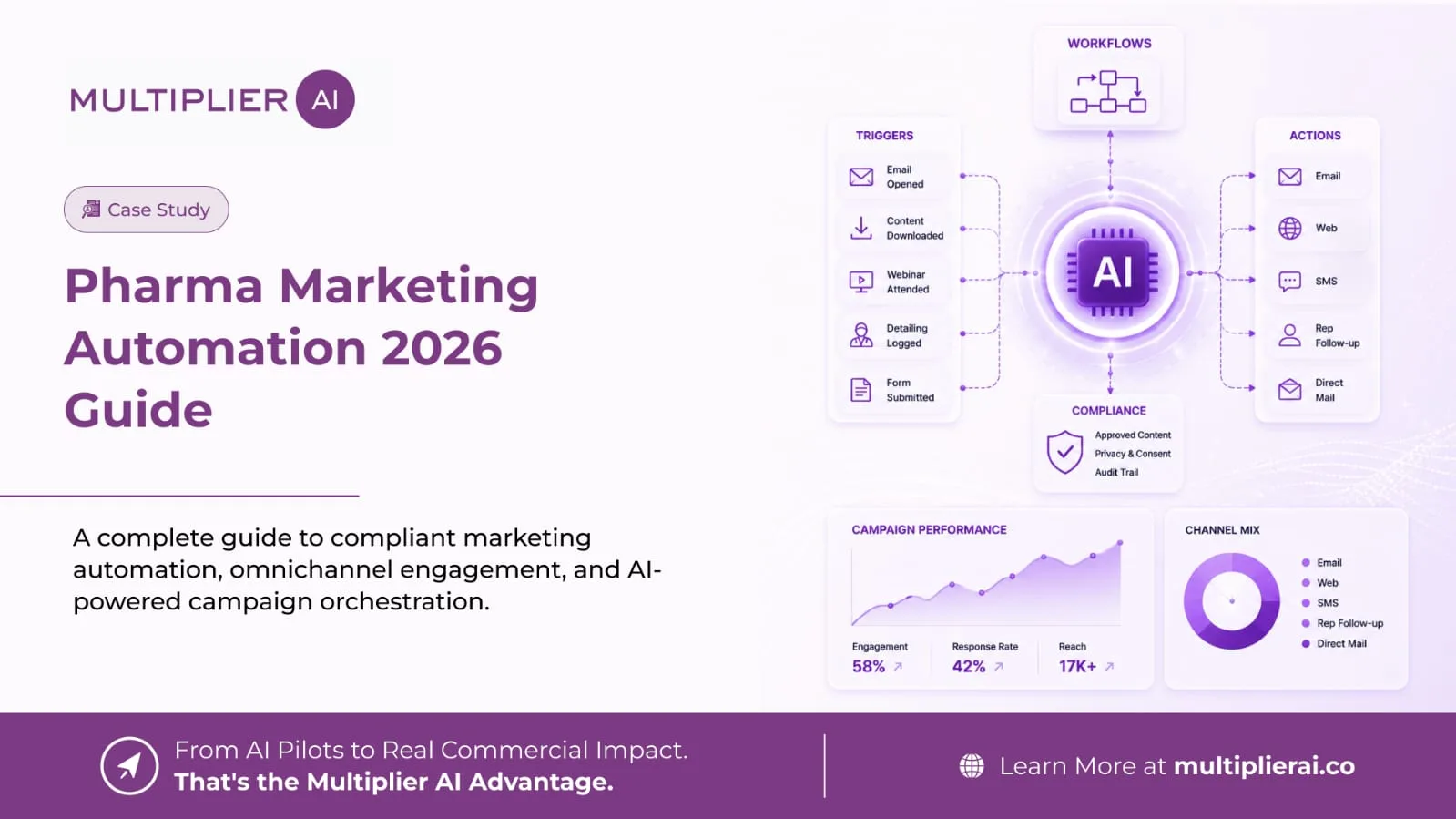
Pharma marketing automation is the use of software to automate repetitive marketing work and to orchestrate multi-step campaigns across channels. It turns manual, one-off sends into rules-based journeys that run on their own.
At its core, it links two things:
- Triggers — something a person does, like attending a webinar or opening an email.
- Actions — the automated response, like sending a clinical resource or alerting a rep.
It builds directly on a strong pharma marketing strategy and a solid pharma digital marketing foundation — automation is how that strategy actually runs at scale.
Why pharma needs marketing automation now
For years, pharma marketing meant mass emails and rep visits, tracked in spreadsheets. That no longer works. Four pressures make automation essential.
- Scale. Teams must reach more HCPs across more channels than any manual process can handle.
- Personalization. Doctors expect relevant, timely messages, not generic blasts.
- Smaller teams. Tighter budgets mean each marketer must do far more.
- Compliance. Rules around consent and content keep getting stricter, and manual processes make mistakes.
Automation answers all four at once — more reach, more relevance, less effort, and fewer compliance errors.
What you can automate: triggers and actions
The easiest way to understand pharma marketing automation is to see triggers paired with automated actions. Here are common examples.
| Trigger (what happens) | Automated action |
| Rep visits an HCP | Send a follow-up email with a dosing guide or MoA video |
| HCP attends a webinar | Offer a sample, invite to a speaker program |
| HCP reads about a drug | Push a relevant case study or resource |
| HCP opens an email | Update engagement score, suggest a next-best-action |
| Patient enrols in a program | Start an onboarding and adherence journey |
| Consent is withdrawn | Stop all messaging instantly across channels |
Each interaction also updates an engagement score, which feeds the next-best-action for sales teams and commercial operations.
How pharma marketing automation works: step by step
Behind every automated journey is a simple, repeatable flow. Here is how it works in practice.
- Collect data. Bring HCP and patient data, consent, and behaviour into one place.
- Segment. Group audiences by specialty, behaviour, and stage.
- Define triggers. Decide which events start a journey.
- Map the journey. Lay out the steps, content, and channels for each path.
- Check compliance. Confirm consent and approved content before anything sends.
- Run and measure. Launch the journey and track what works.
- Optimise. Use the data to refine triggers, content, and timing.
The loop never really ends — good pharma marketing automation keeps learning and improving with every interaction.
Pharma vs generic marketing automation
You cannot just bolt a standard marketing tool onto pharma. The difference is the compliance layer.
| Dimension | Generic marketing automation | Pharma marketing automation |
| Content | Any approved copy | Only MLR-approved content |
| Consent | Basic opt-in | Strict, auditable consent (DPDP) |
| Audiences | Customers | HCPs and patients, handled differently |
| Channels | Digital | Digital plus rep/field, coordinated |
| Rules | Marketing best practice | Code compliance (e.g. UCPMP), fair balance |
| Risk | Low | High — regulatory exposure |
Takeaway: pharma marketing automation is marketing automation with compliance built into every trigger and message.
Top use cases for pharma marketing automation
Behind every automated journey is a simple, repeatable flow. Here is how it works in practice.
- Collect data. Bring HCP and patient data, consent, and behaviour into one place.
- Segment. Group audiences by specialty, behaviour, and stage.
- Define triggers. Decide which events start a journey.
- Map the journey. Lay out the steps, content, and channels for each path.
- Check compliance. Confirm consent and approved content before anything sends.
- Run and measure. Launch the journey and track what works.
- Optimise. Use the data to refine triggers, content, and timing.
The loop never really ends — good pharma marketing automation keeps learning and improving with every interaction.
Pharma vs generic marketing automation
You cannot just bolt a standard marketing tool onto pharma. The difference is the compliance layer.
| Dimension | Generic marketing automation | Pharma marketing automation |
| Content | Any approved copy | Only MLR-approved content |
| Consent | Basic opt-in | Strict, auditable consent (DPDP) |
| Audiences | Customers | HCPs and patients, handled differently |
| Channels | Digital | Digital plus rep/field, coordinated |
| Rules | Marketing best practice | Code compliance (e.g. UCPMP), fair balance |
| Risk | Low | High — regulatory exposure |
Takeaway: pharma marketing automation is marketing automation with compliance built into every trigger and message.
Top use cases for pharma marketing automation
Here is where automation creates the most value across commercial teams.
HCP nurture journeys. Multi-step email and digital sequences that follow a rep visit or content download.
Behaviour-triggered messaging. Send a resource the moment an HCP shows interest in a topic.
Event automation. Webinar and conference follow-ups, surveys, and speaker invitations.
Engagement scoring and NBA. Score every interaction and recommend the next best action.
Optimal send time. Use AI to send when each HCP is most likely to engage.
Patient programs. Automate onboarding and reminders, linked to AI patient engagement.
Omnichannel orchestration. Coordinate rep, email, and digital into one journey.
These build on your AI HCP segmentation, so the right people enter the right journeys.
The compliance layer: what makes pharma different
This is the part generic tools miss, and the part you cannot skip. Compliant automation is the only kind worth running.
- Consent first. Only message HCPs and patients who have given valid consent — capture it properly, as in how to capture explicit consent from doctors.
- DPDP and privacy. Handle data under India's DPDP Act 2023 and keep it secure, in line with data privacy in omnichannel pharma.
- Approved content only. Automation should fire only MLR-approved assets — pair it with AI MLR review so content is cleared fast.
- Code compliance. Respect promotional codes such as UCPMP 2024, including limits on samples and claims.
Build these rules into the platform, and compliance becomes automatic rather than a manual gate.
How automation powers omnichannel engagement
Marketing automation is the engine behind omnichannel marketing in pharma. It is what makes a journey feel connected instead of a series of random messages.
A patient or HCP might get a rep visit, then an email, then a WhatsApp message, each informed by the last. Automation keeps that sequence coherent, and AI in omnichannel marketing decides the best channel and timing for each person. To see where this is heading, read the omnichannel marketing trends for 2026.
Automation also needs fuel: a steady supply of approved, personalised content from a GenAI medical content engine and AI content generation.
GET ACTIONABLE AI AND HEALTHCARE INSIGHTS THAT HELP YOU STAY AHEAD IN A FAST-CHANGING PHARMA WORLD
HCP vs patient automation: what is different
Pharma marketing automation serves two very different audiences, and the rules differ for each.
- HCP automation focuses on doctors — rep-triggered journeys, clinical content, engagement scoring, and next-best-action, all within promotional codes.
- Patient automation focuses on people on therapy — onboarding, adherence reminders, and support, with extra care around health data and consent.
The biggest difference is tone and risk. HCP journeys are promotional and code-bound; patient journeys are supportive and privacy-sensitive. A strong platform handles both, with the right rules for each audience.
The benefits of pharma marketing automation
When applied well, automation delivers gains that compound over time.
- Reach. Engage thousands of HCPs with relevant, personalised outreach.
- Speed. Campaigns launch and adapt in days, not weeks.
- Relevance. Messages match each person's behaviour and stage.
- Compliance. Consent and content rules are enforced automatically.
- Insight. Every interaction is measured, improving the next campaign.
The biggest benefit is consistency — the right rules and the right content, applied the same way every time.
Automation maturity: where is your team?
Most teams progress through clear stages. Knowing where you sit shows the next step.
| Stage | What it looks like | Next step |
| 1. Manual | Mass emails, spreadsheets | Add basic email automation |
| 2. Basic | Scheduled email campaigns | Add behaviour triggers |
| 3. Triggered | Event- and behaviour-based journeys | Add AI and omnichannel |
| 4. AI-driven | Engagement scoring, NBA, optimal timing | Scale and govern |
Most pharma teams sit at stage 2 or 3. The goal is to move steadily toward AI-driven, omnichannel automation — without skipping the compliance foundation.
How to choose a pharma marketing automation platform
Whatever you shortlist, judge it against the same checklist. A strong platform should offer:
- Built-in compliance — consent management, MLR-approved content, code rules
- Omnichannel reach — email, rep, WhatsApp, web, and more
- AI and NBA — scoring, optimal timing, and next-best-action
- Segmentation — target the right HCPs and patients
- Integration — connect to your CRM, data, and content
- Analytics — clear measurement across channels
- India-readiness — DPDP support and local-language channels
Score each option on these seven points, and the right fit becomes clear.
5 common pharma marketing automation mistakes
Avoid these and your program will perform far better.
Automating without consent. Messaging without valid consent is a compliance risk, not a shortcut.
Using a generic tool. A platform without pharma compliance built in creates more risk than value.
Poor data. Automation on messy HCP data sends the wrong message to the wrong person.
Set and forget. Journeys need review and improvement, not a one-time setup.
No content supply. Automation stalls without a steady flow of approved content.
Fix these five, and automation becomes a reliable growth engine.
Pharma marketing automation in India
For Indian pharma, automation is a major opportunity — if it is built for local reality.
- WhatsApp-led. Automation should orchestrate WhatsApp journeys, the channel doctors actually use.
- Vernacular content. Journeys must support local languages, not just English.
- DPDP consent. Consent and data security must be built in from the first message.
- Cost efficiency. Automation lets lean Indian teams reach far more HCPs without growing headcount.
A platform designed for tier-2 and tier-3 India will out-engage a copy-pasted global setup every time.
Metrics that prove automation is working
You cannot improve what you do not measure. Track these to see the impact.
| Metric | What it measures | Why it matters |
| Reach | HCPs and patients engaged | Top-of-funnel scale |
| Engagement rate | Opens, clicks, content views | Relevance of messaging |
| Engagement score | Combined activity per HCP | Drives next-best-action |
| Journey completion | % who finish a journey | Quality of the flow |
| Conversion | Prescriptions, refills, enrolments | Commercial impact |
| Compliance rate | % of sends fully compliant | Risk control |
Track engagement score and conversion together — they connect activity to real outcomes.
A compliant automation engine
Pharma marketing automation works best when content, compliance, and channels run on one connected platform rather than a patchwork of tools. That is the idea behind Multiplier AI's hyper-personalized content platform and its DPDP-compliant HCP marketing — automated, omnichannel engagement with consent and approved content built in. Delivered through AI agents in healthcare, it becomes part of an agentic platform for pharma commercial operations that keeps campaigns fast, personalised, and compliant.
The goal is simple: automate the busywork so your team can focus on strategy and relationships, while every message stays on the right side of the rules.
The future: from automation to agentic campaigns
Pharma marketing automation is moving from rules to reasoning. Today, journeys follow pre-set triggers. Next, AI agents will plan and run whole campaigns — choosing the audience, content, channel, and timing, then adjusting in real time, all within compliance guardrails.
Three shifts are underway:
- From rules to AI. Fixed if-then journeys give way to models that decide the next best action for each person.
- From single channel to orchestrated. Email, rep, and messaging act as one coordinated journey, not separate tools.
- From manual setup to agentic execution. AI agents assemble and optimise campaigns, with humans approving the strategy.
The destination is an always-on engine where pharma marketing automation runs quietly in the background — compliant, personalised, and improving on its own — while marketers focus on strategy and creativity.
Frequently Asked Questions For Pharma Marketing Automation
Pharma marketing automation is software that runs marketing campaigns and journeys automatically, triggered by HCP or patient behaviour. It sends the right message on the right channel at the right time, with consent and approved content enforced at every step.
The difference is the compliance layer. Pharma automation can only use MLR-approved content, requires strict and auditable consent, follows promotional codes like UCPMP, and coordinates both digital and field channels for HCPs and patients.
You can automate HCP nurture journeys, behaviour-triggered messaging, event follow-ups, engagement scoring and next-best-action, optimal send times, patient onboarding and adherence, and full omnichannel orchestration.
It can be, if built correctly. The platform must capture and honour consent, secure personal data, and message only opted-in HCPs and patients, in line with the DPDP Act and your own policies.
Start with one high-value journey, such as a rep-visit follow-up, on clean data and with consent in place. Use approved content, measure the lift, then expand to more triggers and channels.
It needs a steady supply of MLR-approved, personalised content. Pairing automation with AI content generation and AI MLR review keeps the journeys filled with compliant assets.
A first journey can launch in a few weeks if your data and consent are in order. The bigger effort is usually data quality and content supply, not the software itself.
No. It supports reps by handling follow-ups and surfacing next-best-actions, so reps spend more time on high-value visits. Automation extends the field team's reach rather than replacing it.
GET ACTIONABLE AI AND HEALTHCARE INSIGHTS THAT HELP YOU STAY AHEAD IN A FAST-CHANGING PHARMA WORLD
Let's Discuss Your Requirements