Measuring Omnichannel ROI in Pharma: Metrics That Actually Tell You If It’s Working
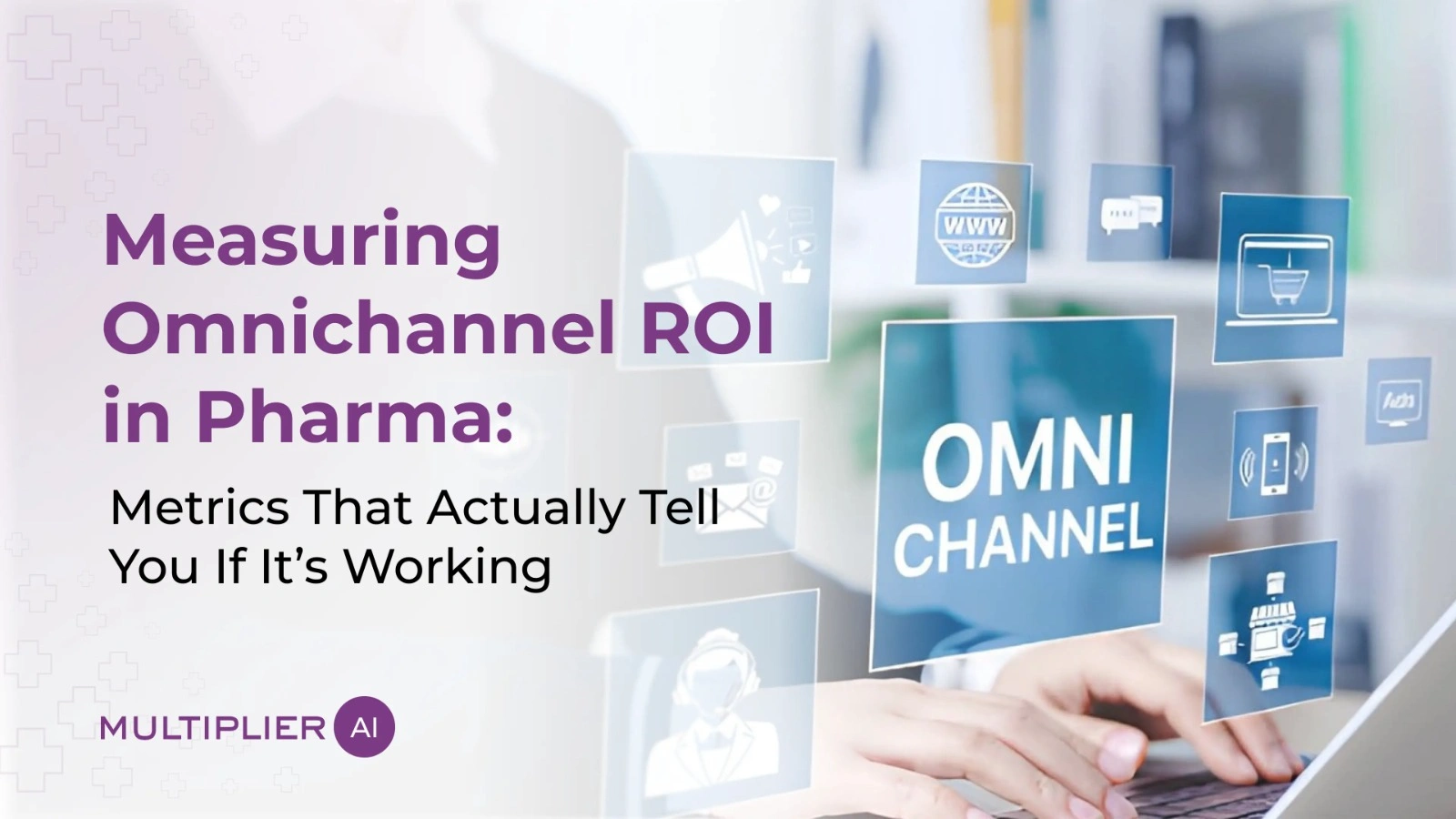
Most pharma companies are not underinvesting in omnichannel. They are under-measuring it. The problem is not whether omnichannel activity is happening. The problem is whether anyone can prove what it is changing.
If you ask a pharma leader whether omnichannel is important, the answer is almost always yes. If you ask whether their organization is investing in it, the answer is also yes. But if you ask a third question - "How do you know it is working?" - the answers become less confident.
This is where the gap appears. Most organizations can point to activity metrics. They can show how many emails were sent, how many calls were made, how many impressions were generated. They can even highlight improvements in individual channels.
But channel activity is not the same as commercial impact. A campaign can look busy and still fail to move the business. This is why omnichannel ROI pharma measurement must focus on outcomes, not only channel activity.
What many pharma teams struggle to show is a clear connection between omnichannel activity and actual business outcomes. This is not a minor issue. It is one of the biggest barriers to scaling omnichannel initiatives. Without a clear understanding of return on investment, it becomes difficult to justify continued investment or refine strategy.
The challenge is not a lack of data. It is a lack of the right framework for interpreting that data. To measure omnichannel ROI in pharma, teams need to connect field activity, digital engagement, content response, prescription movement, and journey progression into one view. pharma digital marketing with AI and data becomes more effective when teams use connected measurement frameworks instead of evaluating digital activity in isolation.
What Is Omnichannel ROI in Pharma?
Omnichannel ROI in pharma measures whether coordinated HCP engagement across field, email, digital, content, mobile, and other channels is improving business outcomes such as prescription growth, therapy adoption, engagement quality, retention, and commercial efficiency.
It is not measured only by channel activity such as emails sent, calls made, or impressions generated. The best measurement frameworks connect engagement journeys to real outcomes.
Why Most Pharma Teams Cannot Clearly Prove Omnichannel Impact
Many pharma teams have dashboards, reports, campaign summaries, and channel-level metrics. Yet leadership often still asks the same question: what changed because of this investment?
The reason is simple. Most measurement systems were built around activity, not impact. They can show that work happened, but they cannot always show whether that work changed HCP behavior, improved prescription movement, strengthened engagement quality, or increased commercial efficiency.
This creates a reporting gap. Teams may increase activity volume while still failing to prove business value. Omnichannel measurement must therefore move from reporting what teams did to explaining what changed in the HCP journey and commercial outcome.
The core problem with traditional measurement approaches
The measurement problem starts when teams try to evaluate omnichannel journeys using single-channel dashboards.
Traditional measurement in pharma has been built around channels. Email performance is measured through open rates and click rates. Doctor Mobile and Email Platform can support measurement when mobile and email engagement data are connected back to CRM, campaign, and HCP journey analytics.
Field performance is measured through call volume and coverage. Digital campaigns are evaluated through impressions and engagement metrics. Each channel has its own indicators. Pharma omnichannel metrics should not be evaluated only channel by channel because the value of omnichannel comes from how touchpoints work together.
| Measurement Type | What It Measures | Limitation |
| Email metrics | Opens, clicks, delivery, unsubscribes | Does not show whether engagement changed behavior |
| Field metrics | Calls, coverage, frequency, visit notes | Does not show how digital signals influenced the visit |
| Digital metrics | Impressions, clicks, website visits | Does not show whether the doctor moved closer to action |
| Event metrics | Registrations, attendance, session engagement | Does not show follow-up impact |
| Journey metrics | Sequence, progression, depth, outcome movement | Gives better view of omnichannel impact |
| Business metrics | Prescription movement, adoption, retention, ROI | Shows whether engagement created measurable value |
When multiple channels work together, their impact cannot be understood in isolation. This is why enabling omni channel customer engagement in healthcare requires measurement across the full journey rather than isolated channel dashboards.
A doctor may see a digital ad, open an email, attend a webinar, and then respond during a field visit. Which channel drove the outcome? Traditional models struggle to answer this question. As a result, organizations often fall back on simplistic assumptions or assign credit based on the last interaction. This does not reflect reality and can lead to poor decision-making.
Channel Metrics vs Journey Metrics
Omnichannel ROI becomes clearer when teams stop asking which channel performed best and start asking which journey produced the strongest outcome.
Channel metrics are still useful, but they are incomplete. They tell teams whether a specific channel created activity. Journey metrics tell teams whether the sequence of engagement created progression.
For example, a low email click rate may look weak in isolation. But if that email prepared the HCP for a later webinar, which then supported a field discussion, the email may still have played a useful role in the journey.
As omnichannel marketing trends in pharma continue to evolve, ROI measurement must also move beyond channel activity toward journey progression and business impact.
Shifting From Channel Metrics to Journey Metrics
To measure omnichannel ROI effectively, the focus needs to shift from individual channels to the overall journey. Instead of asking how each channel performed, the question should be how interactions across channels contributed to engagement and outcomes.
A journey-based approach looks at the sequence of interactions experienced by the doctor. It considers how each touchpoint influences the next and how the overall experience evolves over time.
For example, an email may not lead to immediate action, but it may increase awareness. A subsequent digital interaction may deepen interest. A Hyper Personalized Content Platform helps pharma teams connect content personalization with measurable engagement response across HCP cohorts and channels. A field visit may then convert that interest into a decision. Each step plays a role.
By analyzing these sequences, organizations can gain a more accurate understanding of what drives results.
Connecting engagement to real business outcomes
Engagement is useful only when it can be connected to meaningful movement in behavior, adoption, or revenue.
One of the biggest challenges in measuring ROI is linking engagement metrics to outcomes that matter. Engagement is often used as a proxy for effectiveness, but it does not always translate directly into business impact. HCP engagement ROI becomes meaningful only when engagement can be linked to adoption, retention, prescription growth, or commercial efficiency.
The Difference Between Engagement and Impact
Engagement means that an HCP interacted with a message, channel, event, or content asset. Impact means that the interaction contributed to a meaningful outcome.
For example, a doctor opening an email is engagement. A doctor opening an email, attending a webinar, discussing the topic with a representative, and later increasing adoption is impact.
Both types of metrics matter, but they should not be confused. Engagement helps explain the journey. Impact proves whether the journey created value.
Organizations should track how interactions influence key indicators such as prescription volume, adoption rates, and market share. A GenAI Doctor Data Platform can support omnichannel ROI measurement by unifying HCP profiles, CRM activity, engagement signals, segmentation, KOL insights, consent status, and preferred-channel data. Strengthening HCP relationships for prescription growth requires measurement that connects engagement quality, follow-up consistency, and doctor behavior to commercial outcomes.
It also requires integrating data from different sources and analyzing it in a way that reveals patterns. doctor data in pharma becomes the foundation for omnichannel ROI because accurate HCP profiles are needed to measure journey progression, segmentation response, and commercial impact.
Why Activity Metrics Create False Confidence
Activity metrics are useful for operational tracking, but they can create false confidence if they are treated as proof of impact.
A campaign may send more emails, generate more impressions, or increase field frequency without improving the quality of HCP engagement. In some cases, more activity may even reduce effectiveness if doctors experience the outreach as repetitive or poorly timed.
This is why omnichannel ROI should not be measured by volume alone. The real question is whether the activity helped move the doctor through a meaningful journey and contributed to a measurable business outcome.
| Weak Metric | Why It Is Weak | Stronger Metric |
| Emails sent | Measures volume, not impact | Email engagement leading to journey progression |
| Email open rate | May not indicate meaningful interest | Content engagement depth |
| Calls made | Measures activity, not quality | Calls influenced by prior digital signal |
| Impressions | Measures exposure only | HCP movement after exposure |
| Clicks | Can be shallow engagement | Repeat engagement with relevant content |
| Webinar attendance | Shows participation only | Follow-up action after webinar |
| Channel ROI alone | Ignores cross-channel influence | Journey-level ROI |
The Role of Attribution in Omnichannel Measurement
Attribution is difficult because omnichannel success is rarely caused by one touchpoint. It is usually created by a sequence.
Attribution is one of the most complex aspects of measuring omnichannel ROI. Omnichannel attribution pharma models should account for the full sequence of HCP touchpoints rather than assigning credit to one interaction.
In a multichannel environment, it is relatively straightforward to assign credit to individual channels. In an omnichannel environment, where interactions are interconnected, this becomes much more difficult. Single-touch attribution models, which assign credit to the first or last interaction, are insufficient.
More advanced models consider the contribution of each interaction within the journey. They distribute credit based on the role each touchpoint plays in influencing the outcome. The goal is not to achieve perfect attribution, but to move closer to a realistic understanding of how different interactions contribute to results.
| Attribution Model | How It Works | Pharma Use Case |
| First-touch attribution | Gives credit to the first interaction | Useful for awareness campaigns |
| Last-touch attribution | Gives credit to the final interaction before outcome | Useful but often too simplistic |
| Linear attribution | Gives equal credit to all touchpoints | Useful when journey data is limited |
| Time-decay attribution | Gives more credit to recent touchpoints | Useful for campaign sequences |
| Position-based attribution | Gives higher credit to first and last touchpoints | Useful for awareness-to-conversion journeys |
| Journey-based attribution | Evaluates the full sequence and role of each touchpoint | Best suited for omnichannel pharma engagement |
Metrics That Actually Matter in Pharma Omnichannel ROI
Not all metrics are equally valuable when it comes to measuring omnichannel ROI. Activity metrics, such as the number of emails sent or calls made, provide limited insight. They indicate effort, but not effectiveness.
Engagement metrics, such as open rates and click rates, offer more information, but still do not capture the full picture. The most valuable metrics are those that reflect progression and impact. brand share of voice can also support omnichannel ROI analysis when teams want to understand whether visibility across channels is translating into stronger market presence.
| Metric Level | Example Metrics | What It Tells You |
| Activity metrics | Emails sent, calls made, impressions generated | How much effort was deployed |
| Engagement metrics | Opens, clicks, webinar attendance, content views | Whether HCPs interacted |
| Journey metrics | Multi-touch progression, sequence completion, channel movement | Whether engagement deepened over time |
| Quality metrics | Meaningful conversations, repeat engagement, content depth | Whether interactions were relevant |
| Outcome metrics | Prescription change, adoption rate, retention, market share | Whether engagement influenced business results |
| Efficiency metrics | Cost per engaged HCP, cost per converted HCP, resource utilization | Whether investment was used effectively |
| Metric | Why It Matters |
| HCP journey progression | Shows whether doctors are moving from awareness to deeper engagement |
| Multi-channel engagement depth | Indicates whether channels are working together |
| Relevant content engagement | Shows whether content matches HCP interest |
| Field follow-up conversion | Measures whether digital signals improve rep interactions |
| Prescription movement | Connects engagement to commercial outcome |
| Therapy adoption rate | Shows whether engagement supports product uptake |
| Market share movement | Measures competitive impact |
| Cost per meaningful engagement | Connects investment to engagement quality |
| Response by segment | Shows which HCP groups are reacting |
| Time from signal to action | Measures execution speed |
Why Baselines Matter in Omnichannel ROI
Omnichannel ROI cannot be proven without a baseline.
Before launching an omnichannel initiative, teams need to define the current level of engagement, prescription movement, adoption rate, segment performance, and resource utilization. Without this starting point, it becomes difficult to know whether improvement is caused by the strategy or by normal market movement.
A strong baseline also helps leadership understand the business case. It shows what is changing, where improvement is happening, and whether the investment is justified.
GET ACTIONABLE AI AND HEALTHCARE INSIGHTS THAT HELP YOU STAY AHEAD IN A FAST-CHANGING PHARMA WORLD
Building an Omnichannel Measurement Framework That Works
Developing an effective measurement framework requires a structured approach. The first step is defining clear objectives. Organizations need to identify what they are trying to achieve through omnichannel engagement. This could include increasing adoption, improving retention, or expanding market share.
Once objectives are defined, relevant metrics can be selected. These should align with the desired outcomes and provide insight into progress.
The next step is integrating data from different sources. This includes CRM systems, digital platforms, and prescription data. DPDP-Compliant HCP Marketing ensures that omnichannel measurement and engagement are supported by consent-driven workflows, channel permissions, purpose limitation, and audit-ready execution. Measurement frameworks should also account for compliance in omni channel marketing in pharma because ROI cannot be separated from consent, permissions, and responsible data usage.
Finally, organizations need to establish processes for analyzing and acting on data. Insights should be used to refine strategies and improve performance over time. GPT and LLM Based Tools can help teams summarize campaign performance, detect weak points, analyze competitor movement, and generate real-time recommendations from omnichannel data.
| Step | What to Define |
| 1. Objective | What business outcome should omnichannel improve? |
| 2. Audience | Which HCP segment, specialty, region, or account group is being measured? |
| 3. Journey | What sequence of interactions should the HCP experience? |
| 4. Channels | Which field, email, digital, mobile, webinar, or content channels are involved? |
| 5. Metrics | Which activity, engagement, journey, and outcome metrics will be tracked? |
| 6. Data sources | Which CRM, campaign, digital, field, and prescription datasets are needed? |
| 7. Attribution | How will credit be assigned across touchpoints? |
| 8. Baseline | What was performance before omnichannel intervention? |
| 9. Measurement window | Over what time period will impact be evaluated? |
| 10. Action loop | How will insights change future strategy? |
How to Connect CRM, Digital, Field, and Prescription Data
Integration is essential for understanding how interactions across channels contribute to outcomes. Without a unified measurement layer, teams see separate fragments of the journey instead of the full picture.
| Data Source | Role in ROI Measurement |
| CRM data | Captures field visits, rep notes, HCP history, and call activity |
| Email data | Tracks opens, clicks, unsubscribes, and content response |
| Digital platform data | Captures website visits, content downloads, and campaign engagement |
| Webinar/event data | Shows participation and topic interest |
| Mobile/WhatsApp data | Captures direct communication response and opt-outs |
| Prescription data | Connects engagement to prescribing movement |
| HCP profile data | Supports segmentation and cohort analysis |
| Consent data | Ensures engagement is permissioned and compliant |
| Competitive data | Helps explain market movement and share changes |
| Field feedback | Adds qualitative insight behind numbers |
Data integration also helps teams understand why performance changes. A prescription increase may be linked to a campaign sequence, but it may also be influenced by competitive activity, formulary changes, access changes, or field-force execution. Better data integration improves interpretation.
AI integration in pharma marketing helps address this challenge by connecting CRM, digital, campaign, and engagement data into more actionable measurement workflows.
Making Measurement Actionable for Teams
Measurement is only valuable if it leads to action. One of the common challenges in pharma organizations is that data is collected and analyzed, but not effectively used to guide decisions.
To address this, insights need to be presented in a way that is accessible and relevant to different teams. Field reps should be able to see how their interactions contribute to outcomes. sales acceleration and enablement platforms for pharma can improve ROI visibility when field actions, engagement signals, and follow-up outcomes are measured together.
Marketing teams should understand which campaigns are driving engagement and which are not. Leadership should have a clear view of overall performance. scientific share of voice as a KPI in medical affairs can complement omnichannel ROI measurement by showing whether scientific engagement is improving visibility and influence.
| Team | Metrics They Need |
| Field teams | HCP priority, digital signals, follow-up success, call quality |
| Marketing teams | Campaign journey progression, content engagement, segment response |
| Commercial excellence | Resource efficiency, coverage quality, productivity, territory impact |
| Medical teams | Scientific content engagement, KOL participation, evidence interest |
| Digital teams | Channel contribution, journey drop-off, content performance |
| Compliance teams | Consent status, opt-outs, channel permissions, audit trails |
| Leadership | ROI, business impact, market share movement, investment efficiency |
When teams understand what is working and why, they can adjust their approach accordingly. This turns measurement from a reporting activity into an operating system for commercial improvement.
If your omnichannel dashboards show emails, calls, impressions, and clicks but cannot explain which HCP journeys are driving prescription movement or commercial impact, the measurement framework is incomplete. Multiplier AI helps pharma teams connect doctor data, engagement signals, personalized content, and compliant execution into a clearer ROI view.
The Importance of Continuous Optimization
Omnichannel engagement is not a static process. It evolves over time based on changing behavior and market conditions. Measurement should reflect this.
Instead of evaluating performance only at fixed intervals, organizations need to adopt a continuous approach. Data should be analyzed regularly, and strategies should be adjusted based on insights. AI in omni channel marketing for pharmaceuticals can help teams detect journey patterns, optimize touchpoints, and adjust engagement strategies based on performance signals.
This creates a cycle of improvement. As organizations learn more about what drives engagement and outcomes, they can refine their approach and achieve better results.
Common Challenges in Measuring Omnichannel ROI
Despite the importance of measurement, organizations often face challenges in implementing effective frameworks. Data fragmentation is one of the most common issues. When data is stored in separate systems, it becomes difficult to create a unified view of interactions.
Another challenge is complexity. Advanced attribution models and analytics can be difficult to implement and interpret. This can lead to delays or reluctance to adopt new approaches. There is also the issue of alignment. Different teams may have different priorities and metrics, which can create inconsistencies in measurement.
Addressing these challenges requires a combination of technology, processes, and collaboration.
| Challenge | What Happens | Fix |
| Data fragmentation | CRM, digital, field, and prescription data remain disconnected | Build unified measurement layer |
| Channel silos | Teams optimize their own metrics | Shift to journey-level KPIs |
| Weak attribution | Credit is assigned to last touch only | Use multi-touch or journey-based attribution |
| Activity bias | Teams measure effort instead of impact | Add progression and outcome metrics |
| Delayed reporting | Insights arrive too late to act | Move toward continuous measurement |
| Poor baseline | ROI cannot be proven | Define pre-campaign baseline |
| Misaligned teams | Different teams report different success stories | Create shared measurement framework |
How Multiplier AI Supports Omnichannel ROI Measurement
Multiplier AI helps pharma teams measure omnichannel ROI by connecting doctor data, engagement intelligence, personalized content, campaign execution, and compliance-aware workflows.
The GenAI Doctor Data Platform helps teams unify HCP profiles, CRM activity, engagement signals, KOL insights, segmentation, consent status, and preferred-channel data. GPT and LLM Based Tools can support campaign analysis, weak-point detection, competitor monitoring, performance summarization, and real-time recommendations.
The Hyper Personalized Content Platform helps teams personalize communication and measure content response across cohorts. The Doctor Mobile and Email Platform supports mobile and email engagement execution. DPDP-Compliant HCP Marketing helps ensure that measurement and engagement respect consent, channel permissions, purpose limitation, and audit-ready controls.
Together, these capabilities help pharma teams move from channel-level reporting to journey-level measurement and business impact analysis.
What Success Looks Like
When omnichannel ROI is measured effectively, organizations gain clarity.
| Success Indicator | What It Means |
| Journey-level visibility | Teams understand how touchpoints work together |
| Clear attribution logic | Credit is assigned more realistically across channels |
| Stronger resource allocation | Investment shifts toward high-impact journeys |
| Field and digital alignment | Rep actions and digital campaigns reinforce each other |
| Outcome connection | Engagement is linked to prescription, adoption, or retention |
| Leadership confidence | ROI can be explained clearly |
| Continuous optimization | Insights improve future campaigns |
| Less channel conflict | Teams stop overvaluing isolated metrics |
Teams become more aligned, as they share a common understanding of performance. Decision-making becomes more data-driven, reducing reliance on assumptions. Most importantly, organizations are able to demonstrate the value of their investments. This supports continued growth and innovation.
Conclusion
The strongest omnichannel teams do not just measure more. They measure what explains impact.
Measuring omnichannel ROI in pharma is complex, but it is essential. Traditional approaches, which focus on individual channels, are no longer sufficient. Organizations need to adopt a journey-based perspective that reflects how doctors actually engage.
By connecting engagement to outcomes, using more advanced attribution models, and focusing on meaningful metrics, pharma teams can gain a clearer understanding of performance. This enables better decision-making, more effective strategies, and stronger results.
The goal is not just to measure activity. The goal is to understand impact. That is what ultimately defines success.
Frequently Asked Questions For Measuring Omnichannel ROI in Pharma: Metrics That Actually Matter
Omnichannel ROI in pharma measures whether coordinated HCP engagement across field, email, digital, content, mobile, and other channels is improving outcomes such as prescription growth, therapy adoption, engagement quality, retention, and commercial efficiency.
It is difficult because HCPs interact across multiple channels, and outcomes are usually influenced by a sequence of touchpoints rather than one isolated interaction.
The most important metrics include HCP journey progression, multi-channel engagement depth, content engagement quality, field follow-up conversion, prescription movement, therapy adoption, market share movement, and cost per meaningful engagement.
No. Email open rates show engagement with one channel, but they do not prove whether the doctor moved through the journey or whether the interaction influenced business outcomes.
Channel metrics measure the performance of individual channels. Journey metrics measure how multiple touchpoints work together to move HCPs toward deeper engagement or business outcomes.
Teams can connect engagement to outcomes by integrating CRM data, digital engagement data, field activity, prescription data, event data, and HCP profile data into one measurement framework.
Attribution is the process of understanding how different touchpoints contribute to an outcome. In pharma, journey-based attribution is often more useful than first-touch or last-touch attribution.
Useful data sources include CRM data, email data, digital engagement data, webinar data, mobile or WhatsApp data, prescription data, HCP profile data, consent data, competitive data, and field feedback.
Insights become actionable when they are translated into decisions for field teams, marketing teams, digital teams, medical teams, compliance teams, and leadership.
Multiplier AI supports omnichannel ROI measurement through GenAI Doctor Data Platform, GPT and LLM Based Tools, Hyper Personalized Content Platform, Doctor Mobile and Email Platform, and DPDP-Compliant HCP Marketing.
GET ACTIONABLE AI AND HEALTHCARE INSIGHTS THAT HELP YOU STAY AHEAD IN A FAST-CHANGING PHARMA WORLD
Let's Discuss Your Requirements