Veeva Alternatives for Pharma in 2026: When to Complement, When to Switch, and How an AI Layer Changes the Question
Veeva alternatives is one of the most searched vendor comparison terms in pharma commercial technology, and it is usually searched for the wrong reason. When a pharma commercial leader types that phrase, the problem is rarely Veeva itself. The problem is what is happening around it: doctor data that decays faster than anyone updates it, campaign engines that send more but convert less, reps who open the CRM to log calls rather than to decide their next move, and competitive shifts that show up in dashboards weeks after they mattered.
This guide takes a position that most Veeva alternatives listicles do not. Veeva earned its place as the life sciences industry standard, and ripping out a validated CRM of record is one of the most expensive, disruptive projects a commercial organization can take on. Before comparing replacement vendors, the smarter question is whether the missing capability can be added on top of what already works. That is exactly where agentic AI platforms such as Multiplier AI operate: not against Veeva, but with it. This article covers what a Veeva alternative really means in 2026, when complementing beats replacing, how a Veeva plus Multiplier AI architecture works in practice, and the three scenarios where a genuine alternative is the rational choice.
What is the best Veeva alternative for pharma companies?
For most pharma companies, the best Veeva alternative is not a replacement at all. Veeva remains the industry standard for life sciences CRM and content operations. What most teams searching for alternatives actually need is an AI intelligence layer that works with Veeva: identity-resolved doctor data, next-best-action, and agentic execution running inside existing Veeva workflows. Multiplier AI provides that layer, integrating with both Veeva and Salesforce. A true alternative makes sense mainly for emerging-market teams where enterprise licensing does not fit the commercial model, or where India-scale DPDP-compliant HCP data is the core need.
What Does a Veeva Alternative Actually Mean in 2026?
A Veeva alternative traditionally meant another CRM or content management suite for life sciences. In 2026, the term covers three very different buying intents, and mixing them up leads to the wrong purchase:
- Full platform replacement: a different CRM of record. The classic interpretation: replacing the system where HCP interactions, consent, and approved content live. This is a multi-year, high-risk migration and is rarely the real need.
- Intelligence layer on top: keeping Veeva as the system of record and adding the missing capability above it: intelligent doctor data, next-best-action, hyper-personalized content, and competitive intelligence delivered inside existing workflows. This is where most alternative searches should land.
- Fit-for-market alternative: for specific markets or company profiles, running a leaner stack where the economics, data model, or compliance regime of an enterprise suite does not fit. Common in India and other emerging markets.
The rest of this article maps each intent to a decision, because the right answer depends on which of the three problems you actually have.
What Veeva Does Well, and Why That Matters
Any honest discussion of Veeva alternatives has to start with what Veeva gets right. It has been the reference platform for life sciences commercial operations for over a decade, and the reasons are structural, not accidental.
| Veeva strength | Why it matters for pharma |
| Purpose-built for life sciences | Compliance concepts such as approved email, sample management, and MLR-aligned content are native, not bolted on. |
| CRM of record discipline | A single validated home for HCP interactions, consent, and activity history that regulators and auditors recognize. |
| Content operations at scale | Managed creation, approval, and distribution of promotional content across markets and brands. |
| Global deployment maturity | Established rollout playbooks, admin ecosystems, and trained users across the industry. |
| Ecosystem and integrations | A broad partner network, which is precisely what allows intelligence layers to plug in cleanly. |
This is why the complement-first argument is not a compromise. The strongest AI outcomes in pharma commercial run on top of a disciplined CRM foundation, and Veeva provides one. The question is what that foundation is not designed to do on its own.
The 5 Real Reasons Pharma Teams Search for Veeva Alternatives
Across pharma commercial teams in India, the US, and the UK, the same five drivers show up behind almost every Veeva alternatives search. None of them is really about the CRM. All of them are about the layer above it.
| # | Driver | What it looks like day to day | Is replacing the CRM the fix? |
| 1 | Doctor data decay | HCP records go stale, duplicates accumulate, mobile numbers and affiliations drift. The CRM faithfully stores whatever quality it is given. | No. The fix is an identity-resolved data layer feeding the CRM. |
| 2 | Weak next-best-action | Reps see activity history but not what to do next. Call plans run on quarterly segmentation instead of live signals. | No. The fix is an NBA engine that writes recommendations into CRM workflows. |
| 3 | Underperforming omnichannel | Campaigns send more content while engagement quality falls. Channels run parallel playbooks with no live coordination. | No. The fix is an orchestration layer across email, mobile, field, and content. |
| 4 | Slow competitive response | Competitor launches and prescribing shifts surface weeks late through manual monitoring. | No. The fix is real-time competitive intelligence connected to action. |
| 5 | Cost-to-fit mismatch | Emerging-market and mid-size teams carry enterprise licensing structures that do not match their commercial model or data regime. | Sometimes. This is the one driver where a true alternative can be rational. |
Four of the five drivers point to the same conclusion: the outcome gap sits above the CRM, so the solution should too. The enterprise application investment is not the problem. The absence of an intelligence layer converting that investment into outcomes is.
The First Question to Ask: Complement or Replace?
Before shortlisting any Veeva alternative, run your situation through this decision framework. It saves months of vendor evaluation aimed at the wrong problem.
| Your situation | Recommended path | Why |
| Veeva deployed, adoption stable, outcomes flat | Complement: add an AI intelligence layer | The CRM foundation works. The missing piece is decision intelligence, not record keeping. |
| Doctor data quality is the biggest complaint | Complement: identity-resolved data layer feeding Veeva | Replacing the CRM migrates the same bad data into a new system. |
| Reps ignore the CRM because it gives nothing back | Complement: NBA and copilot agents inside existing workflows | Adoption problems are solved by making the CRM useful, not by retraining everyone on a new one. |
| Multi-market team on both Veeva and Salesforce | Complement: cross-platform agent layer | A layer that runs on both platforms unifies intelligence without forcing CRM consolidation. |
| India-first commercial model, DPDP is the core requirement | Evaluate a true alternative or a lean coexistence stack | India-scale HCP data with native DPDP consent handling may matter more than global CRM features. |
| Emerging-market economics, enterprise licensing does not fit | Evaluate a true alternative | Cost-to-fit is the one driver a layer cannot fully solve. |
| New commercial organization, no CRM legacy | Evaluate agent-native stacks alongside Veeva | With no migration cost, the comparison is genuinely open. |
| “Pharma does not have a CRM problem. It has an intelligence problem. The companies getting real outcomes are not the ones switching platforms. They are the ones putting agents on top of the platforms they already trust.” |
How Multiplier AI Works With Veeva: Integration, Not Rip-and-Replace
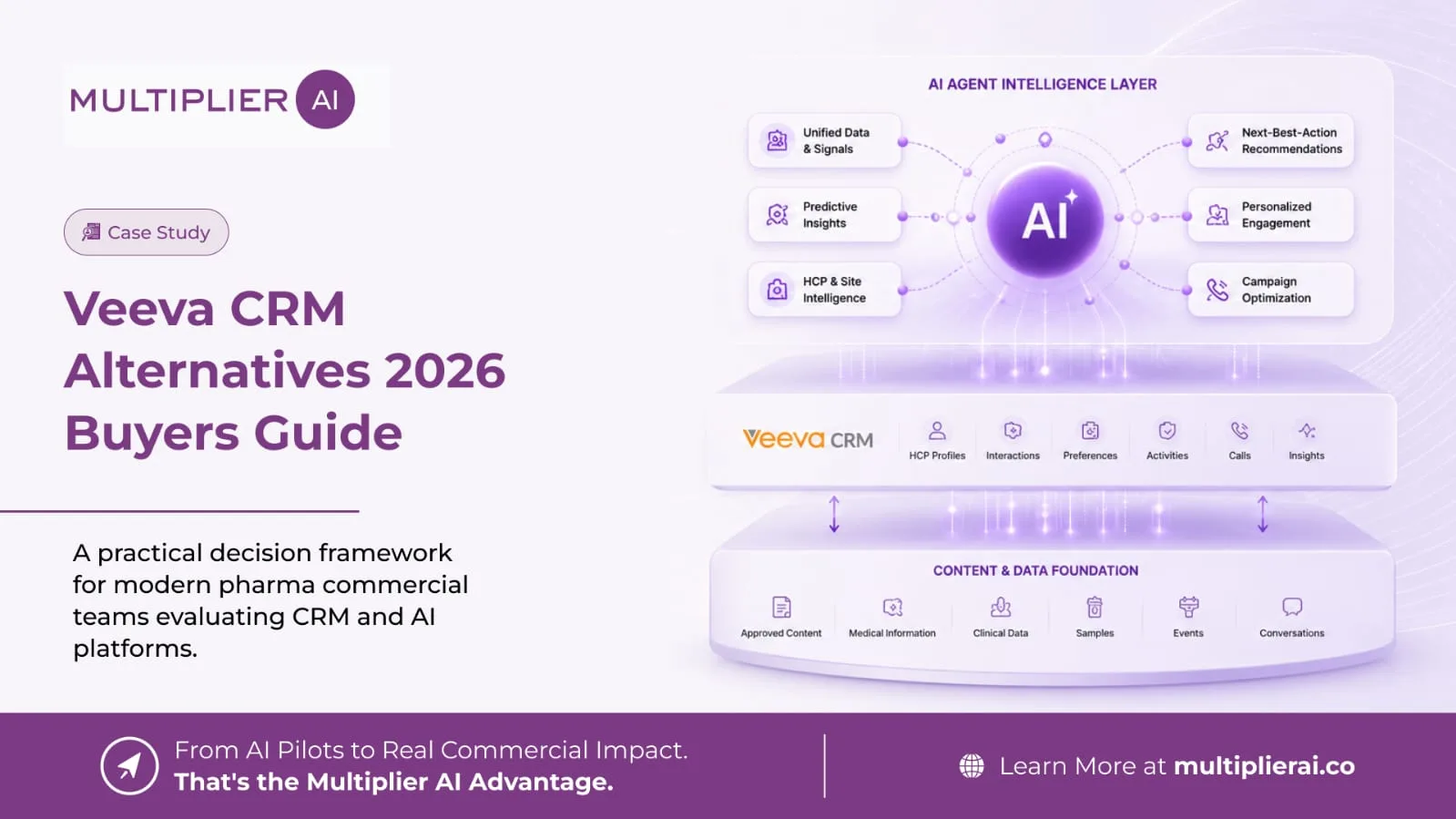
Multiplier AI was built for the complement path. The Agent Stack for Commercial Teams runs closed-loop execution on both Salesforce and Veeva, which means Veeva is an integration surface for Multiplier AI, not a competitor to be displaced. Here is what the combined architecture looks like in practice.
Layer 1: The data foundation
The GenAI Doctor Data Platform supplies identity-resolved doctor data validated at 99% accuracy, covering 120+ parameters per HCP. Instead of reps and admins manually cleaning records, the platform resolves duplicates, refreshes contactability, and enriches profiles, then syncs the clean records into Veeva as the system of record. Clients including Wockhardt, Abbott, GSK, and Alkem run HCP engagement on this data foundation.
Layer 2: The agent layer
Agents monitor engagement signals, prescribing patterns, and competitive movements, then write recommendations back into the CRM: which HCP to see next, which content to lead with, which channel to use, and when. Reps experience this inside the Veeva workflows they already know. Nothing about their system of record changes. What changes is that the CRM starts telling them things worth knowing.
Layer 3: The content layer
The Hyper Personalized Content Platform adapts approved content to each HCP's specialty, behavior, and channel preference, working with the approved asset library rather than around it. Personalization happens within compliance boundaries because it starts from content that has already cleared review.
Layer 4: The compliance layer
For India operations, DPDP-compliant HCP marketing is native: consent capture, purpose limitation, data minimisation, and deletion workflows are built into how the data layer operates, not added afterwards. For US and UK deployments the same architecture aligns with HIPAA boundaries and GDPR obligations.
| Architecture layer | What runs there | System |
| System of record | HCP interactions, consent history, approved content library, activity logging | Veeva (unchanged) |
| Data foundation | Identity resolution, 99% accuracy validation, 120+ parameter enrichment, deduplication, sync to CRM | Multiplier AI GenAI Doctor Data Platform |
| Agent layer | Next-best-action, competitive intelligence, engagement scoring, closed-loop execution | Multiplier AI Agent Stack (runs on Veeva and Salesforce) |
| Content intelligence | Hyper-personalization of approved assets by HCP profile, channel, and context | Multiplier AI Hyper Personalized Content Platform |
| Compliance | DPDP consent workflows, purpose limitation, deletion; HIPAA and GDPR alignment for US/UK | Multiplier AI compliance layer + Veeva consent records |
Capability Map: What Runs in Veeva, What Runs in the AI Layer
This is not a which-is-better table. It is a division-of-labor table. Each system does the job it was designed for, and the combination is what produces outcomes.
| Capability | Veeva's role | Multiplier AI's role |
| HCP record keeping | System of record, audit trail, consent history | Supplies clean, identity-resolved, continuously refreshed records |
| Doctor data quality | Stores what it receives | Validates at 99% accuracy across 120+ parameters before sync |
| Next-best-action | Displays tasks and call plans | Generates the recommendation from live signals and writes it into the workflow |
| Content management | Approval workflows, compliant asset library | Personalizes approved assets per HCP, channel, and moment |
| Omnichannel execution | Channel infrastructure: approved email, events, CRM activities | Orchestrates across channels so each HCP gets one coordinated journey |
| Competitive intelligence | Not a core function | Monitors signals in real time and routes response actions to the right team |
| Rep experience | Logging and history | Copilot-style prep, talking points, and follow-up recommendations in-workflow |
| India DPDP compliance | Consent record storage | Native DPDP consent, purpose limitation, and deletion workflows at data-layer level |
When a True Veeva Alternative Makes Sense
Complement-first does not mean complement-always. There are three scenarios where evaluating a genuine alternative stack is the rational move, and pretending otherwise would make this guide less useful.
Scenario 1: Emerging-market cost structures
For India-focused and emerging-market commercial teams, enterprise CRM licensing can consume a share of the commercial technology budget that the market economics do not support. If the team is paying for global capabilities it will never switch on, a leaner stack built around an India-scale doctor data platform and lightweight execution tools can deliver more outcome per rupee. The evaluation should be honest about what is given up: mature content operations and global standardization.
Scenario 2: India-first DPDP compliance as the core need
Where the primary requirement is DPDP-compliant HCP engagement at India scale, the deciding factor becomes the data platform rather than the CRM. India-native consent handling, purpose limitation, and deletion workflows, combined with doctor data that is actually accurate for the Indian market, matter more than CRM feature depth. Multiplier AI's DPDP-compliant HCP marketing stack serves this scenario directly, with or without an enterprise CRM underneath.
Scenario 3: Agent-native greenfield builds
New commercial organizations with no CRM legacy can evaluate the question freshly. When there is no migration cost, comparing an agent-native stack against a traditional CRM-first stack is a legitimate architecture decision. Even here, many teams land on a hybrid: a lean system of record plus a full agent layer.
| Scenario | Signal that it applies | What to evaluate |
| Emerging-market cost fit | Licensing consumes outsized share of commercial tech budget; global features unused | Lean stack: India-scale doctor data platform + execution tools; total cost of outcome, not license cost |
| India-first DPDP need | DPDP compliance and India HCP data accuracy are the top two requirements | Data platform depth: consent workflows, 120+ parameters, identity resolution, deletion handling |
| Greenfield build | No incumbent CRM, no migration cost, team open to agent-native design | Hybrid architectures: lean record system + full agent layer vs traditional CRM-first |
The 90-Day Coexistence Roadmap: Adding Multiplier AI to a Veeva Stack
Teams that choose the complement path do not face a multi-year program. A typical Veeva plus Multiplier AI integration follows a 90-day arc from kickoff to measurable outcomes.
| Phase | Days | What happens | Output |
| 1. Data audit and mapping | 1-15 | Current Veeva HCP records profiled for duplicates, decay, and gaps; field mapping agreed; consent states reconciled | Data quality baseline report and sync plan |
| 2. Data foundation live | 16-40 | GenAI Doctor Data Platform resolves identities, validates at 99% accuracy, enriches to 120+ parameters, first sync to Veeva | Clean, refreshed HCP records inside the existing CRM |
| 3. Agent layer activation | 41-70 | Next-best-action and engagement-scoring agents switched on for a pilot brand or region; recommendations surface in rep workflows | Reps receiving live recommendations in Veeva |
| 4. Measure and scale | 71-90 | Test-and-control comparison of pilot cohort vs control; content personalization layer activated; scale decision | Measured lift report and rollout plan |
The critical discipline is phase 4. Run the pilot cohort against a matched control so the AI layer's contribution is isolated from market noise. That measurement is what turns the project from an experiment into a business case.
Benchmarks: What to Expect From an AI Layer on Veeva
These are the typical benchmark ranges pharma teams use when building the business case for an intelligence layer on an existing CRM stack, measured with test-and-control discipline over one to three quarters.
| Outcome | Typical benchmark range | Driven by |
| Prescribing lift in target segments | 15-30% vs control cohort | HCP prioritization on identity-resolved data |
| Engagement quality lift | 20-35% on deep-engagement measures | Next-best-action plus content personalization |
| Rep time reclaimed | 8-15 hours per rep per month | Copilot-style prep and prioritization in-workflow |
| Redundant outreach reduction | 30-50% | Cross-channel orchestration over Veeva and digital channels |
| Competitive time-to-respond | From 2-4 weeks to 2-5 days | Real-time competitive intelligence connected to action |
Ranges depend on baseline data quality, brand lifecycle stage, and how fully the agent layer is embedded in workflows. Teams starting with poor data quality see the largest early gains from the data foundation phase alone.
Governance: Keeping the Combined Stack Inside DPDP, GDPR, HIPAA, and MLR Boundaries
Adding intelligence above a CRM raises fair governance questions, and they should be answered before activation, not after.
- Auditability: every recommendation and data update the agent layer writes into Veeva carries an audit trail, so the system of record remains the single source of truth for compliance review.
- DPDP alignment: for India operations, consent capture, purpose limitation, and deletion requests flow through the data layer natively under DPDP. Consent withdrawal in Veeva propagates to the intelligence layer.
- MLR boundaries: personalization starts from MLR-approved assets. The content layer adapts sequencing, emphasis, and channel, never claims.
- US and UK regimes: US and UK deployments run within HIPAA and GDPR obligations, with data residency and processing agreements defined at contract stage.
- Deployment control: private deployment options keep sensitive HCP data inside client-controlled environments where required.
What Not to Do When Evaluating Veeva Alternatives
- Do not start a CRM replacement to fix a data quality problem. The migration will faithfully carry the bad data into the new system.
- Do not compare vendors before deciding whether your problem is the record layer or the intelligence layer. The shortlists are completely different.
- Do not run an AI layer pilot without a control group. Without one, you cannot separate the layer's contribution from market movement, and the business case dies in review.
- Do not evaluate on feature checklists alone. Evaluate on the outcome the stack produces per commercial dollar, which is where data accuracy and workflow embedding dominate.
- Do not treat compliance as a phase-two item. DPDP, GDPR, and MLR boundaries should be architecture inputs, not launch-week discoveries.
The Bottom Line on Veeva Alternatives
The Veeva alternatives question in 2026 is really two questions wearing one search term. If the problem is the layer above the CRM, and for most teams it is, the answer is to complement: keep Veeva as the disciplined system of record it was built to be, and add an agentic intelligence layer that turns that record into decisions. Multiplier AI was designed for exactly that role, running on both Veeva and Salesforce, on top of identity-resolved doctor data validated at 99% accuracy. If the problem is genuine cost-to-fit or an India-first DPDP requirement, then a true alternative or lean hybrid deserves an honest evaluation, and the deciding factor will be the data platform, not the CRM feature list. Either way, the teams that win will be the ones that stopped asking which CRM and started asking where the intelligence lives.
See What an Intelligence Layer on Veeva Looks Like for Your Team Multiplier AI runs closed-loop agentic execution on both Veeva and Salesforce, built on identity-resolved doctor data validated at 99% accuracy across 120+ parameters. Whether you are strengthening an existing Veeva stack or evaluating an India-first DPDP-compliant architecture, we can map your highest-impact starting point in one working session. |
Frequently Asked Questions For Veeva Alternatives for Pharma
For most pharma companies, the best Veeva alternative is an AI intelligence layer that works with Veeva rather than a replacement CRM. Veeva remains the industry standard for life sciences CRM and content operations. Platforms like Multiplier AI add identity-resolved doctor data, next-best-action, and content personalization on top of existing Veeva workflows. True replacements make sense mainly for emerging-market cost structures or India-first DPDP requirements.
No. AI agent platforms built for pharma, including the Multiplier AI Agent Stack, run closed-loop execution directly on Veeva and Salesforce. Agents read signals, generate next-best-action recommendations, and write them back into the CRM workflows reps already use. The system of record does not change.
Multiplier AI integrates at four layers: the GenAI Doctor Data Platform syncs identity-resolved HCP records validated at 99% accuracy into Veeva; the Agent Stack writes next-best-action recommendations into rep workflows; the Hyper Personalized Content Platform adapts MLR-approved assets from the existing library; and the compliance layer aligns consent states between both systems.
In architecture terms, Multiplier AI operates as an intelligence layer that integrates with Veeva, treating it as the system of record. The two address different layers of the stack: Veeva handles compliant record keeping and content operations, Multiplier AI handles doctor data intelligence, agentic decisions, and personalization. For specific India-first scenarios, Multiplier AI can also anchor a standalone stack.
Three scenarios: emerging-market teams where enterprise licensing does not fit the commercial economics, India-first organizations where DPDP-compliant HCP data is the core requirement, and greenfield commercial builds with no CRM migration cost. In all other cases, complementing the existing stack is usually faster, cheaper, and lower risk.
Yes. Cross-platform flexibility is a core design principle of the Agent Stack. Multi-market pharma organizations running Veeva in some regions and Salesforce in others can run one intelligence layer across both, unifying doctor data and next-best-action logic without forcing CRM consolidation.
A typical coexistence deployment follows a 90-day arc: data audit and mapping in the first two weeks, the data foundation live by day 40, next-best-action agents active for a pilot brand by day 70, and a measured test-and-control lift report by day 90.
Yes. DPDP compliance is native to the platform: consent capture, purpose limitation, data minimisation, and deletion workflows operate at the data layer. Multiplier AI serves Indian pharma clients including Wockhardt, Abbott, GSK, and Alkem on this foundation.
Typical benchmark ranges, measured against control cohorts, are 15-30% prescribing lift in target segments, 20-35% engagement-quality lift, 8-15 hours per rep per month reclaimed, 30-50% reduction in redundant outreach, and competitive time-to-respond dropping from weeks to days. Results depend on baseline data quality and how fully agents are embedded in workflows.
Not when architected correctly. Every agent action carries an audit trail into the system of record, personalization starts only from MLR-approved content, and consent states stay synchronized between the CRM and the intelligence layer under DPDP, GDPR, and HIPAA obligations as applicable to the market.
Let's Discuss Your Requirements