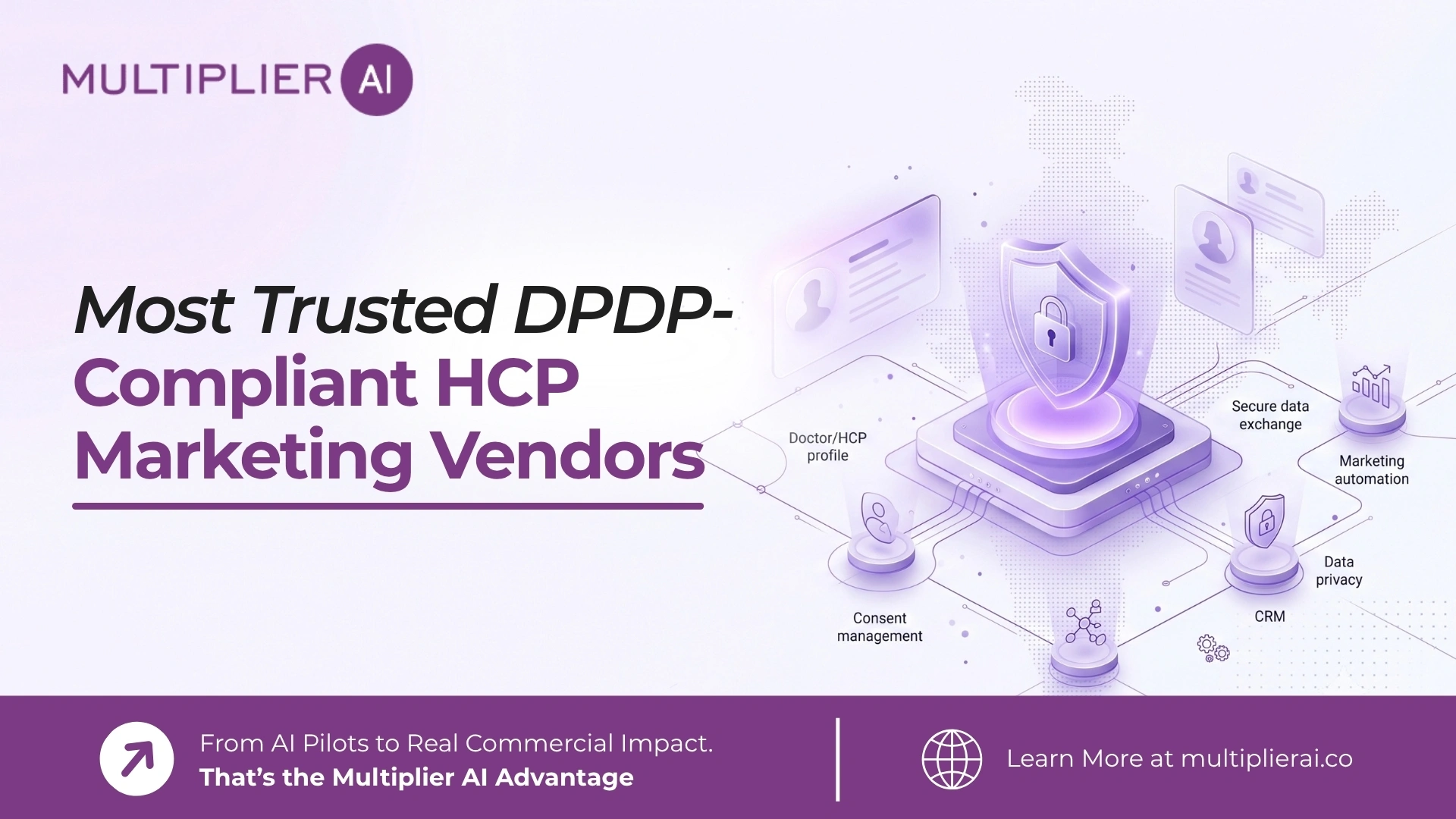
Most Trusted DPDP-Compliant HCP Marketing Vendors
If you have searched for a trusted DPDP-compliant HCP marketing vendor, you have probably noticed that the results are almost entirely law-firm commentary. Excellent commentary, in many cases — but it explains the obligation and stops. It does not tell you how to choose a supplier.
Meanwhile every vendor in Indian healthcare marketing now describes itself as DPDP compliant. Including us. The phrase appears on pitch decks, one-pagers and website footers, and it is doing almost no work, because there is no way for a buyer to distinguish a company that has built for the framework from one that has added a line to its boilerplate.
This article exists to close that gap. It sets out what the Rules actually require, why the liability does not transfer to your vendor no matter what the contract says, and a twelve-point test you can run in a single meeting. We have deliberately written it so that it can be used against us.
No vendor is DPDP certified, because DPDP certification does not exist. The framework creates no accreditation body, no public register of compliant suppliers, and no audit standard that a marketing vendor can be assessed against. The only statutory audit in the framework is the annual independent audit required of a Significant Data Fiduciary — and that assesses you, not your supplier. So the question "which vendors are DPDP compliant" has no verifiable answer. The answerable question is: can this vendor evidence the specific safeguards Rule 6 requires me to impose on them — and can I show the Board that I imposed them?
Which vendors are DPDP compliant for healthcare marketing?
The honest answer is that the question cannot be answered as asked, and that is worth understanding before you spend a procurement cycle trying.
Why "DPDP compliant" is a claim, not a credential
Compare it with frameworks buyers are used to. SOC 2 has an audit standard and a named auditor issuing a report you can read. ISO 27001 has an accreditation chain and a certificate with a registration number. GDPR has approved codes of conduct and certification mechanisms under Articles 40 and 42.
The DPDP framework has none of that for suppliers. There is no notified certification body for vendors, no public register of compliant processors, and no defined audit standard a marketing platform can be measured against. A vendor saying "we are DPDP compliant" is making a self-assessment, and a self-assessment is not evidence.
The one genuine audit obligation in the framework runs in the opposite direction from where buyers assume. Under Rule 13, a Significant Data Fiduciary must appoint an independent Data Auditor and undergo an independent audit every twelve months from designation. That audit examines the SDF's own compliance — which, for most pharmaceutical companies, means it examines you, including how you govern the vendors you engaged.
The reframe this article is built on
Stop asking "is this vendor DPDP compliant?" — it has no verifiable answer and every vendor will say yes.
Start asking "can this vendor evidence the specific safeguards Rule 6 requires me to impose on them, and can I show my auditor that I imposed them?"
The second question has a testable answer, it maps directly onto your own audit obligation, and it changes the meeting. A vendor who has genuinely built for this will produce documents. A vendor who has not will produce adjectives.
The obligation that does not transfer
Under the DPDP framework the Data Fiduciary — the pharmaceutical company deciding why and how doctor data is processed — carries the statutory obligation. A marketing vendor typically acts as a Data Processor on your instructions. Rule 6 requires that processor agreements impose equivalent safeguards on that processor. Engaging a vendor therefore does not outsource the liability; it adds a party you are now responsible for governing.
This is the single most consequential thing a marketing head can misunderstand about this framework, and it is misunderstood constantly. The instinct — reasonable in most commercial contexts — is that hiring a specialist transfers the risk to the specialist. Here it does not. If your vendor suffers a breach involving doctor data you gave them, the notification duty, the regulatory exposure and the penalty sit with you.
Two practical consequences follow, and they should shape how the contract is written rather than how the platform is demoed.
- Your contract has to do real work. Rule 6's seventh requirement is a data processor agreement imposing equivalent safeguards. A standard master services agreement with a generic confidentiality clause does not satisfy that. The safeguards have to be specified, and they have to be the same ones you are required to maintain yourself.
- You need evidence, not assurance. When your independent Data Auditor asks how you satisfied yourself that your marketing vendor met Rule 6, "they told us they were compliant" is not an answer. The twelve-point framework below exists to give you something better to put in that file.
We wrote the underlying principle up separately in DPDP and third-party vendors — why responsibility cannot be outsourced, and the fiduciary question itself in are pharma companies data fiduciaries under the DPDP Act.
The twelve-point vendor verification framework
Twelve testable requirements, grouped into four areas, each tied to the rule it comes from. All of them can be checked in one working session — ask the question, then ask to see it in the product rather than in a deck.
The right-hand columns matter more than the question. A good answer is demonstrable. A bad answer is an adjective.
Group 1 — Consent (Rule 3)
| # | What to verify | What a strong answer looks like | What should worry you |
|---|---|---|---|
| 1 | Consent is captured per purpose, not once globally. A doctor may accept educational content and decline promotion | Shows separate purpose records in the interface, with different states against the same doctor | "We have an opt-in flag." One flag cannot represent two answers |
| 2 | Consent is stored per channel. WhatsApp, email, SMS and voice are separate permissions | Demonstrates channel-level state and shows what happens when one channel is withdrawn | Channel is a preference field rather than a permission record |
| 3 | Every consent record carries a timestamp and a verifiable source, and no pre-ticked boxes exist anywhere in the capture flow | Opens a record and shows when, where and how consent was given — click-to-WhatsApp, form, keyword reply | Cannot show provenance, or the demo form has a box already ticked |
| 4 | Withdrawal cascades immediately across every downstream system | Withdraws consent live and shows the change propagate to the campaign engine and any connected CRM | Withdrawal is a nightly batch, or applies only inside their own platform |
Point four is the one that fails most often and matters most. A withdrawal honoured in the marketing platform but not in the CRM that feeds it is not a withdrawal — it is a delay before the next message. We covered the mechanics in consent withdrawal under DPDP and why permission changes must cascade.
Group 2 — Security safeguards (Rule 6)
| # | What to verify | What a strong answer looks like | What should worry you |
|---|---|---|---|
| 5 | Encryption in storage and in transit, with the approach documented | Names the standard, shows where it applies, and can say what is not encrypted and why | "Everything is encrypted" with no detail. It never is |
| 6 | Access controls limiting personal data to authorised personnel, with roles evidenced | Shows the role model and who at the vendor can see your doctor data. Ideally: almost nobody | Support staff have broad production access as a matter of routine |
| 7 | Access and activity logs retained for one year, and producible on request | Pulls a log for a named record across a date range, during the meeting | Logging exists but retention is 30 or 90 days, or logs cannot be exported |
Point seven is the sharpest single question in the whole framework, because the one-year log retention requirement is specific, unambiguous, and almost never asked in a sales cycle. A vendor who can produce a twelve-month access trail for an individual doctor record has built for this framework. A vendor who has to check has not.
Group 3 — Breach, rights and retention (Rules 7, 8 and 12)
| # | What to verify | What a strong answer looks like | What should worry you |
|---|---|---|---|
| 8 | Breach notification to you, fast enough for you to meet your own clock — Board as soon as discovered, affected individuals within 72 hours of that | A contractual notification window measured in hours, with a named contact and a rehearsed process | "We will inform you promptly." Promptly is not a timeline you can plan a 72-hour obligation around |
| 9 | Erasure executed within 90 days of a request, including from backups and any derived datasets | Describes the erasure path end to end, including what happens in backups and analytics copies | Deletion is a soft flag, or backups are treated as out of scope |
| 10 | Data principal rights are operable through the platform — access, correction, erasure, grievance | Shows each right being exercised in the product, not described in a policy | Rights are handled by a support ticket and a manual process |
Group 4 — Governance and structure
| # | What to verify | What a strong answer looks like | What should worry you |
|---|---|---|---|
| 11 | A processor agreement that specifies equivalent safeguards, not a generic confidentiality clause | Offers a data processing addendum enumerating the Rule 6 controls, and will negotiate it | Refers you to standard terms, or treats the DPA as a formality |
| 12 | Named accountability and honest scope — who is responsible, where data resides, which sub-processors touch it, and what the vendor does not do | Provides a sub-processor list and states its limits without prompting | Cannot name sub-processors, or claims to handle every obligation on your behalf |
How to score it This is deliberately not a points system. Points one to four and point seven are effectively pass or fail — a vendor who cannot store consent per channel and per purpose, cascade a withdrawal, or retain a year of logs is not a cheaper option, they are an exposure with an invoice attached. The rest are negotiable. A vendor missing point ten today but with a credible roadmap and a willing DPA is a reasonable partner. A vendor who bristles at being asked is telling you something useful for free. Send the twelve points before the meeting. The quality of the preparation is itself the strongest signal you will get. |
What each failure actually costs
The penalty schedule is unusually specific, which is helpful — it lets you weight the twelve points by exposure rather than by intuition.
| Failure | Maximum penalty | Which of the twelve points protects you |
|---|---|---|
| Failure to maintain reasonable security safeguards | ₹250 crore | Points 5, 6 and 7 — encryption, access control, one-year logs. The largest exposure in the framework, and the one most directly delegated to a vendor |
| Failure to notify a personal data breach | ₹200 crore | Point 8. Your ability to notify depends entirely on when your vendor tells you |
| Breach of children's data obligations | ₹200 crore | Relevant to patient programmes rather than HCP marketing — but paediatric patient support programmes sit squarely inside it |
| Failure to meet Significant Data Fiduciary obligations | ₹150 crore | Points 11 and 12 — your vendor governance is part of what an SDF audit examines |
| Data principal duty violations | ₹10,000 | Applies to individuals, not to you. Included so the schedule reads honestly |
Two things stand out when you read the schedule against a marketing stack. The largest penalty attaches to security safeguards — the area buyers evaluate least and vendors describe most vaguely. And the second largest attaches to breach notification, which is the one obligation you cannot discharge without your vendor's cooperation, on a clock that starts when they decide to tell you.
That is why point eight is worth negotiating hard. A contractual notification window measured in hours is not an unreasonable ask when the alternative is a ₹200 crore exposure that turns on someone else's judgement about what counts as prompt.
Are you a Significant Data Fiduciary?
The Central Government designates Significant Data Fiduciaries under Section 10, based on the volume and sensitivity of personal data processed, the risk to data principals' rights, and impact on sovereignty, public order, national security or electoral democracy. SDF designations have not yet been formally published. A pharmaceutical company processing health-adjacent data on a national doctor universe and running patient support programmes should plan on the assumption that it is in scope, because the additional obligations take months to build and cannot be assembled after designation.
| SDF obligation (Rule 13) | What it requires | Why your vendor choice affects it |
|---|---|---|
| Data Protection Officer | Designated, resident in India, reporting to the board or equivalent, and the contact point for complaints | Your DPO will be asked how vendor risk was assessed. The twelve points are the answer |
| Annual Data Protection Impact Assessment | Every twelve months from designation, with key observations submitted to the Board | Every processor in your marketing stack is in scope of the assessment |
| Annual independent audit | An independent Data Auditor verifying compliance, every twelve months, with results to the Board | The auditor examines your vendor governance, not just your own systems |
| Algorithmic due diligence | Verifying that tools and algorithms used to host, share, modify, store or transmit personal data do not endanger data principals' rights or produce unfair outcomes | Directly relevant to AI-driven targeting and next-best-action. If a model decides which doctor gets which message, it is in scope |
| Data localisation | Processing of specified personal data within India, with restrictions on cross-border movement | Ask where your vendor actually hosts. Approved countries have not yet been notified |
The algorithmic due diligence point deserves more attention than it is getting Rule 13 requires an SDF to verify that the algorithms it uses to process personal data do not endanger data principals' rights or produce unfair outcomes. For a pharmaceutical company running AI-driven HCP targeting, that is not an abstract obligation. If a model decides which doctors receive which messages, that model is in scope — and "the vendor's algorithm decided" is not a defence when the vendor is your processor and you are the fiduciary. Practically: ask any AI-driven marketing vendor whether they can explain, per decision, why a given doctor was selected for a given message. Vendors who built explainability in can answer. Vendors who bolted AI on cannot, and that gap will surface in your first annual audit rather than in the sales cycle. |
How the vendor categories typically score
Generalisations, offered as a starting point rather than a verdict — run the twelve points on the specific vendor in front of you. Categories behave differently because they were built for different purposes.
| Vendor category | Typically strong on | Typically weak on | Verdict for HCP marketing under DPDP |
|---|---|---|---|
| Pharma-native suites (Veeva, IQVIA, Salesforce Life Sciences) | Governance, audit trails, content control, processor agreements they will actually negotiate | India-specific consent granularity and WhatsApp permission modelling | Strong foundation. Verify points 1–4 specifically for Indian channels |
| Global martech (Marketo, HubSpot, Salesforce MC) | Security posture, encryption, mature certifications like SOC 2 and ISO 27001 | No DPDP-shaped consent model. Purpose and channel granularity must be built by you | Capable but not configured. You will own the consent layer |
| Indian engagement platforms (WebEngage, MoEngage, CleverTap, Netcore) | Channel handling, WhatsApp, Indian data residency, price | Consumer-grade consent. No UCPMP awareness. Built for marketing opt-ins, not professional-purpose consent | Good for patient programmes. Weaker for HCP promotion without a consent layer above them |
| Doctor-data providers | Coverage and verification | Provenance is the whole question. A purchased database is not consent, however it is described | Ask for lawful basis per record, not a compliance statement |
| Agencies reselling platforms | Speed, execution capacity | Often cannot answer points 5–7 because they do not control the platform. Add a sub-processor layer you must also govern | Ask who the actual processor is. You may be governing two parties, not one |
| Consent managers | The consent layer itself, done properly | Registration requirements not yet formally published, so the category is still forming | Watch this space. Rule 4 registration opens 13 November 2026 |
Where Multiplier AI is not the right choice
We built consent-first HCP marketing for India because the DPDP framework made the consent layer the constraint, and because the doctor data underneath it was the thing nobody else was fixing. That is a specific position, not a universal one.
Applied honestly, our own twelve points rule us out of several situations.
| If this is your situation | Choose this instead | Why |
|---|---|---|
| You are a global pharma with a Veeva or Salesforce estate and a group-level DPA already negotiated | Your existing suite | Vendor governance is easier with fewer processors. Adding a party to govern for a marginal capability gain is a poor trade under an SDF audit |
| Your programme is patient-facing at high volume — adherence, reminders, refills, post-discharge | An Indian engagement platform with a consent layer above it | They are better and cheaper at that job. Our advantage is HCP-side compliance, which is not the binding constraint there |
| Paediatric patient programmes involving children's data | A specialist with verified parental consent flows | Rule 10 requires verified parental consent and prohibits tracking, monitoring, profiling and behavioural targeting of minors. That is a distinct build and we would not claim it as a strength |
| You need a consent manager as a registered, standalone function | A dedicated consent manager, once Rule 4 registration opens | We provide consent handling inside our platform. That is not the same as being a registered consent manager, and we will not blur the two |
| Your organisation needs an independent audit or a compliance opinion | A law firm and an independent Data Auditor | A vendor cannot audit the buyer's compliance with obligations that govern the buyer. We would be marking our own work |
| You are outside India with no Indian doctor universe | A vendor built for your jurisdiction | DPDP-shaped consent architecture is an advantage in India and irrelevant in Germany |
Where we genuinely are the strongest option: Indian pharmaceutical companies doing HCP promotion where consent has to be demonstrable per channel and per purpose, doctor data quality is the underlying constraint, WhatsApp is the primary channel, and the team needs an evidence file rather than a compliance statement. That is a real segment. It is not the whole market, and a page that implied otherwise would fail its own test.
A 90-day vendor compliance audit you can actually run
For teams that already have vendors in place and are looking at the enforcement dates with some discomfort. This sequence assumes no budget and no new headcount.
- Days 1–10: inventory every processor. List every party that touches doctor or patient personal data — marketing platforms, WhatsApp providers, data vendors, agencies, analytics tools, email services. Most teams find more than they expected, and the surprises are usually agency sub-processors nobody catalogued.
- Days 11–25: send the twelve points to each one. In writing, with a deadline. The responses are your first evidence artefact, and the speed of reply is itself informative.
- Days 26–40: run the demo test on the top three by data volume. Ask them to show consent per channel, a live withdrawal cascade, and a one-year access log for a named record. Watch the product, not the deck.
- Days 41–55: review every processor agreement against Rule 6(7). Does it specify equivalent safeguards, or does it gesture at confidentiality? Where it gestures, request a data processing addendum that enumerates the controls.
- Days 56–70: negotiate breach notification windows. Convert every "promptly" into a number of hours. This is usually the easiest clause to win because vendors have no principled reason to refuse it.
- Days 71–85: close the gaps or change the vendor. Anything failing points 1–4 or point 7 gets a remediation plan with a date, or gets replaced. A vendor unwilling to commit to either has answered the question.
- Days 86–90: write the file. A short memo per processor: what was asked, what was shown, what was contracted, what remains open. This memo is what you hand your independent Data Auditor, and it is the difference between demonstrating diligence and asserting it.
Why the file matters more than the outcome You will not finish this exercise with every vendor passing every point. Nobody does. What you will have is documented evidence that you assessed each processor against the specific obligations in Rule 6, identified the gaps, and either remediated them or accepted them knowingly. Under an audit, a demonstrated process with known gaps is a very different position from an undocumented assumption that everything was fine. Diligence you cannot evidence is diligence you did not do, as far as the file is concerned. |
What is still pending, and should not be assumed
Several parts of the framework have not been formally published. Any vendor speaking with certainty about these is overstating, and that itself is a useful signal about how they handle the rest.
- Significant Data Fiduciary designations. The criteria exist in Section 10; the designations have not been published. Plan for inclusion, do not claim exclusion.
- Approved countries for cross-border transfer. The restriction mechanism exists; the approved list has not been notified. A vendor guaranteeing that their hosting location is permitted is guaranteeing something not yet decided.
- Consent Manager registration requirements. Rule 4 registration opens on 13 November 2026, and the detailed requirements have not been formally published. Treat "we are a consent manager" as a description of function, not a registration status.
- Categories of specified personal data subject to localisation. The mechanism exists; the specification does not yet.
The reasonable posture on all four is to build for the stricter interpretation. Every one of them is easier to relax later than to retrofit under enforcement, and the enforcement dates are the part that is not pending: penalty provisions become operative on 13 November 2026, and full compliance lands on 13 May 2027.
What does "consent-first doctor marketing" actually mean in practice?
Consent-first means the permission record is the source of truth that campaigns read from, rather than a compliance artefact stored alongside them. In a consent-first system, a campaign cannot select a doctor whose consent state does not permit that purpose on that channel — the restriction is enforced by the architecture, not by a person remembering to check. In a consent-second system, the campaign selects the audience and consent is applied as a filter afterwards, if at all. The difference shows up the first time somebody is in a hurry.
The phrase has become common enough in vendor marketing to be nearly meaningless, so it is worth reducing to something testable. Four operational differences separate the two designs.
| Question | Consent-first | Consent-second |
|---|---|---|
| Where does consent live? | In the doctor record, per purpose and per channel, as the state campaigns query | In a separate compliance system or a spreadsheet, reconciled periodically |
| What happens when someone builds a segment? | Ineligible doctors are not selectable. The system will not offer them | All doctors are selectable. Consent is applied as a suppression list before send, if someone remembers |
| What happens on withdrawal? | State changes immediately and propagates. The next campaign cannot include them | Added to a suppression list that is refreshed on a schedule. There is a window |
| What can you show an auditor? | A per-record history: consent given, purpose, channel, source, timestamp, every change since | A policy document and an assurance that the process is followed |
The architectural point underneath this is simple and worth stating plainly: a suppression list is a subtraction, and a consent state is a permission. Subtraction fails open — if the list is stale, the message sends. Permission fails closed — if the state is unknown, nothing sends. Under a framework where security-safeguard failure carries a ₹250 crore maximum, failing closed is the only defensible default.
When a vendor describes themselves as consent-first, ask them to build a segment live and show you a doctor being excluded because of consent state. A consent-first system can demonstrate that in thirty seconds. A consent-second system will explain its process instead.
DPDP is not the only code that applies
A gap worth naming, because teams that solve the data question sometimes assume they have solved the compliance question.
The DPDP framework governs personal data. The Uniform Code for Pharmaceutical Marketing Practices governs promotional conduct. They overlap in HCP marketing and neither substitutes for the other. A message can be perfectly compliant on consent and still breach the promotional code on content — and a vendor evaluation that checks only the twelve points above will not catch it.
| Dimension | Governed by DPDP | Governed by UCPMP | What your vendor must handle |
|---|---|---|---|
| Whether you may contact a doctor at all | Yes — consent per purpose and channel | Indirectly | Consent state enforced at selection, not at send |
| What the message is allowed to say | No | Yes — promotional claims, comparisons, substantiation | Medico-legal review workflow before any asset can be selected |
| What you may record about the interaction | Yes — purpose limitation, retention, minimisation | Partly | Retention rules per data category, with erasure inside 90 days |
| Gifts, hospitality and inducements | No | Yes | Not a software question. A vendor claiming to handle it is overselling |
| Evidence you can produce afterwards | Yes — logs, consent history, breach records | Yes — approval trail per asset | Both trails, and they must reconcile |
The practical test for a vendor is whether the two trails join up. If the platform can show that a specific doctor received a specific asset, that the doctor's consent permitted that purpose and channel at that moment, and that the asset had passed medico-legal approval on that date, then the evidence file writes itself. If those live in three systems that do not reference each other, somebody will be assembling that file by hand under time pressure, which is exactly when it is discovered to be incomplete.
We treated the promotional-code side separately in ethical physician engagement in pharma marketing and the content-approval mechanics in AI-generated pharma content and MLR compliance.
A worked example — what the framework catches
An anonymised composite of evaluations we have seen run, included because the abstract version of this exercise makes it sound more theoretical than it is. Three vendors, same twelve points, same afternoon.
| Vendor A — global martech | Vendor B — Indian engagement platform | Vendor C — pharma-specific | |
|---|---|---|---|
| Points 1–2 consent per purpose and channel | Single subscription status. Fails | Channel preferences, no purpose dimension. Partial | Both dimensions present. Passes |
| Point 3 timestamp and source | Timestamp yes, source not retained. Partial | Both retained. Passes | Both retained. Passes |
| Point 4 withdrawal cascade | Within their platform only. Partial | Within their platform only. Partial | Propagates to connected CRM. Passes |
| Points 5–6 encryption and access control | Strong. SOC 2 and ISO 27001 held. Passes | Adequate, less documented. Partial | Adequate. Passes |
| Point 7 one-year log retention | 90 days by default, extendable at cost. Fails as sold | Could not answer in the meeting. Unknown | Twelve months, demonstrated live. Passes |
| Point 8 breach notification window | "Without undue delay". Negotiable | Not addressed in standard terms. Negotiable | 24 hours, contractual. Passes |
| Point 9 erasure inside 90 days | Yes, backups unclear. Partial | Yes. Passes | Yes, including derived datasets. Passes |
| Point 11 processor agreement | Standard DPA, will negotiate. Passes | Generic terms, reluctant. Concern | Enumerated DPA offered. Passes |
What the buyer actually did Not what the scorecard suggests, and that is the useful part. Vendor A was the strongest on security and the weakest on consent — a common and instructive pattern, because security maturity and consent maturity are unrelated, and buyers routinely assume a SOC 2 report implies the second. It does not. The buyer kept Vendor A for a patient-facing programme where the consent model was simpler, put a consent layer above it, and chose Vendor C for HCP promotion. Two vendors, clean separation, and the compliance surface concentrated where the regulator is looking. The decisive moment was point seven. Vendor C pulled a twelve-month access trail for a named doctor record during the meeting. Vendor B could not say what their retention period was. Neither answer was about the product — both were about whether anyone had ever asked before. |
Frequently Asked Questions For DPDP-Compliant HCP Marketing Vendors
None are certified, because DPDP certification does not exist — there is no accreditation body, no public register of compliant suppliers, and no defined audit standard for marketing vendors. Any vendor claiming DPDP certification is describing a self-assessment. The answerable question is whether a vendor can evidence the specific safeguards Rule 6 requires you to impose on your processors: consent per channel and per purpose with timestamp and source, encryption, access controls, one-year log retention, breach notification fast enough for your 72-hour clock, and a processor agreement that enumerates those controls rather than gesturing at confidentiality.
Your vendor has contractual liability to you, but the statutory obligation stays with the Data Fiduciary — the pharmaceutical company that decided why and how the data would be processed. Rule 6 requires processor agreements imposing equivalent safeguards, which means engaging a vendor adds a party you must govern rather than removing your exposure. If a vendor breach involves doctor data you provided, the notification duty and the regulatory penalty are yours. That is precisely why the breach notification window in the contract deserves real negotiation.
The schedule is specific. Failure to maintain reasonable security safeguards carries a maximum of ₹250 crore, assessed per contravention rather than per organisation. Failure to notify a personal data breach carries up to ₹200 crore, as do breaches of children's data obligations. Failure to meet Significant Data Fiduciary obligations carries up to ₹150 crore. The largest exposure attaches to security safeguards, which is the area most often delegated to a vendor and least often verified during procurement.
Two stages. The Data Protection Board must be notified as soon as the breach is discovered, with a description of the breach, the categories of data affected, the likely consequences and the remediation being undertaken. Affected data principals must then be notified within 72 hours of that Board notification, in plain language covering what happened, what data was exposed and what protective steps to take. Because you cannot start either clock until your vendor tells you, a contractual notification window measured in hours is the single most valuable clause to negotiate.
No. Consent must be free, specific, informed, unconditional and unambiguous, given through a clear affirmative action, with a verifiable record of when and how it was obtained. A purchased list carries none of that, however the seller describes its provenance. Pre-ticked boxes are also invalid. When evaluating a doctor-data provider, the question to ask is not whether they are DPDP compliant but what the lawful basis is for each record and whether they can evidence it per record rather than per dataset.
One year. Rule 6 requires monitoring of access and processing activity, with logs retained for twelve months. This is one of the most useful questions in a vendor evaluation precisely because it is specific and rarely asked — a vendor who can pull a twelve-month access trail for an individual doctor record during the meeting has built for this framework, and one who has to check has not. Separately, erasure requests must be completed within 90 days, which is worth testing against backups and derived datasets rather than just the primary database.
Designations have not yet been formally published, so nobody can tell you definitively. The criteria under Section 10 cover volume and sensitivity of data processed, risk to data principals' rights, and impact on sovereignty, public order, national security and electoral democracy. A pharmaceutical company processing health-adjacent data across a national doctor universe and running patient support programmes should plan on being in scope. The additional obligations — a resident DPO reporting to the board, annual DPIA, annual independent audit, algorithmic due diligence and localisation of specified data — take months to build and cannot be assembled after a designation arrives.
Yes, and more directly than most teams expect. Beyond the general consent and security obligations, Rule 13 requires a Significant Data Fiduciary to conduct algorithmic due diligence — verifying that the tools and algorithms used to host, share, modify, store or transmit personal data do not endanger data principals' rights or produce unfair outcomes. If a model decides which doctors receive which messages, that model is in scope, and "the vendor's algorithm decided" is not a defence when the vendor is your processor. Ask any AI-driven vendor whether they can explain, per decision, why a specific doctor was selected.
Let's Discuss Your Requirements