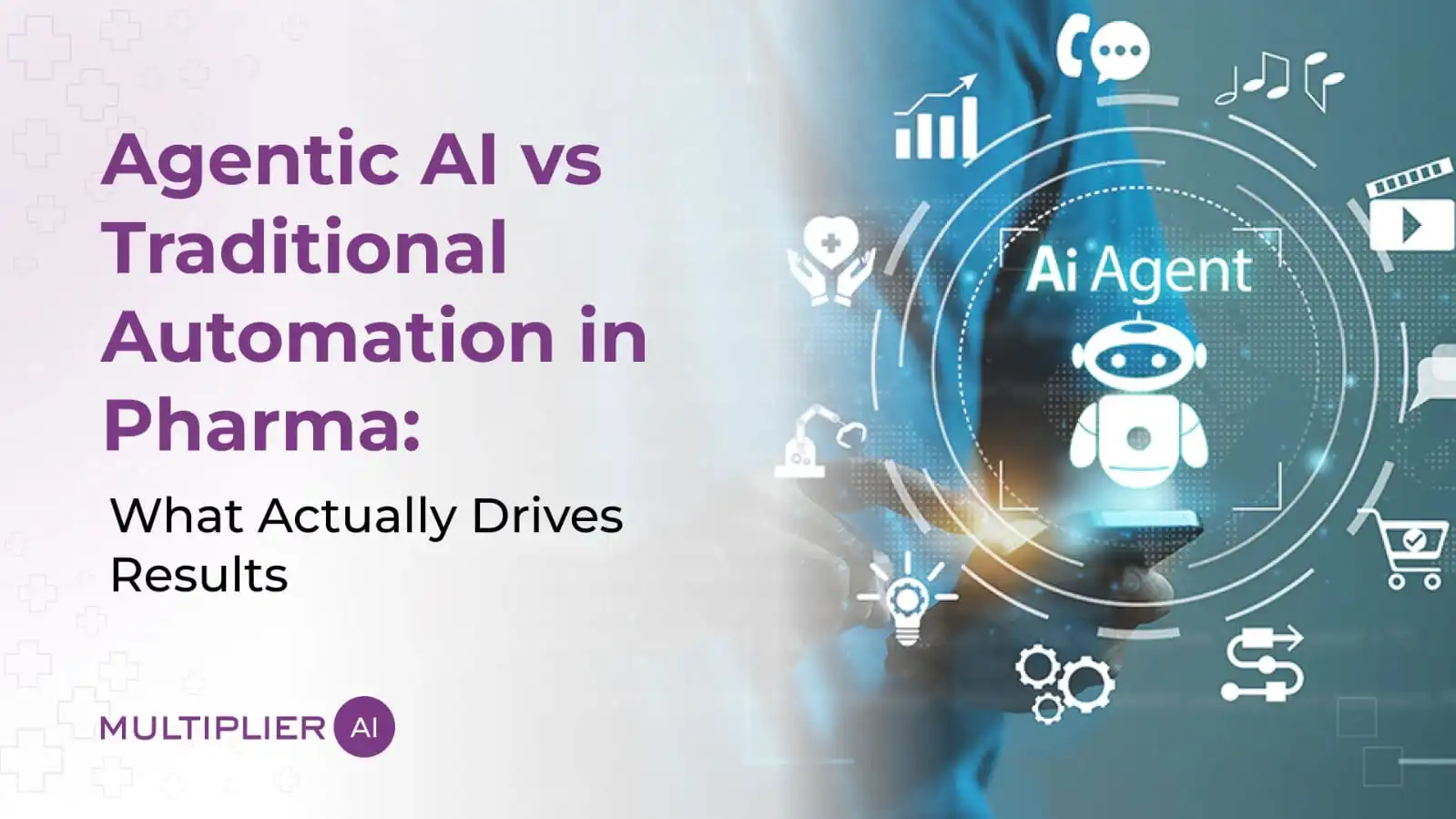
Agentic AI vs Traditional Automation in Pharma: What Actually Drives Results in 2026
Traditional pharma automation executes predefined rules. Agentic AI reasons, decides, and adapts based on goals.
In modern pharma commercial, where HCP behavior, competitive dynamics, and clinical context shift weekly, agentic AI is what drives results — and automation is what keeps the routine running underneath it.
Pharma has spent more than a decade investing in automation — CRM systems, marketing automation, workflow tools, scheduled campaigns, rep activity triggers. The results were real. Campaigns became consistent. Follow-ups stopped slipping. Reporting improved. Field teams got better structure. But pharma commercial teams in India, the US, and the UK are now feeling the same thing: the curve has flattened. Automation continues to execute exactly what it was designed to do. The problem is that what it was designed to do is no longer enough.
Healthcare professionals are interacting across more channels with shifting preferences. Competitive dynamics move weekly. New therapies enter the market with different positioning. Clinical data evolves. Patient expectations influence decision-making. In this environment, predefined workflows can't keep up — because they were never designed to. The fix is not more automation. It is a different category of system: agentic AI. This article breaks down exactly what agentic AI is, how it differs from rule-based automation, when to use each one, and what becomes possible in pharma commercial when the system finally starts to reason instead of just execute.
Why Pharma Is Hitting the Ceiling of Rule-Based Automation
For more than a decade, automation was the most important productivity lever in pharma commercial — CRM, marketing automation, workflow tools, scheduled campaigns, rep activity triggers. It delivered real results: campaigns became consistent, follow-ups stopped slipping, reporting improved, digital engagement expanded. But pharma is now hitting the ceiling of what rules-based systems can do.
HCPs interact across multiple channels with shifting preferences. Competitive dynamics move weekly. Clinical data evolves. Predefined workflows cannot keep up — and pharma teams are feeling it. Automation continues to execute exactly what it was designed to do; the problem is that what it was designed to do is no longer sufficient. It cannot interpret change. It cannot adapt to new signals. It cannot decide when the situation requires a different approach. This is the same reason static HCP lists are failing pharma.
What Traditional Pharma Automation Actually Does (and Where It Stops)
Traditional pharma automation operates on rules — if a specific condition is met, a predefined action runs. Typical pharma examples:
1. Send a follow-up email three days after an HCP opens a campaign message.
2. Trigger a rep visit reminder after a defined gap since the last interaction.
3. Update CRM records automatically when a digital engagement happens.
4. Route MLR-approved content based on therapy area + segment tags.
These systems work because they remove manual effort and ensure consistency. They are reliable, predictable, scalable. They work particularly well for tasks that don't change often and don't require interpretation.
But the strength of automation is also its limit. Automation does not evaluate context. It does not understand intent. It does not learn from outcomes unless explicitly programmed to. It simply follows instructions. In a complex, dynamic environment, that creates gaps.
What Agentic AI Introduces That Pharma Automation Cannot
Agentic AI is fundamentally different from automation. Instead of following predefined rules, agentic systems operate based on goals. They are designed to achieve outcomes — not execute instructions. An AI agent observes data, interprets signals, makes decisions, takes actions, and learns from the results. That creates a feedback loop where the system continuously improves.
In a pharma setting, that means an agent can decide what the next best action is for each HCP, based on current conditions — not a journey designed three quarters ago. If an HCP engages with a specific content piece, the agent decides whether to follow up immediately, wait, switch channels, or escalate to a rep. It evaluates the situation rather than applying a fixed rule. This ability to reason and adapt is what separates agentic AI from traditional automation.
Rules vs Reasoning: The Critical Difference in Pharma AI
The easiest way to understand the difference is to look at how each system makes decisions.
Automation is rule-based: if a specific condition is met, a predefined action runs. It works when the environment is stable.
Agentic AI is reasoning-based: it evaluates multiple factors, considers context, and determines the most appropriate action to achieve a goal. It is not limited to predefined scenarios.
Example: an HCP opens an email but doesn't click further. An automated system triggers a follow-up email after a fixed period — ignoring whether the HCP is busy, already engaged elsewhere, or simply uninterested. An agentic system looks at past engagement patterns, recent interactions, and external signals, then decides to delay, change messaging, switch channels, or escalate. The result is fewer wasted touches and more relevant ones.
Agentic AI vs Traditional Automation: Side-by-Side Comparison
The contrast between rule-based automation and agentic AI shows up across every dimension of pharma commercial execution — from how decisions get made to how the system responds to change.
Table 1: Agentic AI vs Traditional Automation in Pharma
| Dimension | Traditional Automation | Agentic AI | Why It Matters |
| Decision basis | Predefined rules (if X, do Y) | Goals + reasoning over context | Adapts to new situations the rules never anticipated |
| Data usage | Operates on programmed fields | Interprets multi-signal context, incl. unstructured | Captures nuance rules can't encode |
| Response to change | Static — same action regardless of context | Dynamic — action changes with conditions | Handles HCP-by-HCP variation in real time |
| HCP journey | Predefined journey, same per segment | Generated and adjusted per HCP, per moment | Personalization at the individual level |
| Channel orchestration | Fixed multi-channel sequences | Live cross-channel coordination | Coordinated experience, not parallel universes |
| Learning | No learning unless reprogrammed | Continuous improvement from outcomes | System gets better automatically |
| Noise / overcommunication | Fires every triggered rule | Decides whether action is needed | Higher signal-to-noise |
| Best for | Stable, repeatable workflows | Dynamic decisions and context-dependent actions | Use both — the future is hybrid |
| Guardrails | Hard-coded; predictable | Explicit guardrails + audit + MLR | Agents need clearer governance |
| Time to deploy | Weeks | Weeks to a few months for novel use cases | Trade-off: more setup, more value |
| Where it breaks | When conditions shift; rules conflict | When data is fragmented or guardrails missing | Foundation matters more than the agent |
| Pharma examples | Email triggers, CRM auto-updates, reminders | Next-best-action, AI copilots, real-time orchestration | Use cases overlap; difference is sophistication |
When to Use Automation vs Agentic AI in Pharma: 5-Question Decision Framework
Pharma teams don't have to choose one or the other. They have to choose the right one for each workflow. Use this 5-question framework to decide:
1. Is the workflow stable and repeatable? → If YES, use automation. If conditions shift weekly, use agentic AI.
2. Does the action depend on context or just on a trigger? → Trigger-only = automation. Context-dependent = agentic AI.
3. Does the right action vary by HCP, brand, or moment? → If variation matters, use agentic AI. If one rule fits all, automation is fine.
4. Do you have clean data and identity-resolved HCP records? → If NO, fix the data layer first — agentic AI needs trustworthy inputs.
5. Are MLR guardrails and compliance boundaries defined? → If NO, define them before deploying agents. Agents need explicit governance.
The answer is rarely ‘one or the other.’ For most pharma teams, the answer is ‘automation for the routines, agentic AI for the decisions.’
Table 2: When to Use Each in Pharma
| Workflow Type | Use Automation | Use Agentic AI | Why |
| CRM record updates | ✓ Yes | Stable, rule-based, no judgment needed | |
| Email follow-up triggers | ✓ Yes (routine) | ✓ Yes (dynamic timing) | Automation for routine, AI for high-stakes HCPs |
| Rep call planning | ✓ Yes | Context-dependent; varies per HCP weekly | |
| Content selection | ✓ Yes | Matches HCP behavior + brand priority + MLR in real time | |
| Compliance checks (MLR) | ✓ Yes (binary checks) | ✓ Yes (nuanced reasoning) | Hybrid — hard rules for safety, AI for judgment |
| Omnichannel orchestration | ✓ Yes | Requires live cross-channel context | |
| HCP segmentation refresh | ✓ Yes | Behavior shifts faster than quarterly cycles | |
| KOL identification | ✓ Yes | Needs interpretation of multi-signal patterns | |
| Conference / event registration | ✓ Yes | Process-heavy, deterministic | |
| Field-rep activity reporting | ✓ Yes | Structured input, structured output |
Why Pharma Needs Adaptability, Not Just Efficiency: 3 Execution Scenarios
Automation was designed to improve efficiency — doing more with less, with consistency. But in today's pharma environment, efficiency alone isn't enough. The ability to adapt has become more valuable than the ability to execute.
HCP engagement — from fixed journeys to dynamic decisions
Every HCP behaves differently. Each interaction happens in a unique context. Each decision is influenced by clinical data, experience, peer discussion, patient outcomes, and external factors that shift over time. Rules can't capture this. Agentic AI can. AI-driven HCP segmentation continuously refreshes — it's not a quarterly job anymore.
Omnichannel orchestration — from prebuilt journeys to live coordination
Traditional omnichannel relies on predefined journeys executed across channels. While this improves coordination, it remains static. Agentic AI enables dynamic orchestration: each channel operates as part of a connected system that responds to current conditions. If an HCP engages digitally, the next field interaction adjusts immediately. If a rep call reveals new context, digital engagement updates accordingly.
Competitive response — from quarterly playbooks to weekly adaptation
Competitive dynamics in pharma change faster than quarterly brand-plan refresh cycles. Automation can't keep up; agentic AI can. Agents pick up competitive signals (new clinical data, formulary changes, competitor rep activity) and adjust messaging, channel, and timing in real time.
By the Numbers — Why Pharma Is Moving Toward Agentic AI
- Industry surveys show 70-80% of pharma commercial leaders cite ‘inability to adapt fast enough’ as a top constraint with rule-based automation.
• Pharma teams using agentic AI for HCP engagement report 20-35% lifts in response rates vs static automation journeys.
• Multi-channel orchestration powered by AI agents reduces redundant outreach by 30-50% — fewer touches, higher relevance.
• Gartner forecasts that by 2028, 33% of enterprise applications will include agentic AI, up from less than 1% in 2024.
Example: a top-20 specialty pharma launching a new biologic across India, the US, and the UK with 180 reps and a multi-channel marketing engine. Before agentic AI: HCP journeys were defined at the brand-planning stage — quarterly playbooks, fixed email cadences, predictable rep call plans. Within the first 6 weeks of launch, the team realized the original segmentation underestimated digital-first prescribers by 2x — but the automation kept executing the original plan. After moving HCP engagement onto an agentic AI layer: the system re-segmented in real time based on engagement signals, redirected 40% of digital spend to high-engaging digital-first HCPs, and triggered rep visits only when interest reached a defined threshold. Email response rates lifted 28%, rep meeting conversion lifted 19%, and the field force reclaimed an estimated 14 hours per rep per month from low-value scheduled visits.
Automation made pharma efficient. Agentic AI is what makes pharma adaptive. The teams that win the next five years will run both — routines on automation, decisions on agents.
How Agentic AI Improves Engagement Quality: Less Noise, Continuous Learning
Two of the most underrated benefits of agentic AI are quieter execution and built-in learning.
Less noise, better relevance
One unintended consequence of automation is overcommunication. Because systems execute every rule that gets triggered, they generate interactions that aren't always relevant. Agentic AI evaluates whether an action is actually needed and what form it should take. Instead of sending three follow-ups in two weeks, the system may wait for a better moment, switch channels, or skip the action entirely. Fewer wasted touches. Higher signal-to-noise. Better HCP experience.
Learning as a built-in capability
Automation doesn't learn unless explicitly reprogrammed. Agentic systems improve continuously based on outcomes. If a certain content type consistently performs well with a specific group of HCPs, the agent prioritizes similar content. If a strategy underperforms, the agent adjusts — without manual intervention. Over time, the system gets smarter on its own.
4 Challenges in Adopting Agentic AI in Pharma (and How to Solve Them)
Agentic AI adoption in pharma can stall on 4 predictable challenges — each with a known solve:
1. Data quality — agents need clean, unified, identity-resolved HCP data to make good decisions. You also inherit the hidden cost of bad doctor data and the cost of duplicate doctor records in pharma CRM the moment you deploy agents on a fragmented database. Solve: build the unified data layer for pharma AI first; don't deploy agents on fragmented data.
2. Trust — commercial teams need to understand and trust agent decisions. Solve: explainability + audit trails + human-in-the-loop for high-stakes actions, especially in the first 90 days.
3. Compliance — agents must respect MLR-approved content, HCP consent, and country regulation (DPDP Act 2023 in India, GDPR in the EU, HIPAA in the US). Solve: build guardrails into the agent specification, not bolted on afterward.
4. Integration — agents must work with existing pharma stack (Veeva CRM, Salesforce Health Cloud, marketing automation). Solve: scope integration in the design phase; treat agents as a layer above the existing systems, not a replacement.
The Future Is Hybrid: Automation + Agentic AI Working Together
Automation is not going away. The next stage of pharma commercial is a hybrid: automation continues to handle structured, repeatable workflows that need consistency — CRM updates, scheduled campaigns, activity reminders, MLR routing. Agentic AI handles the dynamic decisions that need interpretation — next-best-action, AI copilots for pharma field teams, real-time omnichannel orchestration, content matching, competitive response.
This hybrid model gives pharma the best of both worlds. Efficiency is maintained where it matters. Adaptability is introduced where it pays off. The same data layer feeds both. The same governance applies to both. The result is a commercial engine that runs predictably underneath and reasons intelligently on top.
What a Successful Agentic AI Deployment in Pharma Looks Like
When agentic AI is implemented well in pharma, the shift is measurable within the first two quarters.
Engagement becomes more relevant. Interactions are tailored to individual HCPs. Decisions get made faster. The system adapts to change rather than waiting for the next quarterly brand-plan refresh.
Field teams are better supported. Digital engagement gets sharper. Competitive responses get timely. The business sees the impact in response rates, rep productivity, channel ROI, and time-to-launch on new use cases. From a commercial standpoint, organizations move from reacting to market dynamics to anticipating them — and that shift is what separates the winners over the next three to five years.
Conclusion
Automation has played a critical role in the evolution of pharma operations. It improved efficiency and enabled scale. It is still essential — it just isn't enough on its own anymore. Agentic AI introduces a different level of intelligence: systems that interpret context, adapt to change, and learn from outcomes. In a complex and dynamic pharma environment, these capabilities are no longer optional.
The pharma organizations that move beyond pure automation and embrace agentic AI — with a clean data layer underneath, explicit guardrails on top, and a decision framework in the middle — will be the ones best positioned to win the next five years. Because in modern pharma marketing, the ability to adapt is what drives results.
Multiplier AI is built as an agentic AI company for pharma. The Multiplier AI Agent Stack sits on top of a clean, identity-resolved data foundation — powering next-best-action, AI copilots, real-time omnichannel orchestration, and DPDP-compliant HCP engagement. Book a discovery call to map your hybrid (automation + agentic AI) execution model.
Frequently Asked Questions For Agentic AI vs Automation in Pharma (2026 Guide)
Agentic AI in pharma is a goal-directed form of artificial intelligence that observes data, interprets signals, makes decisions, takes actions, and learns from outcomes. Unlike traditional automation, which executes predefined rules, agentic AI reasons about context and adapts the action to the situation — making it suited to dynamic pharma workflows like HCP engagement, next-best-action, and omnichannel orchestration.
Traditional automation is rule-based: if a specific condition is met, a predefined action runs. Agentic AI is reasoning-based: it evaluates multiple factors, considers context, and decides on the best action to achieve a goal. Automation is excellent for stable, repeatable workflows. Agentic AI is required when the right action depends on the moment.
No. Automation will continue to handle the structured, repeatable workflows that need consistency and predictability — CRM updates, scheduled campaigns, rep activity reminders. Agentic AI takes over the dynamic decisions that require interpretation and adaptation. The future is hybrid: automation for the routines, agentic AI for the decisions.
Use agentic AI when the workflow is dynamic, the right action varies by HCP or moment, the context matters more than the trigger, and the cost of a wrong rule is high. Use traditional automation when the workflow is stable, the trigger fully determines the action, and consistency matters more than personalization.
Yes, provided guardrails are built in from day one. Agents must respect MLR-approved content, HCP consent per channel, and regional regulation (DPDP Act 2023 in India, GDPR in the EU, HIPAA in the US). Compliance comes from explicit guardrails, audit trails, human-in-the-loop on high-stakes actions, and a clean, consent-tracked data foundation.
Top use cases include: next-best-action engines for HCP engagement, AI copilots for pharma field teams, real-time omnichannel orchestration, dynamic HCP segmentation, content matching against approved libraries, competitive response, and intelligent routing of medical inquiries. Each benefits from agentic AI's ability to evaluate context and decide — not just execute.
Yes. Agentic AI is generally deployed as a layer above existing pharma CRM (Veeva CRM, Salesforce Health Cloud) and marketing automation systems, not as a replacement. The agent reads data from these systems, decides what to do, and writes actions or recommendations back into them. Integration scope should be defined in the design phase, not after deployment.
ROI shows up in three places: higher engagement quality (20-35% response-rate lift on agentic vs static journeys), reduced overcommunication (30-50% fewer redundant touches), and faster scale-up of new use cases (each new agent plugs into the same data layer). ROI compounds as more agents come online.
Start with the data layer — agents need clean, unified, identity-resolved HCP data to make good decisions. Define one high-value use case (next-best-action, AI copilots, content matching). Set explicit guardrails for MLR and compliance. Pilot with 1 brand team, 1 therapy area, measurable KPIs. Scale only after the first agent meets adoption and outcome thresholds.
Agentic AI needs CRM interaction history, digital engagement data, prescribing patterns, content engagement signals, HCP consent records, and ideally external signals like conference participation and KOL activity — all linked to the same physician through identity resolution. The cleaner the data foundation, the sharper the agent's decisions.
Let's Discuss Your Requirements