
Patients and clinicians now ask ChatGPT, Gemini and Perplexity which medicine to consider and how it compares. A US pharma brand team had no way to answer the follow-up question: what are those engines actually saying about our medicine. With Multiplier AI's Pharma AI Visibility and GEO Platform, the team measured presence and recommendation separately, saw where the brand collapsed in the HCP and patient journey, and acted on a ranked, evidence-backed fix list.
GET ACTIONABLE AI AND HEALTHCARE INSIGHTS THAT HELP YOU STAY AHEAD IN A FAST-CHANGING PHARMA WORLD
A reported March 2026 physician survey (1,165 physicians across seven countries) found that 92% of surveyed clinicians use GenAI in clinical practice, 83% name ChatGPT, 50% name Gemini, 73% say AI influences their medical decision-making to some degree, and 85% expect their AI use to increase in the next year. (Figures are from a trade-press-reported survey; verify against the primary publication before external citing.) The clinicians had moved. Brand measurement had not.
The brand team could not answer three basic questions. Are we even present when a clinician asks? Where do we disappear in the journey? What should we change tomorrow, with what evidence? Traditional SEO told the team where its pages ranked. Generative engines have no rank to check. The answer is written fresh every time, and being mentioned is not the same as being recommended.
The real problems:
- No way to measure brand presence in ChatGPT, Gemini or Perplexity answers.
- No visibility into where the brand collapsed in the HCP or patient journey.
- No evidence a medical reviewer would accept behind any recommended action.
- No alerts when a competitor started gaining AI share between quarterly reviews.
The team deployed Multiplier AI's Pharma AI Visibility and GEO Platform. It is a GEO intelligence platform built for brand, digital, competitive intelligence and medical teams. Four capabilities carried the work.
Five metrics that quantify AI presence, measured separately. Presence, Visibility, Share of Voice, Recommendation Rate and Average Position. A strong Presence score can never disguise a weak Recommendation Rate, which is where the revenue risk lives.
Journey heatmap by stage and persona. Visibility broken down by journey stage (Aware, Educate, Compare, Choose) and persona (patient, caregiver, PCP, specialist). Weak spots immediately visible, not buried in an average.
Multi-engine monitoring with every raw answer preserved. Answers collected across ChatGPT, Gemini, Perplexity-class engines and others. Every raw response preserved word for word. Multi-turn conversations included.
Opportunity engine with evidence trail. Gaps become a ranked list of specific, prioritised actions, each carrying the metrics that triggered it and the exact AI responses it came from.
Human in the loop, by architecture. The platform generates no content and has no publication path. Every recommendation is labelled as requiring human review. It makes no judgement on medical accuracy or label consistency, and no compliance determination of any kind.
For the first time, the brand team could see the picture. Presence held steady across the journey. Recommendation collapsed by two-thirds between Educate and Choose. Every finding carried the verbatim AI response that triggered it, so medical review had evidence to work from.
What changed:
- Presence and recommendation measured separately, so a strong Presence score could no longer hide a weak Recommendation rate.
- Journey heatmap showed exactly where in the journey the brand lost ground.
- Every finding carried verbatim engine responses.
- Monitoring and alerts replaced the quarterly report.
- Content and FAQ gaps surfaced as concrete opportunities for medical and content teams.
Before and After
| Before | After |
|---|---|
| No way to measure brand presence in AI engines | Multi-engine monitoring (ChatGPT, Gemini, Perplexity) |
| One blended number that hid the problem | Journey heatmap by stage and persona |
| Opinions in review meetings | Verbatim engine responses behind every recommendation |
| Quarterly surprises on competitor shifts | Monitoring and alerts between reviews |
| No path from gap to action | Ranked opportunity engine with evidence trail |
Clinicians have moved. Brand measurement has not.
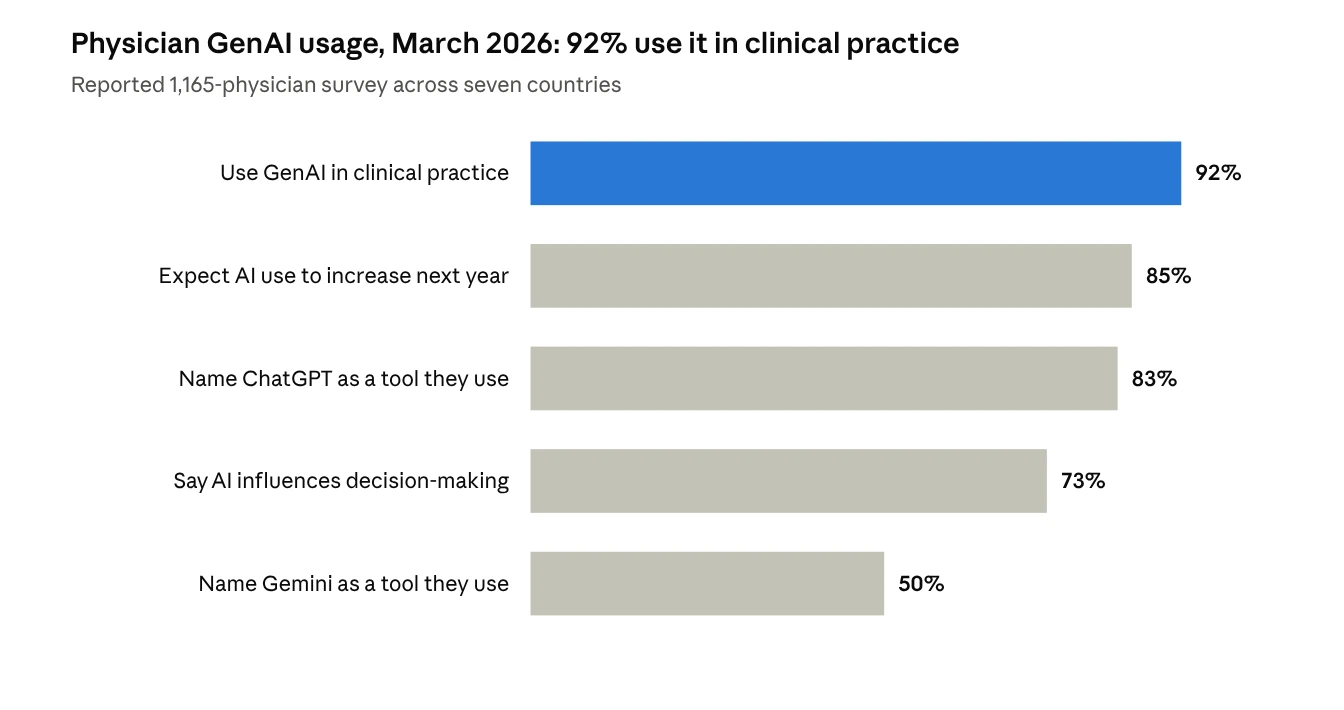
Before any brand team can act on AI visibility, a quick picture of where physicians actually are helps.
Figures from a March 2026 multi-country physician survey as reported in the trade press. Verify against the primary publication before external citing.
Reading the data like an analyst, not a marketer:
- The 92% is not a trend line. It is a baseline. GenAI usage is no longer early-adopter behaviour in clinical practice; it is the default research surface for the audience that writes the prescription.
- The 85% expecting usage to grow says the baseline keeps rising. Treating today's number as a ceiling is the strategic mistake.
- The 83% / 50% split between ChatGPT and Gemini says monitoring one engine is not monitoring the market.
- The 73% decision-influence line is the number that matters commercially. It is the bridge between AI visibility (what the engines say) and prescribing behaviour (what clinicians do).
Presence is not Recommendation. The gap is where the revenue risk lives.
A brand can be present in two out of three AI answers about its therapy area and almost never recommended in any of them. These are two different metrics measuring two different behaviours.
Presence asks: does the brand name appear at all in the answer? It is a count of mentions, blunt and generous. Any brand named in passing after three competitors scores a hit on Presence.
Recommendation asks: is the brand named as an option the user should seriously consider? It only counts the mentions that come with a recommendation verb (recommended, preferred, first-line, consider, suggested). It ignores the ones where the brand is mentioned as a comparator or a historical reference.
In commercial terms, Presence is awareness. Recommendation is intent. The gap between them is where revenue risk now lives.
Where the gap shows up: a data view by journey stage
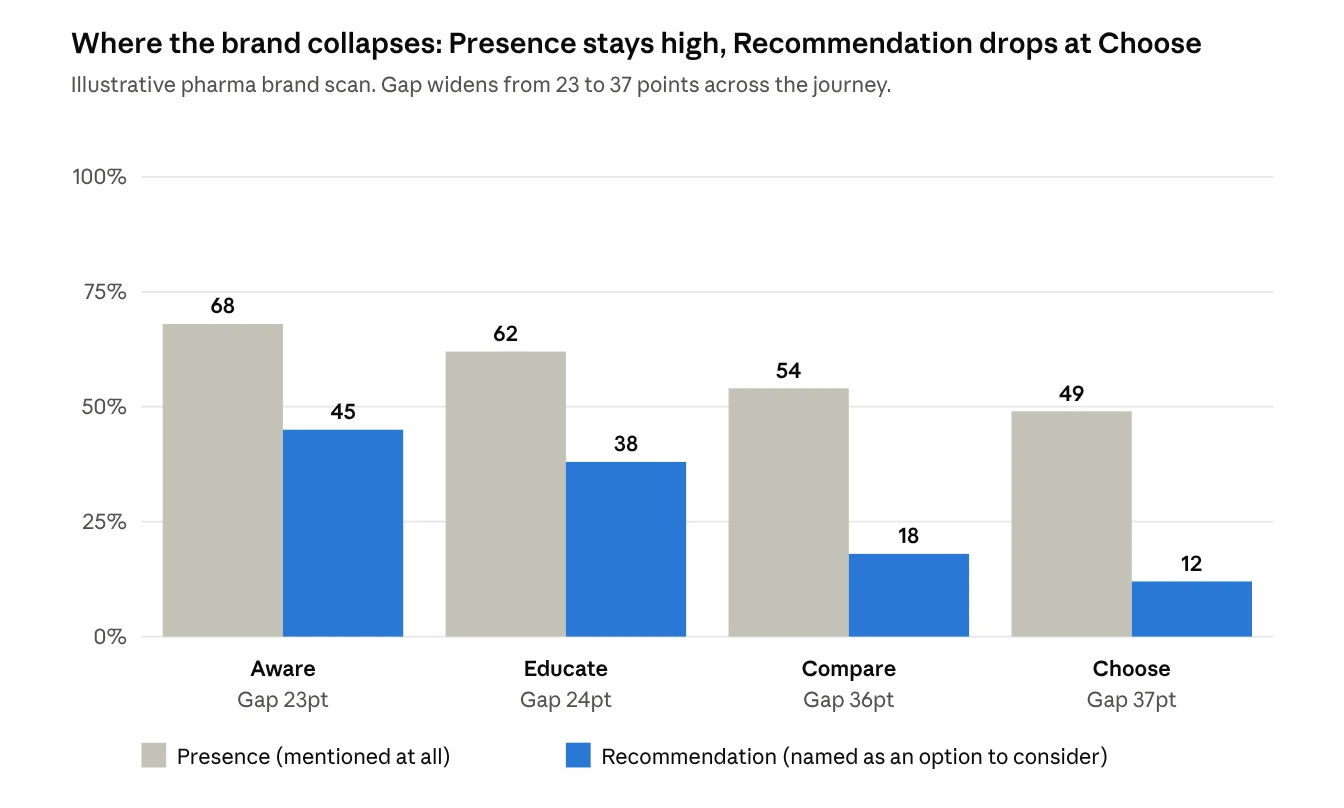
To make the gap concrete, here is a worked example. The data is illustrative, but the shape is the pattern we see repeatedly in real GEO scans.
Illustrative four-stage journey scan for a pharma brand. The shape (strong Presence, collapsing Recommendation) is the pattern Multiplier AI sees repeatedly across real scans.
What the picture is showing (data-scientist read):
- Presence looks healthy throughout. 68% at Aware, holding at 49% even at Choose. A dashboard tracking only Presence would label this brand strong across the funnel.
- Recommendation tells the opposite story. Starts at 45% at Aware and collapses to 12% at Choose.
- The gap widens. 23 points at Aware. 24 at Educate. 36 at Compare. 37 at Choose. The signature of a brand that is recognisable but not preferred at the decision point.
- Choose is where revenue sits. A collapse concentrated at the decision stages is a direct revenue signal, not a general brand concern.
GET ACTIONABLE AI AND HEALTHCARE INSIGHTS THAT HELP YOU STAY AHEAD IN A FAST-CHANGING PHARMA WORLD
Why a single blended score hides the problem
Averages hide everything a brand team needs to decide. In the illustrative scan above, the four-stage average Presence is 58% and the four-stage average Recommendation is 28%. Those two numbers will fit tidily in a quarterly dashboard. They will also keep the team focused on the wrong problem.
The actual problem is concentrated at Compare and Choose. That is where the Recommendation score is 18% and 12%. That is where an educated patient or a specialist is choosing between named options. A general AI visibility uplift campaign spends against Aware and Educate, where the brand is already healthier. The right fix spends against the stages where the gap is widest.
A working rule for brand teams: the smallest cell that still holds a meaningful decision is the cell you measure at. For most pharma brands, that cell is stage × persona. Four stages, four personas, one scan per month. Sixteen cells, each with Presence and Recommendation separately. Minimum viable measurement surface for AI visibility in 2026.
What to measure starting Monday
For a brand team that wants to stop guessing about AI visibility:
- Define the competitive set. Name every brand your reviewers would accept as a legitimate comparator. Scanning without a competitive set is scanning against nothing.
- Separate Presence from Recommendation. Two columns, not one. A single blended score is the thing you are trying to replace.
- Break down by journey stage. Four stages minimum: Aware, Educate, Compare, Choose.
- Preserve every verbatim engine response. A finding you cannot show in the engine's own words will not survive medical review.
- Set a monthly rhythm, not a quarterly one. AI visibility shifts weekly.
We were counting mentions and feeling fine. The platform showed us we were present often and recommended rarely. That gap is where our conversations now start.
Mentions and recommendations are different numbers. Measuring only the first hides the commercial risk.
Visibility collapses by stage and persona, so one blended score is misleading.
Evidence survives review when every finding links back to the exact AI answer that caused it.
Human in the loop is a feature, not a limitation. No content generation and no auto-publish is what makes it reviewable.
Frequently Asked Questions
Ready to See Similar Results?
Talk to our team about your challenges. No pitch — just a real conversation about what you need.
Schedule a 30-Minute Free Consultation →Let's Discuss Your Requirements