
One of India's largest hospital chains carries hundreds of units across tens of cities. Each unit has its own Google Business Profile, each profile has its own reviews, categories and listing drift. In September, only 878 of its profiles were verified. Four months later, with Multiplier AI's GMB chain programme, that number had crossed 3,000. Phone calls booked through Google rose 5X. Google visibility across the chain rose 8 to 10 times. And across the current reporting period, every leading engagement metric (Search Mobile, Maps Mobile, Total Searches, Phone Calls, Directions) moved
GET ACTIONABLE AI AND HEALTHCARE INSIGHTS THAT HELP YOU STAY AHEAD IN A FAST-CHANGING PHARMA WORLD
For a hospital chain operating across hundreds of units, Google Business Profile is not one profile. It is a fleet. Each unit inherits its own patient flow from local search, each unit's listing drifts independently, and each unit's reviews pile up in a different inbox. At chain scale, the problem is governance, not creativity.
The chain started the engagement with only 878 verified profiles. The rest were a mix of unclaimed listings, duplicate entries created by patients or former staff, outdated categories, missing service information, or profiles that had never been set up. Several consequences followed:
- Patients searching for "cardiologist near me" or "MRI scan near me" were seeing competitors rank for searches the chain should have owned.
- Reviews were splitting across multiple duplicate listings, so no single entity accumulated enough review authority to rank.
- Unit managers were updating their own listings inconsistently, which lowered Google's confidence in the brand as a whole.
- There was no chain-wide view of which units were performing in local search and which were invisible.
- Published 2026 local-search benchmarks show the top three map pack listings take roughly 48.1% of all local clicks (and the number one result alone has a 17.6% click-through rate). The chain was outside the top three in most of the local searches that mattered.
Across the industry, 71% of patients read reviews as their first step when finding a new doctor, and 62% of consumers avoid a business showing incorrect information. For a hospital, that is lost footfall, lost diagnostics, lost surgeries.
The chain adopted Multiplier AI's GMB chain programme. The work was governance and bulk operations, not creative writing. Four capabilities carried it.
Bulk profile verification and architecture through the Google Business Profile API. Every eligible unit location was claimed, verified and structured with the right primary and secondary categories, service lists, timings and hospital-to-department relationships. What was 878 verified profiles at the start became 3,000+ verified profiles over four months.
Duplicate consolidation and NAP consistency. Duplicates created by patients, staff or former agencies were claimed, merged or suppressed so each unit had one strong entity that accumulated its own reviews. Name, Address and Phone made identical across Google, Bing, Apple Maps and healthcare directories, with drift alerts when a unit edited something it should not.
Department-level and doctor-level profile strategy. For large multi-speciality units, department-level listings (cardiology, orthopaedics, maternity, emergency, diagnostics) were created so each department competed for its own treatment searches. Doctor-level profiles linked to the hospital entity, so consultants became findable by name and speciality.
Chain-wide dashboard and central review moderation. Rank, calls, direction requests and reviews tracked per unit in a single dashboard, ranked best to worst performing. Reviews routed centrally with unit-level response SLAs. New units follow an onboarding playbook so they launch optimised instead of taking months to catch up.
AI local search, by design. The same work that lifted Google local visibility (profile completeness, review growth, directory consistency, structured data) also feeds the four sources AI assistants draw on when they name one to three clinics in a local answer. The chain was optimising for both channels at once.
The lift is captured in three growth multiples and a broad-based period-over-period gain across every leading search metric.
The growth multiples:
- 3.4X growth in verified Google Business Profiles (878 to 3,000+).
- 5X increase in phone calls routed through Google since September.
- 8 to 10X boost in Google visibility across the chain.
The current reporting period (period-over-period, positive movements):
- Search Mobile impressions: +14.9%
- Maps Mobile impressions: +12.3%
- Total Searches: +10.7%
- Phone Calls booked: +4.7%
- Direction requests: +3.7%
Before and After
| Before | After |
|---|---|
| 878 verified Google Business Profiles | 3,000+ verified profiles (3.4X growth) |
| Duplicate listings splitting reviews across entities | One strong entity per unit, review authority consolidated |
| Unit managers editing their own listings | Chain-wide governance with drift alerts |
| Invisible on "cardiologist near me" and treatment searches | Department-level listings competing for treatment queries |
| No chain-wide view of local search performance | Single dashboard ranking every unit by performance |
| Patients routing phone calls elsewhere | 5X phone calls from Google |
Why GMB at chain scale is operationally different
A solo clinic can hand-polish one Google profile. A 500-unit hospital chain cannot. The work splits into two types that require different skill sets:
- Content work (what agencies usually sell): category setup, service lists, Q&A, Google Posts, photo refreshes, review responses. This matters, but it is 10% of the problem at chain scale.
- Governance and bulk operations (what chains actually need): API-driven updates across hundreds of units, duplicate consolidation, name and category drift alerts, anti-cannibalisation service-area mapping, department and doctor linkage, central review routing, chain-wide performance dashboards.
Most chains buy the first and wonder why their local search performance does not move. The chain in this case study bought the second. The results followed.
A second structural factor matters: the map pack is unusually concentrated. Published 2026 local-search benchmark studies show that the top three map pack listings capture roughly 48.1% of local clicks combined, and the number one result alone has a 17.6% click-through rate. Position four onwards competes for the remainder. Moving from position six to position two is not a four-place improvement; in revenue terms it is closer to a step change.
The three growth multiples
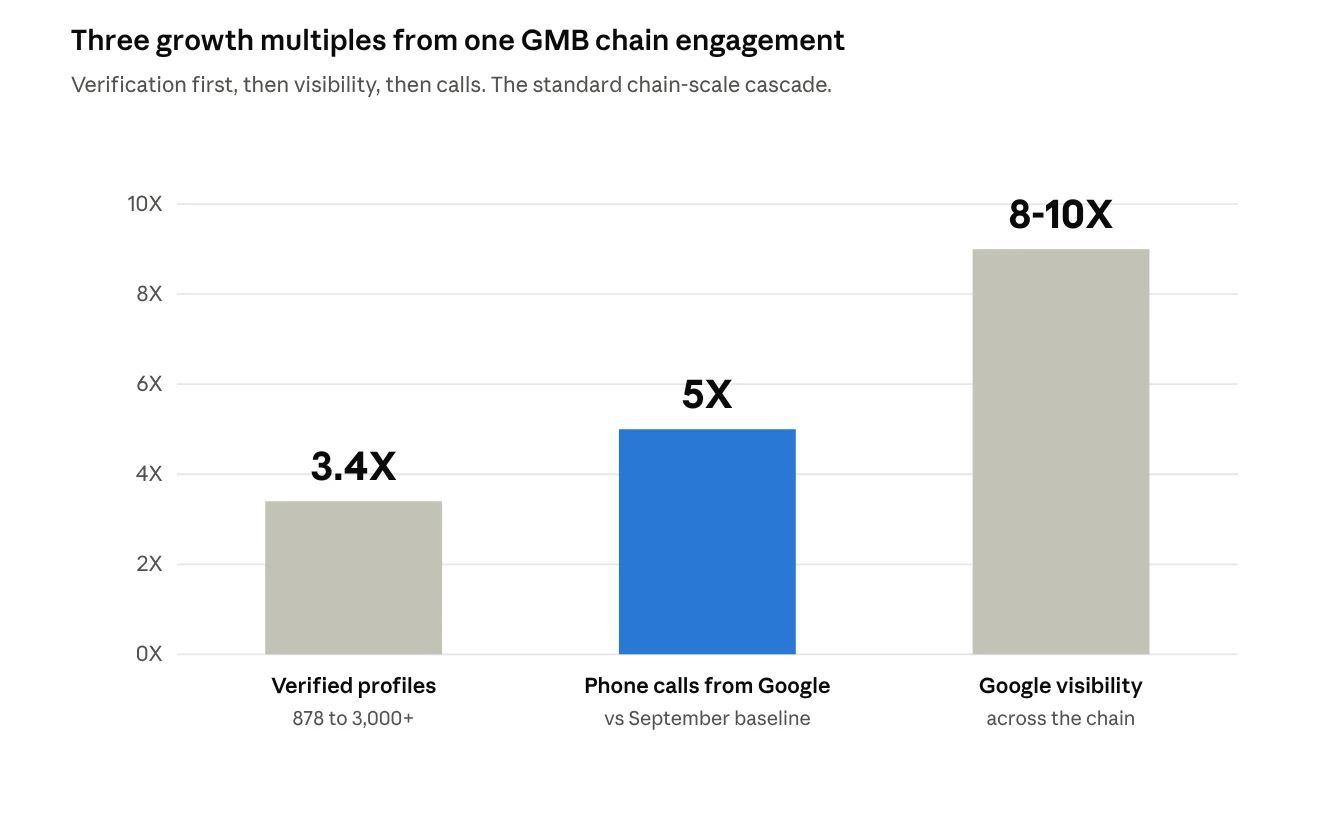
Three numbers from this engagement are worth stating together, because they capture the full chain of cause and effect.
Three growth multiples achieved in roughly four months by one of India's largest hospital chains using Multiplier AI's GMB chain programme. Figures from client-supplied reporting.
Reading the picture like a data analyst:
- 3.4X verified profiles. This is the foundation. Google's eligibility to rank a profile depends on verification; unverified profiles rarely surface on competitive queries. Scaling from 878 to 3,000+ in four months is the base layer every other metric sits on.
- 5X calls. The downstream commercial metric. Verified profiles show up in the map pack; patients see the "Call" button; calls arrive at the hospital. Multiplying verified presence by roughly 3.4X did not multiply calls by 3.4X; it multiplied them by 5X, because the new profiles were more complete, better categorised and more responsive to local search intent than the baseline average.
- 8 to 10X visibility. The leading indicator. Visibility (search impressions across Google Search and Maps) multiplied an order of magnitude because the chain's addressable surface for local queries expanded by roughly 3.4X and then each profile became individually more rankable.
The order matters. Verification first (3.4X), then visibility (8 to 10X), then calls (5X). This is the standard cascade for a chain-level GMB engagement. A programme that fails to move these three in order is not working as designed.
Why the "5X calls" number is really a routing story
A 5X increase in Google-routed phone calls is not just more phones ringing. It is a change in which calls arrive at which unit.
Before the engagement, a patient searching for a condition would often land on a competitor's listing, call them, and walk through their door. Of the patients who did find a unit in the chain, many hit a duplicate listing with the wrong phone number, dialled it, got a dead line, and gave up. Across the industry, 62% of consumers avoid a business showing incorrect information. For a hospital chain, that is directly lost footfall per day.
After the engagement, verified profiles carried the right number for the right unit, department-level listings routed cardiology queries to cardiology and emergency queries to emergency, and the chain-wide dashboard showed in near real time which units were converting search impressions into calls and which needed category or review intervention.
The 5X is the net effect of three operational fixes compounding:
- More units actually surfacing in the map pack.
- Fewer calls lost to wrong-number duplicates.
- Better department-level matching between patient intent and unit specialty.
Period-over-period performance snapshot
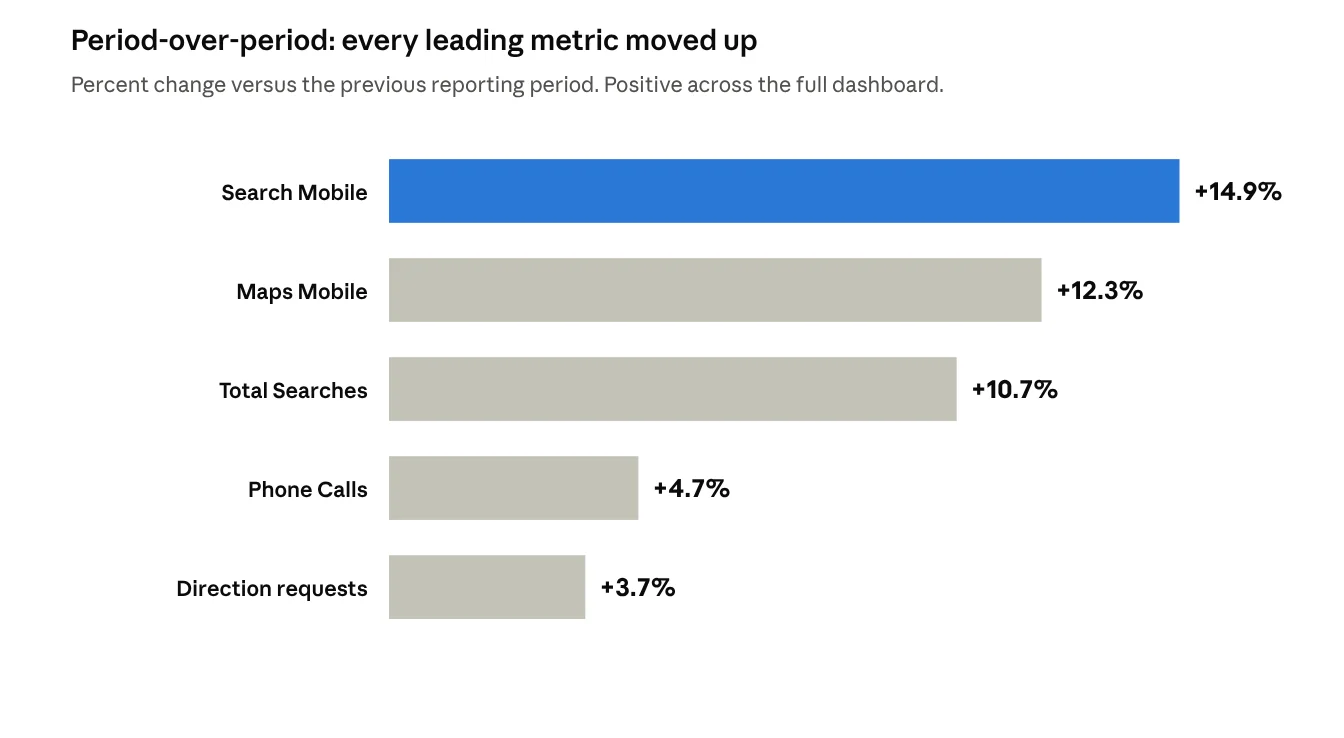
Beyond the multi-month growth multiples, the current reporting period shows a broad-based lift across every leading engagement metric versus the period immediately before. For a chain this large, that broad-based consistency is the hard part. Many programmes deliver a spike in one metric and a drop in another; this one delivered positive movement across the full dashboard.
Current reporting period, positive movements only. Broad-based lift across every leading engagement metric is the signal that the underlying governance work is intact.
Reading the picture like a data scientist:
- Search Mobile +14.9% is the standout. Mobile search is where new patient queries now originate; growing it in double digits means the chain is reaching more first-time intent, not just serving existing patients.
- Maps Mobile +12.3% mirrors it. Patients using Google Maps for "hospital near me" or "pharmacy near me" are in direct-intent mode. This lift converts almost directly into footfall.
- Total Searches +10.7% confirms the reach expansion is real, not a single-channel artefact. All search surfaces are moving up together.
- Phone Calls +4.7% is the conservative conversion signal. In healthcare, not every search becomes a call; many patients self-navigate to the clinic or book through a partner. 4.7% monthly growth on top of a 5X four-month base is sustained performance, not a one-time spike.
- Directions +3.7% is the physical-world indicator: patients tapping "Get Directions" from a verified profile. Steady monthly growth here reflects actual visits.
What a broad-based positive print tells you. A healthy GMB programme shows gains across both impression metrics (Search, Maps) and action metrics (Calls, Directions). The absence of any single-metric collapse is the signal that the underlying governance work (verification, category accuracy, NAP consistency, review routing) is intact. One-metric success stories are usually artifacts.
GET ACTIONABLE AI AND HEALTHCARE INSIGHTS THAT HELP YOU STAY AHEAD IN A FAST-CHANGING PHARMA WORLD
Why this matters for AI local search, not just Google
A shift worth being direct about: the same four sources that decide Google local rankings now decide AI local answers. When a patient asks ChatGPT, Gemini, Copilot or Perplexity for "the best hospital near me for X," the assistant builds its answer from four inputs:
- Google Business Profile data (categories, services, hours, attributes, reviews).
- Third-party review platforms.
- Directory and "best of" listings.
- LocalBusiness and MedicalClinic structured data on the hospital's website.
It then names only one to three businesses. Reported figures put AI usage for local search rising from around 6% in 2025 to roughly 45% in 2026. There is no page two in an AI answer. The hospitals not named are invisible on that query.
The chain-level GMB work in this engagement is therefore doing two jobs at once. It is lifting Google local search performance today, and it is positioning the chain to be in the small set of hospitals named by AI assistants as those queries grow.
One uncomfortable detail worth saying plainly: a hospital's own marketing copy is the least influential of the four sources an AI assistant uses. Verified profile data, third-party reviews and structured data (what others verifiably say about the hospital) carry more weight than any c
If you run a hospital chain, clinic group or multi-location practice, audit these on Monday
The GMB chain programme is a fit for any multi-location healthcare operation facing one or more of the structural issues below. A one-week audit surfaces most of them:
- Verified profile ratio. Count the verified profiles against the total units. If the ratio is below 80 percent, the chain is invisible on most local queries by default.
- Duplicate audit. Pull every listing on Google that carries your brand name or a variant. Duplicates split review authority across entities and lower ranking signal for every one of them.
- NAP consistency scan. Pick 20 units and compare Name, Address and Phone across Google, Bing, Apple Maps, Practo, JustDial and your own website. Any mismatch across channels tells Google and AI assistants to trust you less.
- Department-level profiles. For large multi-speciality units, check whether you have separate listings for the departments patients actually search for (cardiology, orthopaedics, emergency, maternity, diagnostics). Without them you rank only for your hospital name, not for treatment queries.
- Review distribution and response SLA. Count reviews per unit and measure response time. In hospitals, review recency and response rate are both ranking and trust signals.
- Structured data on the website. Confirm that LocalBusiness and MedicalClinic schema is implemented per unit. This is the fourth source AI assistants use when they name hospitals.
The chain in this case study ran this audit at the start of the engagement and used the gaps as the sequencing plan. The 3.4X verified-profile growth was the first result of acting on item 1.
This programme is built for hospital chains, branded clinic groups (dental, eye-care, dermatology, IVF, dialysis, diagnostics), multi-speciality hospitals, and polyclinic networks. For solo practitioners and single-site clinics, the GMB solo plan applies instead.
The market data behind the case
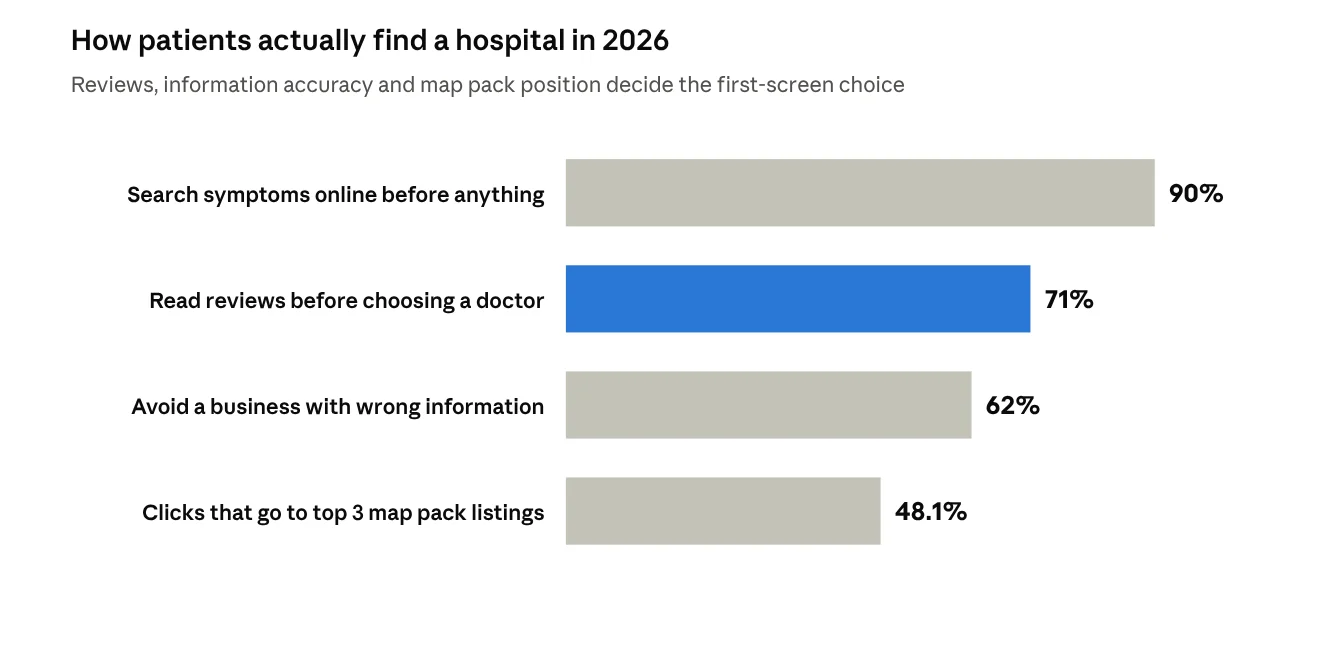
Three industry benchmarks explain why chain-scale GMB work is worth the investment now, not later. Each number reinforces why the growth multiples above are not a one-off, they are a market pattern.
The local search market is top-heavy.
Published 2026 local-search benchmark studies, summarised on the Multiplier AI GMB product page.
The top three map pack listings capture roughly 48.1 percent of all local clicks. The number one position alone wins 17.6 percent CTR. Everything from position four down fights for the remaining half. For a multi-location hospital chain, this is the single most important demand-side fact. Being outside the top three for a given treatment query in a given catchment is the same, in revenue terms, as not existing on that query.
Patient search behaviour is review-first and accuracy-first.
Patient search behaviour benchmarks from published 2026 studies, summarised on the Multiplier AI GMB product page.
Over 90 percent of patients search their symptoms online before booking. 71 percent then read reviews before choosing a doctor. 62 percent walk away from a business that shows wrong information. For a hospital, this means the GMB listing is the sales floor; reviews are the sales conversation; and correct timings, phone numbers and department categories are the price tag. All three have to be right or the patient goes to a competitor.
AI local search is the fastest channel shift of 2026.
Reported AI usage for local search, 2025 to 2026. Figures summarised on the Multiplier AI GMB product page.
Reported figures put AI usage for local search at around 6 percent in 2025 and roughly 45 percent in 2026, a 7.5X jump in one year. When a patient asks ChatGPT, Gemini, Copilot or Perplexity for the best hospital near them, the assistant names only one to three businesses, drawn from Google Business Profile data, third-party reviews, directory listings and LocalBusiness schema. Hospitals not in that set are invisible on the channel that is growing fastest. The chain-wide GMB programme is the single intervention that improves standing on both channels at once.
Our Google Business Profile performance has seen remarkable growth since September. We started with just 878 verified profiles, and today we have successfully scaled to 3,000+ verified profiles. This growth reflects consistent efforts towards profile verification, optimisation and performance improvement, helping us build a stronger digital presence and connect with more potential patients.
GMB at chain scale is a governance problem, not a creative one. The work is verification, duplicate consolidation, NAP consistency and department-level architecture.
The cascade is predictable: verified profiles first, then visibility, then calls. This engagement moved 3.4X, 8 to 10X, and 5X in that order.
A healthy chain programme shows positive movement across every leading metric (Search, Maps, Calls, Directions), not a spike in one and a drop in another.
The same work that wins Google local search also feeds AI local answers, where assistants now name only one to three hospitals per query.
Frequently Asked Questions
Ready to See Similar Results?
Talk to our team about your challenges. No pitch — just a real conversation about what you need.
Schedule a 30-Minute Free Consultation →Let's Discuss Your Requirements