

The WHO projects a 11.1 million global health-worker shortfall by 2030. Demand is not the problem for an international recruitment agency. Finding, verifying and lawfully approaching the right clinicians is. One international healthcare staffing firm was placing physicians into UK Trusts and Gulf ministries that audit every candidate's data provenance. Its bought contact lists could not pass that scrutiny. With Multiplier AI's SE platform, it replaced the list with a 474,000-physician universe where every enriched field carries its source and timestamp, and started defending every candidate at client audit.
GET ACTIONABLE AI AND HEALTHCARE INSIGHTS THAT HELP YOU STAY AHEAD IN A FAST-CHANGING PHARMA WORLD
The firm placed physicians across borders into Trusts, ministries and hospital groups. Those clients audit how candidates were identified. “We bought a list” is not an answer that passes.
The demand side was structural and growing: the WHO's September 2026 health-workforce release projects a global shortfall of 11.1 million clinicians by 2030, with roughly 1 in 4 doctors globally over 55 and 1 in 3 in high-income destination countries. 67 countries are already flagged as unable to meet population health needs by 2030.
Against that demand, the firm faced four operational problems:
- A large legacy candidate database nobody could rate for usability.
- Bought contact lists that claimed 100 percent verified emails but could not prove any of it at audit.
- No source-country exposure visibility until a client compliance review pointed it out.
- A WHO Global Code that was amended on 29 May 2026 (now including care workers and emergency contexts), with the UK Code naming 48 red-list countries that must not be actively targeted plus 2 amber (Kenya and Nepal) that permit recruitment only under government-to-government agreement.
The firm deployed Multiplier AI's SE platform. It is a verification-first sourcing universe built for regulated use. Four capabilities carried the work.
A 474,000-doctor universe, keyed on one identifier. Every record resolves to one physician across identity, credentials, affiliation, publications, trials and digital footprint. Profiles are filtered by specialty, geography, experience band, publication count, trial involvement and digital presence, and ranked by data richness so the most actionable records surface first.
Provenance on every enriched value. Every enriched field stores the source it came from and the date it was written. When a Trust or ministry asks how a candidate was identified, the audit trail already exists. Enrichment fills empty fields only. The firm's verified placement records are preserved and never overwritten.
A strict verification gate on contact data. Free-mail addresses are accepted only on an exact match against an authoritative page. Any address that maps to more than one doctor is dropped entirely. The pool of verified email is smaller, but every address is defensible. Unverified addresses are kept as flagged candidates, not promoted as truths.
Country-first design for code-aware recruitment. Country, state and city are first-class fields on every profile. Source-country exposure under the WHO Global Code and the UK Code is visible at the filter stage, before a list is built, not at client compliance review.
Scope boundary: SE surfaces the geography and provenance recruiters need to apply the WHO and UK codes. It does not maintain the red and amber lists, perform primary source verification, or assess any individual's eligibility to practise in a destination country. Those remain the recruiter's obligations.
The firm started with the cleaning offer on 5,000 legacy records to prove the method against data it already understood. The before-and-after was decisive, and gave the leadership team the evidence they needed to licence the universe for new sourcing.
What changed:
- Every record placed in front of a client carried a visible audit trail.
- Clinic details were filled on approximately 99.6% of records in the pilot cohort.
- A social or digital profile was found for approximately 93% of records.
- Verified email coverage settled at around 7%, lower than the bought list claimed, trustworthy for the first time.
- Source-country exposure under the WHO and UK Codes became visible at the filter stage.
Before and After
| Before | After |
|---|---|
| Bought contact list with no provenance | Source and timestamp on every enriched field |
| Legacy database of unknown usability | Audit-and-impact report on 5,000-record pilot |
| Every email presented as equally verified | Verified email gate (~7%), unverified flagged |
| Source-country exposure found at client review | Country on every profile, visible at filter stage |
| Enrichment that overwrote verified data | Fill-only; original values preserved |
The demand side is structural: the shortage is baked in
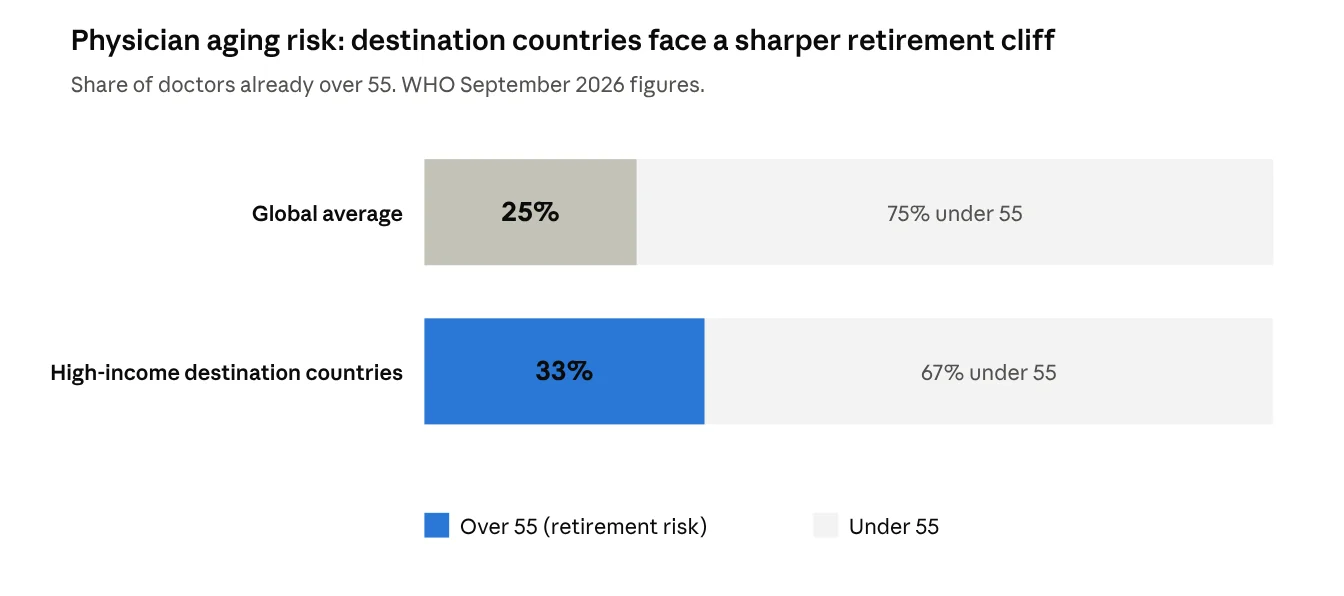
Before any sourcing strategy, a quick look at the demand side. The clinician shortage is not a cyclical labour-market story. It is structural, and the destination countries are most exposed.
Physician aging by country tier. Figures summarised from WHO's September 2026 health-workforce release (122 countries). Destination markets for international recruitment carry a materially sharper retirement cliff.
Reading the picture like a demographer:
- Global baseline: 25 percent of doctors over 55. One in every four clinicians is within ten years of standard retirement age. The global pipeline is not replacing this cohort fast enough.
- Destination-country bias: 33 percent over 55. The UK, Germany, Australia, Canada, Gulf region and other prime destinations for international recruitment carry a sharper retirement cliff. 1 in 3 doctors in those systems is approaching retirement.
- 67 countries flagged. WHO identifies 67 countries that will be unable to meet their population health needs by 2030 at current trajectories. These are a mix of source and destination markets.
- 11.1 million projected shortfall by 2030. The headline number is the net of attrition, population growth and training throughput.
What it means for a recruiter. The commercial opportunity is not going away. Every structural indicator points to multi-decade demand. The constraint moves from finding willing candidates to proving where the data about them came from when a client or regulator asks.
The WHO 2026 Code: what changed and why it matters
The WHO Global Code of Practice on the International Recruitment of Health Personnel was amended on 29 May 2026 to cover care workers and to apply during emergencies. Its Support and Safeguards List identifies countries where active international recruitment should be avoided. Passive recruitment, where a clinician responds to a published vacancy, remains permitted.
The UK Code adopts that list directly: 48 red-list countries that must not be actively targeted, plus 2 amber-list countries (Kenya and Nepal) where recruitment is permitted only under a government-to-government agreement.
Two operational facts follow:
- Country is now a compliance field, not a demographic one. It decides whether a given sourcing action is permitted, not just where a candidate lives.
- Proof of consent and provenance is a client-audit requirement, not a nice-to-have. Trusts and ministries ask how candidates were identified, and “we bought a list” fails the question.
The gap most recruitment stacks still have. Most legacy sourcing databases treat country as a search filter and treat contact data as homogeneous. Under the 2026 Code, both assumptions are unsafe. Country must drive what can be done. Contact data must come with a story.
The honest number: why 7 percent verified email is a feature
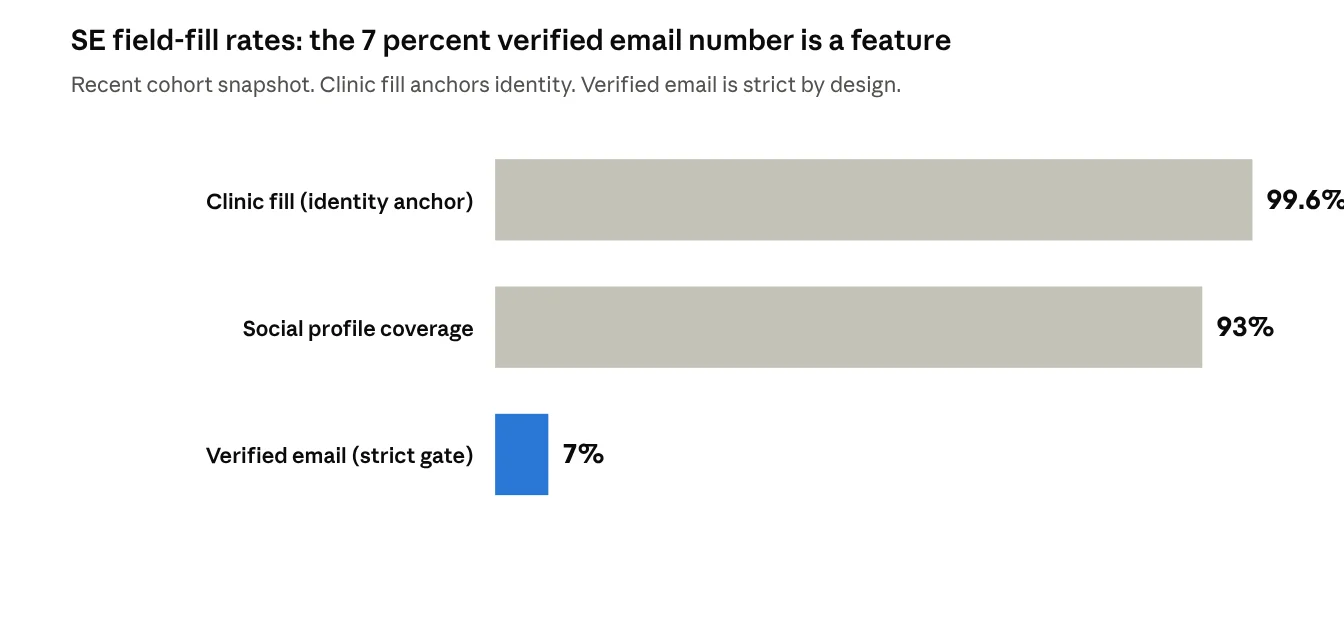
Most HCP databases sold to recruiters are contact lists: a name, a specialty and an email of unknown age. SE is the opposite: a verification-first sourcing universe. The practical shape of that choice shows up in the field-fill numbers on a recent cohort.
SE field-fill snapshot on a recent cohort. The low verified-email number is the verification gate working as designed; it is what makes the universe defensible at client audit.
Reading the picture like a data scientist:
- Clinic fill: 99.6 percent. Every physician record resolves to a current clinic or institution. This is the identity anchor.
- Social coverage: 93 percent. LinkedIn, Doximity or a published professional presence found for almost all records. These are approach routes that do not require holding an email address.
- Verified email: 7 percent. Deliberately low. Free-mail addresses are accepted only on an exact match against an authoritative page. Any address that maps to more than one doctor is dropped entirely. What remains is defensible at audit.
What this says about the design choice. A bought list that claims 100 percent verified emails is almost always wrong. The question an auditor asks (how do you know this email belongs to this doctor?) collapses the claim. SE answers that question with evidence on every enriched value.
The business implication. Fewer contactable emails, far more defensible records, and multiple approach routes (digital, institutional, referral, published vacancy) rather than dependence on a single field. For a recruiter whose clients audit, this is the trade worth making.
GET ACTIONABLE AI AND HEALTHCARE INSIGHTS THAT HELP YOU STAY AHEAD IN A FAST-CHANGING PHARMA WORLD
Two front doors: clean your own database first, licence the universe second
Most agencies start with the cleaning offer. It is cheaper, it proves the method on data they already understand, and it usually finds more placeable candidates than a new list does.
This recruiter sent 5,000 legacy records through the SE cleaning pipeline: audit, duplicate check, enrichment from public sources, and a before-and-after impact report. The output clarified what proportion of the legacy database was still usable and which specialties and corridors were under-represented.
Approved cleaned records then loaded into SE, and the universe licence followed once the leadership team had seen the pilot report. The sequence matters: it replaces a procurement debate with an evidence-backed decision.
Scope boundary again, because it is important. SE surfaces the geography and provenance recruiters need to apply the WHO and UK codes. It does not maintain the red and amber lists, perform primary source verification, or assess any individual's eligibility to practise in a destination country. Those remain the recruiter's obligations and their clients'.
What to audit starting Monday
For an international recruiter who suspects the same gap but is not sure, a week-long audit surfaces most of it:
- Pull 50 recent placements and ask the simple question: can we show a client where every data point on each candidate came from and when? If not, the provenance layer is missing.
- Count red/amber exposure. Sample 500 records and tag their source country against the UK Code list. Any share above 5 percent on the red list is an immediate compliance exposure.
- Spot-check the verified email field. Pick 20 "verified" emails and test deliverability. A bounce rate above 10 percent on verified addresses means the verification is not what the vendor claims.
- Check for enrichment overwrites. For 50 placed candidates, compare the current database value against the record you originally created. Any overwrite of a known-good field by enrichment is data loss.
- Review credential coverage. Pick 100 records and check whether a registration or licensing identifier (national provider number, council registration) is present. Records without a credential anchor are not candidates, they are contacts.
We stopped selling our clients a verified email number we could not defend. SE gave us a smaller, truer pool and a story we could tell at audit.
The 11.1M clinician shortfall by 2030 is structural; the constraint shifts from supply to defensible sourcing.
Under the WHO 2026 Code, country becomes a compliance field, not just a filter. It belongs on every record.
A 7 percent verified-email rate under a strict gate beats a 100 percent claim that cannot be defended.
The cleaning pilot proves the method on data the recruiter already understands, before any universe commitment.
Frequently Asked Questions
Ready to See Similar Results?
Talk to our team about your challenges. No pitch — just a real conversation about what you need.
Schedule a 30-Minute Free Consultation →Let's Discuss Your Requirements