
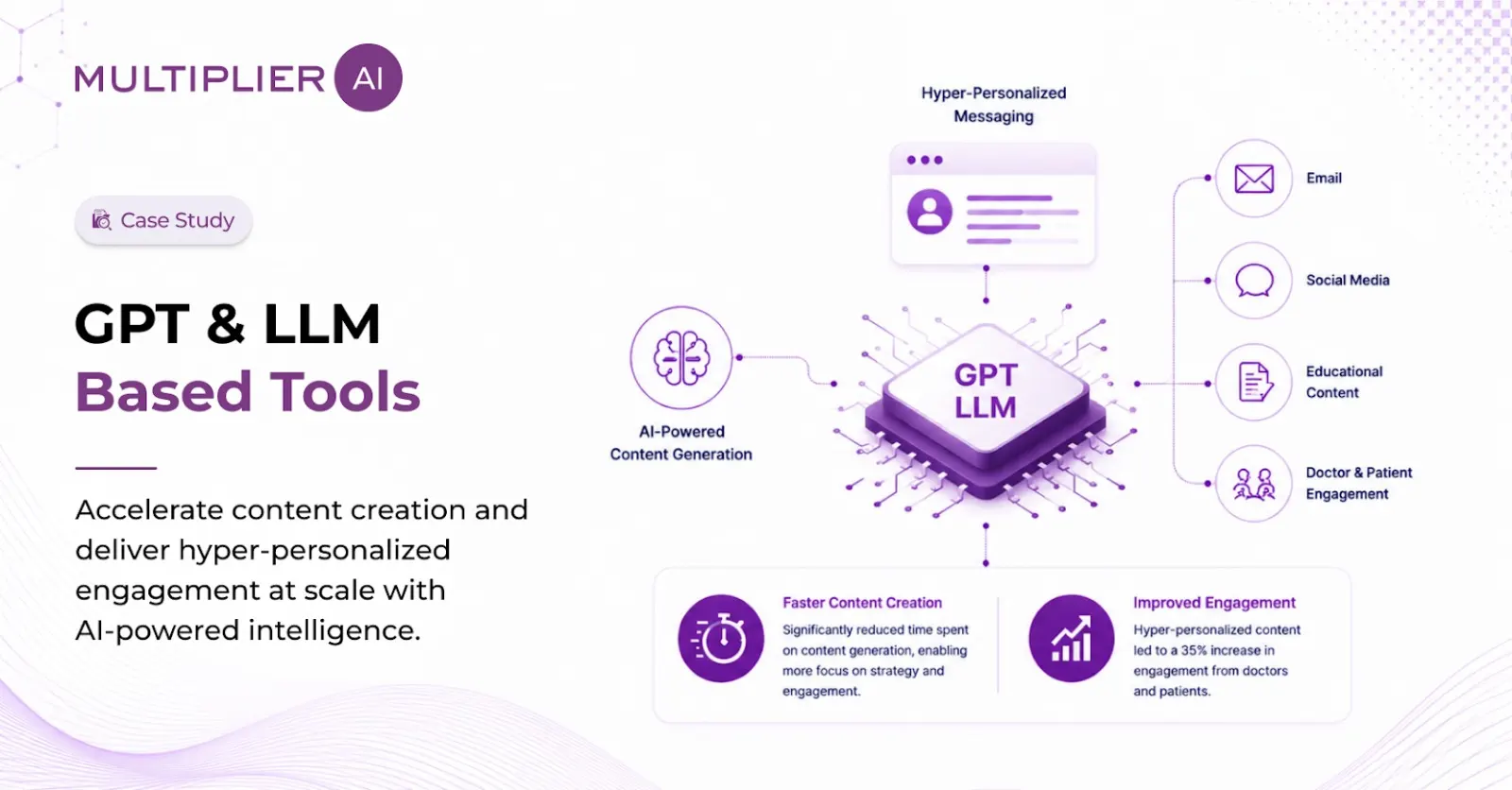
A leading pharmaceutical company was producing every email, social post, and educational asset by hand — and it couldn’t keep up. Manual content creation was slow, expensive, and too generic to stand out, so engagement from doctors and patients kept slipping. Using Multiplier AI’s GPT & LLM-based tools, the company automated the heavy lifting: AI assembled approved, medically accurate content into hyper-personalized messages for each audience and channel, and a Virtual Medical Affairs Assistant turned campaign data into insights on demand. Content that once took weeks shipped in days, the team shifted its time from production to strategy, and engagement from doctors and patients rose 35%.
The company’s marketing ran on manual content production. Every campaign meant writing emails, social posts, and educational material from scratch, routing each through review, and repeating the cycle for every audience. It was slow, costly, and hard to scale — and the output was too generic to cut through.
- Slow to produce — building a single campaign’s content set took weeks, delaying launches and limiting how often the team could engage.
- Generic by default — with limited time, content was one-size-fits-all, so it rarely matched a specific doctor’s speciality or a patient’s context.
- Falling engagement — generic material drove lower open, read, and response rates from both HCPs and patients.
- Hard to scale across channels — producing tailored variations for email, social, and educational content, for many audiences, simply wasn’t feasible by hand.
- Time lost to production, not strategy — skilled marketers spent their days writing and reworking copy instead of planning engagement.
The company needed a faster, more personalized way to create compliant content — at a scale manual work could never reach.
The company deployed Multiplier AI’s GPT & LLM-based tools — pharma-tuned AI that generates and assembles content from approved sources, personalizes it per audience, and turns data into insight, all within healthcare compliance guidelines.
Four capabilities did the work:
- AI-assisted content generation — emails, social posts, and educational content drafted in minutes from approved, medically accurate source material — not from a blank page.
- Hyper-personalized messaging — the tools use data insights to tailor each message to the audience’s needs and preferences, across channels.
- Virtual Medical Affairs Assistant — a chat interface that translates campaign and competitor data into actionable advice in real time, and turns raw data into clear visuals.
- Compliance built in — outputs stay grounded in approved content and aligned with global healthcare guidelines, with human review where it matters.
Because the tools assemble approved modular content rather than inventing claims, output is both fast and defensible. They run on the same clean, consented data as Multiplier AI’s GenAI Doctor Data Platform and plug into hyper-personalized, omnichannel delivery.
Within weeks, content stopped being the bottleneck.
- 35% more engagement — hyper-personalized content lifted engagement from doctors and patients by 35%.
- Dramatically faster content — campaign content sets that took weeks shipped in days (≈7× faster, illustrative).
- More content, same team — AI assembly let the team produce far more tailored variations per cycle without adding headcount.
- Time shifted to strategy — with production automated, marketers spent the majority of their time on targeting and engagement, not copy rework.
- Compliant by default — every asset stayed grounded in approved content and healthcare guidelines.
Faster, more relevant content didn’t just save time — it changed how often and how well the company could engage its audiences.
Why Manual Content Creation Can’t Keep Up
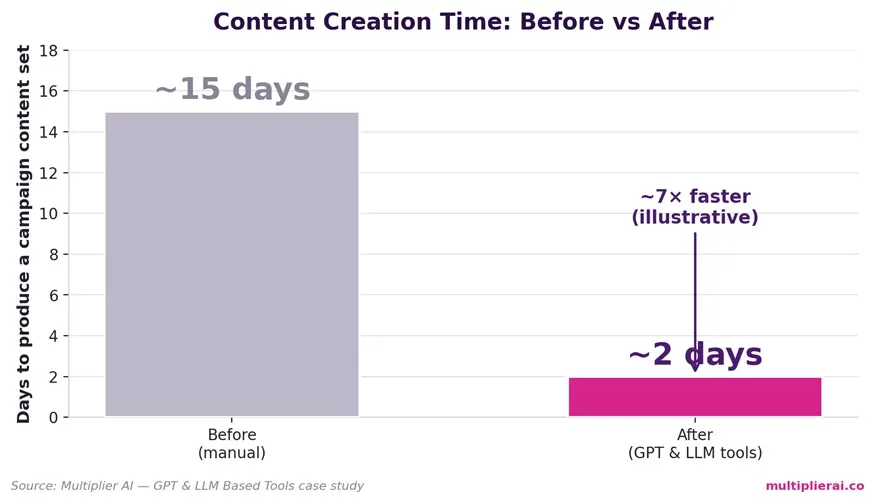
Pharma marketing teams are asked to produce more content, for more audiences, across more channels — while every asset still has to be accurate and compliant. Done by hand, that maths doesn’t work. A single campaign’s content set can take weeks to write and review, which limits how often a brand can engage and forces teams toward generic, one-size-fits-all material. The bottleneck isn’t creativity; it’s production capacity.
What GPT and LLM Tools Do for Pharma Marketing
Multiplier AI’s GPT & LLM-based tools are tuned for pharma, not generic copywriting. They draft emails, social posts, and educational content from approved source material; personalize messaging per audience; and include a Virtual Medical Affairs Assistant that answers questions from campaign to competitor analysis and turns raw data into clear visuals. Every interaction is designed to respect global healthcare guidelines, so speed never comes at the cost of compliance.
Content Assembly, Not Just Creation
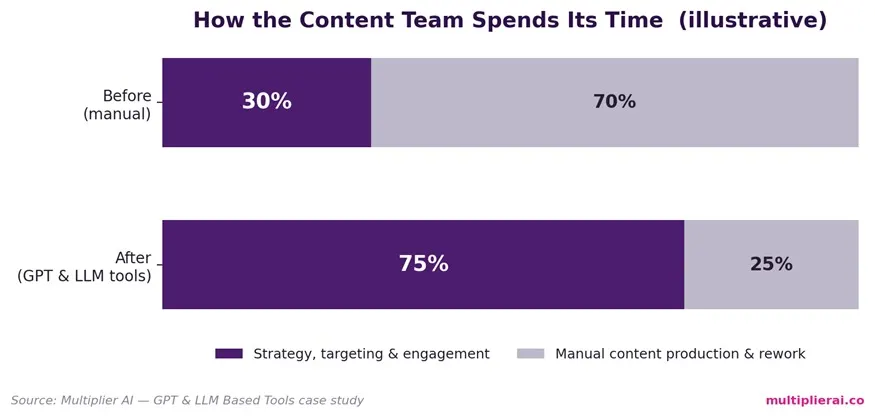
The speed comes from a shift in method: from writing each asset from scratch to assembling MLR-approved modular content. Headlines, summaries, data points, and calls to action are pre-approved once, then recombined into relevant variations for each audience and channel. This is the same principle behind Multiplier AI’s medical writing and pharma content generation — fast output that stays defensible. The result is a team that spends far less time on production and far more on strategy.
From Faster Content to Higher Engagement
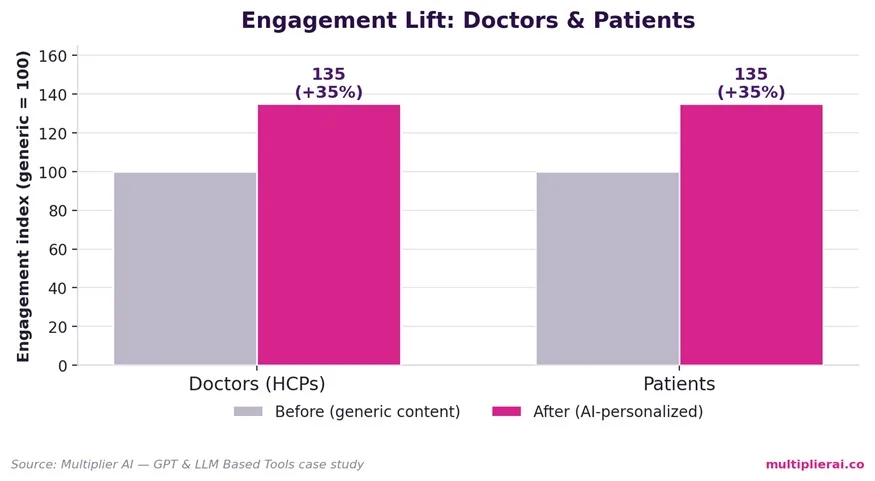
Speed matters because it unlocks relevance. When content can be produced quickly, it can be tailored to each audience instead of broadcast generically — and relevant content gets engaged with. For this company, AI-personalized content lifted engagement from both doctors and patients by 35%.
Compliant, Data-Grounded, and Built for Pharma — Why Multiplier AI
AI content is only useful in pharma if it is accurate, compliant, and grounded in real data. Multiplier AI keeps outputs anchored to approved source content, aligned with DPDP and healthcare guidelines, and built on clean, consented HCP data. It is privately deployed, healthcare-only, and designed to deliver measurable results within 30 to 60 days. Explore more AI solutions for pharma companies or browse other Multiplier AI case studies.
“Our team went from writing every email by hand to shipping personalized campaigns in days. The same people now spend their time on strategy, not production.”
Manual content can’t scale — producing tailored content by hand is too slow and too generic to keep engagement up.
Assembly beats creation — GPT & LLM tools recombine approved, compliant modules instead of writing from scratch, so output is fast and defensible.
Speed unlocks relevance — faster production means content can be personalized per audience and channel, lifting engagement 35%.
AI frees people for strategy — automating production shifts skilled marketers from copy rework to targeting and engagement.
Ready to See Similar Results?
Talk to our team about your challenges. No pitch — just a real conversation about what you need.
Schedule a 30-Minute Free Consultation →Let's Discuss Your Requirements