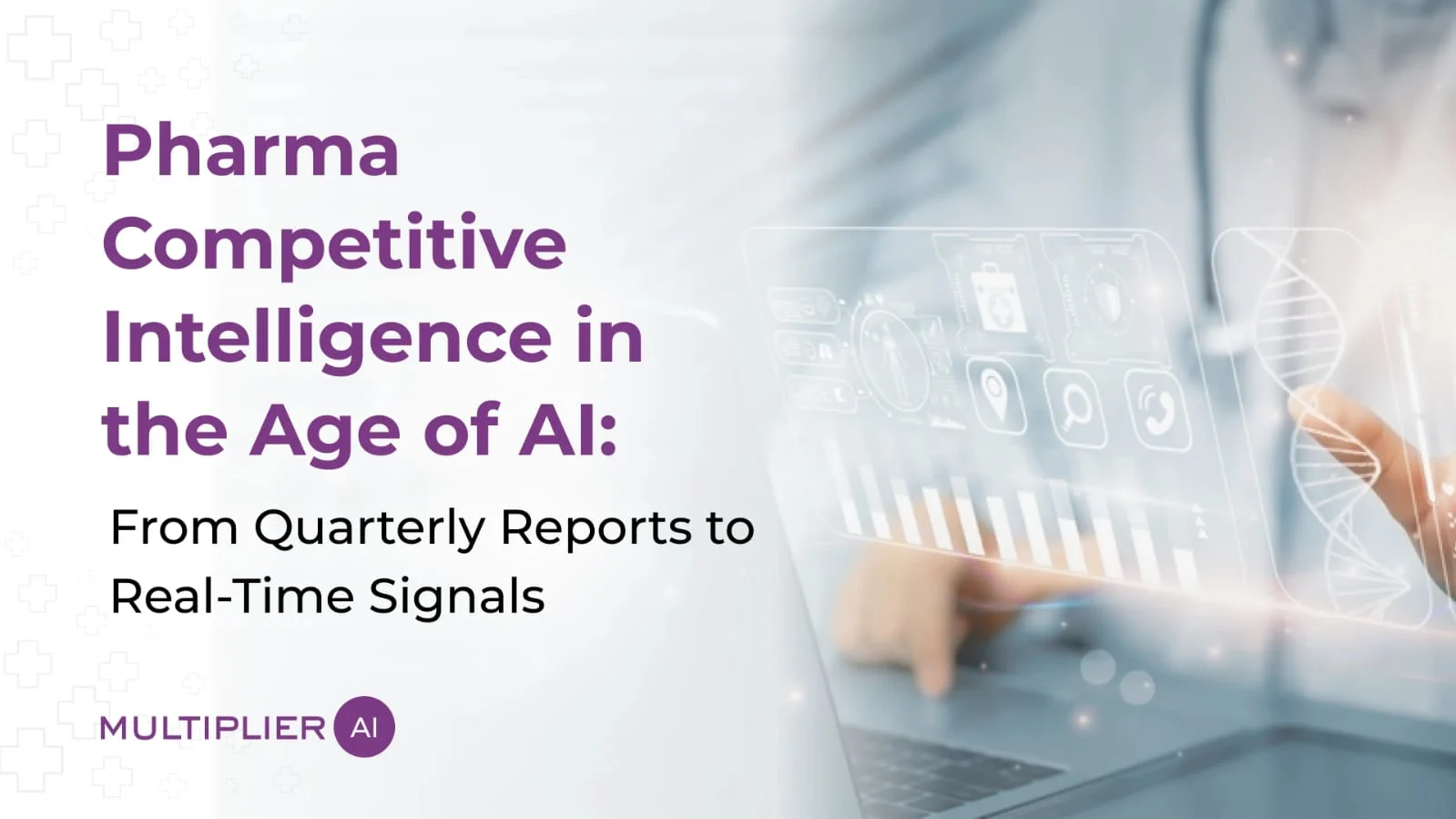
Pharma Competitive Intelligence in the Age of AI: From Quarterly Reports to Real-Time Signals
Pharma competitive intelligence AI is changing a function that has always been critical: understanding what competitors are doing, how markets are shifting, and where opportunities exist has a direct impact on commercial success. Yet despite its importance, the way competitive intelligence is executed in many organizations has not evolved at the same pace as the market itself. Most teams still rely on periodic reports — quarterly updates, slide decks summarizing competitor activity, and retrospective analyses dominate the process. These reports are often detailed and well-researched, but they share a common limitation: they are static. This is why pharma competitive intelligence AI is becoming important for teams that need faster visibility into competitor activity, market shifts, and HCP behavior.
By the time insights are compiled, validated, and distributed, the situation on the ground has already changed. Competitor strategies evolve, new data emerges, and market dynamics shift. This creates a gap between insight and action. Teams have access to information, but not at the speed required to make timely decisions.
What Is AI-Driven Pharma Competitive Intelligence?
AI-driven pharma competitive intelligence is the process of using artificial intelligence to continuously monitor internal and external market signals, detect competitor activity, identify meaningful patterns, and convert those signals into actionable commercial, medical, or strategic decisions.
Unlike traditional competitive intelligence, which often depends on quarterly reports and retrospective analysis, AI-driven competitive intelligence focuses on real-time signals such as prescribing shifts, digital engagement patterns, clinical trial updates, regulatory filings, competitor messaging, field feedback, and market activity.
The Shift from Information to Signal
The core problem with traditional competitive intelligence is not the lack of data. It is the inability to identify and act on meaningful signals quickly. In today's environment, relevant information is generated continuously. Doctors change prescribing patterns. Competitors adjust messaging. Clinical data is released. Digital engagement reveals shifts in interest. Regulatory filings provide early indications of future moves. Each of these events represents a signal. Individually, they may seem insignificant. Together, they form patterns that can reveal important insights.
Table 1: AI Signal Types in Pharma Competitive Intelligence
| Signal Type | Example |
| Prescribing signal | Competitor drug usage rises in one region |
| Engagement signal | HCPs suddenly respond more to a specific disease topic |
| Messaging signal | Competitor starts emphasizing a new claim or benefit |
| Regulatory signal | Filing or label update suggests upcoming market activity |
| Scientific signal | New clinical data changes the evidence narrative |
| Field signal | Reps report repeated competitor objections |
| KOL signal | Influential doctors discuss a competitor therapy more often |
| Access signal | Tender, formulary, or reimbursement changes affect competition |
The challenge is that these signals are often buried within large volumes of data. Traditional approaches are not designed to capture and interpret them in real time. This is where AI changes the equation. Real-time competitive intelligence in pharma helps teams move from retrospective reporting to continuous signal detection and faster commercial response.
What Real-Time Competitive Intelligence Actually Means
Real-time competitive intelligence is not about monitoring everything all the time. It is about identifying the signals that matter and translating them into actionable insights. This requires a different approach. Instead of collecting data and analyzing it periodically, organizations need systems that continuously process information and highlight changes that require attention. For example, a sudden shift in prescribing behavior within a specific segment may indicate increased competitor activity, while a change in digital engagement patterns may suggest that a competitor's messaging is gaining traction. These insights need to be surfaced quickly. The goal is not just awareness, but action. AI competitive intelligence pharma workflows should connect signals to owners, recommended actions, and measurable outcomes. Teams should be able to respond to changes as they happen, rather than reacting after the fact.
Table 2: Traditional Competitive Intelligence vs AI-Driven Competitive Intelligence
| Area | Traditional Competitive Intelligence | AI-Driven Competitive Intelligence |
| Frequency | Quarterly or periodic updates | Continuous monitoring |
| Output | Reports, slide decks, retrospective summaries | Real-time signals, alerts, recommendations |
| Data handling | Manual research and analysis | Automated signal detection across multiple sources |
| Speed | Slow insight distribution | Faster insight-to-action cycle |
| Focus | What happened | What is changing and what to do next |
| Decision support | Requires manual interpretation | Provides context and suggested actions |
| Best suited for | Strategic reviews | Daily commercial and market response |
How AI Enables Signal Detection at Scale
The volume and complexity of data in pharma make manual analysis increasingly difficult. AI provides a way to manage this complexity. By analyzing data from multiple sources, AI can identify patterns and detect anomalies that may indicate competitive activity, processing large datasets quickly and continuously so signals are not missed. For example, AI can monitor prescribing trends across regions and identify unusual changes. It can analyze digital engagement data to detect shifts in interest or behavior. It can track content and messaging to understand how competitors are positioning themselves. A GenAI Doctor Data Platform can strengthen competitive signal detection by connecting CRM activity, doctor digital presence, real-time doctor insights, KOL signals, and data-driven segmentation into one HCP intelligence layer.
The key advantage is speed. AI insights for pharma marketing help teams detect market shifts, competitor movements, and engagement changes before quarterly reporting cycles catch up. AI enables organizations to move from periodic analysis to continuous monitoring. This allows teams to stay ahead of changes rather than reacting to them.
From Insights to Decisions: Closing the Gap
One of the biggest challenges in competitive intelligence is translating insights into decisions. Even when valuable information is available, it is not always clear how to act on it. AI can help bridge this gap by providing context and recommendations. GPT & LLM Based Tools can help pharma teams convert competitive intelligence into summarized insights, competitor analysis, campaign recommendations, and real-time strategic guidance. Instead of simply highlighting changes, systems can suggest potential actions based on historical patterns and current data. For example, if a competitor is gaining traction in a specific segment, the system may recommend adjusting messaging or increasing engagement in that area. If a new trend is detected, it may suggest exploring new opportunities. This does not replace human judgment. Reverse profiling for pharma can help teams convert market and HCP signals into actionable insights for targeting, messaging, and strategic decision-making. It supports decision making by providing relevant information and possible actions.
Response Playbooks for Competitive Signals
Real-time competitive intelligence becomes valuable only when teams know how to respond. Pharma organizations should create response playbooks for common signal types such as competitor messaging shifts, prescribing changes, digital engagement spikes, regulatory updates, and field-reported objections.
Each playbook should define the signal, owner, urgency level, review process, approved response options, and measurement approach. For example, if field teams report repeated competitor objections, the brand and medical teams can review the pattern, prepare approved response content, and update rep guidance. This ensures that intelligence does not remain as an observation. It becomes a trigger for structured action. The signal-to-action workflow below shows how a raw signal becomes a measured response.
Table 3: Signal-to-Action Workflow
| Step | What Happens |
| 1. Data is monitored | Internal and external sources are tracked continuously |
| 2. Signal is detected | AI identifies a shift, anomaly, or emerging pattern |
| 3. Signal is prioritized | The system evaluates relevance, urgency, and business impact |
| 4. Context is added | Historical data and segment-level information are used |
| 5. Recommendation is generated | Teams receive suggested next actions |
| 6. Owner is assigned | Brand, field, medical, or leadership team takes responsibility |
| 7. Action is executed | Messaging, targeting, engagement, or strategy is adjusted |
| 8. Outcome is measured | The impact of the response is tracked and refined |
Integrating Competitive Intelligence into Daily Workflows
For competitive intelligence to be effective, it needs to be integrated into everyday decision making. This means moving beyond standalone reports and embedding insights into the tools and processes used by teams. Field reps should have access to relevant competitive insights before engaging with doctors. Marketing teams should be able to adjust campaigns based on emerging trends. AI in omni channel marketing for pharmaceuticals helps teams activate competitive intelligence across field, digital, CRM, and content workflows instead of keeping insights inside reports. Leadership should have visibility into key changes that require strategic decisions. This requires a shift in how information is delivered: instead of periodic updates, insights need to be available in real time and presented in a way that is easy to understand and act upon. Integration ensures that competitive intelligence is not just informative, but actionable.
Table 4: Competitive Intelligence Use Cases by Team
| Team | How Real-Time Competitive Intelligence Helps |
| Brand teams | Adjust messaging and campaign focus based on competitor activity |
| Sales teams | Prepare for doctor objections and competitor comparisons |
| Medical affairs | Track emerging evidence, KOL activity, and scientific narratives |
| Leadership | Identify market shifts and strategic risks earlier |
| Market access | Monitor reimbursement, tender, formulary, and pricing changes |
| Commercial excellence | Prioritize territories, segments, and engagement opportunities |
| Digital teams | Adapt content based on HCP engagement trends |
| Strategy teams | Anticipate competitor moves and identify white-space opportunities |
Key Data Sources for Real-Time Competitive Intelligence
Effective competitive intelligence relies on multiple data sources. Prescription data provides insight into market dynamics and shifts in behavior. Digital engagement data reveals how doctors are interacting with content. CRM data captures interactions and feedback from the field. Strong doctor data in pharma is essential for connecting prescribing shifts, CRM feedback, digital engagement, and HCP-level market signals into a single competitive intelligence view.
External sources also play a role. Multiple social listening tools can help pharma teams track competitor conversations, HCP sentiment, digital narratives, and early market signals across public channels. Clinical trial updates, regulatory filings, conference presentations, and public communications provide valuable information about competitor strategies. AI can bring these sources together. By combining internal and external data, organizations can gain a more comprehensive view of the competitive landscape. This integrated approach improves the accuracy and relevance of insights. Pharma market intelligence AI becomes most valuable when internal doctor data and external market signals are analyzed together.
Table 5: Data Sources for Real-Time Pharma Competitive Intelligence
| Data Source | Competitive Signal It Can Reveal |
| Prescription data | Shifts in market share, therapy adoption, or competitor pull |
| CRM field feedback | Doctor objections, competitor mentions, local market changes |
| Digital engagement data | HCP interest shifts and content resonance |
| Competitor websites and campaigns | Messaging, positioning, and product focus |
| Clinical trial updates | Pipeline movement and future launch signals |
| Regulatory filings | Approval timelines, label changes, and market-entry signals |
| Conference presentations | Emerging evidence and expert positioning |
| Social listening | Sentiment, conversation trends, and awareness signals |
| KOL activity | Scientific influence and competitor alignment |
| Market access signals | Pricing, reimbursement, formulary, or tender changes |
Moving from Reactive to Proactive Competitive Strategy
Traditional competitive intelligence is often reactive. Teams analyze what has happened and use that information to inform future decisions. While this approach has value, it is limited in a fast-changing environment. Real-time intelligence enables a proactive approach: instead of waiting for changes to occur, organizations can anticipate them. For example, early signals from clinical data or regulatory filings can indicate upcoming product launches, and changes in engagement patterns can suggest shifts in market dynamics. AI in pharma sales can help commercial teams use competitive signals to adjust outreach, prioritize territories, and prepare reps for changing market conversations. By identifying these signals early, teams can prepare and respond more effectively. This proactive capability is a key advantage.
GET ACTIONABLE AI AND HEALTHCARE INSIGHTS THAT HELP YOU STAY AHEAD IN A FAST-CHANGING PHARMA WORLD
Challenges in Adopting Real-Time Intelligence
Despite its benefits, moving to real-time competitive intelligence is not without challenges. Data integration is one of the most significant — bringing together information from different sources requires effort and coordination, and without integration insights remain fragmented. Another challenge is prioritization: not all signals are equally important, so organizations need to define what matters and focus on those areas, or teams can become overwhelmed by information. There is also the issue of adoption. Teams need to trust and use the insights provided by AI systems, which requires transparency and training. Addressing these challenges is essential for successful implementation.
Table 6: Challenges and Fixes in AI-Driven Competitive Intelligence
| Challenge | Practical Fix |
| Too much data | Define priority signals and therapeutic focus areas |
| Fragmented sources | Build a unified intelligence layer |
| False positives | Use human validation for high-impact signals |
| Low adoption | Embed insights into CRM, dashboards, and team workflows |
| Slow action | Define ownership and response playbooks |
| Poor data quality | Clean and standardize internal datasets |
| Compliance uncertainty | Use role-based access and approved workflows |
| Lack of trust | Show source, confidence level, and explanation for every signal |
Governance, Data Quality, and Compliance in Competitive Intelligence
Real-time competitive intelligence depends on reliable data and responsible use. Pharma teams should define which data sources are allowed, who can access different types of insights, and how sensitive information should be handled.
Internal sources such as CRM feedback, field notes, doctor engagement data, and campaign performance should be governed carefully. Teams should avoid using unverified data, unsupported claims, or sensitive HCP-level information without proper permissions and role-based access. A DPDP-Compliant HCP Marketing framework helps pharma teams keep HCP intelligence usable, permissioned, auditable, and aligned with consent, purpose limitation, data minimisation, and role-based access.
A strong governance model should include source validation, data quality checks, audit trails, role-based access, signal confidence scoring, and clear ownership for action. Competitive intelligence can become unreliable when pharma CRMs fail at consent tracking, because teams may not know which HCP-level signals are permissioned, current, or safe to activate. This ensures that competitive intelligence remains useful, trustworthy, and defensible.
Making Competitive Intelligence Actionable
To make competitive intelligence truly valuable, organizations need to focus on action. This involves defining how insights will be used and ensuring that they are delivered to the right people at the right time. For example, if a significant shift is detected, there should be a clear process for evaluating and responding to it — this may involve adjusting campaigns, updating messaging, or reallocating resources. A Hyper Personalized Content Platform helps teams respond to competitive signals by adapting personalized messaging, content journeys, and campaign communication based on changing HCP behavior. Clear ownership is important. Teams need to understand their role in acting on insights, which ensures that information leads to decisions rather than remaining unused.
How Multiplier AI Supports Real-Time Competitive Intelligence
Multiplier AI helps pharma teams move from static competitive reports to real-time commercial intelligence by connecting doctor data, CRM activity, digital engagement signals, content behavior, and AI-powered insight generation.
The GenAI Doctor Data Platform helps teams track doctor activity, digital presence, KOL insights, and real-time doctor signals. GPT and LLM-based tools can support competitor analysis, campaign insight generation, and rapid summarization of complex market data. The Hyper Personalized Content Platform helps teams respond to competitive signals with more relevant content and engagement journeys. Together, these capabilities help pharma teams detect signals earlier, understand their commercial meaning, and take faster action across brand, field, medical, and digital teams — all running on identity-resolved doctor data validated at 99% accuracy.
“The future of competitive intelligence is not about knowing more. It's about knowing what matters, when it matters, and acting on it — before the quarterly report would have even noticed.”
Turn Market Signals Into Action With Multiplier AI Competitive intelligence should not remain trapped inside quarterly reports. Multiplier AI helps pharma teams connect doctor data, CRM feedback, digital engagement, market signals, and AI-powered insight generation — so commercial, medical, brand, and leadership teams can detect changes earlier and act faster. It runs on identity-resolved doctor data validated at 99% accuracy, with consent-aware, audit-ready governance built in. |
Measuring AI-Driven Competitive Intelligence
To know whether real-time competitive intelligence is working, teams need metrics that go beyond how many reports were produced. The right measures track how fast signals are detected, how quickly teams act, and whether that action improves commercial outcomes. From a business perspective, this leads to stronger performance — companies are better positioned to compete, adapt, and succeed in a dynamic environment.
Table 7: Metrics for AI-Driven Competitive Intelligence
| Metric | Why It Matters |
| Signal detection time | Measures how quickly market changes are identified |
| Insight-to-action time | Tracks how fast teams respond |
| Signal accuracy | Measures relevance and reduces noise |
| Field adoption rate | Shows whether sales teams use the insights |
| Campaign adjustment rate | Measures whether brand teams act on signals |
| Competitor objection tracking | Shows how well teams respond to market narratives |
| Territory response improvement | Tracks commercial impact by geography |
| Strategic decision speed | Measures leadership responsiveness |
What Success Looks Like in the AI-Driven Model
When competitive intelligence is driven by real-time signals, the impact is clear. Organizations are able to respond more quickly to changes. They can identify opportunities earlier and adjust strategies more effectively. Teams become more aligned, as they are working with the same information, and decision making becomes more data-driven and less reliant on assumptions. From a business perspective, this leads to stronger performance. Companies are better positioned to compete, adapt, and succeed in a dynamic environment.
Conclusion
The traditional model of competitive intelligence, based on periodic reports and retrospective analysis, is no longer sufficient in today's pharma landscape. The shift toward real-time signals represents a fundamental change in how organizations understand and respond to competition. AI plays a central role in this transformation, enabling continuous monitoring, pattern detection, and actionable insights. For pharma companies, the opportunity is significant. By moving from static information to dynamic intelligence, they can improve decision making, enhance agility, and gain a competitive advantage. The future of competitive intelligence is not about knowing more. It is about knowing what matters, when it matters, and acting on it.
Frequently Asked Questions For Pharma Competitive Intelligence AI: From Reports to Real-Time Signals
Pharma competitive intelligence is the process of monitoring competitors, market trends, prescribing behavior, regulatory activity, clinical data, and customer signals to support better commercial and strategic decisions.
AI is helping pharma teams move from static reports to real-time signal detection by continuously analyzing internal and external data sources for meaningful changes.
Real-time competitive intelligence means continuously tracking market and competitor signals such as prescribing shifts, digital engagement changes, clinical trial updates, regulatory filings, and competitor messaging.
Quarterly reports are often retrospective. By the time they are compiled and distributed, competitor strategies, market behavior, or HCP engagement patterns may have already changed.
Common sources include prescription data, CRM feedback, field notes, digital engagement, competitor websites, clinical trial updates, regulatory filings, conference presentations, KOL activity, and social listening.
AI analyzes patterns, anomalies, and changes across datasets. It can identify unusual prescribing shifts, rising competitor messaging, changing HCP interest, or emerging scientific narratives.
Teams can adjust messaging, update field guidance, refine targeting, reprioritize territories, create new content, or escalate signals to brand, medical, market access, or leadership teams.
Challenges include fragmented data, too many signals, false positives, low adoption, unclear ownership, poor data quality, and compliance uncertainty.
It should include source validation, data quality checks, role-based access, audit trails, signal confidence scoring, consent-aware HCP data usage, and clear ownership for action.
Multiplier AI supports real-time competitive intelligence through GenAI doctor data, GPT and LLM-based insight tools, hyper-personalized content workflows, and DPDP-compliant HCP data activation.
GET ACTIONABLE AI AND HEALTHCARE INSIGHTS THAT HELP YOU STAY AHEAD IN A FAST-CHANGING PHARMA WORLD
Let's Discuss Your Requirements