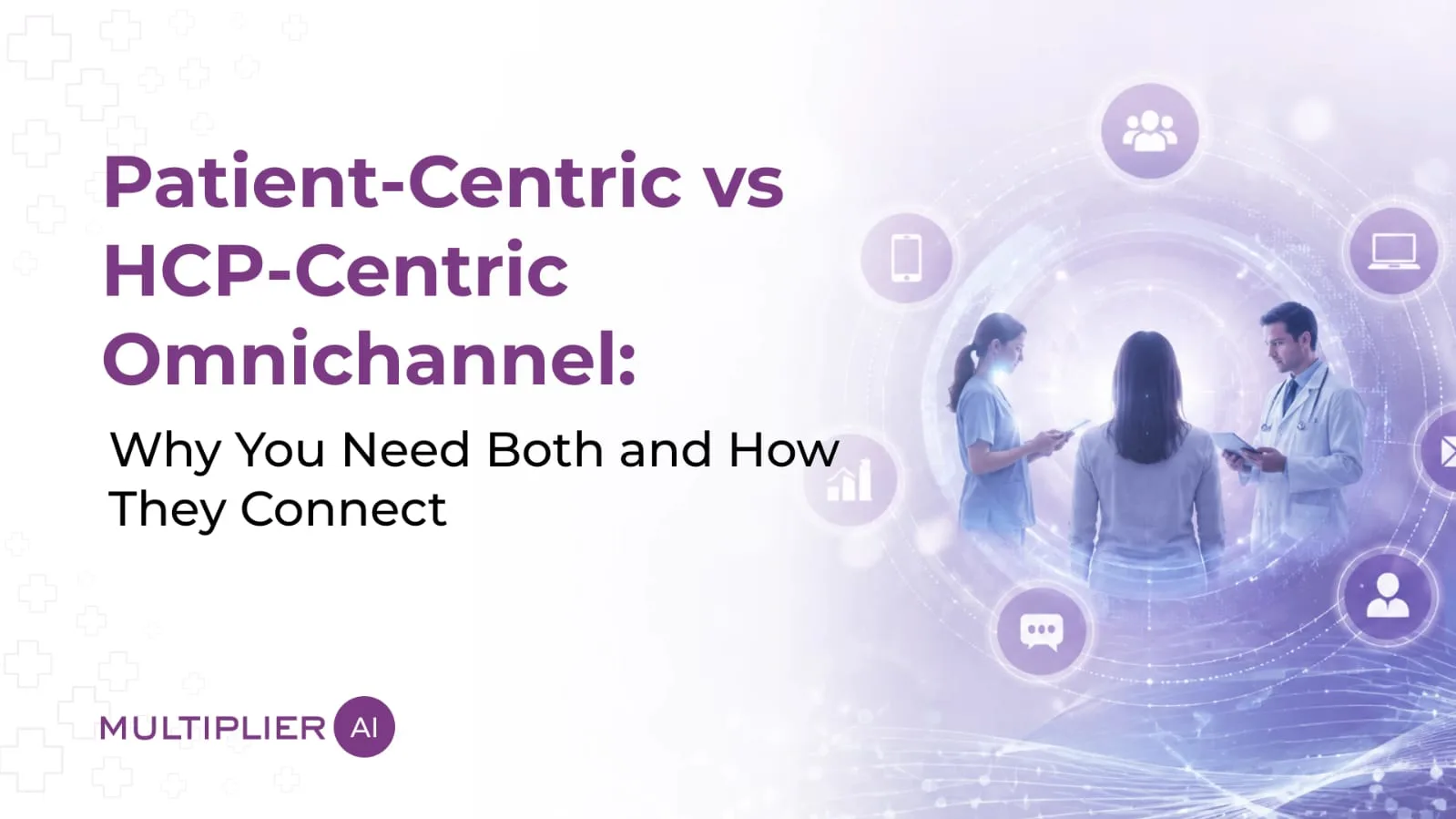
Patient-Centric vs HCP-Centric Omnichannel: Why You Need Both and How They Connect
The False Choice That Limits Most Pharma Strategies
The debate over patient-centric vs HCP-centric omnichannel pharma engagement has shaped how most companies allocate budgets, build teams, and design campaigns. Some teams emphasize healthcare professionals as the primary audience, while others advocate for a more patient-focused approach. This often leads to a perceived trade-off. Resources are allocated either toward HCP engagement or patient engagement, with each side operating through its own strategies, tools, and metrics. Over time, these approaches become increasingly disconnected. This is why patient-centric vs HCP-centric omnichannel pharma engagement should be treated as a connected strategy rather than a choice between two separate priorities.
The issue is not the focus on either group. Both are essential. The problem arises when they are treated as separate systems. In reality, patient and HCP journeys are deeply interconnected. Decisions made by doctors are influenced by patient needs, behaviors, and expectations. At the same time, patient outcomes depend on the guidance and recommendations of healthcare professionals. When these two perspectives are not aligned, engagement becomes fragmented. To create meaningful impact, pharma organizations need to move beyond this false choice and understand how patient-centric and HCP-centric strategies work together.
What Is the Difference Between Patient-Centric and HCP-Centric Omnichannel in Pharma?
HCP-centric omnichannel in pharma focuses on engaging healthcare professionals with clinical evidence, therapy information, medical education, and decision-support content across field, digital, CRM, and content channels. Patient-centric omnichannel focuses on supporting patients through education, reminders, adherence support, access guidance, and treatment journey communication.
The two strategies are different, but they should not operate separately. Patient insights can make HCP engagement more relevant, and HCP engagement can improve patient understanding, adherence, and outcomes. That connection is the entire point of a modern pharma omnichannel engagement strategy.
Understanding Patient-Centric vs HCP-Centric Engagement
To connect these strategies effectively, it is important to first understand how they differ. HCP-centric engagement focuses on influencing clinical decision making. It involves providing doctors with information about therapies, clinical evidence, and treatment guidelines, with the goal of supporting informed prescribing decisions. Patient-centric engagement, on the other hand, focuses on supporting individuals throughout their treatment journey, including education, adherence support, and access to resources that improve outcomes.
While these approaches serve different purposes, they are part of the same ecosystem. A doctor's decision to prescribe a therapy is influenced by how well it fits the needs of their patients. A patient's ability to adhere to treatment depends on the clarity and relevance of the information they receive. Understanding this connection is key to building an integrated strategy. Patient and HCP omnichannel engagement works best when doctor communication, patient education, adherence support, and journey insights reinforce each other.
Table 1: Patient-Centric vs HCP-Centric Omnichannel
| Area | HCP-Centric Omnichannel | Patient-Centric Omnichannel |
| Primary audience | Doctors, specialists, KOLs, medical teams | Patients, caregivers, support communities |
| Main objective | Support clinical decision-making | Support education, access, adherence, and outcomes |
| Typical channels | Field reps, CRM, email, webinars, medical content, digital | SMS, WhatsApp, apps, patient portals, reminders, education |
| Content focus | Evidence, therapy data, guidelines, clinical context | Disease education, treatment journey, adherence, access support |
| Data needed | Doctor profile, specialty, CRM history, engagement, consent | Patient behavior, journey stage, adherence signals, consent |
| Success metrics | HCP engagement, content depth, prescribing relevance | Adherence, revisit rate, support usage, patient outcomes |
| Risk if isolated | HCP conversations miss real patient barriers | Patient communication lacks clinical alignment |
Why Treating Patient and HCP Journeys Separately Creates Inefficiencies
When patient and HCP engagement are managed independently, several issues emerge. The first is inconsistency: doctors may receive messaging that emphasizes certain benefits, while patients receive information that highlights different aspects, which creates confusion and reduces trust. The second issue is missed opportunities. Insights from patient engagement are often not used to inform HCP strategies — for example, if patients struggle with adherence due to specific challenges, this information could help shape conversations with doctors. Without integration, these insights remain underutilized. The third issue is duplication of effort, where separate teams create similar content or run parallel campaigns without coordination, increasing costs and reducing efficiency. Over time, these inefficiencies limit the effectiveness of both approaches.
Table 2: Why Separate Patient and HCP Strategies Create Inefficiency
| Problem | What Happens When Journeys Are Separate |
| Inconsistent messaging | Doctors and patients receive different or disconnected information |
| Missed insights | Patient barriers do not inform HCP conversations |
| Duplicate content | Separate teams create similar materials without coordination |
| Weak follow-up | HCP discussions are not reinforced through patient support |
| Poor journey visibility | Teams cannot see how doctor and patient behavior influence each other |
| Lower efficiency | Budgets are split across parallel systems |
| Reduced trust | Communication feels fragmented across the care journey |
Why Pharma Needs a Unified Engagement Model
To address these challenges, pharma organizations need to adopt a unified engagement model. This does not mean merging all activities into a single function. It means ensuring that patient and HCP strategies are aligned and informed by shared insights. At the core of this model is a connected understanding of the healthcare ecosystem. This is the same principle behind omni channel customer engagement in healthcare, where every touchpoint should support a connected experience across the care journey. Doctors and patients are not isolated entities — they are part of a continuous interaction where decisions and outcomes influence each other. By recognizing this, organizations can design engagement strategies that reflect the full journey. A unified pharma engagement strategy should connect HCP decision-making with patient journey needs without compromising privacy, consent, or compliance.
How Patient Insights Improve HCP Engagement
One of the most valuable aspects of integrating patient and HCP strategies is the ability to use patient insights to improve doctor engagement. Patients provide real-world information about how therapies are experienced, including challenges related to adherence, side effects, and overall satisfaction. A Patient Intelligence Platform helps pharma and healthcare teams track patient behavior, preferences, journey stages, and next-best-action opportunities that can inform more relevant HCP engagement. When these insights are captured and analyzed, they can inform more meaningful conversations with HCPs. For example, if data shows that patients struggle with a specific aspect of treatment, field reps can address this directly during interactions, providing information and solutions that help doctors manage these challenges more effectively. This makes engagement more relevant. Instead of focusing solely on clinical data, conversations incorporate practical insights that reflect real patient experiences.
Table 3: How Patient Insights Can Improve HCP Engagement
| Patient Insight | How It Helps HCP Engagement |
| Adherence challenges | Helps reps discuss practical treatment barriers |
| Side-effect concerns | Helps medical teams provide relevant support material |
| Drop-off points | Shows where doctors may need patient-support resources |
| Patient education gaps | Helps shape clearer HCP-facing content |
| Access or affordability issues | Helps teams support conversations around patient assistance |
| Appointment behavior | Helps identify follow-up or continuity challenges |
| Patient preference data | Helps tailor support resources and communication style |
How HCP Engagement Supports Patient Outcomes
The relationship also works in the opposite direction. Effective HCP engagement plays a critical role in improving patient outcomes. When doctors have access to relevant and timely information, they are better equipped to make decisions that benefit their patients — selecting appropriate therapies, managing side effects, and providing guidance on adherence. Omnichannel strategies can support this by ensuring that doctors receive the information they need at the right time. For example, digital content can provide updates on new evidence, while field interactions can address specific questions, and follow-up communication can reinforce key points. This coordinated approach helps ensure that patient care is supported by accurate and consistent information.
Table 4: How HCP Engagement Supports Patient Outcomes
| HCP Engagement Action | Patient Outcome Impact |
| Sharing updated clinical evidence | Supports informed therapy selection |
| Providing patient-support resources | Helps doctors guide patients more effectively |
| Addressing adherence barriers | Improves treatment continuity |
| Reinforcing safety information | Supports better patient understanding |
| Coordinating field and digital follow-up | Keeps information consistent |
| Educating HCPs on journey-stage needs | Helps improve patient communication |
| Responding to HCP questions quickly | Reduces delay in clinical decision support |
Designing Connected Patient and HCP Journeys
A key step in integrating patient and HCP strategies is moving from campaign-based thinking to journey-based design. Instead of planning separate campaigns for each audience, organizations need to consider how interactions unfold over time. This involves mapping the journey from both perspectives. For patients, this may include stages such as diagnosis, treatment initiation, and ongoing management. For HCPs, it involves decision-making points related to prescribing and patient support. A Hyper Personalized Content Platform helps teams create audience-specific content journeys so HCPs and patients receive relevant messages that remain consistent across channels. By aligning these journeys, organizations can identify opportunities for coordination. For example, when a patient enters a new stage of treatment, corresponding information can be provided to HCPs, ensuring that both sides are aligned. Designing journeys in this way creates continuity and improves the overall experience.
Table 5: Connected Patient + HCP Journey Example
| Journey Stage | Patient Need | HCP Need | Coordinated Omnichannel Action |
| Diagnosis | Understand condition and next steps | Explain disease and treatment options | Give doctor education aids and patient approved intro content |
| Treatment initiation | Know how to start therapy correctly | Select therapy and guide expectations | Share HCP evidence content and patient onboarding support |
| Early treatment | Manage doubts and side effects | Monitor response and adherence | Trigger patient reminders and HCP follow-up insights |
| Ongoing management | Stay adherent and confident | Identify barriers and adjust support | Use patient engagement signals to inform HCP discussions |
| Drop-off risk | Re-engage and address barriers | Understand why adherence is falling | Notify support teams and provide HCP-facing adherence insight |
The Role of Data in Connecting Both Worlds
Data is the foundation of any integrated strategy. To connect patient and HCP engagement, organizations need to bring together information from different sources, including clinical data, engagement metrics, and real-world insights. A GenAI Doctor Data Platform can provide the HCP intelligence layer needed to connect doctor profiles, CRM activity, real-time engagement signals, and preferred-channel communication with broader patient journey insights. The goal is to create a comprehensive view that reflects both perspectives.
This does not require perfect integration from the start. Even partial connections can provide valuable insights. Strong doctor data in pharma is essential for connecting HCP engagement history, clinical focus, channel preference, and patient-support context into one coordinated strategy. For example, linking patient adherence data with HCP engagement patterns can reveal opportunities for improvement, and understanding how patient behavior changes in response to different interventions can inform future strategies. As data integration improves, the ability to coordinate engagement increases.
Table 6: Data Needed to Connect Patient and HCP Engagement
| Data Type | Why It Matters |
| HCP profile data | Shows specialty, practice context, and clinical focus |
| CRM interaction history | Captures field and medical engagement context |
| HCP content engagement | Shows which topics doctors are responding to |
| Patient journey stage | Helps align education and support needs |
| Patient behavior signals | Reveals adherence, drop-off, or engagement barriers |
| Support program usage | Shows what resources patients actually use |
| Channel preference | Helps personalize communication for both audiences |
| Consent status | Ensures communication follows permissions |
| Outcome indicators | Helps connect engagement with measurable impact |
How AI Enables Alignment at Scale
Managing the complexity of integrated engagement manually is challenging. AI provides a way to handle this complexity. AI omnichannel pharma strategies can help align patient signals, HCP engagement data, content recommendations, and next-best-action workflows at scale. By analyzing data across patient and HCP interactions, AI can identify patterns and generate insights that support decision making, helping determine which messages are most relevant and when they should be delivered. AI in omni channel marketing for pharmaceuticals helps teams coordinate HCP and patient-facing signals into more connected engagement journeys across field, digital, CRM, and content workflows. For example, AI can identify when patient engagement indicates a need for additional support, which can trigger communication with HCPs to ensure they are aware of potential challenges. Similarly, it can help tailor content for both audiences based on shared insights. This level of coordination enables organizations to operate at scale without losing relevance.
GET ACTIONABLE AI AND HEALTHCARE INSIGHTS THAT HELP YOU STAY AHEAD IN A FAST-CHANGING PHARMA WORLD
Compliance, Consent, and Data Governance Across Patient and HCP Journeys
Connecting patient-centric and HCP-centric engagement requires strong governance because both sides involve sensitive data, permissions, and purpose-specific communication. Pharma teams must ensure that patient insights are used responsibly and that HCP engagement respects consent, channel permissions, approved content rules, and data minimisation principles. A DPDP-Compliant HCP Marketing framework helps pharma teams manage consent, channel permissions, approved communication purposes, data minimisation, and audit-ready engagement workflows across HCP-facing activity.
Patient-level data should not be casually exposed to field or commercial teams. Instead, teams should use aggregated, anonymized, or permissioned insights wherever appropriate. Data minimisation under DPDP is important because connected engagement should use only the data required for a defined patient or HCP communication purpose. Purpose limitation under DPDP also means that insights collected for one journey should not be reused for unrelated engagement without proper governance. For example, a field team may not need to know individual patient details, but it may benefit from understanding that adherence barriers are common within a specific therapy journey.
A connected model should therefore include consent tracking, purpose limitation, data minimisation, role-based access, audit trails, approved content controls, and clear separation between patient support workflows and HCP commercial engagement. Integrated engagement can break down when pharma CRMs fail at consent tracking, because teams may not know which channels, purposes, or permissions apply to each HCP. Integration should improve relevance without weakening privacy or compliance.
How Multiplier AI Supports Connected Patient and HCP Engagement
Multiplier AI helps pharma and healthcare teams connect patient and HCP engagement through dedicated intelligence layers for both audiences. The GenAI Doctor Data Platform supports HCP profiling, CRM-connected doctor insights, real-time engagement signals, and preferred-channel communication. The Patient Intelligence Platform helps teams understand patient behaviors, preferences, journey stages, and next-best-action opportunities.
Together, these capabilities allow teams to identify where patient needs should inform HCP conversations and where HCP engagement can improve patient support. The Hyper Personalized Content Platform can then help create relevant content journeys for different audiences, while DPDP-Compliant HCP Marketing supports consent-aware activation and audit-ready workflows. This allows pharma teams to move beyond separate patient and doctor campaigns and build connected engagement strategies that reflect how healthcare decisions actually happen — all running on identity-resolved doctor data validated at 99% accuracy.
“The future of pharma engagement isn't about choosing between patients and HCPs. It's about connecting both in a way that reflects how healthcare actually works — where every doctor decision and every patient outcome shapes the other.”
Making Integration Practical for Pharma Teams
While the concept of integrating patient and HCP engagement may seem complex, it can be approached in a structured way. The first step is aligning objectives — teams need to understand how their efforts contribute to overall outcomes, which requires defining shared goals that reflect both patient and HCP perspectives. The next step is improving data visibility, because even basic integration can provide valuable insights, so the focus should be on making relevant information accessible to teams. It is also important to establish processes for coordination, including how insights are shared and how actions are aligned across teams. Training and communication play a critical role: teams need to understand the value of integration and how to apply it in practice. When the benefits are clear, adoption becomes easier.
A Practical Integration Model for Pharma Teams
A practical way to connect patient-centric and HCP-centric engagement is to start with one therapy journey and map both sides together. Pharma teams should identify the key patient stages, the corresponding HCP decision points, and the information required at each moment.
For example, during treatment initiation, patients may need onboarding support, reminders, and education about what to expect. At the same stage, doctors may need evidence summaries, patient-support resources, and guidance on adherence barriers. Connecting these two needs helps create a more coherent engagement model. Teams can begin with a small use case, such as improving adherence for one therapy area or supporting a product launch. Once the model works, it can be expanded across additional patient segments, HCP groups, and channels.
Measuring Success Across Both Dimensions
Evaluating the effectiveness of integrated engagement requires a broader set of metrics. Instead of focusing solely on HCP engagement or patient outcomes, organizations need to consider both. This includes tracking how engagement influences prescribing behavior and how it impacts patient outcomes, and it also involves measuring consistency and continuity across interactions. By taking a holistic view, organizations can gain a better understanding of performance, which enables more informed decision making and continuous improvement.
Table 7: Metrics for Integrated Patient + HCP Engagement
| Metric | Why It Matters |
| HCP engagement quality | Measures relevance and depth of doctor interaction |
| Patient adherence | Shows whether patient support is improving continuity |
| Journey progression | Tracks movement through care and engagement stages |
| Content consistency | Ensures HCP and patient communication are aligned |
| Support program usage | Shows whether patients use available resources |
| Field follow-up quality | Measures whether HCP conversations reflect patient needs |
| Patient revisit or continuation | Shows downstream journey impact |
| Consent-safe engagement | Confirms compliant communication across both audiences |
Connect Patient and HCP Engagement With Multiplier AI Patient-centric and HCP-centric omnichannel strategies should not operate in isolation. Multiplier AI helps pharma and healthcare teams connect patient intelligence, doctor data, personalized content, AI-driven insights, and consent-aware engagement workflows — so both journeys support each other without compromising compliance. |
What Success Looks Like in an Integrated Model
When patient and HCP engagement are aligned, the difference is significant. Doctors receive information that reflects real patient needs. Patients receive support that is consistent with clinical guidance. Interactions across channels feel connected. This creates a more cohesive experience. From a business perspective, this leads to better outcomes — engagement improves, adherence increases, and overall effectiveness strengthens. Perhaps most importantly, organizations gain clarity. They understand how different elements of their strategy work together and how to refine them over time.
Conclusion
The distinction between patient-centric and HCP-centric engagement has led many pharma organizations to treat these approaches separately. However, the reality is that they are deeply interconnected. To create meaningful impact, organizations need to move beyond this separation and adopt a unified approach. By aligning strategies, integrating data, and designing connected journeys, pharma teams can improve both engagement and outcomes. AI plays a key role in enabling this alignment, providing the insights needed to coordinate efforts at scale. The future of pharma engagement is not about choosing between patients and HCPs. It is about connecting both in a way that reflects how healthcare actually works.
Frequently Asked Questions For Patient-Centric vs HCP-Centric Omnichannel in Pharma: Why Both Matter
Patient-centric omnichannel in pharma focuses on supporting patients through education, reminders, adherence support, access guidance, and treatment journey communication across relevant channels.
HCP-centric omnichannel focuses on engaging healthcare professionals with clinical evidence, therapy information, medical education, field interactions, digital content, and CRM-driven communication.
Patient-centric omnichannel supports the patient journey, while HCP-centric omnichannel supports doctor decision-making. Both are connected because patient outcomes depend on HCP guidance, and HCP decisions are shaped by patient needs.
Pharma teams need both because doctors influence patient treatment decisions, while patient behavior, adherence, and support needs can inform more relevant HCP engagement.
Separate engagement can create inconsistent messaging, duplicated content, missed insights, weaker follow-up, and fragmented experiences across the healthcare journey.
Patient insights can help doctors understand adherence barriers, side-effect concerns, education gaps, access issues, and support needs, making HCP conversations more practical and relevant.
HCP engagement helps doctors access relevant clinical information, patient-support resources, adherence guidance, and timely follow-up content that can improve patient care.
AI can analyze patient and HCP engagement signals, identify patterns, recommend relevant messages, trigger next-best actions, and help align communication across both audiences.
Teams need consent tracking, purpose limitation, data minimisation, role-based access, audit trails, approved content controls, and clear separation between patient support and commercial workflows.
Multiplier AI supports connected engagement through the Patient Intelligence Platform, GenAI Doctor Data Platform, Hyper Personalized Content Platform, and DPDP-Compliant HCP Marketing workflows.
GET ACTIONABLE AI AND HEALTHCARE INSIGHTS THAT HELP YOU STAY AHEAD IN A FAST-CHANGING PHARMA WORLD
Let's Discuss Your Requirements