Patient Intelligence Platforms: Key Features & Evaluation Checklist (2026)
Most hospitals already hold enough data to know which patients are about to stop coming back. The information sits in the HIS, the lab system, the pharmacy, the radiology module, the call centre log and the billing ledger — and almost none of it is connected to a single patient identity. The result is a hospital that can report yesterday's occupancy to two decimal places but cannot answer a simpler question: which of the 40,000 people who visited us this year are we losing, and what should we do about it this week?
That gap is what a patient intelligence platform exists to close. The category is crowded, the terminology is loose, and vendors from four different software traditions all claim the label. This guide is written for the hospital or pharma digital head who has to run the evaluation: what the platform must actually do, what a genuine patient 360 contains, how the vendor landscape breaks down, a weighted scorecard you can take into a committee, and the questions that separate a working system from a dashboard with ambition.
What is a patient intelligence platform?
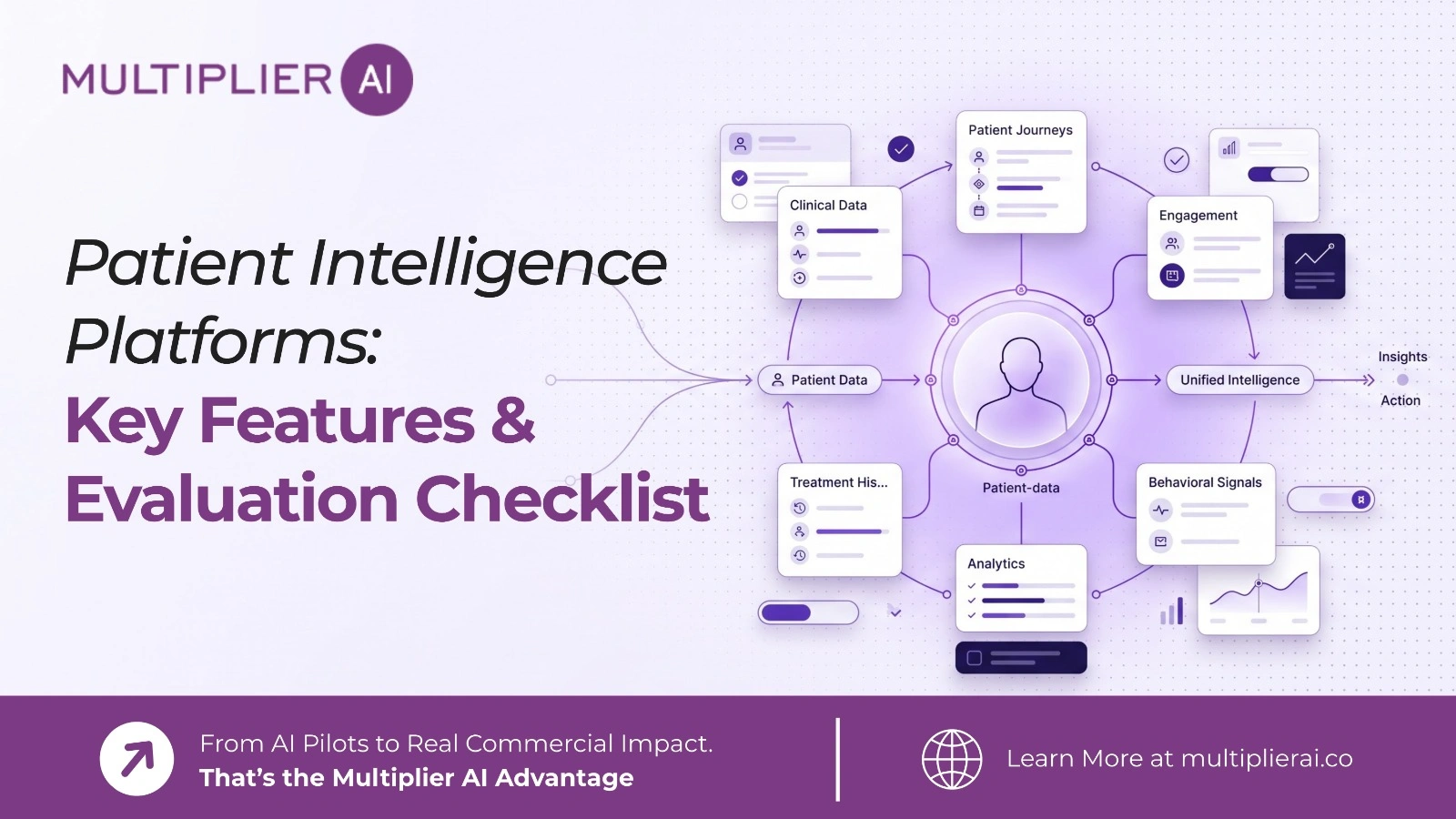
A patient intelligence platform is a system that unifies patient data from all clinical, diagnostic, pharmacy and financial systems into a single resolved patient record, applies predictive models to that record, and triggers the next best action for each patient. It differs from a hospital information system, which records care, and from a BI tool, which reports on care. A patient intelligence platform decides and acts.
The clearest way to place the category is by what each adjacent system is designed to do. A HIS or EMR is a system of record: its job is accurate capture of an encounter. A BI or analytics tool is a system of reporting: its job is to describe what happened. A healthcare CRM is a system of engagement: its job is to manage outreach and leads. A patient intelligence platform is a system of decision — it sits above the others, reads from all of them, and determines what should happen next for a named individual.
That distinction matters commercially because hospitals frequently buy the wrong layer. A group that already owns a competent HIS and a BI licence does not need a fourth dashboard; it needs the connective layer that resolves identity across those systems and converts the resulting picture into scheduled action. Conversely, a hospital with genuinely broken source data will not be rescued by a prediction engine, however sophisticated the models.
| System | Its core job | What it does well | What it cannot do alone |
|---|---|---|---|
| HIS / EMR | System of record | Accurate capture of clinical encounters, orders and results | Connect one patient's history across departments, entities or time |
| LIS / RIS / pharmacy | Departmental record | Deep detail within one modality | Show revenue or behaviour beyond its own module |
| BI / analytics | System of reporting | Describe what happened, by department and period | Identify an individual patient at risk and act on it |
| Healthcare CRM | System of engagement | Manage leads, campaigns and call-centre workflows | Derive who to contact from clinical and diagnostic behaviour |
| Population health tools | System of cohorts | Risk stratification across a defined population | Operate on the commercial questions of revisits and footfall |
| Patient intelligence platform | System of decision | Resolve identity, predict behaviour, trigger the next action, measure the result | Replace the source systems it depends on |
What are the key features to look for in a patient intelligence platform?
Look for ten capabilities: patient identity resolution across systems; longitudinal data unification including diagnostics, pharmacy and billing; a consent and preference ledger; patient segmentation; predictive models for churn, next visit and care gaps; next-best-action recommendation; multi-channel engagement orchestration; patient lifetime value and revenue attribution; closed-loop measurement; and role-based access with full audit logging. The first three determine whether the remaining seven produce anything trustworthy.
The table below is the working feature list to take into a vendor evaluation. The right-hand column matters more than the left: any vendor will confirm they have the capability, so the useful question is the one that forces a demonstration rather than an assertion.
| Capability | What good looks like | The question that tests it |
|---|---|---|
| Patient identity resolution | Probabilistic and deterministic matching across HIS, LIS, pharmacy and billing, with a survivorship rule set and a manual review queue | “Show me your duplicate rate before and after, on our data, in the pilot.” |
| Longitudinal data unification | One timeline per patient spanning OPD, IPD, diagnostics, pharmacy, billing and digital touchpoints | “Pull up one real patient and show me every interaction across two years in one view.” |
| Consent and preference ledger | Consent status, purpose, channel preference and withdrawal held per patient and enforced at query time | “What happens technically when a patient withdraws consent at 11am today?” |
| Segmentation | Dynamic segments built on behaviour and clinical attributes, not static list uploads | “Build a segment live in the demo: diabetic patients with no visit in 180 days.” |
| Predictive models | Churn risk, likely next visit window, care-gap and comorbidity propensity — with visible model inputs | “What features drive this patient's churn score, and what is the model's precision on our data?” |
| Next-best-action | A ranked recommendation per patient with a reason, not a generic campaign list | “For this patient, what is the recommended action and why that one?” |
| Engagement orchestration | Journeys across SMS, WhatsApp, IVR, email and call-centre tasks with frequency capping | “Show the orchestration builder and how you prevent four messages in one day.” |
| Patient lifetime value & attribution | Revenue per patient across departments, and attribution from outreach to booked and completed visit | “Show me the rupee value of the last campaign, traced to completed appointments.” |
| Closed-loop measurement | Every action linked to an outcome, with a holdout or control group by default | “How do you prove the revisit would not have happened anyway?” |
| Access control & audit | Role-based access, purpose limitation, immutable logs of who saw and did what | “Produce the audit trail for one outbound message end to end.” |
Two of these deserve emphasis because they are the ones most often waved through. Closed-loop measurement with a holdout group is what separates a platform that generates revenue from a platform that takes credit for revenue — if every patient receives outreach, no one can prove the outreach worked. And the consent ledger is not a compliance checkbox; it is an operational asset, because a platform that knows channel preference and consent state per patient sends fewer, better-targeted messages and preserves the hospital's ability to reach patients at all.
What should a patient 360 platform include?
A genuine patient 360 includes four layers: a resolved identity that survives across systems and duplicate records; a longitudinal clinical and diagnostic history; a complete financial and revenue view spanning departments, labs and pharmacy; and an engagement history with consent and channel preference. If any one of the four is missing, the view is partial and the decisions built on it will be too.
Most implementations that disappoint do so because they stop at the second layer. A unified clinical history is genuinely useful and relatively easy to assemble from a HIS. But without the financial layer you cannot compute patient lifetime value or prioritise outreach by commercial return, and without the engagement layer you repeat contacts, breach preferences and lose the ability to attribute anything.
| Layer | What it contains | Common source systems | Failure symptom if missing |
|---|---|---|---|
| Identity | One resolved patient ID with linked aliases, MRNs, phone numbers and ABHA where available | HIS registration, ABDM/ABHA, call centre, digital forms | The same patient counted three times; outreach sent twice; revisit rates understated |
| Clinical & diagnostic | Encounters, diagnoses, procedures, prescriptions, lab and imaging results over time | HIS/EMR, LIS, RIS, pharmacy | No clinical trigger for follow-up; recall programmes reduced to generic reminders |
| Financial & revenue | Billing across OPD, IPD, diagnostics and pharmacy; payer mix; lifetime value | Billing, TPA/insurance, pharmacy POS | Cannot rank patients by value; marketing spend allocated by volume, not return |
| Engagement & consent | Every contact attempt, channel, response, plus consent status and preference | CRM, SMS/WhatsApp gateway, IVR, call centre, website | Duplicate messaging, consent breaches, zero attribution from outreach to visit |
The identity layer carries the most risk and receives the least scrutiny in most evaluations. Black Book research found that before deploying an enterprise master patient index, an average of 24% of an organisation's patient records were duplicates, and that organisations without EMPI tooling achieved only 17% match rates when exchanging records externally. The financial consequence was measurable: 35% of denied claims were attributed to inaccurate patient identification or information, costing roughly $2.5 million per hospital annually. Those figures come from a US context, but the mechanism is universal — and Indian hospitals, where a single patient may register under a nickname, a spouse's phone number and three different spellings, are not advantaged.
This is also where India's infrastructure has changed the calculus. ABDM has now linked over 100 crore health records to ABHA as of 22 May 2026, doubling from 50 crore in roughly fifteen months, with more than 450 health technology solutions integrated into the ecosystem. A patient intelligence platform that can consume and reconcile ABHA-linked records has a materially stronger identity foundation than one built purely on internal MRNs. Ask directly whether the vendor's identity layer is ABDM-aware — see also our guide to AI for patient referral tracking in hospitals for how identity resolution extends across referring networks.
Best patient intelligence platforms for hospitals
There is no single best platform, because the category contains five distinct vendor types solving different problems: EHR-native analytics modules, US population-health and value-based-care platforms, healthcare CRM and engagement suites, healthcare data networks, and India-market patient intelligence platforms built for OPD/IPD commercial operations. Choose the type that matches your primary question — care quality, payer economics, patient acquisition or revisit growth — before comparing individual vendors.
Most published “best platform” lists compare products that are not substitutes for each other. A platform optimised for US value-based-care contracting is not a competitor to a system designed to increase footfall in a multi-speciality hospital in Hyderabad; they share vocabulary and almost nothing else. The honest comparison starts with the vendor category.
| Vendor type | Representative players | Best fit when | Typical limitation |
|---|---|---|---|
| EHR-native analytics | Epic, Oracle Health (Cerner) native modules | You are standardised on one EHR and want reporting inside it | Weak across non-EHR data; limited outbound engagement and attribution |
| Population health / VBC analytics | Innovaccer, Arcadia, Health Catalyst | Your economics are driven by risk contracts and quality measures | Built around US payer models; heavy implementation; not tuned to footfall growth |
| Healthcare CRM & engagement | Salesforce Health Cloud, LeadSquared and similar | Your primary gap is lead management and outreach workflow | Engagement layer is strong, intelligence layer is thin — you supply the analytics |
| Healthcare data networks | Komodo Health, Truveta, IQVIA and similar | You need market-level or real-world evidence, not operational decisions | External data, not your patients; not an operational system |
| India-market patient intelligence | Multiplier AI and comparable regional platforms | You need revisits, footfall and loyalty in an OPD/IPD business, under DPDP and ABDM | Smaller ecosystem than global suites; verify enterprise scale and security posture |
| In-house build | Internal data team on a cloud data platform | You have a mature data engineering function and unusual requirements | Identity resolution and consent tooling are far harder to build than dashboards |
A note on how to read any vendor list, including this one: shortlists published by analytics companies tend to feature the publisher favourably, and marketplace listicles rank by review volume rather than fit. The defensible approach is to define your primary business question first, select the two vendor types that genuinely serve it, and then run the scorecard below across three to four vendors rather than eight.
The 12-point evaluation scorecard
Score vendors across four weighted groups: data foundations at 40%, intelligence and prediction at 25%, engagement and orchestration at 20%, and compliance and security at 15%. Weighting matters because feature-parity checklists reward vendors with long feature lists rather than working data pipelines — and data foundations are where these projects actually succeed or fail.
Use the weights below, score each criterion 1–5 on evidence demonstrated in a pilot rather than claimed in a deck, and require the vendor to prove the top four criteria on your own data before contract.
| # | Criterion | Weight | What to verify — evidence, not assertion |
|---|---|---|---|
| 1 | Source system connectivity | 12% | Live connectors to your specific HIS, LIS, RIS, pharmacy and billing versions — named, not “API-capable” |
| 2 | Identity resolution quality | 12% | Measured duplicate rate and match rate on a sample of your real data during the pilot |
| 3 | Data freshness and reliability | 10% | Sync frequency, failure handling, and what the system does when a source system is down |
| 4 | Historical data depth | 6% | How much history is migrated and how quickly — models need 18–24 months to be useful |
| 5 | Predictive model transparency | 10% | Visible model inputs, performance measured on your data, and a documented retraining cycle |
| 6 | Next-best-action logic | 8% | Recommendations with stated reasons and an editable rules layer clinicians can override |
| 7 | Segmentation flexibility | 7% | Business users build segments without a support ticket; demonstrate live |
| 8 | Channel coverage and orchestration | 8% | WhatsApp, SMS, IVR, email and call-centre tasks in one journey, with frequency capping |
| 9 | Closed-loop attribution | 7% | Holdout groups by default; revenue traced from action to completed visit |
| 10 | Consent and DPDP readiness | 6% | Consent enforced as a query-time filter; withdrawal honoured in real time; data residency confirmed |
| 11 | Security and access control | 5% | Role-based access, encryption, immutable audit logs, and a current independent security certification |
| 12 | Time to first measurable outcome | 4% | A named metric moving within 60–90 days, contractually stated, not a 12-month roadmap |
If a vendor scores below 3 on either criterion 1 or criterion 2, the remaining ten scores are close to meaningless. Connectivity and identity are prerequisites — everything downstream inherits their quality. This is the single most common reason patient intelligence programmes stall in year one: the analytics were bought and the plumbing was assumed.
What does a patient intelligence platform need to work in India?
In the Indian market a platform additionally needs ABDM and ABHA awareness in its identity layer, DPDP-compliant consent handling with data residency, connectors for a fragmented HIS landscape including regional and in-house systems, WhatsApp and IVR as first-class channels, vernacular content support, and a multi-entity data model for hospital groups operating several units under one brand.
ABDM / ABHA readiness: The identity layer should be able to consume ABHA-linked records and reconcile them with internal MRNs. With over 100 crore records now linked, this is becoming the default patient identifier rather than an optional integration.
- DPDP consent architecture: Substantive data fiduciary obligations become enforceable on 14 May 2027, with penalties up to ₹250 crore. Consent must be enforced when data is retrieved, not checked after a campaign list is built — see our framework for keeping AI agents compliant with healthcare data regulations.
- HIS fragmentation: Indian hospitals run a wide mix of commercial, regional and in-house HIS products, frequently with different systems across units in the same group. Ask for named connectors, and treat “we can build it” as a project risk with a cost.
- Multi-entity data model: A group with six hospitals needs one patient identity across all six, with unit-level reporting and permissioning. Retrofitting this later is expensive.
- WhatsApp, IVR and vernacular: For most Indian patient populations WhatsApp and voice outperform email substantially, and language handling is an engagement requirement rather than a nicety.
- Commercial orientation: Indian hospital economics are driven by footfall, revisits, diagnostics attach rates and referral flow — not payer risk contracts. The platform's default metrics should reflect that.
The market context supports the investment case. India's patient engagement solutions market was USD 4.2 billion in 2025 and is forecast to reach USD 11.9 billion by 2034, a 12.07% CAGR — which means both that capable vendors are being funded and that a hospital delaying the decision will be competing against groups that did not.
How do we run a 60-day evaluation and pilot?
Run a structured 60-day evaluation in seven steps: define the single business question, audit your source data, shortlist three vendors by category fit, score them against weighted criteria, run a paid pilot on real data with a holdout group, verify identity resolution and attribution independently, then negotiate on demonstrated outcomes rather than promised features.
Define one business question (days 1–5). Not “patient analytics” but “increase revisits among diabetic OPD patients who have not returned in six months.” A single measurable question disciplines the entire evaluation and gives the pilot a pass/fail line.
- Audit your own data first (days 5–15). Inventory source systems, versions, API availability, history depth and current duplicate rate. Do this before vendor conversations — otherwise the vendor scopes the project and you lose the ability to compare quotes.
- Shortlist three vendors by category (days 15–20). Select from the two vendor types that match your business question. Three is enough; eight produces a comparison matrix nobody reads and a decision made on rapport.
- Score against the weighted criteria (days 20–30). Run the same scripted demo with each vendor, using the questions from the feature table. Score on what was demonstrated, and record where a vendor deflected.
- Run a paid pilot on real data (days 30–55). A pilot on synthetic data proves nothing about your identity problem. Scope it narrowly — one department, one cohort, one outcome — and insist on a holdout group so the result is attributable.
- Verify identity and attribution independently (days 50–58). Have your own team check the duplicate rate before and after, and confirm that reported revisits reconcile with the HIS. This is the step most often skipped and the one that most often changes the decision.
- Negotiate on outcomes (days 55–60). Tie commercial terms to a named metric moving within a defined window, with a clear data exit clause. A vendor confident in the pilot result will accept outcome-linked terms; hesitation here is itself information.
What metrics prove a patient intelligence platform is working?
Measure six things: revisit rate within the clinically appropriate window, no-show rate, patient lifetime value, care-gap closure rate, campaign-to-completed-visit conversion, and cost per retained patient. Each should be measured against a holdout group, and the first movement should be visible within 90 days rather than at annual review.
| Metric | How to measure it | What movement to expect |
|---|---|---|
| Revisit rate | Share of a defined cohort returning within the clinically appropriate window, versus holdout | First measurable lift in 60–90 days on an active cohort |
| No-show rate | Booked appointments not attended, by department and channel of reminder | Early and visible — reminder logic is the fastest-acting lever |
| Patient lifetime value | Total revenue per resolved patient identity across OPD, IPD, diagnostics and pharmacy | Baseline in month one; trend meaningful from month six |
| Care-gap closure | Patients with an identified gap who complete the indicated follow-up | Depends on cohort size; report as rate, not absolute count |
| Outreach to completed visit | Conversion from contact to booked to completed, by channel and message | Available immediately; use it to kill underperforming journeys |
| Cost per retained patient | Total platform and outreach cost divided by incremental retained patients versus holdout | The number to take to the CFO; only credible with a holdout |
Note what is absent from that list: dashboard logins, records unified, messages sent and model accuracy. Those are implementation milestones, not outcomes. A steering committee that reviews activity metrics for two quarters will conclude the platform works while the revisit rate has not moved.
Where patient intelligence projects fail
- Identity resolved too late. Analytics are configured on unresolved records, and every early report is quietly wrong. Resolve identity first, then build on it.
- Buying a fifth reporting layer. The organisation already had dashboards; what it lacked was action. If the platform's output is a report rather than a scheduled task or message, nothing changes operationally.
- No holdout group. Outreach goes to everyone, results look excellent, and no one can distinguish the platform's contribution from seasonality. Holdouts are cheap and non-negotiable.
- Engagement without consent architecture. Contact volume rises, complaints follow, and the organisation ends up with a regulatory problem attached to a revenue programme.
- Clinical teams excluded. Recall recommendations that clinicians consider inappropriate are ignored, and adoption collapses within a quarter. A clinical override layer is a design requirement.
- No named owner. The platform is bought by marketing, depends on IT for data and on clinicians for action, and is owned by none of the three. Name an accountable owner before signature.
Five of those six are organisational rather than technical, which is consistent with what determines outcomes in practice. The platform decision is genuinely important, but the operating model around it decides whether the platform is used.
Key takeaways
- A patient intelligence platform is a system of decision, distinct from the HIS that records care, the BI tool that reports on it and the CRM that manages outreach.
- A genuine patient 360 has four layers — identity, clinical and diagnostic, financial, and engagement with consent. Stopping at two is the most common design failure.
- Identity resolution is the highest-risk, least-scrutinised layer: Black Book found 24% average duplicate records pre-EMPI and 35% of denied claims attributable to misidentification.
- India's ABDM ecosystem passed 100 crore ABHA-linked health records on 22 May 2026, making ABDM-aware identity resolution a real evaluation criterion rather than a roadmap item.
- Weight your scorecard — data foundations 40%, intelligence 25%, engagement 20%, compliance 15% — instead of treating every feature as equal.
- Insist on a paid pilot on real data with a holdout group, and verify duplicate rates and attribution with your own team before contracting.
- DPDP substantive obligations land on 14 May 2027 with penalties up to ₹250 crore; consent must be enforced at the query layer, not applied to a list after the fact.
- Multiplier AI's Patient Intelligence Platform reports 25% more appointment revisits, 21% higher comorbidity-related footfall and 32% higher patient loyalty.
Turning the evaluation into a decision
The evaluation questions in this guide converge on one principle: a patient intelligence platform is only as good as the identity layer beneath it and the operating model around it. Vendors compete on models and dashboards because those demonstrate well in a forty-minute meeting. The difference between a platform that lifts revisits and one that produces attractive reports is almost always resolved somewhere less visible — in whether the system genuinely connects to your pharmacy billing, whether it knows that three records are one person, and whether a consent withdrawal at 11am changes what happens at noon.
Score data foundations at forty per cent. Run a paid pilot on real data. Insist on a holdout group. Verify the numbers with your own team. A vendor that welcomes all four is telling you something useful, and so is one that resists.
See it on your own data Multiplier AI's Patient Intelligence Platform tracks patient behaviour, treatment patterns and churn signals across OPD and IPD, unifies revenue across HIS/EMR, diagnostics and pharmacy, and runs AI-driven follow-up and re-engagement automatically. Hospitals using it report a 25% increase in appointment revisits, a 21% boost in footfall for comorbidity-related appointments, and a 32% increase in patient loyalty. Explore the full AI platform for hospitals, the Doctor Referral Platform and our case studies — or book a working session to run the evaluation scorecard against your own data. |
Frequently Asked Questions For Patient Intelligence Platform
Ten capabilities matter: patient identity resolution, longitudinal data unification, a consent and preference ledger, dynamic segmentation, predictive models for churn and next visit, next-best-action recommendations, multi-channel engagement orchestration, patient lifetime value and attribution, closed-loop measurement with holdouts, and role-based access with audit logging.
Four layers: a resolved identity that survives duplicates and system boundaries; a longitudinal clinical and diagnostic history; a complete financial view across OPD, IPD, diagnostics and pharmacy; and an engagement history with consent status and channel preference. Missing any one layer makes the resulting decisions unreliable.
It depends on your primary business question. EHR-native modules suit single-EHR reporting; Innovaccer, Arcadia and Health Catalyst suit US value-based-care economics; CRM suites suit lead management; data networks suit market evidence; and India-market platforms such as Multiplier AI suit OPD/IPD revisit and footfall growth under DPDP and ABDM.
A CRM manages outreach workflow and leads but does not derive who to contact from clinical, diagnostic and financial behaviour. A patient intelligence platform resolves patient identity across systems, predicts what each patient needs next, and then drives the CRM or engagement channel. Many hospitals need both layers.
A narrow pilot on one department and one cohort should produce a measurable outcome within 60 to 90 days. Full enterprise deployment across a hospital group typically runs six to twelve months, with the majority of that time spent on source system connectivity and identity resolution rather than analytics configuration.
Increasingly, yes. With over 100 crore health records linked to ABHA as of 22 May 2026 and more than 450 health technology solutions integrated, ABHA is becoming a practical patient identifier. A platform whose identity layer can consume and reconcile ABHA-linked records has a stronger foundation than one relying only on internal MRNs.
It can be, provided the platform enforces consent as a query-time filter, honours withdrawal in real time, applies purpose limitation and role-based access, maintains immutable audit logs and confirms data residency. Substantive data fiduciary obligations become enforceable on 14 May 2027, with penalties up to ₹250 crore.
Run every programme against a holdout group and report cost per incrementally retained patient alongside revisit rate and patient lifetime value. Without a holdout, revisit improvements cannot be separated from seasonality and referral trends, and the finance function is right to discount them.
Let's Discuss Your Requirements