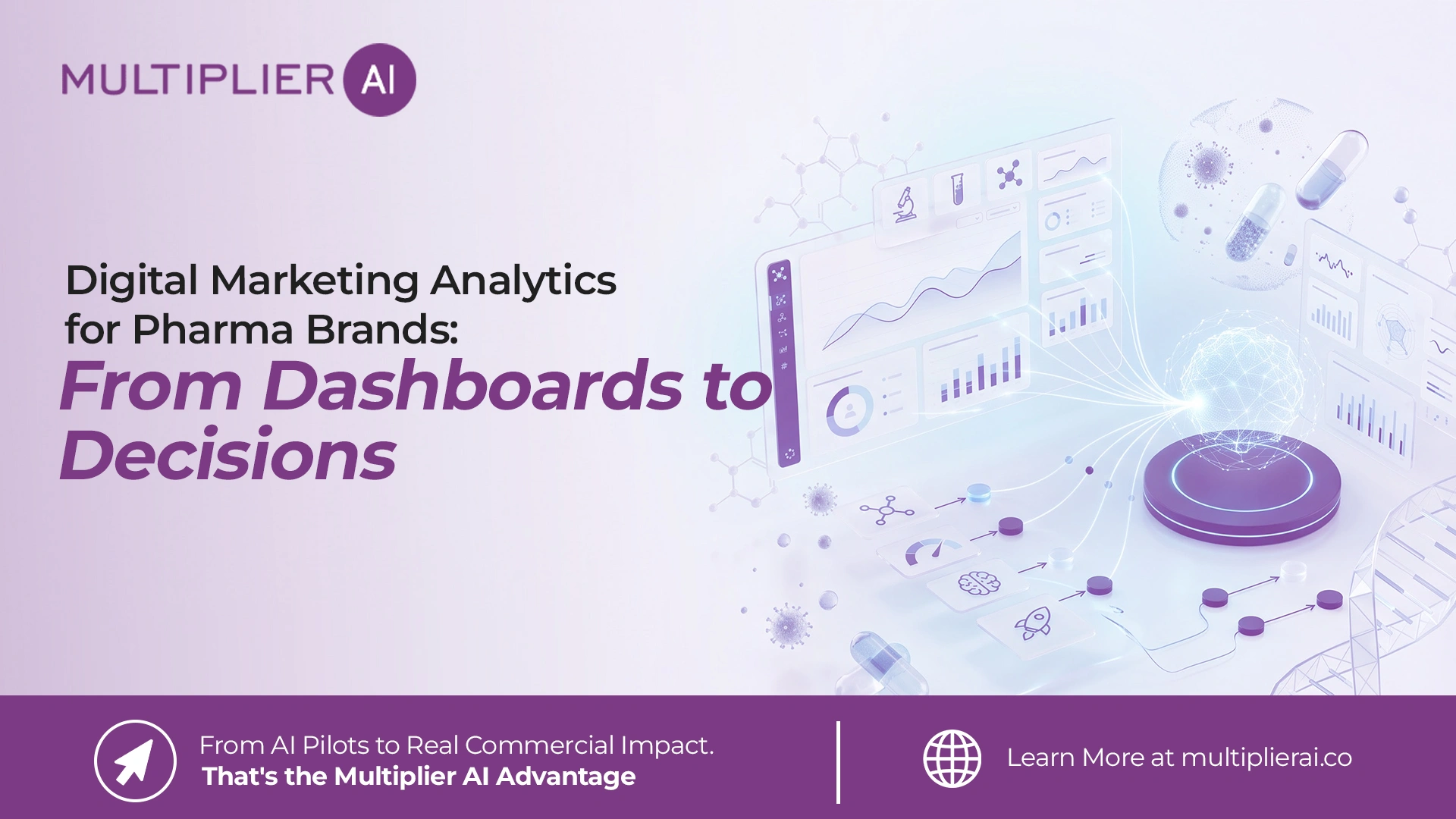
Digital Marketing Analytics for Pharma Brands: From Dashboards to Decisions
Most pharma brand teams are not short of digital marketing data. They have email open rates, web sessions, webinar registrations, rep-triggered content sends, paid media impressions and portal logins — each sitting in its own dashboard, each telling a partial story. What is usually missing is the connective layer that turns all of it into a decision: which HCP to reach next, on which channel, with which message.
That connective layer is digital marketing analytics. This guide explains what it is, how it differs from ordinary reporting, which metrics actually matter in a life-sciences context, and how AI is changing what a brand team can realistically do with its own data.
Digital marketing analytics is the practice of collecting, connecting and interpreting data from every digital channel — email, web, paid media, events, portals and rep-triggered content — to measure what is working and decide what to do next. In pharma, it means linking HCP-level engagement signals to prescribing behaviour, so marketing spend and field effort can be directed at the physicians and channels most likely to move the brand.
What is digital marketing analytics?
Digital marketing analytics is the discipline of measuring digital marketing performance end to end — from first impression to commercial outcome — and using those measurements to improve the next campaign. It sits one level above channel reporting: where a channel dashboard tells you an email campaign achieved a 32% open rate, digital marketing analytics tells you whether the physicians who opened it went on to engage further, request a rep visit, or change prescribing behaviour.
It is helpful to separate three terms that are often used interchangeably. Digital analytics usually refers to behavioural measurement of owned digital properties — a website, a portal, an app. Marketing analysis is the broader evaluation of marketing effectiveness, including offline and field activity. Digital marketing analytics sits between them: it covers all digital channels and connects their performance to business results. In practice, mature teams run all three together.
The distinction matters because it determines what question you can answer. Channel reporting answers what happened. Proper digital marketing analysis answers why it happened and what to do next — and that second question is where commercial value sits.
Why digital marketing analytics is different in pharma
Consumer marketers can track a customer from ad click to purchase in a single session. Pharma cannot. The audience is a regulated professional audience, the conversion event is a prescription written days or weeks later, and the data is bound by consent and privacy rules such as DPDP in India and GDPR in Europe. That creates four structural differences:
- Indirect conversion. The outcome — a prescription — happens outside the digital funnel, so engagement must be linked to prescribing data rather than observed directly.
- Small, high-value audiences. A brand may care about 8,000 specialists, not eight million consumers. Every HCP-level signal carries weight, and statistical shortcuts built for mass audiences break down.
- Consent-bound data. Every HCP touchpoint must respect consent status and channel preference. Compliance is a design constraint, not an afterthought — as covered in DPDP-compliant HCP marketing.
- Field and digital are one system. A rep visit and an email are two moves in the same conversation. Measuring them separately produces a distorted picture of what actually influenced the physician.
This is why generic online marketing analytics playbooks rarely transfer cleanly. The measurement framework has to be rebuilt around the HCP, not the click.
The four layers of a digital marketing analytics stack
A working analytics capability has four layers. Most teams have the first two and stall before the third.
| Layer | What it does | Typical question answered | Maturity |
|---|---|---|---|
| 1. Channel reporting | Per-channel metrics from native tools | How did this email perform? | Descriptive |
| 2. Unified digital marketing data | One HCP-level record across channels | What has Dr. Rao engaged with overall? | Diagnostic |
| 3. Attribution & impact | Links engagement to prescribing outcomes | Which touchpoints actually moved TRx? | Predictive |
| 4. Next Best Action | Recommends the next move per HCP | What should we do tomorrow, for whom? | Prescriptive |
The jump from layer two to layer three is the hard one, because it requires joining marketing data to commercial data — the prescription metrics such as TRx, NRx and NBRx that define brand performance. That join is where data analytics in digital marketing stops being a reporting exercise and becomes a commercial one.
Metrics that matter: beyond opens and clicks
Open rates and click-through rates are useful hygiene metrics, but they measure attention, not influence. A stronger measurement set for a pharma brand looks like this:
- Reach against target list. What percentage of your priority HCP segment has been reached at all this quarter — not what percentage of your database.
- Engagement depth. Repeat interaction, content completion and return visits, rather than a single open.
- Channel preference accuracy. Are you reaching each HCP on the channel they actually respond to? A rising unsubscribe rate is a targeting failure, not a content failure.
- Time-to-next-engagement. How quickly an HCP re-engages after a touchpoint is one of the earliest signals of genuine interest.
- Engagement-to-prescription lift. The difference in prescribing behaviour between engaged and matched non-engaged physicians. This is the metric that justifies budget.
- Cost per meaningful engagement. Spend divided by qualified interactions with target HCPs, not by impressions.
These sit naturally alongside the field metrics discussed in pharma sales and marketing analytics. Read together, they show whether digital and field effort are compounding or cannibalising each other.
Digital marketing analytics examples in life sciences
Abstract frameworks are easy to agree with and hard to act on. Four concrete digital marketing analytics examples from commercial pharma:
- Channel reallocation. Analysis shows that among high-value cardiologists, webinar attendance predicts NBRx growth three times more strongly than email engagement. Budget shifts from broad email to targeted virtual events, and reach against the priority segment rises without additional spend.
- Content decay detection. A therapy-area asset drives strong engagement for six weeks, then flattens. Analytics detects the decay early and triggers a refresh, instead of the drop being noticed a quarter later in a review deck.
- Silent-HCP identification. A cohort of target physicians has not engaged on any digital channel for 90 days. Rather than sending more email, the system flags them for field follow-up — turning a marketing gap into a rep opportunity.
- Sequence optimisation. Comparing engagement paths shows that an email following a rep visit within 48 hours performs far better than the reverse order. The orchestration calendar is rebuilt around that finding, as explored in omnichannel engagement in pharma.
Each of these starts with the same ingredient: unified digital marketing data at HCP level. Without it, none of the four analyses is possible.
How to build the capability: a five-step approach
- Define the commercial question first. Start from the decision you want to improve — budget allocation, targeting, sequencing — and work backwards to the data required. Building a dashboard first almost always produces a dashboard nobody uses.
- Unify identity. Resolve every channel's identifier to one HCP record. This is the single highest-value technical step and the one most often skipped.
- Establish a consent-aware data layer. Bake consent status and channel preference into the data model so every downstream analysis and activation is compliant by construction.
- Connect engagement to outcomes. Join marketing data to prescription and territory data so impact can be measured, not assumed.
- Close the loop with action. Feed insight back to the field and to campaign systems as specific recommendations. Analytics that ends in a report ends too early.
- Step two is worth dwelling on. Most failed analytics programmes in pharma are not analysis failures — they are identity-resolution failures. The models were fine; the data underneath described the same physician five different ways. Getting the underlying doctor data right, as described in reverse profiling and doctor data, determines the ceiling on everything built above it.
Where AI changes the picture
Traditional digital analytics is retrospective by design: someone asks a question, an analyst runs a query, an answer arrives days later. At the scale of thousands of HCPs across six or seven channels, that loop is simply too slow — the useful moment has passed before the analysis lands.
Agentic AI changes the economics in three ways. It monitors continuously rather than on request, surfacing anomalies — a segment disengaging, a channel underperforming, a content asset decaying — without anyone needing to ask. It personalises at HCP level, generating message and channel recommendations for each physician instead of each segment. And it recommends rather than reports, converting patterns into a ranked Next Best Action the field or campaign team can execute directly.
This is the model Multiplier AI builds for life-sciences teams: connected doctor data, compliant engagement, and AI that turns signals into prioritised action. The approach runs across the AI platform for pharma companies, the GenAI Doctor Data Platform and the hyper-personalised content platform. Real deployments are documented in the case studies.
Common pitfalls to avoid
- Vanity metrics. Impressions and open rates flatter reports and change nothing. Measure reach against target list and engagement-to-prescription lift instead.
- Channel silos. Separate dashboards for email, web and events guarantee an incomplete picture. Unify before you analyse.
- Ignoring the field. Digital-only measurement will over-credit digital. HCP influence is a joint effect of rep and digital contact.
- Compliance retrofitting. Adding consent logic after the data model is built creates rework and risk. Design it in.
- Reports without owners. Every recurring analysis should map to a person who can act on it. If nobody owns the decision, the analysis is decoration.
Key takeaways
- Digital marketing analytics connects data across every digital channel and links it to commercial outcomes — it is not the same as channel reporting.
- Pharma's indirect conversion, small high-value audiences and consent rules mean generic frameworks need rebuilding around the HCP.
- The four-layer stack runs from channel reporting to unified data, attribution and Next Best Action; most teams stall at layer two.
- Identity resolution is the highest-leverage technical step and the most commonly skipped one.
- AI shifts analytics from retrospective reporting to continuous monitoring and per-HCP recommendation.
Conclusion
Digital marketing analytics earns its place when it changes a decision. Dashboards that describe last month's opens are cheap to build and easy to ignore; an analytics capability that tells a brand team which physicians to reach next, on which channel, with which message, and what that decision is worth, is a commercial asset.
The path there is not primarily a tooling problem. It is unifying digital marketing data at HCP level, designing consent in from the start, connecting engagement to prescribing outcomes, and then letting AI run the loop continuously rather than quarterly. Brands that make that shift stop reporting on their marketing and start steering it.
See it in action Multiplier AI unifies HCP engagement data across channels and turns it into compliant, prioritised Next Best Actions for your brand and field teams. Book a demo to see what your digital marketing data can actually tell you. |
Frequently Asked Questions For Digital Marketing Analytics for Pharma
Digital marketing analytics is the practice of collecting, connecting and interpreting data from every digital channel — email, web, paid media, events and content platforms — to measure marketing performance and decide what to do next. In pharma it links HCP-level engagement to prescribing outcomes so spend and field effort can be prioritised.
Digital analytics typically measures behaviour on owned properties such as a website or portal. Digital marketing analytics is broader: it covers every digital channel and connects performance to commercial results, so it answers why something happened and what to do next, not just what happened.
Reach against the target HCP list, engagement depth, channel preference accuracy, time-to-next-engagement, engagement-to-prescription lift, and cost per meaningful engagement. Open and click rates are hygiene metrics, not evidence of influence.
By joining HCP-level engagement data to prescription data and comparing prescribing behaviour between engaged physicians and matched non-engaged physicians. That lift, set against campaign cost, is the most defensible ROI measure available.
A unified HCP record with resolved identity across channels, consent and channel-preference status, engagement events from every digital touchpoint, field activity data, and prescription or territory performance data to measure outcomes against.
Let's Discuss Your Requirements