Best Pharma CDP Platforms for HCP Data (2026)
There are roughly 208 active customer data platform vendors, and only 22% of marketers report high usage of the one they purchased. Those two numbers, taken together, describe a category where buying is much easier than benefiting. Pharmaceutical marketing teams are not exempt — if anything they are more exposed, because the pharma martech conversation routinely conflates five different things (CRM, master data management, data warehouse, CDP and marketing automation) and a vendor is happy to sell you whichever one you name.
This guide does two things that most content on this term does not. It answers the prior question honestly — whether a customer data platform is the right purchase for your situation at all — using the industry's own published thresholds. And it describes what actually changed in this category during 2025 and 2026, which is substantial: the 2026 Gartner Magic Quadrant saw mParticle, ActionIQ, Redpoint Global and Zeta Global depart, composable vendors grew headcount roughly six times faster than the industry average, and Salesforce began exposing life sciences workflows as machine-callable tools that reduce the case for a separate activation layer.
If you already know you need one, section three compares the credible options for healthcare professional engagement. If you are not certain, start with section two — and be prepared for the answer to be that your budget is better spent elsewhere first.
Disclosure Multiplier AI builds doctor data verification and content execution for pharma in emerging markets, so we sell into the same budget a CDP would come from. To be direct: we are not a customer data platform and this article does not position us as one. Section nine states where we are the wrong choice. Where the article argues that many teams should not buy a CDP yet, that argument points at data quality and consent work rather than at us specifically — and we say so. |
What a CDP is, and the four things it gets confused with
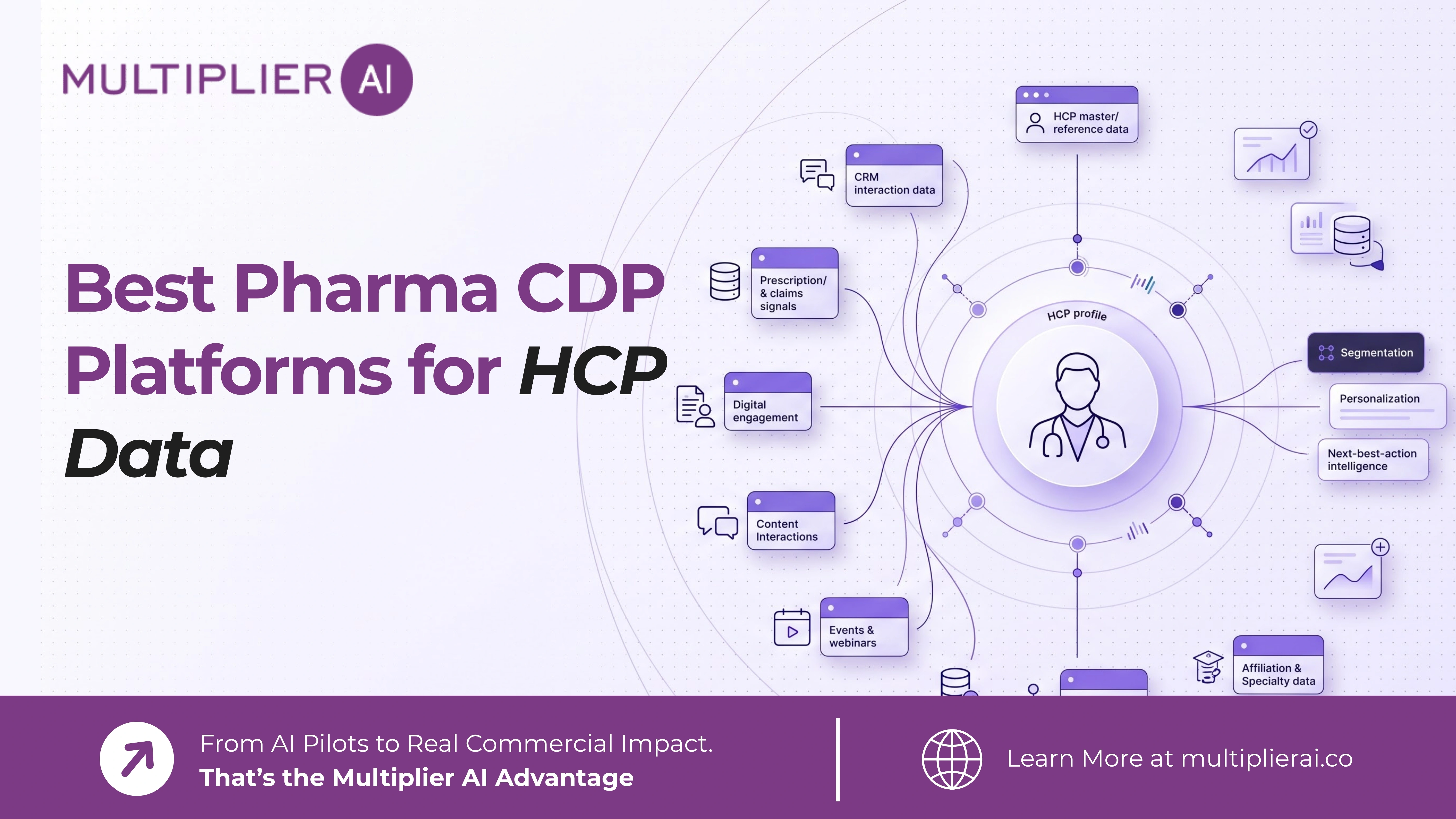
A customer data platform ingests data from many sources, resolves it into persistent unified profiles, and makes those profiles available to activation channels. Its distinguishing features are persistence, identity resolution across sources, and outbound activation. It is not a CRM, which records your own interactions; not master data management, which governs the authoritative record; not a data warehouse, which stores and analyses; and not marketing automation, which executes campaigns. Pharma stacks contain all five, and buying the wrong one for your actual problem is the most common and most expensive error in this category.
| System | Its actual job | What it does not do | Typical pharma example |
|---|---|---|---|
| CRM | Records interactions your own people had with a customer, and supports the field workflow | Unify external and digital signals, or resolve identity across sources it does not own | Veeva Vault CRM; Salesforce Life Sciences Cloud |
| Master data management | Governs the authoritative customer record — matching, survivorship, hierarchy, change requests | Activate anything. MDM decides what is true; it does not send messages | Veeva Network; enterprise MDM tooling |
| Data warehouse | Stores and analyses large volumes of historical data for reporting and modelling | Maintain real-time profiles or push audiences into channels without additional tooling | Veeva Nitro — a life sciences data warehouse launched in 2018 with pre-built connectors for IQVIA, claims and formulary data; Snowflake; Databricks |
| Customer data platform | Unifies sources into persistent profiles, resolves identity, and activates audiences into channels | Replace the system of record or govern data quality. A CDP inherits whatever quality it is given | Salesforce Data Cloud; Adobe Real-Time CDP; Twilio Segment; Treasure Data; Tealium |
| Marketing automation | Executes campaigns — journeys, sends, sequencing, templates | Resolve identity or unify sources; it consumes audiences rather than building them | Marketing Cloud; Veeva Approved Email; specialist HCP platforms |
The practical test is to write down the sentence “we cannot do X today” and see which system X belongs to. If the sentence is “our doctor records are duplicated and nobody agrees which is right”, that is master data management and a CDP will faithfully unify the duplicates. If it is “we cannot see what a physician did across email, portal and events in one place”, that is genuinely a CDP problem. If it is “we have the data but cannot get it into a campaign”, that may be activation tooling rather than a platform. Our existing guide to designing a pharma customer data platform covers the architecture once you have established that you need one.
Do we need a CDP or is CRM enough for pharma marketing?
For a large share of pharma marketing teams, CRM plus disciplined data quality and a consent framework is enough, and a CDP bought before those exist will underperform. The published criteria for skipping a CDP are: fewer than roughly 50,000 customer profiles, a single activation channel, no cloud data warehouse, no data engineering capacity, or unresolved data quality problems. A typical pharma brand's target physician universe is a few thousand — not fifty thousand — which means many brand teams meet the first criterion outright. The standard advice is to spend the budget first on CRM data quality, a consistent event taxonomy, and a consent framework that propagates across systems.
This deserves stating plainly because the category's marketing points the other way, and because the counter-evidence is in the industry's own numbers. Only around 22% of marketers report high usage of the CDP they purchased. That is not a story about bad products; it is a story about products bought before the conditions for using them existed. In pharma the pattern is recognisable: a CDP is procured to solve fragmented physician data, it faithfully unifies records that were duplicated to begin with, and eighteen months later the platform is used for list building that the CRM could have done.
| Skip a CDP if… | Why | What to buy instead |
|---|---|---|
| Your target universe is under roughly 50,000 profiles | Identity resolution at that scale is tractable in a warehouse or even in the CRM. The complexity a CDP solves does not yet exist | Data verification and a defined segmentation model. Most pharma brand universes are a few thousand physicians |
| You activate through one channel | A CDP's core value is consistent audiences across many channels. With one channel there is nothing to reconcile | Better targeting within the channel you have, and a second channel if the strategy justifies it |
| You have no cloud data warehouse | A CDP will become your de facto warehouse, which is an expensive way to acquire one and a poor one analytically | A warehouse first. It is the foundation for everything else including a future CDP |
| You have no data engineering capacity | Every CDP requires ongoing pipeline, schema and taxonomy work. Without it the platform decays into a static list tool | Hire or contract the capability before the platform, or choose a packaged option and budget for services |
| Your customer master has material quality problems | The decisive one for pharma. A CDP inherits the quality it is given, and unifies errors as diligently as facts | Doctor data verification and deduplication. Discrepancy rates around 57% are common in pharma CRM doctor records in our audits |
| Consent state is inconsistent across systems | A CDP that activates against unreliable consent creates regulatory exposure faster than it creates value | A single consent record checked at the point of sending, before any activation platform is added |
The honest positive case is narrower but real. Buy a CDP when you genuinely activate across several channels, your target universe is large enough that manual reconciliation fails, you have a warehouse and the engineering capacity to maintain pipelines, your customer master is reliable, and consent is already governed in one place. That describes large multi-brand commercial organisations more often than it describes a single brand team — and it is a perfectly good description of where a CDP earns its cost.
Best CDP for pharma HCP engagement
Four credible routes. Salesforce Data Cloud is the strongest fit if your commercial stack is already Salesforce, and Salesforce reported 140 life sciences clients as of mid-2026 including Novartis, AstraZeneca and Moderna. Adobe Real-Time CDP suits organisations with heavy Adobe content and experience investment. Twilio Segment and Treasure Data are the mature packaged options for teams without warehouse maturity. And composable tooling — Hightouch, RudderStack and comparable — activates directly from a warehouse you already run, which is increasingly the default for organisations with data engineering capacity.
| Option | Strongest when | Pharma-specific consideration | Watch out for |
|---|---|---|---|
| Salesforce Data Cloud | Your CRM and marketing stack are Salesforce, and you want the shortest path from profile to activation | Salesforce reported 140 life sciences clients by June 2026, named including Novartis, AstraZeneca, Moderna and Merck Animal Health, with Agentforce Life Sciences workflows exposed as machine-callable tools | Deepens Salesforce dependency by design. Reasonable if that is settled, costly if the CRM decision is still open |
| Adobe Real-Time CDP | Heavy investment in Adobe Experience Manager and content operations, with web and digital as primary channels | Strong on anonymous-to-known web journeys, which matters less when your audience is a known, finite physician list | Consumer-oriented identity assumptions. Validate the HCP identity model specifically |
| Twilio Segment | You need packaged capability quickly, without warehouse maturity or engineering headcount | Widely deployed and well documented; the life sciences specificity comes from your configuration rather than the product | Event volume pricing can escalate. Model it against your actual digital footprint |
| Treasure Data / Tealium | Enterprise deployments with complex data residency and governance requirements | Both have healthcare deployments and tend to be strong on consent and governance features | Longer implementations. Confirm the timeline against your campaign calendar |
| Composable on your warehouse | You run Snowflake, Databricks or similar and have data engineers | Increasingly the default for organisations with the capability. Data stays in your governed environment, which simplifies the compliance conversation considerably | Licence cost understates total cost. Typically assumes three to five data engineers |
| Veeva stack without a CDP | You are Veeva-committed, single-channel-dominant, and your problem is really master data | Veeva Network governs the record; Nitro warehouses commercial data. Together they cover much of what a brand team wants from a CDP | Not a CDP and not marketed as one. Cross-channel digital activation is where the gap shows |
One development worth watching closely. Salesforce has begun exposing its life sciences APIs, data models and workflows as machine-callable tools, so that compliant workflows can be driven from whatever AI assistant a team already uses rather than through Salesforce's own interface. If that pattern spreads, the argument for a separate activation layer weakens further, because the platform itself becomes addressable by the tools sitting above it. That is not a reason to defer a decision indefinitely, but it is a reason to prefer shorter commitments in this layer.
What changed in 2025 and 2026
The packaged CDP category consolidated while the composable approach grew. The 2026 Gartner Magic Quadrant saw mParticle, ActionIQ, Redpoint Global and Zeta Global depart, signalling a market tightening toward full platforms at one end and warehouse-native tooling at the other. Composable vendors grew headcount 7.8% against an industry average of 1.3% — roughly six times faster. And the largest platforms began absorbing CDP functions directly, which is why the middle of this market is the least comfortable place to be buying.
| Shift | Evidence | What it means for a pharma buyer |
|---|---|---|
| Packaged category consolidating | Roughly 208 active CDP vendors; the 2026 Gartner Magic Quadrant saw mParticle, ActionIQ, Redpoint Global and Zeta Global depart | Vendor viability is a real evaluation criterion again. Ask about ownership, funding and roadmap, as you would for any consolidating category |
| Composable growing fast | Composable vendors grew headcount 7.8% versus a 1.3% industry average | If you have a warehouse and engineers, this is now the mainstream choice rather than the adventurous one |
| Data platforms absorbing CDP functions | Warehouse and lakehouse vendors adding identity, activation and governance capabilities natively | Check what your existing warehouse already does before licensing a separate platform to do it |
| CRM platforms adding data cloud layers | Salesforce Data Cloud within the life sciences stack; 140 life sciences clients reported by June 2026 | For a Salesforce-committed organisation the incremental case for a third-party CDP narrows considerably |
| Workflows becoming machine-callable | Salesforce exposing life sciences APIs, data models and workflows as tools consumable by external AI assistants | The activation layer is becoming addressable from above. Prefer shorter contract terms in this layer |
| Low realised usage persisting | Only about 22% of marketers report high usage of the CDP they purchased | Treat adoption planning as part of the purchase, not as a phase two |
Read together, these point to a straightforward buying posture for pharma: prefer capability you already own, prefer shorter commitments, and treat the packaged mid-market as the segment requiring the most diligence on vendor durability. None of that says do not buy — it says buy deliberately, in a category where the architecture is still moving.
What pharma needs that generic CDPs handle badly
Four things. Consent has to be enforced at the moment of sending, with an exportable audit trail, rather than reconciled in reporting. HCP identity is a professional-identity problem — registration numbers, practice affiliations, multiple locations — not a consumer device-graph problem, and most CDP identity engines are built for the latter. Promotional content must clear medical, legal and regulatory review, so real-time content assembly is constrained. And patient and physician data must not be casually co-mingled, which cuts against a CDP's founding instinct to unify everything.
| Pharma requirement | Why generic CDPs struggle | What to require in evaluation |
|---|---|---|
| Consent enforced at send | Consumer CDPs typically treat consent as a profile attribute used for suppression at audience build. Regulatory expectation is a check at the moment of sending | Demonstrate a blocked send for a physician whose consent was withdrawn after the audience was built, with the block logged and exportable |
| HCP identity resolution | Identity engines are built around device graphs, cookies and logins. Physicians are identified by registration number, practice and affiliation — and rarely authenticate | The matching approach for professional identity, including how multiple practice locations and name transliteration variants are handled |
| MLR-approved content | Real-time personalisation assumes copy can be assembled freely. Promotional claims cannot | Modular assembly from a pre-approved library, with the approval reference carried through to the send record |
| Separation of patient and HCP data | The instinct to unify all data conflicts with the requirement to keep patient data segregated and governed differently | Demonstrated logical separation, and a clear statement of what would happen if the two were joined |
| Auditability | Consumer marketing rarely needs to reconstruct why an individual received a specific message eighteen months later | The ability to reconstruct, for one physician on one date, what was sent, on what consent basis, with which approved content version |
| Multi-market governance | Global CDP deployments frequently assume one regulatory regime | Per-market consent rules and data residency, enforced by configuration rather than by process discipline |
The first row is the one that most often turns into a finding at audit rather than a feature gap at purchase. An audience built on Monday and sent on Thursday will include physicians who withdrew consent on Tuesday unless the check happens at send. That is an architectural property, it is hard to retrofit, and it is worth making a demonstration requirement rather than a questionnaire item. We covered the consent architecture in AI agents and healthcare data compliance.
What it actually costs
Packaged CDPs typically run $60,000 to $200,000 a year for mid-market deployments and $200,000 to $500,000 or more at enterprise scale, reaching production in six to twelve months. Composable arrangements look substantially cheaper on licence but generally assume three to five dedicated data engineers, which is $450,000 to $1,000,000 a year of cost that vendor pricing pages do not mention. For organisations that must hire those engineers rather than redeploy them, packaged licensing frequently beats composable on total cost — the opposite of the usual assumption.
| Approach | Licence cost | Hidden cost | Time to production | Right when |
|---|---|---|---|---|
| Packaged CDP | $60K–$200K annually mid-market; $200K–$500K+ enterprise | Implementation services and ongoing taxonomy maintenance | 6–12 months | No warehouse maturity or engineering capacity, and a need to move within a year |
| Composable on warehouse | Materially lower licence cost | 3–5 data engineers, roughly $450K–$1M annually. This is the line that decides the comparison | 6–18 months, depending on warehouse maturity | You already run a mature warehouse and have the engineers, or already employ them for other work |
| Extend existing platform | Incremental module cost | Deeper platform dependency, and constraints on future portability | Shortest, often a quarter | Your CRM vendor already offers the capability and you are committed to them |
| No CDP; fix data and consent | Lowest | Internal effort and the discipline to sustain it | Ongoing | The correct answer more often than the category admits, particularly for single-brand teams |
A discipline worth applying to any proposal in this category: ask what proportion of the platform's capability your first-year use case actually requires. Given that only around 22% of marketers report high usage after purchase, the base rate suggests most organisations buy substantially more capability than they deploy. Scoping to the first year, with agreed expansion pricing, is a better structure than buying the full platform and growing into it — a growth that, statistically, usually does not happen.
A 30-day decision process
This sequence is built to reach a defensible yes or no, and it deliberately spends the first third of the time on whether to buy at all rather than on which to buy.
- Days 1–4: write the failure in one sentence. Describe what you cannot do today, without naming a product category. Then classify it against the five systems in section one. A surprising share of stated CDP requirements resolve to master data management or to activation tooling, and buying a CDP for either will not fix them.
- Days 5–8: count your actual universe. How many physicians are in your target list, across all brands and markets in scope? If the number is materially under fifty thousand, the complexity a CDP exists to manage may not be present, and you should be able to say specifically what makes your case different.
- Days 9–13: audit data quality before anything else. Sample 200 physician records against reality. A CDP unifies what it is given. If duplication and staleness are material, remediation is the first project regardless of what you buy afterwards, and doing it first will change what you need.
- Days 14–17: map consent, end to end. Where is consent captured, where is it stored, which systems read it, and at what point is it checked before a message is sent? Draw it. In most organisations this exercise finds at least one channel where the check happens at audience build rather than at send.
- Days 18–21: inventory what you already own. Your warehouse, your CRM's data layer, your marketing automation platform. Several capabilities attributed to a prospective CDP are frequently already licensed and unused. This step regularly removes the requirement entirely.
- Days 22–25: decide packaged versus composable on engineering capacity, not on licence price. If you do not have three to five data engineers and will not hire them, composable is more expensive than it appears. If you already employ them, packaged is usually the more expensive option.
- Days 26–28: require the four pharma demonstrations. A blocked send for withdrawn consent checked at send time; HCP identity resolution on your own records including multi-location physicians; modular assembly from approved content with the approval reference carried through; and reconstruction of one physician's message history with consent basis.
- Days 29–30: scope to year one with agreed expansion pricing. Buy the capability your first use case requires, with the price of the next tier agreed at signature. Given the usage statistics in this category, growing into a full platform is the exception rather than the norm.
Treat steps two and three as gating. A universe below the complexity threshold and an unreliable customer master are, between them, the explanation for most disappointing CDP deployments in this industry — and both are discoverable in a fortnight, before any money is committed.
What changes in India and comparable markets
The case for a CDP is generally weaker here, for four reasons. Target universes are large in absolute terms but the addressable list per brand is usually manageable. There is no prescriber-level prescription data, so a major category of signal a CDP would unify simply does not exist. WhatsApp is the working channel, and consent enforcement there is a compliance requirement rather than a marketing preference. And customer master quality is the binding constraint far more often than data fragmentation is.
| Factor | Position in India and comparable markets | Implication for a CDP decision |
|---|---|---|
| Addressable universe | India has over 1.38 million registered allopathic doctors, but a brand's actual target list is typically a few thousand | The headline number suggests CDP-scale complexity; the working number usually does not. Count the target list, not the register |
| Signal availability | No prescriber-level prescription data; territory-level secondary sales only | One of the richest signals a CDP would unify does not exist. The unification value is correspondingly lower |
| Primary digital channel | WhatsApp rather than email for most practising clinicians | Require native WhatsApp activation with consent checked at send. Many CDPs treat messaging as a secondary connector |
| Regulatory frame | DPDP with full enforcement expected May 2027 and penalties up to ₹250 crore; UCPMP 2024 on promotional conduct | Consent architecture is the priority investment. A CDP that activates against unreliable consent increases exposure rather than reducing it |
| Customer master quality | Discrepancy rates around 57% in our CRM audits, much of it duplication and stale addresses | The binding constraint. Unifying duplicated records produces a unified duplicate, presented with more confidence |
| Channel mix | The medical representative remains the primary channel by influence | Cross-channel unification is worth less where one channel dominates. Field enablement usually returns more than profile unification |
| Engineering capacity | Deep technical talent pool, and often existing warehouse investment | Composable is more viable here than the global vendor positioning assumes. Check what your warehouse already does |
The fifth row is the one that decides most Indian deployments. A CDP applied to a customer master with a high duplication rate does exactly what it is designed to do — it creates a unified profile — and the profile is wrong in the same way the inputs were, but now with the authority of a single view. The remediation sequence is not controversial and is set out in doctor data validation and enrichment.
Where Multiplier AI fits — and where it does not
We are not a customer data platform, and much of this article argues that many teams should not buy one yet. The boundary:
Do not shortlist us if
- You need a customer data platform. We do not ingest arbitrary sources, maintain persistent unified profiles across a martech estate, or provide a general activation layer. Salesforce Data Cloud, Adobe Real-Time CDP, Segment, Treasure Data and composable tooling serve that requirement.
- You need master data management. Governing the authoritative record with survivorship rules and change request workflows is Veeva Network or comparable MDM. We verify and enrich; we are not an MDM platform.
- You need a data warehouse. Storage, historical analysis and enterprise reporting belong to Snowflake, Databricks, Veeva Nitro or equivalent.
- Your customer data is already clean and your consent architecture is sound. Then the argument in section two does not apply to you, and a CDP may well be the right next purchase. We would not be adding anything.
Do shortlist us if
- Section two's answer was “fix the data first”. That is the work we do. Our GenAI Doctor Data Platform profiles physicians across more than 100 parameters with continuous verification, which is the precondition for any profile-based system producing something true.
- HCP identity is the hard part of your unification problem. Professional identity — registration, affiliation, multiple practice locations, transliteration variants — is a different problem from consumer identity, and it is the one we are built for.
- You need activation on WhatsApp with consent enforced at send. Our Hyper Personalized Content Platform delivers approved content across email, WhatsApp and social with the consent check at the point of sending rather than at audience build.
- Your universe is a few thousand physicians and a CDP is oversized. This is the common case in emerging markets, and it is the situation we are designed for rather than one we are stretching to serve.
The mistakes that make this purchase expensive
- Buying a CDP to solve a master data problem. It will unify your duplicates faithfully and present them as a single view, which is worse than leaving them visible.
- Skipping the universe count. If your target list is a few thousand physicians, the complexity a CDP manages may not be present. Say specifically what makes your case different before proceeding.
- Comparing packaged and composable on licence price. Composable commonly assumes three to five data engineers. If you must hire them, packaged is usually cheaper in total.
- Treating consent as a profile attribute. Suppression at audience build is not the same as a check at send, and the difference surfaces at audit rather than in the demo.
- Not inventorying what you already own. Warehouses, CRM data layers and marketing platforms frequently already provide capabilities attributed to a prospective CDP.
- Buying the full platform to grow into it. With only around 22% of marketers reporting high usage after purchase, growing into a platform is the exception. Scope to year one with agreed expansion pricing.
- Ignoring vendor durability. With roughly 208 vendors and notable departures from the 2026 Gartner Magic Quadrant, viability is a live evaluation criterion in the packaged mid-market.
- Assuming consumer identity resolution transfers. Physicians rarely authenticate and are identified professionally. Device-graph identity engines handle this poorly and rarely say so.
Key takeaways
- A CDP unifies sources into persistent profiles and activates them. It is not CRM, MDM, a data warehouse or marketing automation — and pharma stacks contain all five.
- Skip a CDP if your universe is under roughly 50,000 profiles, you activate through one channel, you have no warehouse or data engineers, or your data quality and consent are unresolved.
- Only about 22% of marketers report high usage of the CDP they bought, against roughly 208 active vendors. Buying is not the constraint.
- The 2026 Gartner Magic Quadrant saw mParticle, ActionIQ, Redpoint Global and Zeta Global depart, while composable vendors grew headcount roughly six times faster than the industry average.
- Packaged runs $60K–$200K mid-market and $200K–$500K+ enterprise. Composable hides $450K–$1M a year in engineering. Compare on total cost, not licence.
- Pharma's real requirements — consent enforced at send, professional identity resolution, MLR-constrained assembly, patient and HCP separation — are where generic CDPs are weakest.
- In India the case is generally weaker: no prescriber-level signal to unify, WhatsApp as primary channel, and customer master quality as the binding constraint.
- Spend first on CRM data quality, event taxonomy and a consent framework that propagates. That is the category's own standard advice, not a contrarian position.
The prior question is the valuable one
Comparison articles in this category exist to help you choose a vendor, and this one does that in section three. But the more valuable service is the question that comes before it, because the evidence in this market is unusually blunt: with roughly 208 vendors competing and only around 22% of purchasers reporting high usage afterwards, the dominant failure is not choosing badly among platforms. It is buying one before the conditions for using it exist.
For pharmaceutical marketing that framing is particularly apt, because the conditions are specific and checkable. A target universe large enough that manual reconciliation genuinely fails. Several activation channels whose audiences must agree. A warehouse and the engineers to maintain pipelines into it. A customer master reliable enough that unifying it produces truth rather than a confident error. And consent governed in one place and checked at the point of sending. Where those five hold, a CDP earns its cost comfortably. Where two or three are missing, it will faithfully do its job and disappoint anyway.
Count your universe, sample two hundred records, and draw your consent flow end to end. Those three exercises take a fortnight, cost nothing, and will tell you more about whether to buy a customer data platform than any vendor evaluation.
Work with Multiplier AI If the honest answer in section two was “fix the data first”, that is the work we do. Our GenAI Doctor Data Platform profiles physicians across more than 100 parameters with continuous verification, solving the professional-identity problem that consumer-built identity engines handle poorly — registration, affiliation, multiple practice locations and transliteration variants. And our Hyper Personalized Content Platform activates approved content across email, WhatsApp and social with the consent check at the point of sending rather than at audience build. Published outcomes from Indian deployments include a minimum 120% increase in time spent in the doctor's cabin, a 37% increase in medical representative efficiency and a 35% increase in brand share of voice with doctor influencers. See our pharma solutions page, review our case studies, or book a demo — and bring the count of your actual target universe. It is usually smaller than the platform you were quoted for. |
Frequently Asked Questions For Best Pharma CDP Platforms for HCP Data
A customer data platform for pharmaceutical commercial use ingests data from CRM, digital channels, events, portals and third-party sources, resolves it into persistent unified profiles for healthcare professionals, and makes those profiles available to activation channels. It differs from a CRM, which records your own interactions; from master data management, which governs the authoritative record; from a data warehouse, which stores and analyses; and from marketing automation, which executes campaigns. Pharma stacks typically contain all five.
For many teams, CRM plus disciplined data quality and a consent framework is enough. The published criteria for skipping a CDP are: fewer than roughly 50,000 customer profiles, a single activation channel, no cloud data warehouse, no data engineering capacity, or unresolved data quality. A typical pharma brand's target physician universe is a few thousand rather than fifty thousand, so many brand teams meet the first criterion outright. The standard advice is to invest first in CRM data quality, a consistent event taxonomy and a consent framework that propagates across systems.
It depends on your existing stack. Salesforce Data Cloud is the strongest fit for a Salesforce-committed organisation, and Salesforce reported 140 life sciences clients by mid-2026. Adobe Real-Time CDP suits heavy Adobe content investment. Twilio Segment and Treasure Data are the mature packaged options for teams without warehouse maturity. Composable tooling on your own warehouse is increasingly the default where data engineering capacity exists. If you are Veeva-committed and single-channel dominant, Veeva Network and Nitro together may cover what you actually need.
A CRM records interactions your own people had with a customer and supports the field workflow. A CDP unifies data from many sources — including ones you do not control — into persistent profiles, resolves identity across them, and activates audiences into channels. The CRM is a system of record for your activity; the CDP is a system of unification and activation. Neither governs data quality, which is master data management and is frequently the actual problem.
A composable CDP assembles the functions of a packaged platform from components sitting on your existing data warehouse, activating directly from it through reverse ETL tooling such as Hightouch or RudderStack. It is cheaper on licence and often not cheaper in total: composable architectures typically assume three to five dedicated data engineers, roughly $450,000 to $1,000,000 a year. If you already employ that team, composable usually wins. If you must hire them, packaged licensing at $60,000 to $200,000 for mid-market frequently wins instead.
Packaged platforms typically run $60,000 to $200,000 annually for mid-market deployments and $200,000 to $500,000 or more at enterprise scale, reaching production in six to twelve months. Composable arrangements carry lower licence costs but substantial engineering staffing. Both figures exclude data remediation, which is frequently the largest unplanned cost because the implementation exposes quality problems that then have to be fixed before the platform produces anything trustworthy.
Some can, but it must be tested rather than assumed. The requirement is that consent is checked at the moment of sending, not applied as a suppression rule when the audience is built — an audience assembled on Monday and sent on Thursday will include anyone who withdrew consent on Tuesday unless the check happens at send. Make this a live demonstration in evaluation: withdraw consent for one physician after audience build, attempt a send, and confirm the block occurs and appears in an exportable log.
If you already run a mature warehouse and employ data engineers, yes in most cases — and the market is moving that way, with composable vendors growing headcount roughly six times faster than the industry average. The decisive question is not technical preference but whether the engineering capacity exists or must be hired. Build with a team you already have; buy if the alternative is hiring three to five engineers to support a marketing platform.
Let's Discuss Your Requirements