Axtria vs ZS vs Agentic AI Platforms: Choosing a Commercial Partner
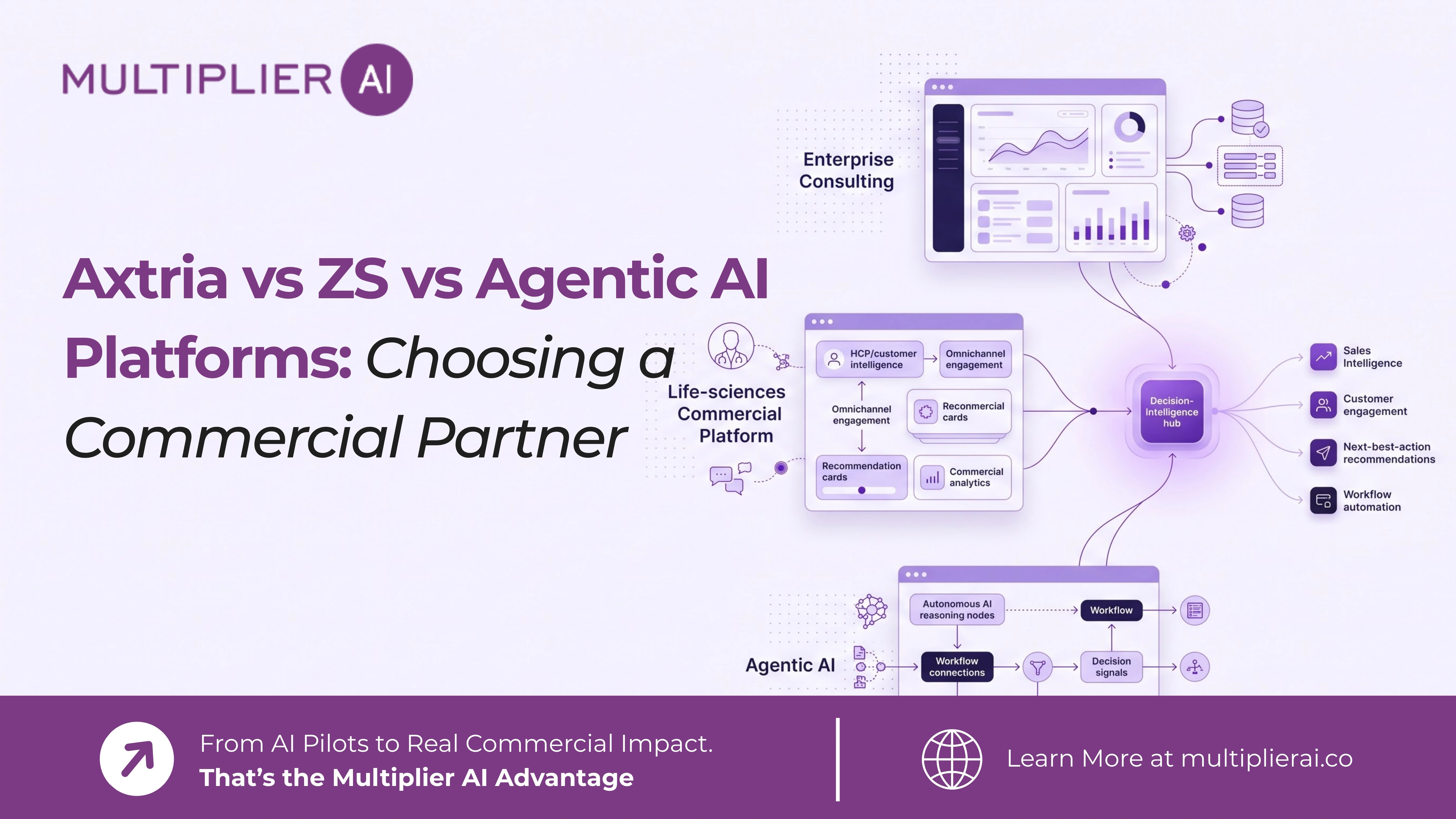
Most comparisons of Axtria and ZS treat the choice as a software decision — feature grids, deployment models, pricing structures. That framing was reasonable two years ago. It is now misleading, because within six months in late 2025 and early 2026 both firms answered a more fundamental question in the same way, and the answer changes what a buyer is actually choosing between.
On 22 October 2025 ZS announced that ZAIDYN's intelligence would be embedded directly inside Salesforce's Agentforce Life Sciences platform, delivered through APIs, MuleSoft, Data Cloud and AgentExchange. On 15 April 2026 Axtria acquired Conexus Solutions, a life sciences technology and managed services firm specialising in CRM transformation across the Veeva and Salesforce ecosystems, explicitly to move its agentic AI from concept into production inside the CRM systems commercial teams already use. Two different firms, two different transactions, one identical conclusion: the platform layer belongs to Veeva and Salesforce, and our value sits as intelligence on top of it.
That has a direct consequence for anyone evaluating them. You are not choosing between Axtria, ZS and your CRM. You are choosing an intelligence and capability partner that will increasingly assume a CRM underneath it. The real decision is therefore not which firm, but which engagement model — and for a mid-size company, that turns on a single question this article gets to in section six.
Disclosure Multiplier AI operates in pharma commercial technology, so we have an interest in this category. To be direct: we are not an alternative to Axtria or ZS. They are analytics and consulting firms with platforms; we build doctor data verification and content execution for emerging markets. Section ten states plainly where we are the wrong choice, and for most of what this article discusses, we are. Every claim about another firm is drawn from its own published material and dated in the source notes. |
What Axtria and ZS actually are
Both are life sciences commercial analytics firms that combine services with software, but they arrived from opposite directions and the difference persists. ZS is a consulting firm founded in 1983 that built a platform; its centre of gravity is expert services, and ZAIDYN is how that expertise scales. Axtria is a technology company founded in 2010 that offers services; its centre of gravity is product — SalesIQ, CustomerIQ, MarketingIQ and DataMAx — with implementation and managed services around it. Neither description is a criticism. They are different businesses that solve overlapping problems in different ways.
| Dimension | ZS Associates | Axtria | Why it matters to you |
|---|---|---|---|
| Origin and scale | Founded 1983; more than 13,000 employees across 35+ offices; describes 40+ years of domain expertise | Founded 2010; headquartered in Berkeley Heights, New Jersey; serves 18 of the top 20 global pharmaceutical companies and 100+ firms across 75+ countries | Depth of accumulated methodology versus speed and product focus. Both are real advantages for different buyers |
| Centre of gravity | Consulting-led. ZAIDYN scales the expertise rather than replacing it | Product-led. Services support deployment of the platform | Determines who you talk to after signature — a consulting team or a customer success team |
| Platform | ZAIDYN, spanning customer engagement, next best action, dynamic targeting and data products | SalesIQ for sales planning, CustomerIQ for next-best-action, MarketingIQ for commercial optimisation, DataMAx for orchestration | Axtria's modular structure makes partial purchase easier. ZAIDYN is more commonly bought as part of an engagement |
| Typical commercial model | Custom enterprise pricing, frequently coupled with consulting services | Annual SaaS licence, usually scaled to field force size or modules | The most consequential practical difference. One is a project budget, the other is a software line item, and they are approved by different people |
| Recent strategic move | ZAIDYN intelligence embedded in Salesforce Agentforce Life Sciences, announced 22 October 2025 | Acquired Conexus Solutions, a Veeva and Salesforce CRM implementation and managed services firm, 15 April 2026 | Both are moving toward the CRM, not away from it. Neither is a route to CRM independence |
| Best-fit buyer | Complex, bespoke problems where methodology matters and one size does not fit — forecasting, segmentation strategy, operating model design | Teams needing to modernise a specific capability quickly, such as territory alignment or field planning, with less bespoke design | Match the firm to whether your problem is novel or standard. Most problems are more standard than they feel internally |
One structural observation that is easy to miss. Axtria raised $240 million from Kedaara Capital in September 2025, in a transaction structured largely as liquidity for current and former employees and early investors, with stated support for both organic and inorganic growth. The Conexus acquisition seven months later is what inorganic growth looked like. Expect more of it from both firms, and factor into any multi-year commitment that the capability you are buying may be assembled from acquisitions rather than built.
Axtria vs ZS for commercial analytics
Choose ZS when the problem is genuinely bespoke and methodology is the value — complex forecasting, segmentation strategy, incentive design, operating model change — and when you have the budget for a consulting engagement and someone internally to receive the capability. Choose Axtria when the problem is well-defined and you want to modernise a specific capability quickly, such as territory alignment or field planning, with a software licence rather than a project. If the honest answer is that you need both a defined product and substantial bespoke design, you are describing an enterprise programme, and the cost should be scoped accordingly rather than discovered later.
| If your situation is… | Lean toward | Because | Watch out for |
|---|---|---|---|
| A novel commercial question with no established answer | ZS | Four decades of accumulated methodology across comparable problems is genuinely hard to replicate, and this is what consulting is for | Scope creep. Bespoke work expands unless the deliverable is defined tightly at the outset |
| A standard capability that is currently manual or outdated | Axtria | Product-led delivery is faster and cheaper for well-understood problems, and territory alignment or field planning is a solved problem | Assuming the product will accommodate an unusual internal process. Ask early rather than discovering it in configuration |
| You have a strong internal analytics team | Either, scoped narrowly | Both firms work well as capability partners when there is somewhere to hand over to | Buying a managed service by default when your team could own it after transfer |
| You have no internal analytics team | Neither, until you address that | Consulting without a receiving team produces dependency rather than capability. This is the most common expensive mistake in the category | A multi-year managed service entered without a plan to build internal capability |
| You are already committed to Salesforce | ZS has a specific advantage | ZAIDYN intelligence is being delivered inside Agentforce Life Sciences, which reduces integration work materially | Confirm which ZAIDYN capabilities are available in that integration rather than assuming all of them |
| You are already committed to Veeva | Both work; Axtria strengthened here recently | The Conexus acquisition added Veeva Vault CRM implementation depth to Axtria specifically | Ask how the acquired capability is being integrated and who will actually staff your project |
| Budget is a software line, not a project | Axtria | An annual SaaS licence scaled to field force size is approved differently from a consulting engagement | Module creep. Confirm which modules the business case actually requires |
The comparison that most buyers actually need is not between these two firms but between an engagement with either of them and a narrower alternative. Both are excellent at what they do and both are priced for a scale of problem that many buyers do not have. Sections four and five deal with that directly.
The convergence nobody is discussing
Between October 2025 and April 2026, the two leading life sciences commercial analytics firms independently concluded that the system-of-record layer belongs to Veeva and Salesforce, and repositioned themselves as intelligence inside it. ZS embedded ZAIDYN into Salesforce Agentforce Life Sciences; Axtria bought a Veeva and Salesforce CRM implementation firm. The practical consequence for buyers is that neither firm is a route to platform independence, and any evaluation premised on choosing an analytics partner instead of a CRM decision is working from an outdated model of the market.
| Date | What happened | What it signals |
|---|---|---|
| 11 October 2025 | Salesforce Life Sciences Cloud for Customer Engagement reached general availability | A credible second system of record emerged, creating a two-platform market rather than a Veeva monopoly |
| 22 October 2025 | ZS announced ZAIDYN intelligence would be delivered inside Salesforce Agentforce Life Sciences via APIs, MuleSoft, Data Cloud and AgentExchange | ZS chose to distribute through a platform rather than compete with one. Eleven days after Salesforce's GA |
| 23 September 2025 | Axtria raised $240 million from Kedaara Capital, structured largely as employee and early-investor liquidity, with stated support for inorganic growth | Capital and mandate for acquisition |
| 3 December 2025 | Veeva AI Agents became available in Vault CRM and PromoMats | The platforms began shipping their own intelligence, compressing the space above them |
| 7 January 2026 | PharmaForceIQ acquired Aktana, consolidating the independent decisioning layer | Independent intelligence vendors consolidating rather than scaling alone |
| 16 March 2026 | IQVIA launched IQVIA.ai, a unified agentic platform developed with NVIDIA | The data incumbent moved up into the same intelligence layer |
| 15 April 2026 | Axtria acquired Conexus Solutions for Veeva and Salesforce CRM implementation and managed services | Axtria bought the ability to deliver inside the platforms rather than alongside them |
Read the sequence together and a strategic picture emerges that no vendor will present to you. The platforms are moving up into intelligence, and the intelligence firms are moving down into the platforms. The independent middle — where a specialist analytics vendor sits above your CRM and below your strategy — is compressing from both directions. For a buyer, that argues for shorter commitments in the intelligence layer, and for treating the CRM decision as the durable one. We covered the platform side in best AI platforms for pharma commercial operations.
Three engagement models, and why the choice matters more than the firm
Commercial analytics can be bought in three ways: services-led, where a firm does the work and you receive outputs; product-led, where you license software and your team operates it; and hybrid, where a firm deploys a platform and transfers operation to you over a defined period. Most dissatisfaction in this category comes from buying one model while expecting another — typically buying services-led delivery and expecting to end up with internal capability. The model should be chosen before the firm, and it should be written into the contract.
| Model | What you get | What it costs you | When it is right | How it fails |
|---|---|---|---|---|
| Services-led | Expert work delivered as outputs — analyses, plans, models, recommendations | Highest ongoing cost; lowest internal capability built | Genuinely novel problems, or a capability you never intend to own | Dependency. Three years in, nobody internally can reproduce or challenge the work |
| Product-led | Software your team operates, with implementation support | Lower ongoing cost; requires internal capability to exist or be built | Well-understood problems and a team able to run them | Shelfware. The licence renews and the platform is used at a fraction of its scope |
| Hybrid with transfer | A platform deployed and operated by the firm, with a defined handover to your team | Moderate; the transfer is where the value or the failure lives | Most mid-size companies, most of the time | The transfer date slips indefinitely because nobody on either side is incentivised to complete it |
If you choose hybrid — and most mid-size companies should — the single clause that determines the outcome is a dated, specific handover with named recipients and a defined competence test. Not a knowledge transfer session. A date, a named person on your side for each capability, and an agreed demonstration that they can run it unaided. Without that, hybrid quietly becomes services-led at services-led prices, and the discovery usually happens at the second renewal.
Alternatives to big analytics consultancies for a mid-size pharma
There are four real alternatives, and “a cheaper consultancy” is not one of them. Narrow the scope with a large firm and buy one capability rather than a programme. Use a boutique or regional specialist, which is usually the best value for a defined problem in a defined market. Buy a product-led platform with light services and build internal capability alongside it. Or build internally with targeted advisory, which is viable more often than mid-size companies assume. The wrong move is to buy a scaled-down version of an enterprise engagement, because the fixed overheads of that model do not scale down with it.
The reason this matters is structural rather than about any firm's pricing. Large consulting engagements carry fixed costs — partner oversight, methodology, quality assurance, account management — that exist regardless of engagement size. On an enterprise programme those costs are a small proportion of the total and buy real value. On a scaled-down engagement they are a large proportion and buy the same value against a much smaller problem. That is not a firm being greedy; it is what the model does at that size.
| Alternative | What it looks like | Best for | The risk to manage |
|---|---|---|---|
| Narrow scope with a large firm | One defined capability — a segmentation refresh, a forecasting model, an incentive plan redesign — with a fixed deliverable and a hard end date | Problems where methodology genuinely matters and you want the best answer once | Scope expansion. Define the deliverable and the end date in the statement of work, not in the kickoff |
| Boutique or regional specialist | A smaller firm with life sciences depth, often strong in one market or one capability | Usually the best value for a defined problem, particularly outside the United States and Western Europe | Bench depth and continuity. Ask who specifically will do the work and what happens if they leave |
| Product-led platform, light services | An annual licence with implementation support, operated by your team | Standard capabilities — territory alignment, field planning, dashboards — where the problem is solved | Underestimating the internal capability required. Budget for a person, not just a licence |
| Internal build with targeted advisory | Your own analysts, with a firm engaged for specific technical questions and design review | Companies with even a small analytics team and a multi-year horizon | Key-person dependency and the absence of methodology. Advisory should include a review cadence, not just answers |
| Offshore or nearshore delivery centre | Dedicated analyst capacity at a lower cost base, either through a firm or directly | Ongoing operational analytics with defined processes | Works for execution, not for judgement. Do not offshore the questions, only the production |
| Do nothing yet | Defer the decision and fix data quality first | More often correct than it sounds. Analytics on a poor customer master produces confident wrong answers at any price point | Deferring indefinitely. Set a date to revisit and a definition of what “fixed” means |
The last row deserves more weight than it usually gets. The discrepancy rate we observe in pharma CRM doctor records runs around 57%, and a segmentation, targeting or territory model built on that data will be internally consistent and externally wrong. Engaging a top-tier firm to model bad data produces a very well-constructed wrong answer, and the firm will not usually tell you this because fixing your data is not what they were asked to do.
The one question that decides the model
Ask: when this engagement ends, who inside our organisation will run what it produced, and do they exist today? If you can name the person and they are already employed, a hybrid model with a dated transfer will build lasting capability. If you cannot name them, you are choosing between a permanent managed service — which is a legitimate choice if made deliberately and budgeted forever — and hiring before you engage. What does not work is buying a transfer-based engagement with nobody to transfer to and hoping the recipient materialises during the project.
This sounds obvious written down. It is nonetheless the most common structural failure in commercial analytics partnerships, and it is invisible for about eighteen months. The first year looks like success because the outputs are good. The second year looks like success because the outputs are still good. The problem surfaces at the second or third renewal, when someone asks what would happen if the contract ended and the honest answer is that the capability would leave with it.
| Question to answer before signing | Good answer | Answer that should change the model |
|---|---|---|
| Who runs this when the engagement ends? | A named, currently employed person or team | “We'll figure that out” or a role that has not been approved for hiring |
| What is the transfer date and what is transferred? | A specific date, a list of capabilities, and a competence demonstration | Knowledge transfer sessions with no date and no test |
| Who owns the models and the code? | You do, with documentation, in a usable and portable form | The firm retains them, or ownership is unaddressed in the statement of work |
| What is the exit cost? | Estimated and understood before signature | Unknown, which usually means high |
| What data quality does this assume? | Explicitly stated, with a remediation plan if the assumption fails | Silence, which means the assumption is that your data is fine |
| How is success measured, and by when? | Agreed metrics with a baseline captured before work starts | Success defined as delivery of the outputs rather than change in the business |
How to scope and budget the engagement
Neither firm publishes pricing, and the commercial structures differ enough that direct comparison requires normalising them. Axtria typically prices as an annual SaaS licence scaled to field force size or modules, which behaves like a software line item. ZS typically prices as custom enterprise engagements often coupled with consulting, which behaves like a project budget. Before comparing quotes, convert both to a three-year total cost including internal effort, data remediation and the cost of the capability you will or will not own at the end.
| Cost component | Frequently included in the quote | Frequently omitted | How to get it on the table |
|---|---|---|---|
| Licence or fees | Yes | Year two and three escalation, and module expansion pricing | Ask for a three-year schedule at signature, including expansion rates |
| Implementation | Usually | The portion your team must staff | Ask how many of your people are required, at what seniority, for how long |
| Data remediation | Rarely | Almost always the largest surprise. Analytics work exposes data problems that then have to be fixed | Require a data quality assessment before the main engagement, priced separately |
| Internal effort | No | Analyst, IT and business time, which is real cost even when unbudgeted | Estimate it explicitly in the business case. It is frequently comparable to the fee |
| Change management | Sometimes | Field and manager adoption work, which determines whether outputs are used | Name an owner and budget for it, or accept that adoption is a hope |
| Capability at the end | Not costed | Whether you own the capability or must renew to retain it | Price the renewal-forever scenario alongside the transfer scenario and compare |
A useful discipline when comparing a services-led and a product-led proposal: model the fourth year. In year four a product-led arrangement with successful capability transfer typically costs a licence and an internal team. A services-led arrangement typically costs what it cost in year one, adjusted upward. Neither is automatically better — permanent managed service is a rational choice for a company that will never build internal analytics — but the two look very different at year four and almost identical in the first business case.
A 30-day partner selection process
This process is designed to prevent the two failures that dominate this category: choosing a firm before choosing an engagement model, and commissioning analytics on data that cannot support it.
- Days 1–4: write the problem statement in one paragraph. Describe the commercial question, not the capability you think you need. “We cannot tell which physicians are worth more field time” is a problem statement. “We need a segmentation refresh” is a solution, and specifying it early forecloses better answers.
- Days 5–8: answer the handover question. Name the person or team who will run the result when the engagement ends. If you cannot name them, decide now whether you are buying a permanent managed service or hiring first. This determines the engagement model, and the model determines the shortlist.
- Days 9–13: assess data readiness honestly. Sample 200 customer records against reality and establish duplication, staleness and completeness. Any analytics engagement inherits this. If the master is materially unreliable, remediation is the first project regardless of which firm you like.
- Days 14–17: decide the engagement model before meeting vendors. Services-led, product-led, or hybrid with dated transfer. Write it down. Vendors will propose the model they prefer to sell, and a buyer without a settled view will be led toward it.
- Days 18–22: shortlist to the model, not to reputation. For bespoke methodology, a large firm. For a standard capability, a product-led platform. For a defined problem in a defined market, a boutique or regional specialist — this option is under-considered and often the best value.
- Days 23–25: require a three-year total cost, normalised. Fees, implementation, your internal effort, data remediation, change management, and the year-four position. Insist that each proposal states what capability you own at the end and what renewal costs if you do not.
- Days 26–28: test the handover clause. Ask each firm to specify the transfer date, the named recipients, and how competence will be demonstrated. Firms genuinely comfortable with capability transfer answer this readily; firms whose model depends on continuation will offer knowledge transfer sessions instead.
- Days 29–30: agree success measurement and capture the baseline. Define what changes in the business, not what gets delivered, and measure the starting point before work begins. A baseline captured after the engagement starts is not a baseline.
Treat steps two and three as gating. An engagement model chosen without a named recipient will default to permanent services, and analytics commissioned on an unreliable customer master will produce sophisticated answers that the field knows are wrong — which is worse than no answer, because it costs both money and credibility.
What changes in India and emerging markets
Three things. The global firms are present but their engagement economics are built for enterprise budgets, so mid-size domestic companies are frequently better served by regional specialists. The absence of prescriber-level prescription data means methodologies imported from the United States often assume inputs that do not exist here. And with growth now price and mix led rather than volume led, the analytical questions worth paying for are different — targeting precision and message relevance rather than coverage optimisation.
| Factor | Position in India and comparable markets | Implication for partner choice |
|---|---|---|
| Data availability | No prescriber-level prescription data; territory-level secondary sales available | Ask directly how the firm's methodology adapts. Approaches built on prescriber-level response data need substantial rework, not just recalibration |
| Engagement economics | Enterprise consulting models carry fixed overheads that do not scale down to mid-size domestic budgets | A regional specialist or a product-led platform will usually deliver more per rupee for a defined problem |
| Growth composition | 10.3% value growth against 0.8% volume growth in April 2026 on the Pharmarack series | Commission work on mix, targeting precision and message relevance. Coverage optimisation analytics answers a question the market is no longer asking |
| Field scale | Field forces are large relative to revenue and remain the primary channel | Field-facing analytics has a higher return here than in developed markets. Prioritise it over digital attribution work |
| Customer master quality | Discrepancy rates around 57% in our CRM audits | Sequence data remediation before analytics. This is the single most common way analytics budgets are wasted in this market |
| Local capability | A deep analytics talent pool, including the delivery centres of the global firms themselves | Building internally is more viable here than the global firms' positioning implies. Consider it seriously before committing to a managed service |
| Regulatory frame | UCPMP 2024 on promotional conduct; DPDP enforcement expected May 2027 with penalties up to ₹250 crore | Confirm the firm's familiarity with local requirements rather than assuming global compliance frameworks transfer |
The sixth row is worth dwelling on because it is rarely said plainly. Much of the global firms' delivery capacity for this work already sits in India. A mid-size Indian pharmaceutical company weighing a managed service against building a small internal analytics team is choosing between renting capability from a domestic talent pool and hiring from the same pool directly. That does not make the managed service wrong — methodology, tooling and continuity are real — but it changes the arithmetic more than the standard build-versus-buy framing suggests.
Where Multiplier AI fits — and where it does not
For most of what this article covers, we are not a candidate. The boundary is unusually wide here and worth stating without hedging.
Do not shortlist us if
- You need commercial analytics consulting. Forecasting, segmentation strategy, incentive design, sizing and operating model work are consulting disciplines. ZS, Axtria, IQVIA and capable boutiques do this. We do not, and we would not do it well.
- You need a commercial analytics platform. Sales planning, territory optimisation and commercial dashboards are a product category we are not in. Axtria SalesIQ, ZAIDYN and comparable platforms serve it.
- You need next-best-action decisioning. That is Aktana under PharmaForceIQ, ZAIDYN, ODAIA, IQVIA, or native CRM capability.
- Your data is already clean and your analytics team is capable. Then your constraint is elsewhere, and the honest recommendation is one of the firms above rather than us.
Do shortlist us if
- Data remediation is the first project, as it usually is. Our GenAI Doctor Data Platform profiles physicians across more than 100 parameters with continuous verification. Analytics built on a 57% discrepancy rate is confident and wrong at any price point.
- You need execution after the analysis, not more analysis. Our Hyper Personalized Content Platform turns segmentation and targeting decisions into delivered content across email, WhatsApp and social — the step where most analytics stops producing value.
- Your growth markets are India and comparable geographies. Our depth is here, and methodologies designed around prescriber-level prescription data need substantial adaptation for these markets.
- You want measured operational outcomes alongside strategic work. Published outcomes from Indian deployments include a minimum 120% increase in time spent in the doctor's cabin and a 37% increase in medical representative efficiency.
The mistakes that make this decision expensive
- Choosing the firm before the engagement model. Vendors propose what they prefer to sell. A buyer without a settled model will be led toward it, and will discover the mismatch at the second renewal.
- Buying a scaled-down enterprise engagement. The fixed overheads of a large consulting model do not scale down with the scope. Buy a narrower scope from a large firm, or the full scope from a smaller one.
- Commissioning analytics on an unreliable customer master. You will get an internally consistent, externally wrong answer, delivered competently, and the field will know before you do.
- Accepting knowledge transfer instead of a dated handover. Transfer without a date, named recipients and a competence test does not happen. Hybrid quietly becomes services-led at services-led prices.
- Comparing quotes without normalising the commercial model. A SaaS licence and a consulting engagement are approved by different people, behave differently in year four, and cannot be compared on headline price.
- Assuming an analytics partner reduces platform dependency. Both leading firms have moved decisively toward delivering inside Veeva and Salesforce. Neither is a route to independence from them.
- Overlooking boutique and regional specialists. For a defined problem in a defined market they frequently deliver more value, and they are systematically under-considered because they are harder to find.
- Importing a methodology that assumes data you do not have. Approaches built on prescriber-level prescription response need rework, not recalibration, in markets where that data does not exist.
Key takeaways
- ZS is consulting-led with a platform; Axtria is product-led with services. Both are excellent and they suit different buyers, budgets and approval processes.
- Between October 2025 and April 2026 both repositioned as intelligence inside Veeva and Salesforce. Neither is a route to platform independence.
- Axtria typically prices as an annual SaaS licence scaled to field force size; ZS typically as custom enterprise engagements coupled with consulting. Normalise before comparing.
- Choose the engagement model — services-led, product-led, or hybrid with dated transfer — before choosing the firm.
- The decisive question is who runs the result when the engagement ends. If you cannot name them today, you are buying a permanent managed service whether or not you intend to.
- For mid-size companies the real alternatives are narrower scope with a large firm, a boutique or regional specialist, a product-led platform, or internal build with advisory — not a cheaper version of an enterprise engagement.
- Sequence data remediation before analytics. A 57% discrepancy rate in the customer master produces confident wrong answers at any price point.
- Model year four. Services-led and product-led proposals look similar in the first business case and very different three years later.
Choose the model, then the firm
Comparisons in this category almost always run vendor against vendor, because that is the question buyers arrive with and the shape the market presents. It is the wrong first question. Axtria and ZS are both genuinely capable firms with different centres of gravity, and a company that has settled its engagement model will usually find the choice between them relatively straightforward. A company that has not will find the choice agonising, make it on reputation or relationship, and discover eighteen months later that it bought a different kind of arrangement than it thought.
The strategic backdrop reinforces this. Both firms have now positioned themselves as intelligence delivered inside Veeva and Salesforce rather than as platforms competing with them, while the platforms move upward into intelligence of their own. The independent middle is compressing, which argues for shorter commitments in the intelligence layer and for treating the system-of-record decision as the durable one.
So: write the problem statement, answer the handover question, check whether your data can support the work, and choose the engagement model. Then choose the firm. Done in that order, this is a manageable decision. Done in reverse, it is the one most commonly regretted in commercial operations.
Work with Multiplier AI We are not an alternative to Axtria or ZS — but we are frequently the project that should come first, because analytics inherits the quality of the customer master. Our GenAI Doctor Data Platform profiles physicians across more than 100 parameters with continuous verification, so the work you commission is built on records that hold up. And when the analysis is done, our Hyper Personalized Content Platform turns those decisions into delivered content across email, WhatsApp and social — the execution step where most analytics quietly stops producing value. Published outcomes from Indian deployments include a minimum 120% increase in time spent in the doctor's cabin, a 37% increase in medical representative efficiency and a 35% increase in brand share of voice with doctor influencers. See our pharma solutions page, review our case studies, or book a demo — and bring 200 records from your CRM. That conversation is usually more useful than a capability deck. |
Frequently Asked Questions For Axtria vs ZS vs Agentic AI
ZS is a consulting firm founded in 1983 with more than 13,000 employees across 35-plus offices, and ZAIDYN is the platform through which its methodology scales. Axtria is a technology company founded in 2010, considerably smaller and product-led, offering SalesIQ for sales planning, CustomerIQ for next-best-action, MarketingIQ for commercial optimisation and DataMAx for orchestration, with services around them. ZS typically prices as custom enterprise engagements coupled with consulting; Axtria typically as an annual SaaS licence scaled to field force size or modules.
Neither is better in general. ZS suits genuinely bespoke problems where accumulated methodology is the value — complex forecasting, segmentation strategy, incentive design — provided you have consulting budget and someone internally to receive the capability. Axtria suits well-defined capabilities you want to modernise quickly, such as territory alignment or field planning, bought as software rather than as a project. If you need both a defined product and substantial bespoke design, you are describing an enterprise programme and should scope it as one.
Four, and a cheaper consultancy is not among them. Narrow the scope with a large firm to one capability with a fixed deliverable and end date. Use a boutique or regional specialist, usually the best value for a defined problem in a defined market. Buy a product-led platform with light services and build internal capability alongside. Or build internally with targeted advisory. Buying a scaled-down enterprise engagement fails because the fixed overheads of that model do not scale down with the scope.
No, and both moved decisively in the opposite direction recently. ZS announced on 22 October 2025 that ZAIDYN intelligence would be delivered inside Salesforce Agentforce Life Sciences through APIs, MuleSoft, Data Cloud and AgentExchange. Axtria acquired Conexus Solutions on 15 April 2026 specifically for Veeva and Salesforce CRM implementation and managed services capability. Both are positioning as intelligence on top of those platforms rather than as alternatives to them.
Neither publishes pricing, and their commercial structures differ enough that headline comparison is misleading. Axtria typically prices as an annual SaaS licence scaled to field force size or modules, behaving like a software line item. ZS typically prices as custom enterprise engagements often coupled with consulting, behaving like a project budget. Compare them by converting both to a three-year total including internal effort, data remediation and change management, and by modelling the year-four position under each.
More often than the market's positioning implies, particularly in India where the talent pool is deep and much of the global firms' delivery capacity already sits. The test is whether you have or can hire someone to own the capability, and whether your horizon is long enough for the investment to pay back. Internal build with targeted advisory — your analysts, with a firm engaged for specific technical questions and design review — is a viable middle path that mid-size companies systematically under-consider.
Two things. Answer the handover question — name the person who will run the result when the engagement ends — because that determines the engagement model and the model determines the shortlist. Then assess data readiness by sampling 200 customer records against reality. Analytics inherits the quality of the customer master, and commissioning sophisticated work on a file with a high duplication rate produces answers that are internally consistent and externally wrong.
Not replacing, but changing what needs consulting. The routine production work — recurring analyses, standard reports, rules-based recommendations — is increasingly automatable, which shrinks the scope of what justifies a consulting rate. What remains, and arguably grows in value, is judgement: deciding which question to ask, whether a model's assumptions hold in your market, and what to do when the data does not support the standard methodology. Buy less production and more judgement.
Let's Discuss Your Requirements