
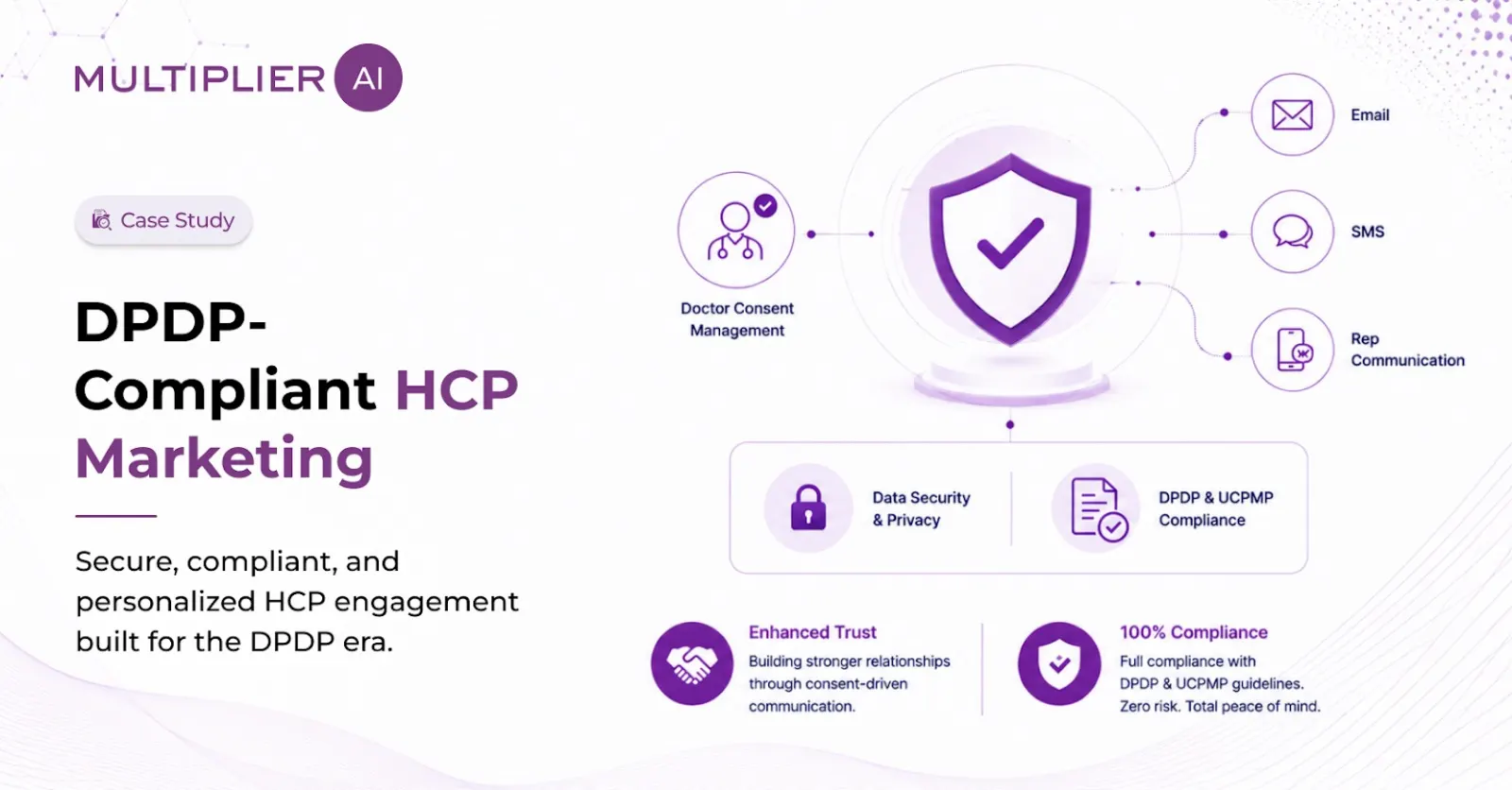
A leading pharmaceutical company wanted to run personalized, multichannel HCP marketing — but India’s Digital Personal Data Protection (DPDP) Act, 2023 and the Uniform Code for Pharmaceutical Marketing Practices (UCPMP) 2024 raised the stakes. The real issue wasn’t the regulation; it was the CRM beneath it: doctor records were inconsistent and ungoverned, and consent either didn’t exist or couldn’t be proven. With penalties reaching ₹250 crore, outbound engagement had become too risky. Using Multiplier AI’s DPDP-Compliant HCP Marketing platform, the company cleansed its doctor data, built provable consent, secured data operations, and made every record audit-ready — reaching 100% DPDP and UCPMP compliance while making outbound HCP marketing possible again.
The company wanted to scale personalized, multichannel doctor engagement. But under India’s DPDP Act, 2023 and UCPMP 2024, every campaign now carried real legal and reputational risk — and the company’s data wasn’t ready.
The deeper issue was the CRM, not the regulation. DPDP didn’t create the problem; it exposed it:
- Ungoverned data — HCP names, specialities, and locations didn’t match across systems; reps, marketing, and external sources all fed data differently, with no single source of truth.
- Consent that couldn’t be proven — consent often didn’t exist, or existed but couldn’t be documented or defended in an audit.
- Unsafe data practices — buying or scraping doctor data created immediate DPDP violations.
- Severe penalties — DPDP fines reach ₹250 crore for a security-safeguard failure that leads to a breach, with further tiers up to ₹200 crore; UCPMP adds scrutiny over how pharma engages HCPs.
- High stakes for a listed company — a single mistake could mean penalties, product withdrawals, and irreversible reputation damage.
The result was relationship-based marketing only. Scalable, outbound HCP engagement had become nearly impossible without risking compliance.
The company deployed Multiplier AI’s DPDP-Compliant HCP Marketing platform — not a generic marketing tool, but a pharma-grade data cleansing and consent-creation system built to make HCP data usable, compliant, and safe for outreach.
Four capabilities did the work:
- Domain-intelligent data cleansing — AI that understands pharma specialities, hierarchies, and terminology cleaned and reconciled the doctor database into a single source of truth.
- Consent creation, not scraping — new HCP data was built through compliant, consent-driven workflows with explicit, provable consent — no scraping, no shortcuts, no regulatory exposure.
- Secure data operations — doctor data stayed private and controlled within defined boundaries, with strict role-based access — not a shared or open AI model.
- Audit-ready by default — every data action, consent event, and interaction was logged immutably, so any campaign could be defended on demand.
Governance was built in: explicit consent tracking, purpose limitation, data minimisation, retention enforcement, and immutable audit trails. The same clean, consented foundation connects to Multiplier AI’s GenAI Doctor Data Platform and hyper-personalized content — so compliant data also powers better engagement.
Within 30–60 days, compliance shifted from a bottleneck to a foundation.
- 100% DPDP & UCPMP compliance — consent, security, and audit controls aligned fully with both frameworks.
- 100% consent-backed outreach — every doctor contacted had explicit, documented, defensible consent.
- 100% audit-ready records — every data action and consent event logged and defensible on demand.
- Zero penalties or breaches — eliminating exposure to fines that reach ₹250 crore.
- Outbound engagement, unlocked — clean, consented data made scalable, multichannel HCP marketing possible again.
Stronger trust with doctors followed naturally — when engagement is consented and relevant, relationships deepen instead of eroding.
DPDP Isn’t the Root Cause — CRM Chaos Is
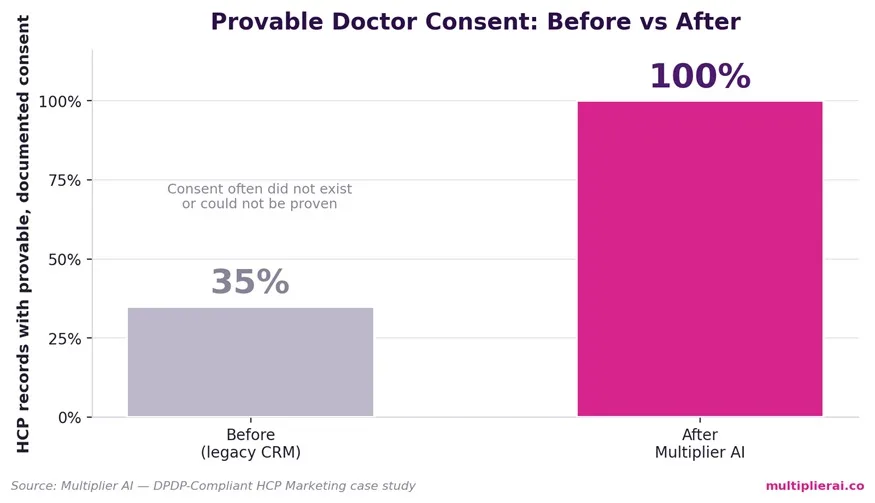
Most pharma companies don’t have a DPDP implementation problem. They have a data problem that DPDP exposed. Years of relationship-based marketing left CRMs inconsistent and ungoverned: specialities and locations that don’t match, data fed differently by every team, and no single source of truth. On top of that, consent often didn’t exist — or couldn’t be proven. The first job wasn’t to “implement DPDP”; it was to fix the data and build provable consent underneath it.
The Real Cost of Non-Compliance
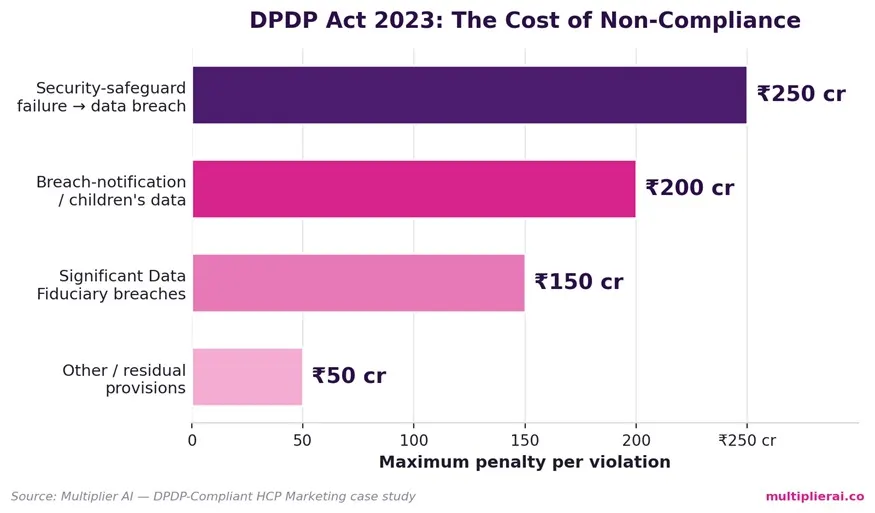
For a listed pharmaceutical company, the downside is not theoretical. The DPDP Act, 2023 imposes penalties of up to ₹250 crore for failing to maintain reasonable security safeguards when a breach occurs, with further tiers up to ₹200 crore — and UCPMP 2024 adds scrutiny over how pharma engages HCPs. Buying or scraping doctor data is an instant violation. Beyond fines, the cost shows up as product withdrawals and reputation damage that cannot be reversed. Read how Multiplier AI approaches DPDP-compliant HCP marketing.
Consent Creation, Not Data Scraping
The only safe way to grow an HCP database is to create consent, not harvest data. Multiplier AI builds new doctor contacts through compliant, consent-driven workflows — capturing explicit, provable consent with a clear record of when and how it was obtained. This is paired with data minimisation and purpose limitation, so only the data needed for an approved purpose is collected and used. The result is a doctor database that grows without ever creating regulatory exposure.
Secure, Audit-Ready by Default
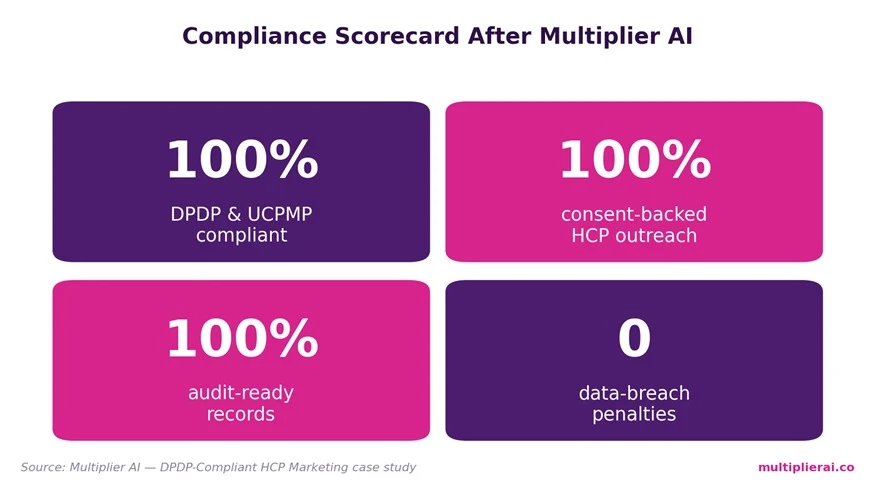
Compliance has to be provable, not promised. Every data action, consent event, and interaction is logged in an immutable audit trail, and doctor data stays inside controlled boundaries with strict role-based access — never a shared or open AI model. Explicit consent tracking, purpose limitation, data minimisation, and retention enforcement are built in, so the company can defend any campaign on demand. The outcome is a clean compliance scorecard.
Compliance as a Foundation — Why Pharma Teams Choose Multiplier AI
Once data is clean and consent is provable, compliance stops being a bottleneck and becomes a foundation: outbound HCP engagement is possible again, dependency on unsafe vendors drops, and the team can scale without reputational fear. Multiplier AI is built for regulated, reputation-sensitive organisations — privately deployed, healthcare-only, with compliance engineered in from day one, typically delivering measurable results within 30 to 60 days. Explore more AI solutions for pharma companies or browse other Multiplier AI case studies
“Compliance used to be the reason we couldn’t market to doctors. Now it’s the reason we can — every outreach is consented, secure, and audit-ready.”
DPDP exposed a data problem, not a marketing problem — ungoverned CRMs and unprovable consent were the real risk.
Consent must be created, not scraped — buying or scraping doctor data is an instant DPDP violation; compliant consent workflows are the only safe path.
The stakes are real — DPDP penalties reach ₹250 crore, and for a listed pharma company reputation damage is irreversible.
Compliance can be a foundation — clean, consented, audit-ready data makes scalable HCP marketing possible again.
Ready to See Similar Results?
Talk to our team about your challenges. No pitch — just a real conversation about what you need.
Schedule a 30-Minute Free Consultation →Let's Discuss Your Requirements