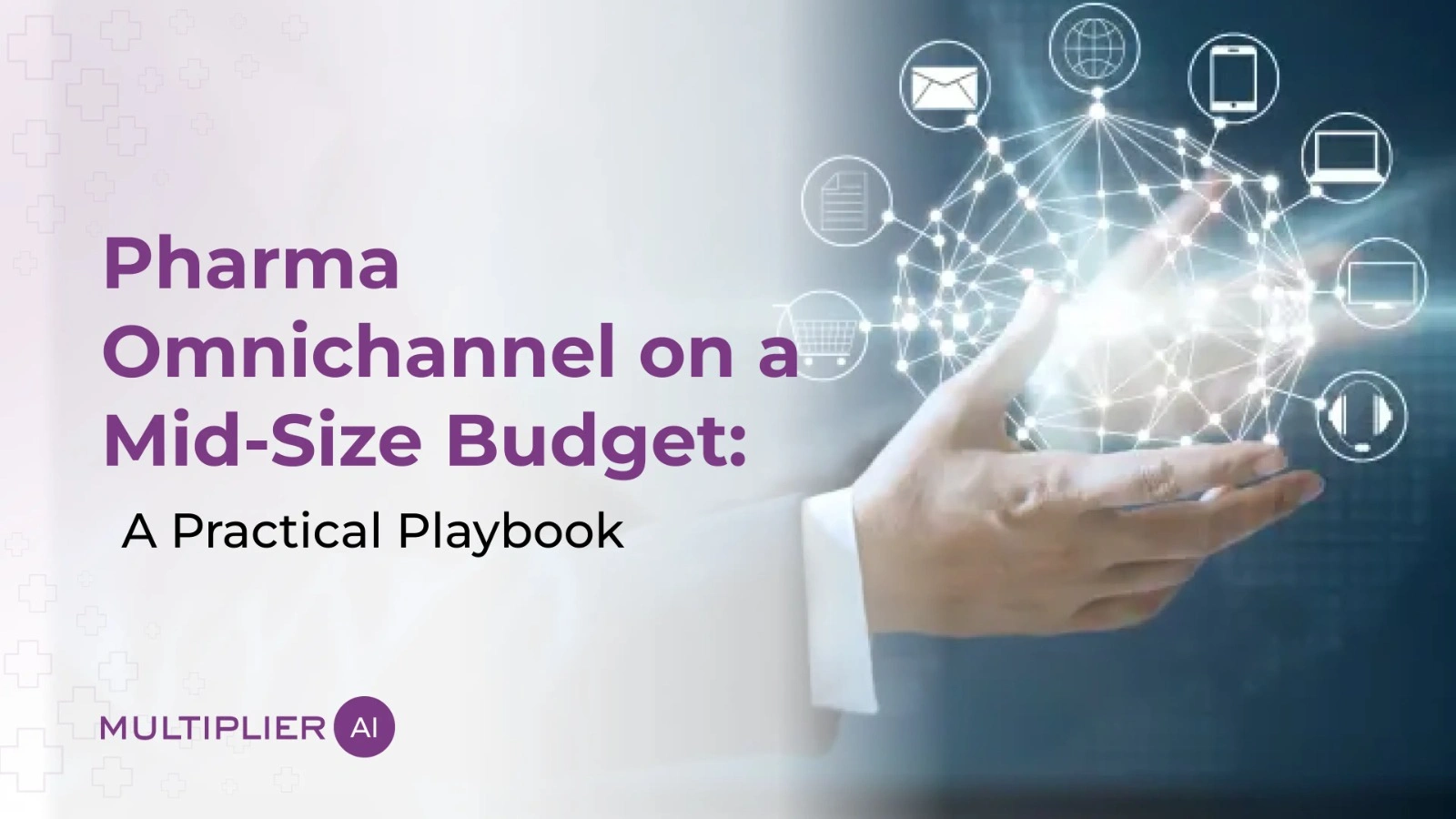
Pharma Omnichannel on a Mid-Size Budget: A Practical Playbook for Growth
Most pharma companies do not need an enterprise-sized budget to begin omnichannel. They need a sharper focus, cleaner HCP data, coordinated workflows, and a practical way to connect existing field and digital channels.
There is a common belief in the pharma industry that true omnichannel engagement is only achievable for large organizations with extensive resources. The assumption is that without massive budgets, advanced platforms, and dedicated teams, meaningful coordination across channels is not realistic. Recent omnichannel marketing trends in pharma show that success depends less on channel volume and more on connected execution, data quality, and personalization.
This belief is one of the biggest reasons mid-size pharma companies fall behind. In reality, the gap is not primarily about budget. It is about how resources are used. Many large organizations invest heavily in tools but struggle with execution because of complexity, silos, and slow decision-making.
Mid-size companies have a different advantage. They can move faster, test focused use cases, align teams more easily, and avoid overbuilding before they know what works. Omnichannel does not start with scale. It starts with focus. A well-designed approach, even with limited resources, can outperform a poorly coordinated strategy with a larger budget.
What Is Pharma Omnichannel on a Mid-Size Budget?
Pharma omnichannel on a mid-size budget means building connected HCP engagement journeys using existing channels, focused use cases, usable doctor data, selective AI, and coordinated field and digital execution instead of relying on large enterprise budgets or complex transformation programs.
In simple terms, mid-size pharma companies do not need to start with every channel, every platform, or every data source. They need to connect the most important channels around the most valuable HCP use cases first.
Why mid-size pharma companies are in a unique position
Mid-size pharma companies operate in a space where efficiency matters more than volume. They cannot rely on sheer scale to drive engagement. Every interaction needs to be intentional.
This constraint can become an advantage.
Without layers of complexity, these organizations can move faster. They can test new approaches, adapt quickly, and align teams more easily. What they often lack is a clear roadmap that translates omnichannel concepts into practical steps.
Instead of trying to replicate enterprise models, mid-size companies need a tailored approach that prioritizes impact over breadth.
| Area | Enterprise omnichannel approach | Mid-size pharma omnichannel approach |
| Scope | Large-scale transformation across brands and markets | Focused use case, therapy area, or HCP segment |
| Budget | High investment in platforms and large teams | Selective investment in data, AI, and execution workflows |
| Technology | Complex multi-system stack | Practical tools connected to priority workflows |
| Data | Broad integration across many sources | Usable HCP view from CRM, digital, and prescription signals |
| Execution | Multiple teams and layers | Faster coordination across smaller teams |
| AI adoption | Enterprise-wide automation roadmap | Targeted AI for prioritization, content, and engagement |
| Success measure | Transformation maturity | Engagement improvement and commercial efficiency |
The real problem is not lack of channels, but lack of coordination
Most mid-size pharma teams already use multiple channels. They send emails, run digital campaigns, and deploy field reps. On paper, this looks like omnichannel.
The issue is that these channels are not connected.
Email campaigns are planned independently from field activities. Digital engagement is tracked, but the insights rarely influence the next action. Each channel operates within its own framework.
This creates inefficiency.
Doctors receive communication that feels repetitive or disconnected. Teams spend resources on activities that do not reinforce each other. Over time, this reduces engagement and increases cost per interaction.
Fixing this does not require adding more channels. It requires making existing channels work together. A practical omnichannel pharma strategy should turn email, field visits, digital campaigns, and content into one connected HCP journey.
This is the same principle behind omni channel customer engagement in healthcare, where existing touchpoints become more valuable when they support one connected experience.
Starting with a focused use case instead of a full transformation
One of the biggest mistakes organizations make is trying to implement omnichannel across the entire business at once. This approach is expensive, complex, and difficult to manage.
A more effective strategy is to start with a focused use case.
For example, a company might choose a specific therapy area, a high-value segment of HCPs, or a product launch. By concentrating efforts on a defined scope, teams can design and test an omnichannel approach without overwhelming resources.
| Focused use case | How omnichannel can start |
| Product launch | Connect digital education, email follow-up, and rep visits for priority HCPs |
| Therapy-area education | Share clinical content based on HCP interest and trigger rep follow-up |
| High-value HCP segment | Coordinate field and digital engagement for top-prescribing or high-potential doctors |
| Low-engagement HCPs | Test alternate channels and reduce repetitive communication |
| Webinar follow-up | Use attendance signals to personalize the next email or field interaction |
| Regional campaign | Start with one region before scaling to more territories |
Within this scope, the goal is to create a connected experience. Each interaction should build on the previous one, and every channel should contribute to a common objective.
This approach allows organizations to learn quickly and demonstrate value before expanding further.
A 90-Day Omnichannel Pilot Plan for Mid-Size Pharma
A practical omnichannel program can start with a 90-day pilot instead of a full transformation. The goal is to prove that connected engagement can improve relevance, reduce waste, and create better HCP response.
In the first 30 days, teams should select one therapy area, one HCP segment, and two or three channels such as email, digital content, and field visits. They should clean the core HCP list, define the engagement objective, and map the basic journey.
In the next 30 days, teams should run the coordinated journey. For example, digital engagement can trigger email follow-up, and strong content engagement can trigger a rep visit with a relevant discussion point.
In the final 30 days, teams should measure performance, identify what worked, refine the rules, and decide whether the use case should be expanded to another region, segment, or therapy area.
| Phase | Timeline | Main action | Expected output |
| Phase 1 | Days 1-30 | Select use case, HCP segment, channels, data sources, and journey objective | Clear pilot scope and clean priority HCP list |
| Phase 2 | Days 31-60 | Run connected field and digital engagement using simple coordination rules | Live omnichannel test with measurable HCP interactions |
| Phase 3 | Days 61-90 | Review engagement quality, follow-up conversion, cost per interaction, and journey progression | Scale decision based on evidence |
Building a simple but effective data foundation
Data is often seen as a barrier to omnichannel implementation, especially for mid-size companies. The assumption is that advanced data infrastructure is required before any progress can be made. In reality, the goal is not to build a perfect data system. It is to create a usable one.
The first step is identifying the most important data sources. This typically includes CRM data, digital engagement metrics, and prescription data.
| Priority | Why it matters | Budget-friendly starting point |
| HCP data quality | Poor data weakens every channel | Clean and validate key doctor records |
| CRM visibility | Field teams need recent HCP context | Connect CRM activity with engagement signals |
| Digital engagement | Shows interest and topic preference | Track email, content, and webinar activity |
| Content relevance | Reduces generic communication | Build reusable content blocks by HCP segment |
| Channel coordination | Prevents overlap and repetition | Create simple rules for email-to-rep follow-up |
| AI prioritization | Focuses limited resources | Use AI to identify high-opportunity HCPs |
| Consent governance | Prevents compliance risk | Track consent and permitted channels |
Instead of trying to integrate everything at once, teams can focus on connecting these key sources.
The objective is to create a basic but unified view of each HCP. This does not need to be highly complex. Even a simple integration that shows recent interactions and engagement patterns can provide valuable insights.
A GenAI Doctor Data Platform can help mid-size pharma teams create this unified HCP view by connecting doctor data, CRM activity, digital signals, and real-time physician insights into one practical intelligence layer.
What matters is that this data is accessible and can be used to inform decisions. Strong doctor data in pharma is the foundation for deciding which HCPs to prioritize, which channels to use, and what message should come next.
Designing engagement around behavior, not assumptions
Traditional planning often relies on assumptions about how doctors behave. Omnichannel requires a shift toward observing actual behavior.
This means paying attention to how doctors interact with different channels. Which emails are opened, which content is consumed, and how often rep visits lead to meaningful conversations.
By analyzing these patterns, teams can begin to identify what works.
For example, if a group of doctors consistently engages with digital content before responding to rep visits, this sequence can be incorporated into the engagement strategy. If another group shows low digital engagement but responds well to in-person interactions, the approach can be adjusted accordingly.
This level of responsiveness does not require complex AI systems at the beginning. It requires a mindset shift toward using data as a guide rather than relying solely on predefined plans.
Making channel coordination practical
Coordination does not need to be complicated to be effective. At a basic level, it involves ensuring that interactions across channels are aligned. If an email introduces a topic, the next interaction should build on that topic rather than repeating generic information.
This can be achieved through simple rules and workflows.
| HCP signal | Simple coordination rule |
| Doctor opens therapy-related email | Send follow-up content or alert rep for contextual visit |
| Doctor attends webinar | Share related clinical content within 48 hours |
| Doctor ignores repeated emails | Reduce email frequency and test an alternate channel |
| Doctor downloads detailed content | Prioritize for field discussion |
| Rep records strong interest in CRM | Trigger personalized digital follow-up |
| Doctor has no consent for a channel | Suppress that channel and use permitted alternatives |
The key is to create connections between interactions. As the system matures, these rules can be refined and eventually replaced with more advanced models. However, even simple coordination can significantly improve engagement.
Using AI selectively to increase efficiency
AI does not need to be implemented across every aspect of the system from the beginning. Mid-size companies can benefit by applying it to specific areas where it provides the most value.
One such area is prioritization. AI can analyze available data to identify which HCPs are most likely to engage at a given time. This allows teams to focus their efforts on high-impact opportunities rather than spreading resources evenly.
Another area is content personalization. AI can help generate variations of content that are tailored to different segments or behaviors. Modular content for pharma marketing can make this more manageable by allowing approved content blocks to be reused across HCP segments and channels. A Hyper Personalized Content Platform helps mid-size pharma teams scale this personalization by automating content creation, cohort building, and personalized messaging across email, WhatsApp, and digital channels.
By applying AI selectively, organizations can achieve meaningful improvements without large investments. AI in omni channel marketing for pharmaceuticals can help mid-size teams prioritize high-impact HCP opportunities, personalize engagement, and coordinate field and digital actions without starting with a full enterprise program.
GET ACTIONABLE AI AND HEALTHCARE INSIGHTS THAT HELP YOU STAY AHEAD IN A FAST-CHANGING PHARMA WORLD
How Multiplier AI Helps Mid-Size Pharma Teams Build Omnichannel
Multiplier AI helps mid-size pharma teams build practical omnichannel capabilities without needing a large enterprise transformation. The platform supports the key foundations required for focused execution: reliable doctor data, CRM-connected insights, personalized content, real-time engagement signals, and consent-aware HCP communication.
For teams starting with a focused use case, Multiplier AI can help identify priority HCPs, understand recent engagement behavior, personalize content, and coordinate field and digital touchpoints. This allows teams to start small, prove impact, and scale what works.
Instead of adding more disconnected tools, mid-size pharma companies can use Multiplier AI to connect existing channels around clearer HCP journeys and measurable outcomes.
Aligning teams around outcomes instead of activities
A common challenge in omnichannel implementation is misalignment between teams. Marketing may focus on campaign performance, while field teams focus on call volume. These metrics do not always reflect the overall effectiveness of engagement. Sales acceleration and enablement platforms for pharma become more effective when field activity is connected to digital engagement, HCP intent, and shared commercial outcomes.
To address this, organizations need to shift toward outcome-based metrics. This includes measuring engagement quality, progression through interaction journeys, and changes in prescribing behavior. When teams are aligned around these outcomes, coordination becomes more natural.
| Metric | Why it matters |
| Engagement quality | Shows whether HCPs are interacting meaningfully |
| Channel coordination rate | Measures whether email, digital, and field actions are connected |
| Rep follow-up conversion | Tracks whether digital signals lead to useful field action |
| Cost per meaningful interaction | Helps mid-size teams control spend |
| HCP journey progression | Shows whether HCPs move through intended touchpoints |
| Content reuse efficiency | Measures whether approved content is used efficiently |
| Consent-safe engagement | Ensures channels are used within approved permissions |
This also encourages collaboration. Instead of optimizing individual channels, teams work together to improve the overall HCP experience.
Scaling what works without increasing complexity
Once a focused use case demonstrates success, the next step is scaling. This does not mean replicating the approach exactly across all areas. It means applying the underlying principles while adapting to different contexts.
For example, the same framework used for one therapy area can be extended to others, with adjustments based on specific requirements. Data integration can be expanded gradually, and AI capabilities can be introduced incrementally. The goal is to grow capabilities without introducing unnecessary complexity.
By building on proven approaches, organizations can scale effectively while maintaining control.
Avoiding common omnichannel pitfalls
As teams move forward, there are several pitfalls to watch for. The first is overcomplication. Adding too many tools or processes can slow down progress and reduce adoption. It is better to keep the system simple, focused, and useful for the teams who will actually use it.
The second pitfall is neglecting adoption. Even the best-designed strategy will fail if teams do not use it. Training, communication, and support are essential to ensure that new approaches are embraced.
The third pitfall is losing focus. Expanding too quickly without solid foundations can lead to fragmentation. Mid-size teams should progress steadily and build on success.
Compliance and Consent for Budget-Sensitive Omnichannel
Mid-size pharma companies should not treat compliance as something to add later. Even a focused omnichannel use case must include consent tracking, channel permissions, approved content rules, frequency controls, and audit visibility.
A DPDP-Compliant HCP Marketing framework helps pharma teams activate HCP data with explicit consent, compliant outreach, channel permissions, and audit-ready workflows without rebuilding the entire tech stack.
This becomes especially important when field, email, WhatsApp, digital campaigns, and content journeys begin to work together. If a doctor has not consented to a specific channel, the engagement workflow should automatically avoid that channel. If a campaign is approved for one purpose, the same data should not be reused for unrelated outreach without proper governance.
A budget-sensitive omnichannel strategy should therefore prioritize simple but strong governance from the beginning. The goal is not to build a complex compliance layer immediately. The goal is to ensure that every interaction is relevant, permitted, and traceable.
What success looks like for mid-size pharma companies
When omnichannel is implemented effectively, the impact is visible across multiple dimensions. Engagement becomes more consistent and meaningful. Doctors receive communication that aligns with their interests and behavior. Interactions feel connected rather than isolated.
Teams become more efficient. Resources are directed toward high-impact activities, and decision-making becomes more informed. From a business perspective, this leads to improved outcomes. Campaigns perform better, relationships strengthen, and overall effectiveness increases. This is a practical way to improve sales in a pharma company because teams can focus limited resources on the HCPs, channels, and interactions that create the most value.
Perhaps most importantly, organizations gain clarity. They understand what works and why, which allows them to refine strategies continuously.
Conclusion
Omnichannel engagement is often seen as a complex and resource-intensive initiative, but it does not have to be. For mid-size pharma companies, the key is to focus on coordination rather than expansion.
By connecting existing channels, using data effectively, applying AI selectively, and aligning teams around outcomes, meaningful progress can be achieved without large budgets. The journey does not require perfection. It requires direction.
Organizations that take a structured and focused approach will find that omnichannel is not just achievable, but highly effective.
You do not need an enterprise budget to start building better omnichannel engagement. You need reliable HCP data, focused use cases, personalized content, consent-aware workflows, and the ability to connect field and digital actions around one doctor journey. Multiplier AI helps mid-size pharma teams build this foundation so they can start small, prove impact, and scale what works.
Frequently Asked Questions For Pharma Omnichannel on a Mid-Size Budget: Practical Growth
Yes. Mid-size pharma companies can start omnichannel by focusing on one use case, connecting existing channels, improving HCP data quality, and using AI selectively for prioritization and personalization.
The first step is to choose a focused use case such as one therapy area, one product launch, one region, or one high-value HCP segment.
Not immediately. They need a usable HCP data foundation, aligned teams, simple coordination rules, and a clear engagement objective before scaling technology.
The most useful starting data includes CRM activity, digital engagement, prescription trends, HCP profiles, content interactions, and consent status.
AI can help prioritize HCPs, identify engagement opportunities, personalize content, recommend follow-ups, and improve coordination between field and digital channels.
Start with the channels already in use, usually email, field visits, webinars, digital content, and CRM workflows.
They often fail because teams try to do too much too soon, add tools without fixing data, ignore adoption, or measure channel activity instead of engagement outcomes.
They should measure engagement quality, HCP journey progression, rep follow-up conversion, channel coordination, cost per meaningful interaction, and consent-safe engagement.
Teams should scale only what works, expand one use case at a time, reuse content and workflows, and add AI capabilities gradually.
Multiplier AI helps mid-size pharma teams unify doctor data, personalize content, connect CRM and digital signals, manage consent-aware engagement, and coordinate HCP journeys without needing a full enterprise transformation.
GET ACTIONABLE AI AND HEALTHCARE INSIGHTS THAT HELP YOU STAY AHEAD IN A FAST-CHANGING PHARMA WORLD
Let's Discuss Your Requirements