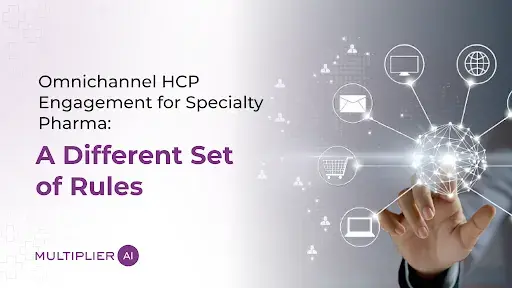
Omnichannel HCP Engagement for Specialty Pharma: A Different Set of Rules
Most omnichannel strategies in pharma are built with scale in mind. They assume large HCP bases, broad segmentation, and high-volume outreach across multiple channels. This approach can work reasonably well for primary care therapies where reach and frequency are important.
Specialty pharma operates in a different environment. The target HCP base is smaller, the clinical complexity is higher, and each interaction carries more weight. Every specialist may represent a meaningful part of the opportunity, especially in rare disease, oncology, immunology, neurology, dermatology, or other complex therapeutic areas.
This is why omnichannel specialty pharma HCP engagement requires a more precise, clinically informed, and relationship-driven approach than broad-market pharma campaigns.
The issue is not the lack of effort. Specialty pharma teams often invest heavily in field teams, medical engagement, scientific content, and digital programs. The problem is that broad-market omnichannel models do not always fit specialty contexts.
Specialty pharma does not need more touchpoints for the sake of visibility. It needs better touchpoints, better timing, deeper HCP intelligence, stronger medical context, and tighter coordination across field, medical, and digital teams.
What Is Omnichannel HCP Engagement for Specialty Pharma?
Omnichannel HCP engagement for specialty pharma means coordinating field, medical, digital, content, CRM, and consent-aware interactions around a smaller, highly specialized group of healthcare professionals using clinical context, precise HCP profiles, and behavior-based insights.
Unlike broad-market omnichannel strategies, specialty pharma engagement focuses less on reach and frequency and more on relevance, depth, trust, scientific credibility, and coordinated communication.
In simple terms, specialty pharma omnichannel is not about reaching more doctors. It is about engaging the right doctors with the right scientific context, through the right channel, at the right moment.
Why Specialty Pharma Cannot Follow the Same Playbook
In broad-market pharma, campaign design often starts with scale: how many HCPs can be reached, how frequently they can be contacted, and how many channels can be activated. Specialty pharma should start with a different question: which HCPs truly matter, what context do they need, and how can each interaction build trust?
Specialty HCPs are often deeply knowledgeable. They may be involved in complex diagnosis, treatment sequencing, patient selection, clinical trials, multidisciplinary care, or management of rare and refractory cases. Basic product awareness is rarely enough.
They do not need generic reminders. They need relevant evidence, practical interpretation, patient-type context, expert discussion, and timely follow-up that respects their workflow.
| Area | Broad-Market Pharma Omnichannel | Specialty Pharma Omnichannel |
| Target HCP base | Large and broad | Smaller and highly specialized |
| Main goal | Reach and frequency | Precision, depth, and relationship quality |
| Content style | Broad product or disease messaging | Clinical-context-specific scientific content |
| Segmentation | Specialty, geography, and volume | Expertise, patient mix, treatment behavior, influence, and scientific interest |
| Field role | Coverage and reinforcement | Deep relationship and clinical context |
| Medical affairs role | Supportive | Central to credibility and expert engagement |
| Digital role | Scale and reminders | Precision support, education, and continuity |
| Success measure | Campaign reach and engagement volume | Engagement quality, trust, adoption indicators, and depth |
Understanding the nature of specialty HCP engagement
Specialty HCP engagement is not just another version of general HCP engagement. It is shaped by clinical complexity, expert networks, scientific expectations, patient-specific decision pathways, and a higher need for credibility.
Specialists are more selective about the content they consume. They are more likely to ignore generic messaging and more likely to value content that reflects their specific patient population, clinical questions, or treatment challenges.
Relationships also play a different role. In specialty pharma, trust is built through repeated, meaningful, and scientifically credible interactions. Field teams, medical affairs, digital content, and peer/KOL engagement all contribute to that trust.
This means specialty engagement should be treated as a journey of scientific relevance, not a sequence of promotional touches.
Why Traditional Omnichannel Approaches Fall Short
Traditional omnichannel strategies often emphasize reach, frequency, and channel activation. In specialty pharma, this can become counterproductive. High-frequency communication may create fatigue. Broad messaging may fail to address specific clinical questions. Digital campaigns may be ignored if they do not connect to the HCP’s real interests.
Standard segmentation is another limitation. Grouping specialists only by specialty or prescribing volume misses important differences. Two oncologists, dermatologists, neurologists, or rheumatologists may work in the same area but treat different patient subtypes, follow different evidence preferences, and engage with different kinds of content.
Top-performing omnichannel guidance from the market increasingly emphasizes precision, connected customer journeys, data-driven field alerts, and unified engagement goals rather than isolated channel activity. For specialty pharma, these ideas become even more important because each interaction is more consequential.
Scale-Driven vs Precision-Driven Omnichannel Engagement
The most important shift in specialty pharma is moving from scale to precision. Instead of asking how many HCPs can be reached, teams should ask how effectively each priority HCP can be engaged.
Precision also applies to channel selection. In specialty pharma omnichannel engagement, the right channel should be chosen based on HCP preference, clinical context, relationship stage, and the depth of discussion required.
For example, a short email may be useful after a webinar. A field visit may be better for relationship-building. A medical affairs interaction may be needed when the HCP has a complex scientific question. A digital follow-up can reinforce key evidence after a discussion.
The goal is not to maximize touchpoints. The goal is to create precision HCP engagement that reflects clinical complexity, scientific interest, and individual doctor context.
Building Rich Specialty HCP Profiles
Specialty pharma engagement depends on understanding HCPs at a much deeper level than basic specialty, geography, or prescribing volume. A meaningful profile should include clinical focus areas, patient mix, treatment behavior, scientific interests, content engagement, prior field interactions, and medical affairs touchpoints.
A GenAI Doctor Data Platform can support this precision by connecting doctor data, CRM activity, KOL insights, real-time physician signals, and preferred-channel communication into one HCP intelligence layer.
This is especially important because two specialists in the same therapy area may have very different needs. One may focus on early-stage patients, another on complex refractory cases, and another on clinical research or multidisciplinary care. Treating them as one segment weakens relevance.
A rich specialty HCP profile allows pharma teams to decide which content is relevant, which expert interaction is needed, which channel should be used, and how the next engagement should build on the previous one.
doctor data in pharma is the foundation for building specialty HCP profiles that reflect clinical focus, treatment behavior, engagement history, and communication preference.
| Data Signal | Why It Matters in Specialty Pharma |
| Subspecialty focus | Helps match content to clinical expertise |
| Patient profile mix | Shows which cases are most relevant |
| Treatment patterns | Helps understand real-world decision behavior |
| Clinical trial involvement | Indicates scientific interest and influence |
| Publication or conference activity | Supports KOL and expert mapping |
| Prior field interactions | Gives context for relationship-building |
| Medical affairs engagement | Shows interest in deeper scientific discussion |
| Digital content behavior | Reveals topic-level interest |
| Channel preference | Helps choose field, medical, email, webinar, WhatsApp, or digital |
| Consent status | Ensures engagement follows permitted channels |
Designing Engagement Around Clinical Context
In specialty pharma, content is not just a campaign asset. It is part of the clinical conversation. Doctors are looking for information that helps them manage complex decisions, understand emerging evidence, and apply data to the patient types they see.
Instead of delivering generic messages across channels, content should be designed to align with specific clinical contexts.
A Hyper Personalized Content Platform helps specialty pharma teams create doctor-specific content journeys by using cohort building, personalized messaging, and real-time doctor behavior tracking.
For example, communication can be tailored to patient type, disease stage, treatment history, therapy switching, refractory cases, or multidisciplinary care pathways. This makes the content more useful and improves the chances that the HCP will engage meaningfully.
Modular content for pharma marketing can help specialty teams reuse approved scientific content blocks while adapting messages for specific patient types, treatment stages, and HCP interests.
| Clinical Context | Content Angle |
| Newly diagnosed patients | Treatment initiation considerations |
| Complex or refractory cases | Evidence and expert discussion material |
| Therapy switching | Comparative data and patient-selection criteria |
| Long-term management | Adherence, monitoring, and outcome tracking |
| Rare patient subgroups | Case-based learning and real-world evidence |
| Specialist education | Deeper scientific summaries and conference updates |
| Multidisciplinary care | Shared decision-making and referral pathway content |
Integrating Field, Medical, and Digital Efforts
One defining feature of specialty pharma is the need for stronger collaboration across field sales, medical affairs, digital, analytics, and compliance teams. No single team owns the full HCP experience.
Field teams often identify practical questions and relationship context. Medical affairs provides scientific depth and credibility. Digital teams support continuity and education at scale. Analytics teams identify signals and prioritization opportunities. Compliance teams ensure that the entire journey is safe and approved.
To achieve true omnichannel engagement, these functions need to work together.
AI in omni channel marketing for pharmaceuticals helps align field, medical, digital, CRM, and content actions into one coordinated HCP journey.
A strong specialty model should avoid parallel activities. If field teams are discussing one issue, digital content should not push an unrelated message. If an HCP asks a complex evidence question, medical affairs should be connected into the journey. If digital behavior shows high interest, the field team should see that signal before the next interaction.
| Team | Role in Specialty Omnichannel | Example Action |
| Field team | Builds relationship and identifies HCP needs | Captures clinical questions from the doctor |
| Medical affairs | Provides scientific depth and credibility | Shares approved evidence or expert discussion |
| Digital team | Supports continuity and scalable education | Sends relevant follow-up content |
| Analytics team | Identifies patterns and prioritization signals | Flags high-interest or high-influence HCPs |
| Compliance team | Ensures safe and approved communication | Reviews content, channel permissions, and purpose alignment |
| Leadership | Aligns outcomes and priorities | Focuses teams on depth, not just activity volume |
Using AI to Enhance Precision and Coordination
The complexity of specialty pharma engagement makes it difficult to manage manually. AI can help teams identify patterns, prioritize HCPs, recommend content, coordinate follow-up, and detect when a different type of engagement is needed.
AI can uncover subtle patterns that may not be immediately visible. For example, it can identify how specific types of content influence engagement or how different sequences of interactions affect outcomes.
GPT & LLM Based Tools can help specialty pharma teams summarize complex medical insights, convert campaign data into actionable guidance, and support guideline-aware engagement decisions.
AI specialty pharma engagement becomes most valuable when it connects field, medical, digital, and content teams around the same HCP intelligence layer.
This is especially useful for specialty teams because small audiences make every signal more important. A content download, webinar attendance, field note, medical inquiry, or KOL activity may all indicate a need for a different next action.
| AI Use Case | How It Helps Specialty Pharma |
| HCP prioritization | Identifies high-value specialists based on relevance and engagement signals |
| KOL mapping | Detects influential HCPs and emerging experts |
| Content recommendation | Matches scientific content to clinical interest |
| Channel selection | Recommends field, medical, webinar, email, WhatsApp, or digital follow-up |
| Journey orchestration | Connects interactions across field, medical, and digital teams |
| Engagement prediction | Identifies which doctors are most likely to respond |
| Medical insight summarization | Helps teams understand complex feedback and questions |
| Compliance checks | Ensures recommendations follow approved rules and permissions |
GET ACTIONABLE AI AND HEALTHCARE INSIGHTS THAT HELP YOU STAY AHEAD IN A FAST-CHANGING PHARMA WORLD
How Multiplier AI Supports Specialty Pharma HCP Engagement
Multiplier AI helps specialty pharma teams move from broad engagement to precision-driven HCP journeys by combining doctor data, digital behavior, CRM activity, scientific content signals, and consent-aware workflows.
The GenAI Doctor Data Platform helps build deeper HCP profiles with real-time doctor insights, KOL intelligence, CRM-connected data, and preferred-channel communication. The Hyper Personalized Content Platform supports doctor-specific content journeys based on digital footprints and behavior. GPT and LLM-based tools can help summarize medical insights, support campaign intelligence, and assist teams in understanding complex engagement signals.
Together, these capabilities help specialty pharma teams coordinate field, medical, and digital engagement around the HCPs who matter most.
Making Omnichannel Execution Practical
Precision-driven omnichannel engagement does not need to begin with a large transformation program. Specialty pharma teams can start with a focused execution model.
The first step is identifying priority HCPs. Since the target base is smaller, teams can create more thoughtful engagement plans for each segment or even for each high-value specialist.
Given the smaller target base in specialty pharma, it is possible to focus on a defined group and develop tailored strategies for each segment or individual.
A Doctor Mobile and Email Platform can help teams validate contactability for priority specialists and ensure outreach is based on reliable doctor communication data.
The second step is building a unified HCP view. This does not have to be perfect on day one. Even connecting CRM notes, digital engagement, content behavior, and medical affairs touchpoints can improve the quality of decisions.
The third step is designing connected engagement sequences. A sequence may begin with a digital scientific update, continue through a field discussion, escalate to medical affairs if a complex question emerges, and end with approved follow-up content.
The final step is continuous learning. Teams should review what worked, which HCPs progressed, which content created deeper engagement, and which channels caused fatigue.
Practical Specialty Pharma Omnichannel Workflow
| Step | What the Team Does | Example |
| 1. Prioritize HCPs | Identify high-value specialists and KOLs | Oncologists managing refractory cases |
| 2. Build context | Review CRM, digital, field, and medical signals | Recent webinar participation plus field question |
| 3. Choose content | Match content to clinical context | Case-based evidence or expert summary |
| 4. Select channel | Use the channel that fits the depth needed | Medical follow-up for complex evidence question |
| 5. Coordinate teams | Align field, medical, and digital next steps | Rep visit followed by approved digital resource |
| 6. Measure quality | Track depth, relevance, progression, and trust | Content engagement plus medical follow-up rate |
| 7. Refine journey | Use feedback to improve the next interaction | Reduce generic content, increase context-specific follow-up |
Compliance and Governance in Specialty Pharma Engagement
Specialty pharma engagement often involves complex scientific content, high-value HCP relationships, and sensitive data-driven targeting. This makes governance especially important.
Data minimisation under DPDP is especially important in specialty pharma because teams should use only the HCP data required for a defined medical or commercial engagement purpose.
Purpose limitation under DPDP also means that specialty HCP engagement should remain aligned with the purpose originally defined and communicated.
Teams should ensure that every interaction uses approved content, respects consent status, follows channel permissions, and stays aligned with the defined communication purpose. Medical, legal, regulatory, and compliance teams should have clear visibility into content, claims, workflows, and audit trails.
A DPDP-Compliant HCP Marketing framework helps specialty pharma teams activate HCP data with explicit consent, compliant outreach, channel permissions, and audit-ready engagement workflows.
Governance should also apply to AI recommendations. If AI suggests a next action, teams should understand which signals were used, whether the recommendation is allowed, and which approved content can be shared.
Specialty engagement can break down when pharma CRMs fail at consent tracking, because field, medical, and digital teams may not know which channels or purposes are permitted for each HCP.
| Governance Area | What Specialty Pharma Should Control |
| Approved content | Only reviewed content, claims, and scientific summaries should be used |
| Consent status | Every channel and purpose should be permissioned |
| Medical review | Complex scientific content should have clear MLR review rules |
| Role-based access | Field, medical, and digital teams should access only relevant data |
| AI transparency | Teams should know why an AI recommendation was made |
| Audit trail | Signals, recommendations, content, and actions should be traceable |
| Frequency control | High-value HCPs should not be over-contacted |
Measuring Success in Specialty Omnichannel Engagement
Measurement in specialty pharma should look different from broad-market measurement. Reach and frequency alone are not enough. A small number of meaningful interactions may be more valuable than a large number of low-relevance touches.
Specialty teams should measure quality, depth, scientific value, journey progression, and relationship strength. They should also consider qualitative feedback from field and medical teams.
The goal is not to prove that more channels were used. The goal is to prove that each interaction helped advance understanding, trust, engagement, or adoption readiness.
| Metric | Why It Matters |
| Depth of HCP interaction | Measures quality beyond touchpoint count |
| Scientific content engagement | Shows whether doctors value the material |
| Medical affairs follow-up rate | Indicates need for deeper evidence discussion |
| Rep conversation quality | Tracks whether field teams are using relevant insights |
| HCP journey progression | Shows whether interactions build over time |
| KOL engagement quality | Measures strategic expert relationship strength |
| Channel relevance | Shows whether the right channel is being used |
| Consent-safe engagement | Confirms communication follows approved permissions |
| Treatment-adoption indicators | Helps assess downstream engagement impact |
Common Mistakes Specialty Pharma Teams Should Avoid
| Mistake | Why It Hurts Specialty Engagement | Better Approach |
| Using primary-care-style frequency goals | Creates fatigue among a smaller HCP base | Prioritize depth and relevance |
| Segmenting only by specialty | Misses patient mix, clinical focus, and scientific interest | Build richer HCP profiles |
| Treating medical affairs as separate | Breaks scientific continuity | Integrate field, medical, and digital journeys |
| Using generic digital content | Fails to address complex clinical questions | Use clinical-context content |
| Measuring only activity volume | Overvalues touches and undervalues trust | Track quality and progression |
| Ignoring consent and purpose limits | Creates governance risk | Use consent-aware workflows |
| No feedback loop | Prevents learning from field and medical signals | Review and optimize journeys continuously |
What Success Looks Like in Specialty Pharma
When omnichannel engagement is implemented well in specialty pharma, the difference is visible. HCP interactions become more focused, more relevant, and more connected.
Doctors receive content that reflects their clinical context. Field teams enter conversations with better intelligence. Medical affairs is brought in when deeper scientific discussion is needed. Digital channels reinforce the journey instead of adding noise.
Teams also operate more efficiently. Resources are directed toward high-impact HCPs and high-value interactions. Leadership gains a clearer view of which engagement strategies are improving depth, trust, and outcomes.
For specialty pharma, success is not more communication. It is better communication with the HCPs who matter most.
Conclusion
Specialty pharma operates under a different set of rules for HCP engagement. The smaller target base, higher clinical complexity, and greater importance of each interaction require a shift from scale-driven strategy to precision-driven engagement.
Omnichannel engagement in this context is not about using more channels. It is about using each channel more intelligently. The strongest specialty pharma strategies combine rich HCP profiles, clinical-context content, field-medical-digital coordination, AI insights, and compliance-aware execution.
Specialty pharma teams that adapt their omnichannel playbook around precision, depth, and trust will be better positioned to engage expert HCPs and support stronger commercial and medical outcomes.
Specialty pharma engagement cannot rely on broad targeting and generic omnichannel playbooks. It requires deeper HCP intelligence, clinical-context content, coordinated field-medical-digital workflows, and compliant engagement controls. Multiplier AI helps specialty pharma teams build this foundation using GenAI doctor data, hyper-personalized content, GPT and LLM-based insights, and DPDP-compliant HCP marketing workflows.
Frequently Asked Questions For Omnichannel HCP Engagement for Specialty Pharma What Works Differently
Omnichannel HCP engagement for specialty pharma means coordinating field, medical, digital, content, and CRM interactions around specialized doctors using clinical context, HCP profiles, and behavior-based insights.
Specialty pharma usually has a smaller HCP target base, higher clinical complexity, deeper scientific content needs, and greater importance of each individual doctor relationship.
Traditional strategies often focus on reach and frequency. Specialty pharma needs precision, relevance, clinical depth, and coordinated scientific engagement.
Useful data includes subspecialty focus, patient mix, treatment patterns, clinical trial activity, publication history, field interactions, medical affairs engagement, content behavior, channel preference, and consent status.
Content should be tailored to clinical context, patient types, treatment stages, scientific interest, and the HCP’s level of familiarity with the topic.
Medical affairs provides scientific depth, responds to complex clinical questions, supports evidence-based discussion, and strengthens credibility in expert HCP relationships.
AI helps prioritize HCPs, identify clinical interests, recommend content, choose channels, coordinate journeys, detect KOLs, and summarize complex engagement signals.
Specialty pharma should measure depth of interaction, scientific content engagement, medical affairs follow-up, HCP journey progression, KOL engagement quality, and consent-safe engagement.
Teams need approved content, consent tracking, channel permissions, purpose limitation, data minimisation, audit trails, role-based access, and transparent AI recommendation logic.
GET ACTIONABLE AI AND HEALTHCARE INSIGHTS THAT HELP YOU STAY AHEAD IN A FAST-CHANGING PHARMA WORLD
Let's Discuss Your Requirements