
Closed-Loop Marketing in Pharma: The Complete Guide
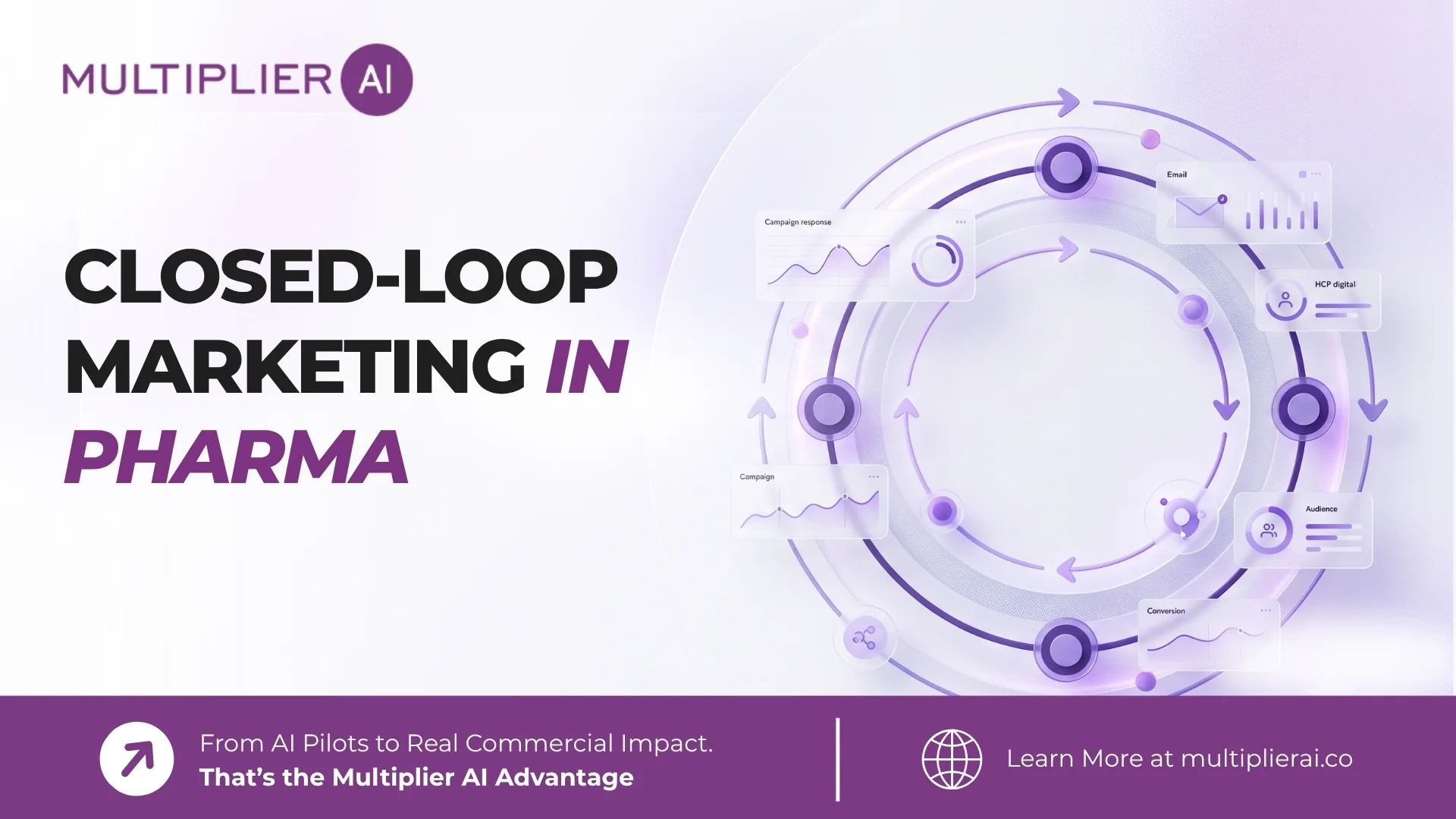
Closed-loop marketing (CLM) in pharma is a cycle in which a representative presents approved digital content to a doctor, the system records how that doctor responded, and those recorded reactions change what is presented next time. The loop has four stages — deliver, capture, analyse, adapt — and the last one is what makes it closed. In practice CLM most often refers to tablet-based e-detailing, where a rep works through an interactive presentation and the platform logs which slides were shown, for how long, in what order, and how the doctor reacted to each key message. The distinguishing feature is not the tablet or the analytics. It is whether the captured reaction demonstrably changes the next interaction.
What is closed-loop marketing in pharma?
Start with the name, because it contains the whole idea and is routinely ignored. The loop is the point. Marketing goes out, information comes back, and the returning information changes what goes out next. A loop that only runs in one direction is not closed, and most of what is called CLM in pharma runs in one direction.
The four stages
| Stage | What happens | What must exist for it to work | Commonly missing? |
|---|---|---|---|
| 1. Deliver | A rep presents approved interactive content to a doctor typically on a tablet, in person or remotely | Approved content synced from the content system to the rep's device, available offline | Rarely. This is the stage everyone builds |
| 2. Capture | The system records what was shown, for how long, in what order, and how the doctor reacted to each key message | Content built with discrete, tagged key messages and a reaction-capture mechanism | Sometimes. Often collected but shallow, a deck of flat slides has nothing to capture |
| 3. Analyse | Captured interactions are aggregated into something interpretable at doctor, message and territory level | A place for the data to land, and someone whose job includes reading it | Frequently. Data lands in a report nobody opens |
| 4. Adapt | The next interaction with that doctor differs because of what was captured | A decision rule connecting the analysis to the next call or message | Almost always. This is the missing stage and it is the one the name refers to |
Where the term came from, and why it misleads now
CLM entered pharma vocabulary with tablet detailing, and the term carries assumptions from that moment: a rep, in a room, with a device, presenting a sequence. Everything in the standard definition assumes the field visit is the interaction being closed.
That assumption no longer holds. A doctor today may see an approved email, open a piece of content on their phone, attend a webinar, receive a WhatsApp message and then have a rep visit and CLM as classically defined observes only the last of those. Closing the loop on the rep visit alone means closing the loop on a shrinking share of the relationship, which is why the second question this article answers matters more than the first.
The uncomfortable finding: most CLM is not closed
This deserves stating plainly because it changes what a brand team should do next, and because it is unusually well evidenced.
We reviewed three substantial sources on closed-loop marketing, including Veeva's own product documentation. All three describe the loop clearly. All three become vague at precisely the same point. None specifies how a captured reaction changes a subsequent interaction, none gives a worked example of the adaptation step, and none offers a single adoption or effectiveness figure. One source names the failure directly that extracted data lacks inherent actionability without further processing.
The generous reading is that adaptation is client-specific and vendors do not publish client configurations. The realistic reading, consistent with what we see in implementations, is that the adaptation stage is frequently not built. The tablets are deployed, the content is synced, the reactions are captured, the dashboard exists and no mechanism connects any of it to what happens on the next call.
The diagnostic question for your own programme takes one minute. Ask a rep what they did differently on their last call because of what the system captured on the previous one. If the answer is that they looked at the previous call's notes which they would have done anyway the loop is open. If the answer is that the system suggested a different sequence, surfaced a different message, or flagged an unresolved objection, it is closed.
What an open loop actually costs It is not merely a missed opportunity, because the capture stage is not free. Building content with discrete tagged key messages, training reps to record reactions, and maintaining the analytics all carry real cost and an organisation running stages one to three without stage four is paying the full price of CLM to receive e-detailing. That is the honest business case for fixing the adaptation stage: the investment has already been made, and the return is being left on the table rather than needing to be funded from scratch. |
What CLM actually captures
Concretely, because vague answers here are why stage three fails. Veeva's documentation describes tracking activity tied to a CLM presentation including related products and the viewing duration of each slide, and tracking reactions to key messages.
| Data captured | What it tells you | How it is actually used | How it should be used |
|---|---|---|---|
| Slide viewing duration | Where attention went and where it did not | Reported as an average in a monthly deck | Lead with the slides that held attention for this doctor next time; drop the ones that did not |
| Slide sequence | The path the rep actually took, which is rarely the designed path | Usually not analysed at all | Reveals which designed flow reps abandon a content design signal, not a compliance one |
| Slides skipped | What the rep judged irrelevant in the moment | Ignored | The most honest content feedback available. Consistently skipped slides should be retired |
| Key message reactions | How the doctor responded to a specific claim positive, neutral, objection | Recorded inconsistently, then aggregated into a number | The single highest-value field. An unresolved objection should drive the next call's opening |
| Related products | Which products featured in the interaction | Reporting | Cross-brand sequencing, where the portfolio allows |
| Call context | Duration, location, who else was present | Compliance and activity reporting | Segmentation input a two-minute corridor conversation is not a detail |
Two observations from implementations. Key-message reaction is the most valuable field and the worst captured, because it depends on a rep tapping a control during a conversation, which is exactly when they are least inclined to. Reaction capture that requires more than one tap will not be used consistently, and inconsistently captured data is worse than none because it looks complete.
And skipped slides are the most under-used signal in the whole dataset. A slide that eighty per cent of reps skip is a slide that eighty per cent of reps have judged unhelpful in front of a doctor. That is a stronger content verdict than any internal review, and almost nobody acts on it.
What is CLM in pharma and which tools support it?
CLM is delivered through the CRM, not as a standalone product. In the dominant model, approved content is authored and reviewed in a content management system, published to the CRM when marked approved, synced to the representative's device for offline use, presented to the doctor, and the interaction data flows back. The tool question is therefore really three questions where content is approved, where it is presented, and where the interaction data lands and in most implementations these are two or three connected systems rather than one.
| Layer | What it does | Representative options | What to check |
|---|---|---|---|
| Content management and MLR | Authoring, review, approval, versioning, publication to the field | Veeva Vault PromoMats, Aprimo, Anthill, in-house DAM | Does approved status automatically publish to the field? Manual publication is where version drift begins |
| CRM and presentation | Delivers the presentation on the rep's device, captures the interaction | Veeva CRM and Vault CRM, Salesforce-based life sciences CRM, IQVIA OCE, regional and India-specific CRMs | Offline capability is non-negotiable in Indian field conditions. Test it in a basement, not in the office |
| Content authoring for e-detailers | Builds the interactive presentation itself with tagged key messages | Specialist CLM authoring tools, agency-built HTML5, template-based builders | Whether key messages are discrete and taggable. A converted PDF cannot capture reactions |
| Approved email | Rep-triggered compliant email from pre-approved templates, tracked as a distribution event | Native CRM approved-email modules | This is the cheapest way to extend the loop beyond the visit and it is frequently unused |
| Analytics | Aggregates interactions into something readable | CRM-native reporting, BI tools, commercial analytics platforms | Does anything consume the output automatically, or does it only render a dashboard? |
| Decisioning | The adaptation stage. Turns captured interactions into a next-call recommendation | Next-best-action engines, suggestion modules, rule engines | The layer most often absent. Its absence is what makes the loop open |
Two practical notes for a team evaluating this. The bottom row is the one to interrogate, because every vendor in the top five rows will describe their product as enabling closed-loop marketing, and each is telling the truth about their own layer. The loop closes only if something consumes the analytics and changes the next interaction.
And for Indian and emerging-market teams specifically: the full enterprise stack is not the only route. A brand running a regional CRM with a competent HTML5 e-detailer and a disciplined rule for how last-call reactions shape the next call has a closed loop. A brand running the most expensive stack available with no adaptation rule does not. The loop is a process property, not a licence.
How to close the loop between rep visits and digital
The question that matters most, and the one the classical definition does not answer because it predates the problem.
Closing the loop across channels requires three things that most organisations have in separate places: one identity for the doctor across rep and digital systems, one record of interactions regardless of channel, and one rule that decides what happens next. The technical work is mostly the first if the rep's CRM record and the marketing platform's contact record are not resolved to the same doctor, no amount of analytics will connect a rep visit to an email open. The organisational work is mostly the third.
The four connections, in build order
- Resolve identity first. The doctor in the CRM and the doctor in the marketing platform must be the same record with the same identifier. This is unglamorous and it is the prerequisite for everything else without it, cross-channel measurement is guesswork wearing a dashboard.
- Make the rep see digital activity. Before any automation, simply show the rep what the doctor did digitally which emails were opened, which content was viewed, which webinar was attended. This alone changes call quality and requires no decisioning layer. It is the cheapest closed-loop win available and it is frequently skipped in favour of something more sophisticated.
- Make digital respond to the visit. An unresolved objection captured on a call should trigger a follow-up sequence addressing it. A key message that landed well should be reinforced. This is where approved email earns its place rep-triggered, compliant, and traceable as a distribution event.
- Add a decision rule, then a model. Start with rules a brand manager can write down: if the doctor raised a safety objection, the next interaction leads with the safety data. Only once rules are running and instrumented is a next-best-action model worth building on top.
The step worth doing this quarter Step two showing reps what their doctors did digitally. It needs no decisioning engine, no model and no new licence in most stacks. It converts the marketing platform from a parallel activity into an input to the conversation, and reps adopt it immediately because it makes them better informed than the doctor expects. Every organisation we have seen do this reports the same thing: the reps start asking for more digital activity on their territories, which reverses the usual field-versus-marketing dynamic entirely. |
CLM content strategy what makes an e-detailer work
Content is the binding constraint and it is where most CLM programmes are quietly defeated. A platform can only capture what the content offers for capture.
| Design choice | The failure version | The version that works |
|---|---|---|
| Structure | A linear deck converted from a slide file. The rep moves forward, that is all | Modular sections the rep can enter in any order based on what the doctor raises. Sequence data then becomes meaningful |
| Key messages | Claims embedded in slide text with no tagging | Discrete, individually tagged key messages so a reaction can be recorded against a specific claim rather than a page |
| Reaction capture | A free-text note field the rep completes afterwards, if at all | One-tap reaction against each key message, in the flow of the conversation. More than one tap and it will not happen |
| Length | Forty slides covering everything the brand team wants said | Six to ten screens the rep will actually use, with depth available on demand. Skipped-slide data will tell you which forty were never needed |
| Interactivity | Static images and text | Something the doctor touches a patient-type selector, a data explorer. Interaction is what generates signal; a doctor watching passively generates almost none |
| Adaptation | One deck for every doctor | Variants by segment and by adoption stage, assembled from approved modules so the review burden stays bounded |
The most consequential line in that table is the last one, and it connects this article to the content architecture question. A CLM programme that needs a bespoke deck per segment will not sustain one, because the review cost scales with the number of variants. A programme built on approved modular blocks can produce segment variants at close to zero marginal review cost, which is what makes genuine adaptation affordable rather than aspirational.
Which means the honest sequencing advice is that modular content is a prerequisite for adaptive CLM, not a parallel initiative. Teams that try to build adaptation on a bespoke-deck content model discover the constraint about six months in.
Measuring CLM properly
Short, because the general principle belongs to the measurement guide and only the CLM-specific part is covered here.
The metrics CLM produces natively slides viewed, time per slide, reactions recorded, calls with content used are activity and engagement measures. They describe what happened in the room. They do not establish that the room changed anything, and presenting them as CLM's return invites exactly the challenge that measurement of this kind cannot survive.
| Question | The wrong measure | The right measure |
|---|---|---|
| Is CLM being used? | Licences deployed | Share of calls where content was presented, by territory. Adoption is uneven and the average hides it |
| Is the content working? | Average time per slide | Skip rate and reaction distribution per key message. These identify specific slides to fix |
| Is the loop closed? | Reports generated | Share of calls where the previous call's captured data demonstrably shaped the plan. Hard to measure, and it is the actual question |
| Is it worth the money? | Engagement uplift | Incremental outcome against a comparison group. CLM-native metrics cannot answer this and should not be asked to |
The third row is worth building a measure for even if it is imperfect, because it is the only one that tests the thing the name promises. A crude version the proportion of call plans that reference a prior captured reaction is better than not measuring it, and it tends to produce an uncomfortable and useful number in the first month.
GET ACTIONABLE AI AND HEALTHCARE INSIGHTS THAT HELP YOU STAY AHEAD IN A FAST-CHANGING PHARMA WORLD
CLM in India — where the economics differ
Worth a section because the standard business case for CLM was built on Western field economics and does not transfer cleanly.
| Factor | Western assumption | Indian reality | What it changes |
|---|---|---|---|
| Cost per call | High, so each call must be optimised | Substantially lower, with larger field forces and higher call frequency | The efficiency case for optimising a single call is weaker. The consistency case is stronger ensuring 800 reps deliver the same approved message |
| Field force size | Hundreds | Often thousands | Content distribution and version control become the dominant problem, ahead of analytics sophistication |
| Call duration | Scheduled, several minutes | Frequently very short, often unscheduled | A forty-slide e-detailer is unusable. Six screens with a clear entry point is the realistic design |
| Device and connectivity | Company tablet, reliable connectivity | Mixed devices, variable connectivity | Offline capability is a hard requirement, and sync behaviour must be tested in real field conditions |
| Outcome data | Prescriber-level scripts available | Not available at prescriber level | CLM's return cannot be measured per doctor. Territory-level comparison is the honest method |
The strategic consequence is a reordering rather than a reduction. In a large Indian field force, the highest-value thing CLM delivers is message consistency and approved-content control at scale knowing that what is being said in eight hundred territories is what was approved. That is a compliance and brand-integrity gain before it is an analytics gain, and it justifies the investment on its own.
The adaptation stage still matters and pays back later. But a team that sequences it as consistency first, capture second, adaptation third will get value earlier than one that buys the full analytics vision and discovers that its reps have four minutes and an intermittent connection.
Seven ways CLM programmes fail
- Building stages one to three and calling it closed. The tablets, the content and the dashboard, with nothing connecting captured data to the next interaction. The dominant failure, and the one the article's central finding points at.
- Converting slide decks into e-detailers. A linear PDF has no discrete key messages and nothing for a doctor to interact with, so the capture stage produces page-turn data and calls it insight.
- Reaction capture that costs the rep attention. Anything requiring more than one tap during a live conversation will be completed inconsistently and inconsistent capture is worse than none, because the resulting dataset looks complete and is not.
- Content too long for the actual call. Forty screens designed for a scheduled fifteen-minute meeting, deployed into four-minute unscheduled calls. The skip data will show this within a month if anyone reads it.
- Unresolved identity between rep and digital systems. The single technical blocker to cross-channel closure, and it is a data problem rather than a CLM problem which is why it never gets funded from the CLM budget.
- Measuring engagement and reporting it as return. Time-per-slide presented to a commercial director as evidence of value invites a challenge the metric cannot survive.
- No content retirement. Slides that are consistently skipped stay in the deck for years because removing them requires a decision and nobody owns it. The e-detailer grows monotonically until reps stop using it.
A worked example — the loop actually closing
This article criticises the published literature for describing the adaptation stage without ever showing it. It would be poor form not to show it. What follows is a concrete walkthrough of one doctor across three interactions, at the level of detail the criticism demands.
Call one - capture
| What happened | What the system recorded |
|---|---|
| Rep presents the efficacy section | Slides 2–4 shown. 41 seconds, 68 seconds, 12 seconds |
| Doctor engages with the patient-type selector, choosing elderly comorbid patients | Interaction logged against the selector. Patient type recorded |
| Doctor asks about renal safety in that group | Rep taps the reaction control against key message KM-SAF-002: objection unresolved |
| Rep does not have the sub-analysis to hand and offers to follow up | Slides 7–9, the safety deep-dive, skipped. Call ends at 4 minutes |
Between calls - the adaptation
This is the stage that is normally absent, and it is not sophisticated. A rule, not a model.
| Trigger | Rule | Action taken |
|---|---|---|
| Unresolved objection on a safety key message | Send the corresponding approved follow-up module within 48 hours | Approved email triggered containing the renal sub-analysis module and its reference. Tracked as a distribution event |
| Patient type selected during the detail | Tag the doctor's record with the expressed clinical interest | Doctor tagged 'elderly comorbid'. Feeds segmentation and future content selection |
| Safety deep-dive skipped while a safety objection was raised | Flag as a content sequencing problem, not a rep problem | Content team notified. The deep-dive sits three screens too deep to reach in a four-minute call |
| Objection remains open at next call planning | Surface it at the top of the rep's pre-call view | Next call opens with the objection, not with the standard sequence |
Call two - the loop demonstrably closed
The rep's pre-call view shows three things it would not have shown without the loop: the unresolved renal safety objection, that the follow-up email was opened twice and the sub-analysis link clicked, and the doctor's tagged interest in elderly comorbid patients.
The rep opens on the renal data rather than the standard sequence. The e-detailer is pre-set to the elderly comorbid variant. Total additional rep effort: none. The system did the adaptation and the rep received a better starting point.
| Element | Open loop | Closed loop |
|---|---|---|
| Rep's opening | Standard sequence, from slide one | The objection raised last time, with the data that answers it |
| Content shown | The default deck | The variant matching the doctor's expressed clinical interest |
| Between-call activity | None, or a generic newsletter | A targeted approved email answering a specific question, sent within 48 hours |
| What the content team learned | Nothing | That the safety deep-dive is unreachable in a real call and must move forward |
| Rep effort to achieve this | n/a | One tap during call one |
What that example is really demonstrating None of the four adaptation rules require artificial intelligence, a next-best-action model or a new licence. They require a reaction that can be captured in one tap, an approved follow-up module ready to send, and four rules somebody wrote down. That is the honest state of closed-loop marketing: the missing stage is usually not a technology gap, it is an ownership gap. Stages one to three have owners in content, IT and analytics. Stage four sits between marketing and the field and belongs to neither, so it does not get built - and the loop stays open in organisations that have already paid for everything needed to close it. |
The CLM maturity model
Useful for locating where you actually are, which is usually one level below where the programme is described internally.
| Level | What is true | What it feels like | The next move |
|---|---|---|---|
| 0 - Paper | Printed detail aids. No capture | Reps carry folders. Content versions are uncontrollable | Digitise for version control first. Analytics is not the reason to move |
| 1 - Digital delivery | Approved content on devices, synced from the content system. Little or no capture | Better version control, no new insight | Build content with discrete tagged key messages. Nothing can be captured until this exists |
| 2 - Capture | Slide duration, sequence, skips and key-message reactions recorded | A dashboard exists. Nobody acts on it | Write the adaptation rules. This is the level most programmes plateau at |
| 3 - Closed on the visit | Captured reactions change the next call. Rules exist and reps see the output | Reps notice their pre-call view is genuinely useful | Extend across channels. Connect rep and digital identity |
| 4 - Closed across channels | Rep and digital interactions share one record and inform each other in both directions | Marketing and field stop arguing about attribution because they can see the same journey | Add decisioning. Move from rules to models where volume justifies it |
| 5 - Adaptive | Content, channel and sequence selected per doctor from approved modules, continuously tuned | The system proposes; humans approve and override | Maintain. The risk at this level is drift, not stagnation |
Two observations worth carrying into a steering meeting. Level 2 is where almost everyone stops, and it is the worst place to stop because the full cost has been incurred and the return has not. And levels 3 and 4 are cheap relative to level 2 - the expensive work was building tagged content and training the field, and what remains is writing rules and resolving identity.
Which means the most common situation is an organisation one inexpensive step away from the return it has already paid for, and unaware of it because the programme is described internally as complete.
Getting started - a 90-day path from level 2
Assumes you have delivery and capture running and the loop is open, which is the most common starting position.
- Days 1–15: audit what you already capture. Pull the last quarter's CLM data. Which fields are populated, how consistently, and by which territories. Reaction capture is usually the sparse one - if it is under 40% populated, fixing capture precedes everything else.
- Days 16–30: read the skip data and fix the content. Retire slides that are consistently skipped and move anything reps need but cannot reach forward. This is a free win that improves calls immediately and it builds credibility for the rest of the programme.
- Days 31–45: write four adaptation rules. Not forty. Four, written by a brand manager, in plain language, covering the most common captured signals. Unresolved objection triggers follow-up is the one to start with because it is unambiguous and its value is obvious to the field.
- Days 46–60: build the follow-up modules the rules require. Each rule needs an approved asset to fire. Without them the rule is a notification nobody can act on, which is worse than no rule.
- Days 61–75: surface the output in the rep's pre-call view. If the rep has to open a report to see it, it does not exist. It must appear where they already look, before the call.
- Days 76–90: measure adoption, then ask the diagnostic question. What share of calls followed a rule-driven recommendation, and can reps describe what they did differently. Ask ten reps directly - the answer will be more informative than the dashboard.
Why four rules and not a decisioning engine Because four rules can be written in an afternoon, understood by the field, argued with by a brand manager and audited by anyone - and because they will teach you which signals actually matter before you spend on a model that assumes you already know. The organisations that jump from level 2 to a next-best-action platform typically discover that their reaction data is too sparse to train anything useful, which is a finding they could have had in week one for free. Rules first is not a compromise. It is the diagnostic. |
Frequently Asked Questions For Closed-Loop Marketing in Pharma
Closed-loop marketing is a cycle in which a representative presents approved digital content to a doctor, the system records how that doctor responded, and those recorded reactions change what is presented next time. It has four stages — deliver, capture, analyse and adapt — and the fourth stage is what makes the loop closed. In practice CLM usually refers to tablet-based e-detailing, where the platform logs which slides were shown, for how long, in what order, and how the doctor reacted to specific key messages. The defining feature is not the tablet or the reporting; it is whether the captured reaction demonstrably changes the next interaction.
E-detailing is the delivery of interactive digital content to a doctor, usually on a tablet. It is stage one of closed-loop marketing. CLM is the full cycle, including capturing the doctor's response, analysing it and using it to adapt subsequent interactions. The terms are frequently used interchangeably and should not be, because the confusion is why many programmes stop after deploying devices and content: they have implemented e-detailing, described it as CLM, and are then puzzled that the analytics do not change anything.
CLM is delivered through the CRM rather than as a standalone product, so the tool question is really three: where content is approved, where it is presented, and where the interaction data lands. A typical stack has a content management and MLR system publishing approved content, a CRM that delivers the presentation and captures the interaction, an authoring tool for the e-detailer itself, an approved-email module, analytics, and — critically — a decisioning layer that turns captured interactions into a next-call recommendation. That last layer is the one most often absent, and its absence is what leaves the loop open regardless of how capable the rest of the stack is.
Typically the viewing duration of each slide, the sequence in which content was presented, which slides were skipped, reactions to specific key messages, related products featured, and call context such as duration and setting. Vendor documentation describes tracking activity tied to a presentation including related products and per-slide viewing duration, along with reactions to key messages. The two most valuable fields in practice are key-message reactions and skipped slides — the first because an unresolved objection should drive the next conversation, and the second because a slide most reps skip is a slide most reps have judged unhelpful in front of a doctor.
Three things must be true: the doctor must be one resolved identity across the CRM and the marketing platform, interactions must land in one record regardless of channel, and one rule must decide what happens next. Build in four steps — resolve identity first, then simply show reps what their doctors did digitally, then make digital respond to what happened on the visit, then add a decision rule before any model. Step two is the cheapest closed-loop win available: it needs no decisioning engine, reps adopt it immediately, and it converts the marketing platform from a parallel activity into an input to the conversation.
Yes, but the business case is different and should be argued differently. The Western case rests on optimising an expensive, scheduled call. In India, with larger field forces, higher call frequency, lower cost per call and much shorter conversations, the highest-value outcome is message consistency and approved-content control at scale — knowing that what is said across hundreds of territories is what was approved. That is a compliance and brand-integrity gain that justifies the investment on its own. Sequence it as consistency first, capture second, adaptation third, and design for six screens and intermittent connectivity rather than for forty slides and reliable wifi.
Because the adaptation stage requires a decision rule that nobody owns. Stages one to three have clear owners — content, IT, analytics — while stage four sits between marketing and the field and belongs to neither. The result is a programme that pays the full cost of CLM, including building tagged content and training reps to capture reactions, and receives e-detailing in return. The diagnostic takes a minute: ask a rep what they did differently on their last call because of what was captured on the previous one. If the answer is that they read the notes, the loop is open.
For basic CLM, no. For adaptive CLM, effectively yes. Genuine adaptation means different content for different segments and adoption stages, and a programme that needs a bespoke deck per variant will not sustain one because the medico-legal review cost scales with the number of variants. Building the e-detailer from pre-approved modular blocks makes segment variants close to free at the margin, which is what turns adaptation from an aspiration into an operating practice. Modular content is a prerequisite for adaptive CLM rather than a parallel initiative, and teams usually discover this about six months into trying it the other way.
GET ACTIONABLE AI AND HEALTHCARE INSIGHTS THAT HELP YOU STAY AHEAD IN A FAST-CHANGING PHARMA WORLD
Let's Discuss Your Requirements