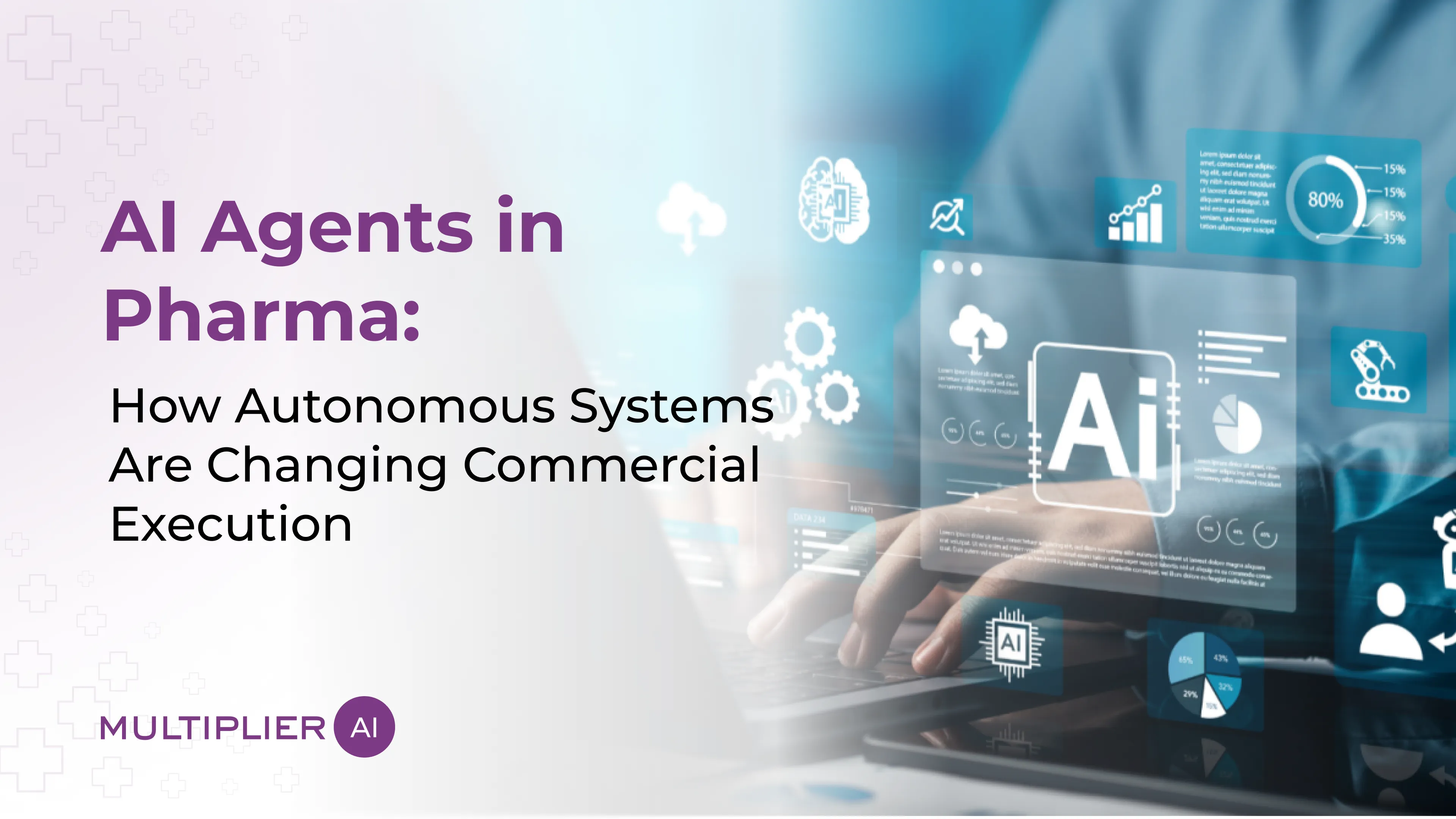
AI Agents in Pharma: How Autonomous Systems Are Changing Commercial Execution
Why Pharma Is Moving Beyond AI Tools into AI Agents
For the past few years, pharma organizations have been experimenting with AI tools. These tools have improved analytics, automated reporting, accelerated content generation, and helped teams make faster decisions. They have made workflows more efficient.
But they have not fundamentally changed how execution happens.
Most decisions are still made by humans. Most actions still require manual intervention. AI provides insights, but it usually does not act on those insights. This is why AI agents pharma adoption is becoming important for organizations that want to move from insight generation to real-time commercial execution.
Pharma is now entering the era of AI agents. AI agents are not just tools. They are systems that can make decisions, take actions, and adapt based on feedback. Instead of only assisting execution, they begin to drive execution within defined business and compliance guardrails.
AI agents are part of the broader AI pharma commercial strategy shift from static campaigns to intelligence-driven, coordinated, and real-time execution.
This changes how pharma companies think about data, campaigns, field execution, HCP engagement, content delivery, and compliance.
What Are AI Agents in Pharma?
AI agents in pharma are autonomous or semi-autonomous systems that can observe healthcare and commercial data, interpret signals, decide the next best action, execute approved workflows, and learn from outcomes.
In pharma commercial execution, AI agents can help prioritize HCPs, trigger personalized content, coordinate omnichannel engagement, detect competitive signals, optimize campaigns, notify field teams, and operate within compliance guardrails.
In simple terms, an AI agent can:
- Observe data
- Interpret signals
- Decide on an action
- Execute that action
- Learn from the outcome
| Agent Step | What It Means in Pharma |
|---|---|
| Observe | Collects CRM, digital, field, prescribing, content, and external signals |
| Interpret | Detects behavior changes, opportunity, risk, or interest |
| Decide | Chooses the next best action within approved rules |
| Execute | Triggers content, alert, task, campaign change, or follow-up |
| Learn | Uses outcomes to improve future recommendations |
| Govern | Applies consent, compliance, access, and audit controls |
For example, an AI agent can monitor HCP engagement patterns, identify changes in behavior, decide which doctors need attention, trigger personalized communication, and adjust future interactions based on response.
Agentic AI pharma systems can observe HCP data, interpret commercial signals, recommend next actions, activate workflows, and learn from outcomes.
AI Tools vs AI Agents in Pharma
There is a lot of confusion between AI tools and AI agents. AI tools usually help users complete specific tasks. AI agents go further by coordinating decisions and actions across workflows.
| Area | AI Tools | AI Agents |
|---|---|---|
| Main role | Assist users | Act within defined goals and guardrails |
| Output | Insights, summaries, reports, or content | Decisions, actions, triggers, and workflow execution |
| Human effort | User interprets and acts | Agent can recommend or execute next steps |
| Adaptability | Limited unless manually updated | Learns from outcomes and adjusts |
| Workflow role | Supports isolated tasks | Coordinates multi-step workflows |
| Example | Dashboard showing HCP engagement | Agent prioritizes HCP, triggers content, notifies rep, and learns from response |
| Pharma risk control | User-led review | Requires embedded guardrails and oversight |
This difference is important because pharma companies do not need only more dashboards. They need faster movement from insight to action.
AI Agents vs Traditional Automation in Pharma
AI agents are also different from traditional automation. Traditional automation follows fixed rules. If a condition is met, a predefined action happens. This is useful for repetitive workflows, but it is limited when context changes.
AI agents are more adaptive. They can interpret multiple signals, select from different possible actions, and improve based on feedback. In pharma, this matters because HCP behavior, competitive signals, campaign performance, and content engagement change quickly.
Autonomous pharma systems are different because they respond to context, not just fixed rules.
| Area | Traditional Automation | AI Agents |
|---|---|---|
| Logic | Rule-based | Goal-driven and context-aware |
| Flexibility | Follows fixed steps | Adjusts based on signals and outcomes |
| Decision-making | Predefined | Dynamic within guardrails |
| Data use | Limited to trigger conditions | Uses multiple real-time signals |
| Learning | Usually none | Learns from feedback |
| Example | Send email after form submission | Decide whether to send email, alert a rep, or trigger medical follow-up |
| Best use | Repetitive tasks | Dynamic commercial execution |
The value of AI agents is not only that they automate work. Their value is that they make execution more responsive.
Why Current Pharma Execution Models Are Breaking
To understand why AI agents matter, it is important to look at how pharma execution works today.
Most organizations operate on a structured but rigid model. Campaigns are planned in advance. Field teams follow call plans. Digital engagement follows predefined sequences. Content is created and distributed in fixed formats.
This model worked when markets were slower and interactions were limited. It breaks in a real-time environment.
Today:
- HCP behavior changes quickly
- Competitive signals appear suddenly
- Engagement happens across multiple channels
- Expectations for personalization are high
- Static execution cannot keep up
| Static Execution Problem | Why It Fails Today |
|---|---|
| Fixed campaign plans | Cannot respond to real-time HCP behavior |
| Static call plans | Field teams may miss urgent opportunities |
| Generic content sequences | Communication feels less relevant |
| Delayed reporting | Signals are acted on too late |
| Separate team workflows | Field, digital, and medical actions become disconnected |
| Manual optimization | Too slow for competitive or behavioral shifts |
| Limited feedback loops | Learning does not improve execution quickly |
By the time a campaign is adjusted, the opportunity may already be gone.
The Core Advantage of AI Agents: Closing the Action Gap
The biggest problem in pharma today is not lack of data. It is the gap between insight and action.
Teams often know what is happening, but they cannot act fast enough. AI agents close this gap by detecting signals in real time, deciding what action is needed, and executing immediately.
GPT & LLM Based Tools can support agentic AI pharma workflows by interpreting complex data, analyzing campaigns, detecting weak points, summarizing insights, and generating real-time recommendations.
Real-time physician intelligence platforms for pharma commercial teams provide the live HCP signals that AI agents need for faster targeting, timing, content, and follow-up decisions.
For example, if a doctor shows increased interest in a competitor’s therapy, an AI agent can identify the signal, trigger targeted content, notify the field rep, and adjust future engagement.
| Signal | AI Agent Action |
|---|---|
| HCP engages with therapy content | Trigger follow-up content or rep notification |
| HCP shows interest in competitor topic | Send approved response content and flag field team |
| Webinar attendance increases | Recommend medical or field follow-up |
| Prescribing pattern changes | Reprioritize account and update call plan |
| HCP becomes inactive | Change channel, message, or frequency |
| Campaign response drops | Adjust audience, content, or timing |
| Consent status changes | Stop or modify outreach automatically |
| KOL activity increases | Update influence map and engagement priority |
AI pharma automation becomes more valuable when it does not stop at reporting, but moves directly into approved action. That speed creates advantage.
From Workflows to Autonomous Systems
Traditional pharma operations are workflow-driven. Each step is defined in advance. Tasks are assigned. Processes are followed.
AI agents introduce autonomy. Instead of following fixed workflows, systems adapt based on context.
An AI-first pharma commercial engine provides the data-to-decision operating model that AI agents need to move from insight to execution in real time.
This does not mean removing structure. It means making structure flexible.
For example, instead of a fixed email sequence, an AI agent can decide whether to send an email, what content to include, when to send it, and whether to follow up.
AI channel selection in pharma helps agents decide whether each HCP should receive email, rep follow-up, digital content, webinar invitations, or another engagement path.
Pharma AI execution becomes more adaptive when agents can coordinate content, channel, timing, follow-up, and field notifications in one workflow.
Where AI Agents Create Immediate Commercial Impact
AI agents are not theoretical. There are specific areas where they can create immediate value for pharma commercial teams.
| Use Case | Agentic AI Impact |
|---|---|
| HCP prioritization | Continuously updates which doctors need attention |
| Call planning | Suggests who to visit, why, and what to discuss |
| Content delivery | Selects approved content based on HCP context |
| Omnichannel orchestration | Coordinates field, email, WhatsApp, webinar, and digital engagement |
| Competitive response | Detects competitor signals and triggers approved response pathways |
| Campaign optimization | Adjusts targeting, timing, and content based on performance |
| Medical follow-up | Flags HCPs needing scientific or evidence-based engagement |
| Compliance checks | Ensures consent, channel rules, and approved content are followed |
HCP Prioritization
Instead of static segmentation, AI agents continuously update priorities based on behavior. This ensures that field teams focus on the most relevant opportunities.
AI-powered call planning for pharma reps is one of the first practical use cases where agents can prioritize doctors, suggest timing, recommend discussion points, and trigger follow-up actions.
Content Delivery
Agents can select and deliver content based on context. This improves relevance without increasing workload.
Omnichannel Orchestration
Agents coordinate interactions across channels. They ensure that field, digital, and medical engagement are aligned.
Competitive Response
Agents detect competitive signals and trigger responses. Pharma competitive intelligence in the age of AI gives agents the market signals needed to detect competitor activity, prescribing movement, KOL commentary, and campaign shifts.
A competitor launch pharma response playbook can be converted into agentic workflows that detect launch signals, prioritize accounts, trigger approved messaging, and notify field teams.
Campaign Optimization
Agents adjust campaigns in real time. They optimize performance continuously instead of waiting for monthly reviews.
AI Agents for Content Delivery and Omnichannel Orchestration
One of the strongest use cases for AI agents in pharma is coordinated content and channel execution. Instead of sending the same content to every HCP, an AI agent can decide what message is most relevant, which channel should be used, and when follow-up should happen.
A Hyper Personalized Content Platform helps AI agents activate approved content journeys through automated content creation, cohort building, personalized messaging, and omnichannel communication across email, WhatsApp, and social channels.
For example, if an HCP engages with a digital asset, the agent can trigger approved follow-up content, notify the field team, and adjust the next campaign step.
AI agents can help coordinate field sales and digital campaigns by ensuring that digital signals, field conversations, and follow-up content are connected in one HCP journey.
GenAI personalized medical content in pharma helps agents activate context-specific content variations for large HCP audiences while maintaining approved messaging and compliance controls.
If the HCP does not respond, the agent can change timing, reduce frequency, or recommend another channel. This turns omnichannel engagement from a manual coordination problem into an adaptive execution system.
The HCP omnichannel maturity model for pharma teams helps organizations understand how to progress from fragmented execution to AI-orchestrated and agentic HCP journeys.
The Role of Humans in an AI Agent-Driven System
change the role of humans.
Instead of executing repetitive tasks, humans focus on strategy, oversight, relationship building, and complex decision making.
Ethical AI pharma engagement ensures that agentic systems remain transparent, fair, privacy-safe, accountable, and governed by human oversight.
| Human Role | What Humans Should Own |
|---|---|
| Strategy | Define goals, priorities, and business direction |
| Oversight | Review high-risk decisions and monitor agent behavior |
| Relationship building | Manage complex HCP and account relationships |
| Medical judgment | Validate scientific interpretation and sensitive outputs |
| Compliance judgment | Approve claims, guardrails, and escalation rules |
| Exception handling | Intervene when context is complex or unclear |
| Continuous improvement | Review performance and refine agent logic |
AI agents handle repetitive and data-driven actions. This increases efficiency without removing the need for human accountability.
Building an AI Agent System in Pharma
Implementing AI agents requires a structured approach. Pharma teams should not start by trying to automate everything. The best approach is to start with focused use cases where the value is clear and the risk can be controlled.
| Step | What Pharma Teams Should Do |
|---|---|
| Define use cases | Start with workflows such as HCP prioritization or content delivery |
| Connect data sources | Integrate CRM, digital engagement, field notes, prescribing, consent, and external signals |
| Define agent goals | Clarify what the agent is expected to optimize |
| Set guardrails | Add approved content, consent rules, MLR controls, and human review triggers |
| Integrate workflows | Connect agents to CRM, marketing platforms, content systems, and field tools |
| Capture outcomes | Track engagement, response, field feedback, and business impact |
| Monitor performance | Review accuracy, compliance, drift, and user adoption |
| Scale gradually | Expand after use case performance and governance are proven |
Agents need access to data. This includes CRM, digital engagement, prescribing data, and external signals.
A GenAI Doctor Data Platform can provide the HCP intelligence layer for AI agents by connecting CRM activity, real-time doctor insights, KOL signals, segmentation, doctor consent, and preferred-channel communication.
Good starting points include HCP prioritization, AI-powered call planning, content follow-up, campaign optimization, competitive signal alerts, and consent-aware communication workflows. These use cases connect directly to commercial execution and can be measured through response rates, time-to-action, field adoption, and campaign performance.
Once these use cases are stable and governed, organizations can expand toward broader agentic orchestration.
GET ACTIONABLE AI AND HEALTHCARE INSIGHTS THAT HELP YOU STAY AHEAD IN A FAST-CHANGING PHARMA WORLD
Governance, Compliance, and Guardrails for AI Agents
AI agents in pharma cannot operate without strong guardrails. Since agents can recommend or execute actions, every workflow must be controlled by approved data sources, consent validation, MLR-approved content, channel permissions, role-based access, and audit trails.
A DPDP-Compliant HCP Marketing framework helps pharma teams embed consent-driven workflows, purpose limitation, data minimisation, immutable audit trails, and role-based access into AI agent execution.
Pharma data privacy omnichannel controls are essential when AI agents use HCP data across CRM, field, digital, WhatsApp, email, content, and analytics workflows.
The goal is not to block autonomy. The goal is to make autonomy safe.
An AI governance pharma framework helps define agent oversight, model monitoring, escalation rules, data permissions, human review triggers, and audit trails before autonomous workflows are scaled.
Low-risk actions can be automated within approved rules, while high-risk actions should trigger human review. AI pharma compliance becomes critical when agents personalize communication, trigger actions, use approved content, validate consent, and create audit-ready execution records.
| Guardrail | Why It Matters |
|---|---|
| Approved data sources | Prevents agents from using unreliable or unauthorized data |
| Consent validation | Ensures HCP outreach is permissioned |
| Purpose limitation | Prevents data from being reused for unrelated actions |
| MLR-approved content | Keeps communication compliant |
| Channel permissions | Controls email, WhatsApp, field, and digital activation |
| Human review triggers | Escalates high-risk or sensitive actions |
| Role-based access | Limits who can configure, approve, or override agents |
| Audit trails | Tracks signal, decision, action, and outcome |
| Model monitoring | Detects drift, misuse, or weak performance |
| Kill switch | Allows teams to pause agents if issues emerge |
A strong agentic AI system should always answer four questions: what signal was detected, why an action was recommended, whether the action was compliant, and what happened after execution.
How Multiplier AI Supports Agentic Pharma Execution
Multiplier AI helps pharma teams build the foundation for agentic commercial execution by connecting doctor data, AI insights, personalized content, omnichannel activation, and compliance workflows.
The GenAI Doctor Data Platform provides the HCP intelligence layer by connecting CRM activity, real-time doctor insights, KOL signals, segmentation, doctor consent, and preferred-channel communication.
GPT & LLM Based Tools support insight interpretation, campaign analysis, competitor intelligence, weak-point detection, and real-time recommendations.
The Hyper Personalized Content Platform supports automated content creation, cohort building, personalized messaging, and omnichannel communication across email, WhatsApp, and social channels.
The DPDP-Compliant HCP Marketing platform supports consent-driven workflows, purpose limitation, data minimisation, audit trails, and role-based access.
Together, these capabilities help pharma organizations move from AI tools to governed AI agents
Challenges in Adopting AI Agents
Despite the benefits, adoption is not easy. Pharma companies must solve several challenges before scaling agentic execution.
Trust
Teams need to trust AI decisions. This requires transparency into why an agent recommended or executed a particular action.
Compliance
Systems must meet regulatory and internal approval requirements. Agents cannot act outside approved content, consent, and governance boundaries.
Integration
Connecting CRM, field systems, digital platforms, data warehouses, content engines, and compliance systems can be complex.
Change Management
Teams need to adapt to new workflows. Field, marketing, medical, and compliance teams must understand how to work with agents rather than around them.
AI Agent Maturity Model for Pharma
Pharma companies do not need to jump directly into full autonomy. AI agent adoption can mature in stages.
| Maturity Stage | Description |
|---|---|
| Stage 1: AI-assisted | AI generates insights, but humans decide and execute |
| Stage 2: AI-recommended | AI recommends next best actions for human approval |
| Stage 3: Semi-agentic | AI triggers low-risk actions and escalates high-risk ones |
| Stage 4: Agentic orchestration | AI coordinates multi-channel workflows within guardrails |
| Stage 5: Autonomous execution | AI manages complex workflows with human oversight and auditability |
This staged approach allows teams to build confidence, governance, and measurable business impact before expanding autonomy.
What Success Looks Like
When AI agents are implemented effectively, decisions happen faster, engagement becomes more relevant, teams become more efficient, and organizations move from reactive to proactive execution.
AI-driven pharma operations will increasingly depend on agentic systems that can detect change, act within guardrails, and continuously improve.
| Metric | Why It Matters |
|---|---|
| Time from signal to action | Measures how fast agents close the action gap |
| HCP prioritization accuracy | Shows whether agents identify the right opportunities |
| Engagement response rate | Measures relevance and timing |
| Field adoption rate | Shows whether reps trust agent recommendations |
| Campaign optimization speed | Tracks how quickly campaigns improve |
| Compliance exception rate | Measures risk control |
| Human override rate | Shows where agent judgment needs refinement |
| Audit trail completeness | Confirms traceability |
| Outcome feedback capture | Supports learning loops |
| Business impact | Measures commercial value |
The Future: Fully Autonomous Pharma Execution
Looking ahead, AI agents will become more advanced. They will handle more complex tasks, coordinate across systems, and operate with less manual intervention.
The future of AI in pharma engagement will be shaped by autonomous orchestration, predictive engagement, dynamic content, embedded compliance, and agentic execution.
This does not eliminate human roles. It elevates them. Humans will focus more on strategy, governance, relationship building, and exception handling, while agents manage repetitive, data-driven, and time-sensitive execution tasks.
Final Conclusion
AI agents represent the next evolution of pharma execution. They move beyond tools and automation. They create systems that can observe, decide, act, adapt, and improve continuously.
For pharma organizations, the opportunity is significant. AI agents can help close the gap between insight and action, improve HCP prioritization, personalize content delivery, coordinate omnichannel engagement, detect competitive signals, optimize campaigns, and support compliant execution.
But success depends on strong foundations: high-quality doctor data, connected systems, approved content, consent-aware workflows, human oversight, audit trails, and clear governance.
Organizations that adopt this model early will gain a significant advantage. The question is not whether AI agents will become standard in pharma. The question is how quickly organizations can integrate them safely, compliantly, and effectively.
Frequently Asked Questions For AI Agents Pharma: How Autonomous Systems Change Execution
AI agents in pharma are autonomous or semi-autonomous systems that observe data, interpret signals, decide next actions, execute approved workflows, and learn from outcomes.
AI tools assist users by generating insights or content. AI agents can act within defined goals and guardrails by triggering workflows, recommendations, notifications, or follow-up actions.
Traditional automation follows fixed rules. AI agents are more adaptive because they interpret context, choose from different actions, and improve based on feedback.
AI agents can help with HCP prioritization, call planning, content delivery, omnichannel orchestration, competitive response, campaign optimization, and compliance checks.
Yes. AI agents can improve HCP engagement by selecting relevant content, timing outreach better, coordinating channels, and triggering follow-up based on HCP behavior.
No. AI agents support field teams by handling repetitive, data-driven tasks while humans focus on strategy, relationship building, oversight, and complex decisions.
AI agents need access to CRM data, digital engagement, field notes, prescribing signals, content behavior, consent records, and external market signals.
AI agents require approved data sources, consent validation, purpose limitation, MLR-approved content, channel permissions, human review triggers, audit trails, and model monitoring.
Agentic AI in pharma refers to AI systems that can pursue defined commercial or operational goals by observing data, deciding actions, executing workflows, and learning from outcomes.
Multiplier AI supports agentic pharma execution through the GenAI Doctor Data Platform, GPT and LLM-based tools, Hyper Personalized Content Platform, and DPDP-Compliant HCP Marketing.
GET ACTIONABLE AI AND HEALTHCARE INSIGHTS THAT HELP YOU STAY AHEAD IN A FAST-CHANGING PHARMA WORLD
Let's Discuss Your Requirements