Share of Voice to Share of Mind in Pharma Marketing: A Practical Guide
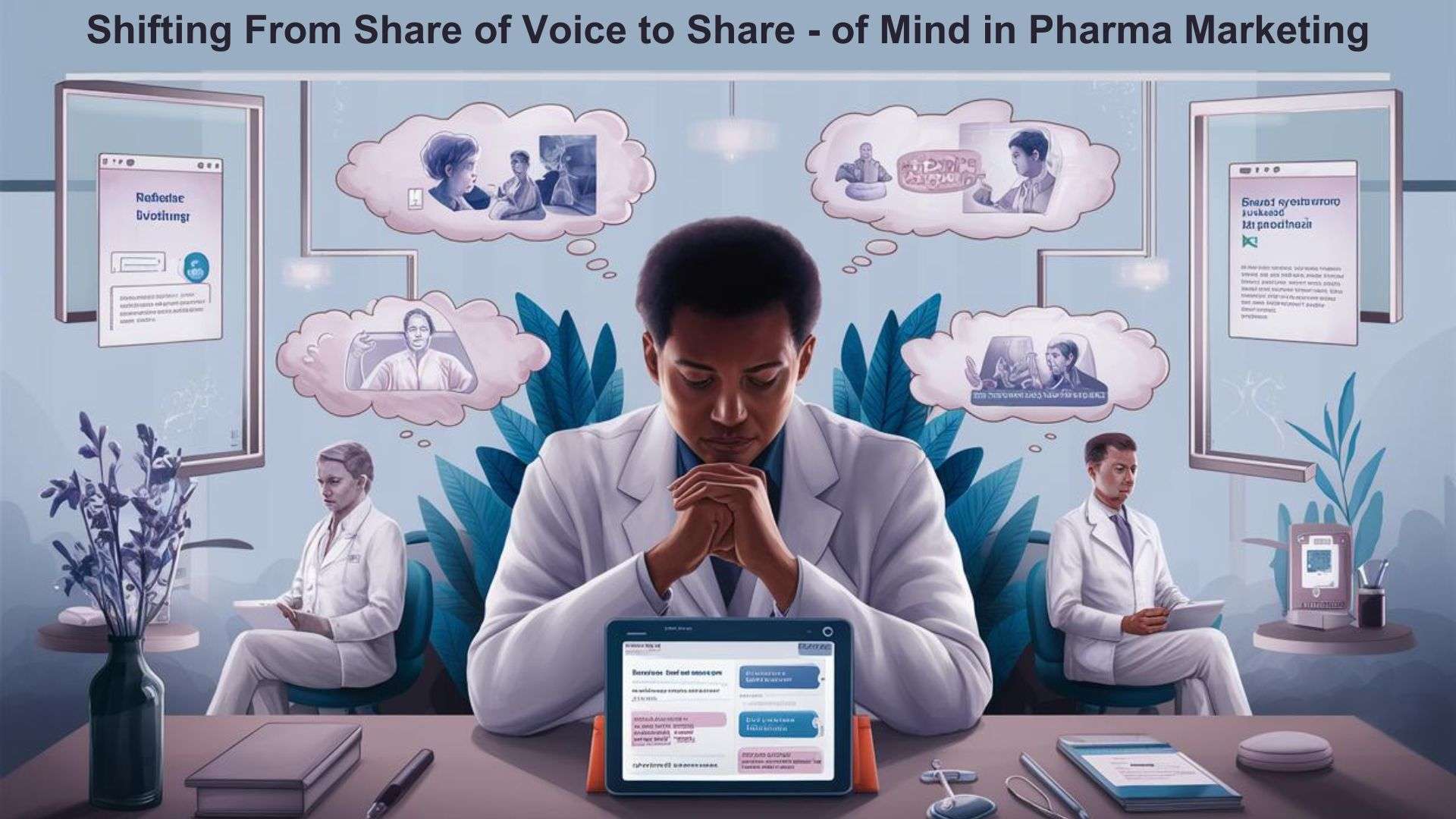
Pharma marketing has traditionally focused on being visible. Brands wanted more rep visits, more printed literature, more journal presence, more digital ads, and more reminders in front of healthcare professionals. This approach helped create awareness, but awareness alone is no longer enough.
Doctors today receive information from multiple pharma companies, digital platforms, journals, webinars, conferences, and peer networks. The problem is not lack of information. The problem is information overload. When every brand is trying to be seen, most messages start to feel similar.
This is why pharma marketers are shifting from Share of Voice to Share of Mind. Share of Voice asks, “How visible are we?” Share of Mind asks, “Are we remembered, trusted, and considered when it matters?”
For this shift to work, brands need accurate HCP intelligence, personalized content, and connected engagement across channels. A GenAI Doctor Data Platform can support this by combining doctor data, CRM activity, real-time physician signals, and preferred-channel insights into one engagement layer.
What Is Share of Mind in Pharma Marketing?
Share of Mind in pharma marketing is the extent to which a healthcare professional remembers, trusts, and mentally associates a pharma brand with a specific therapy area, patient type, clinical problem, or scientific value. It is not only about whether the doctor has seen the brand. It is about whether the brand has earned meaningful recall and relevance in the doctor’s decision-making context.
In simple terms, Share of Voice is about being heard. Share of Mind is about being remembered for the right reason.
A brand can have high Share of Voice and still have weak Share of Mind if doctors see the message but do not find it useful, credible, or different. On the other hand, a brand can build strong Share of Mind by consistently delivering clinically useful, timely, and personalized communication.
Why was Share of Voice preferred in Pharma Marketing?
Share of voice measures a brand’s visibility, promotional presence, and influence in marketing efforts. It was preferred as a marketing strategy because of its simplicity and immediate impact on brand visibility. It measured the extent to which a brand’s
advertising presence dominated in a particular industry, back then it was believed that increasing their share of voice through loud marketing would gain HCPs’ attention, for sure it would, but the information wouldn’t last long. This caused the shift to Share of Mind in pharma marketing because companies realized that though Share of Voice is good for spreading awareness in the initial stages, creating a deep impact on the customer is what matters in the long run.
Why Share of Voice Was Preferred in Pharma Marketing
Share of Voice measures a brand’s visibility and promotional presence compared with competitors. In pharma, this traditionally included rep calls, journal advertising, conference presence, digital impressions, email campaigns, and other promotional activities.
For many years, Share of Voice was attractive because it was simple to measure and easy to connect with sales-force activity. If a brand wanted more market visibility, it could increase call frequency, increase campaign volume, or increase advertising spend.
This model worked better in an environment where doctors had fewer channels, fewer competing messages, and more time for representative-led product discussions. But the current environment is different. HCP attention is limited, digital noise is high, and doctors filter out repetitive communication quickly.
Multiplier AI’s existing brand share of voice content is useful for understanding visibility and competitive presence. However, modern pharma marketing must also ask whether that visibility is creating recall, trust, and clinical relevance.
| Aspect | Share of Voice | Share of Mind |
| Core question | How visible is the brand? | How strongly is the brand remembered and trusted? |
| Main focus | Reach, frequency, promotional presence | Relevance, recall, credibility, and value |
| Common metrics | Calls, impressions, ads, emails, campaign volume | Message recall, engagement quality, trust, preference, consideration |
| Risk | More noise without deeper impact | Requires stronger data, content, and consistency |
| Best use | Creating initial awareness | Building long-term brand preference and HCP relationship |
Why Share of Voice Alone Is No Longer Enough
In a competitive pharma market, increasing visibility can still help during early awareness building. But when every brand increases volume, the result is more noise. Doctors may see a brand multiple times and still fail to remember its differentiated value.
Top-performing pharma content now increasingly emphasizes customer-centric support, precision targeting, measurable engagement, and meaningful message recall rather than only promotional volume. Industry discussions on HCP engagement also show that channel-level activity metrics are not enough; brands need to understand whether engagement changes behavior, recall, or decision-making context.
The biggest limitation of Share of Voice is that it can make teams feel successful because activity is high. But activity does not always mean impact. A campaign can generate impressions, calls, and email opens while still failing to create a lasting impression.
| Problem With Voice-Only Marketing | What Happens | What Pharma Teams Should Do Instead |
| High message frequency | Doctors receive repetitive communication | Reduce noise and prioritize meaningful touchpoints |
| Generic content | HCPs do not see relevance to their practice | Use specialty, behavior, and clinical context |
| Channel-first planning | Teams optimize emails, calls, and ads separately | Plan around the HCP journey |
| Weak measurement | Activity looks strong but impact is unclear | Measure recall, progression, and engagement quality |
| Disconnected field and digital teams | The doctor receives inconsistent messages | Coordinate field, content, CRM, and digital actions |
What Share of Mind Helps Pharma Brands Achieve
Share of Mind helps pharma brands move from visibility to meaningful consideration. It improves the chance that a doctor remembers the brand when discussing a relevant patient profile, reviewing therapy options, attending a scientific meeting, or engaging with a representative.
This matters because HCPs do not retain every brand message. They remember what is clinically useful, credible, timely, and repeated with consistency across the right channels.
- Stronger trust: HCPs are more likely to engage with brands that provide credible and useful information.
- Better message recall: Unique and clinically relevant messages are easier to remember than generic promotional claims.
- Higher engagement quality: Meaningful content leads to deeper conversations and better follow-up.
- Improved differentiation: Brands stand out through value, not just visibility.
- Longer-term relationship building: Consistent value creates a stronger connection between the HCP and the brand.
Share of Mind becomes stronger when content is personalized to the HCP’s needs. A Hyper Personalized Content Platform can help pharma teams create doctor-specific content journeys based on real-time behavior, digital footprint, and channel preference.
How to Build Share of Mind in Pharma Marketing
Building Share of Mind requires more than sending more messages. It requires a structured approach that combines data, scientific credibility, personalized content, coordinated engagement, and measurement.
The goal is to become useful in the doctor’s mind, not simply visible in the doctor’s inbox.
1. Start With Better HCP Understanding
Pharma teams need to understand what matters to each HCP. This includes specialty, patient mix, prescribing behavior, content interests, preferred channels, previous interactions, and scientific engagement patterns.
Strong doctor data in pharma helps teams understand HCP interests, communication context, and engagement history. Without this foundation, Share of Mind strategies remain broad and generic.
2. Create Content That Is Useful, Not Just Promotional
HCPs are more likely to remember content that helps them solve a clinical, educational, or patient-related problem. This may include clinical trial summaries, real-world evidence, expert perspectives, patient-type guidance, treatment pathway information, or concise scientific updates.
The best content does not simply repeat brand claims. It connects the product or therapy area to the doctor’s actual information needs.
3. Personalize the Message, Channel, and Timing
Share of Mind improves when the right message reaches the right doctor through the right channel at the right moment. A cardiologist who recently attended a webinar may need a follow-up clinical summary. A busy general practitioner may prefer a short visual brief. A specialist may value detailed evidence and peer discussion.
Personalization should not be limited to adding the doctor’s name in an email. It should influence the content angle, level of detail, format, timing, and follow-up path.
4. Connect Field, Digital, and Medical Touchpoints
A doctor should not feel like every pharma touchpoint is coming from a separate team. Field visits, emails, webinars, WhatsApp communication, digital content, and medical-affairs interactions should reinforce one connected narrative.
AI in omni channel marketing for pharmaceuticals can help teams coordinate field, digital, CRM, and content actions into a more connected HCP journey.
5. Use AI to Turn Data Into Action
AI helps pharma teams identify which HCPs are likely to engage, what content may be relevant, which channel may work best, and when follow-up should happen. It also helps sales representatives prepare for better conversations by giving them real-time insights before a visit.
GPT & LLM Based Tools can support teams by summarizing insights, assisting with content workflows, and helping translate complex engagement data into practical recommendations.
| Building Block | How It Supports Share of Mind |
| HCP data foundation | Helps understand specialty, behavior, preference, and engagement history |
| Relevant scientific content | Creates credibility and practical value |
| Personalized messaging | Makes communication feel specific to the doctor’s context |
| Omnichannel coordination | Ensures field and digital touchpoints reinforce each other |
| AI-powered insights | Identifies timing, content, channel, and next-best engagement opportunities |
| Compliance controls | Ensures personalization stays permitted, approved, and auditable |
Share of Mind Requires Trust and Compliance
In pharma, trust is not optional. HCPs must feel that the content they receive is accurate, approved, balanced, and relevant. If AI is used to personalize communication, it must be governed carefully.
AI-driven Share of Mind strategies should respect consent status, channel permissions, approved communication purposes, data minimisation, frequency limits, and medical/legal/regulatory review requirements. Personalization should never become uncontrolled data use or unsupported content generation.
A DPDP-Compliant HCP Marketing framework helps pharma teams personalize HCP engagement while respecting consent, channel permissions, purpose limitation, and audit-ready workflows.
| Compliance Area | Why It Matters for Share of Mind |
| Consent status | Ensures doctors receive communication only through permitted channels |
| Approved content | Prevents unsupported or non-compliant claims |
| Purpose limitation | Keeps data use aligned with the original communication purpose |
| Frequency control | Reduces fatigue and protects trust |
| Audit trail | Shows what was sent, why it was sent, and under which approval |
| Human review | Keeps medical, legal, and regulatory oversight in the workflow |
How to Measure Share of Mind in Pharma Marketing
Share of Mind should be measured differently from Share of Voice. Visibility metrics are still useful, but they must be connected to recall, relevance, trust, and action.
Instead of only asking how many doctors were reached, pharma teams should ask how many doctors remembered the message, engaged deeply with the content, moved through the HCP journey, or responded meaningfully to a field or digital follow-up.
| Metric | What It Shows |
| Unaided or aided brand recall | Whether HCPs remember the brand or message |
| Message recall | Whether the key clinical or brand message stayed with the doctor |
| Engagement depth | Whether the HCP interacted beyond a superficial open or click |
| Repeat engagement | Whether the doctor continues to engage over time |
| Content relevance score | Whether the content matches HCP interests |
| Field follow-up quality | Whether rep conversations build on prior insights |
| Journey progression | Whether the HCP moves from awareness to deeper consideration |
| Relationship strength | Whether the brand is becoming more trusted over time |
How Multiplier AI Helps Pharma Brands Move From Share of Voice to Share of Mind
Multiplier AI helps pharma teams move beyond broad promotional visibility toward data-driven, personalized, and compliant HCP engagement.
The platform brings together doctor data, digital engagement signals, CRM activity, content intelligence, and consent status so teams can understand what each HCP cares about and how best to engage them.
- GenAI Doctor Data Platform helps build richer HCP intelligence and real-time doctor profiles.
- Hyper Personalized Content Platform helps create tailored content journeys based on doctor behavior and preferences.
- GPT and LLM-based tools help teams summarize insights and support smarter engagement workflows.
- DPDP-Compliant HCP Marketing helps ensure personalization is consent-aware and audit-ready.
- Omnichannel intelligence helps field, medical, digital, and content teams reinforce one consistent narrative.
For brands that want to strengthen HCP relationships for prescription growth, the shift from visibility to relevance is essential.
Common Mistakes to Avoid
- Equating high campaign activity with strong HCP impact.
- Sending the same content to all doctors in the same specialty.
- Measuring only impressions, calls, and email opens.
- Running digital campaigns separately from field-force conversations.
- Using AI personalization without consent, approval, or governance controls.
- Ignoring message recall and engagement quality.
- Focusing only on product visibility instead of clinical usefulness.
Conclusion
Pharma marketing is moving from a world of loud visibility to a world of meaningful relevance. Share of Voice still has a role in building awareness, but it cannot be the only measure of success.
Doctors do not remember every message they receive. They remember what is useful, credible, timely, and connected to their clinical reality.
The shift from Share of Voice to Share of Mind requires better HCP intelligence, personalized content, omnichannel coordination, compliant execution, and stronger measurement. Pharma brands that make this shift will be better positioned to earn attention, build trust, and create lasting impact with healthcare professionals.
Frequently Asked Questions For Share of Voice to Share of Mind in Pharma Marketing: A Practical Guide
Share of Mind in pharma marketing refers to how strongly a healthcare professional remembers, trusts, and associates a pharma brand with a specific therapy area, patient type, clinical need, or scientific value.
Share of Voice measures visibility and promotional presence. Share of Mind measures recall, trust, relevance, and the brand’s place in the HCP’s decision-making context.
Share of Voice can create awareness, but it may also create noise if messages are repetitive or generic. HCPs need communication that is relevant, credible, and useful.
Brands can build Share of Mind by using accurate doctor data, delivering clinically useful content, personalizing communication, coordinating field and digital touchpoints, and measuring message recall.
AI helps analyze HCP data, identify interests, recommend content, select channels, improve timing, and support more personalized engagement across field and digital channels.
Clinical trial summaries, real-world evidence, expert opinions, patient-type guidance, treatment pathway content, and practical scientific updates can improve Share of Mind when matched to HCP needs.
Yes. Pharma teams can measure it through brand recall, message recall, engagement depth, repeat engagement, journey progression, field follow-up quality, and relationship strength.
Personalization can be compliant when it respects consent, channel permissions, approved purpose, data minimisation, frequency limits, and medical/legal/regulatory review requirements.
Omnichannel marketing supports Share of Mind when field, digital, content, CRM, and medical interactions reinforce one consistent and relevant HCP journey.
Multiplier AI supports Share of Mind strategies through GenAI doctor data, hyper-personalized content, GPT/LLM-based insights, omnichannel engagement intelligence, and DPDP-compliant HCP marketing workflows.
Let's Discuss Your Requirements