GEO for Medical Publishers

The collapse is measured, the cause is not
Health publishing spent fifteen years building a particular machine. You wrote comprehensive, medically reviewed content about every condition a person might search for, you ranked for it, and advertisers paid to reach the people who arrived. The machine worked well enough to support several businesses of real scale, and the thing that made it work was that a person with a symptom typed it into a search box and got a list of links.
That behaviour has changed, and the measurement of the change is now unambiguous even where the cause is not. Through 2025 the major US health publishers lost visibility at a rate that has no precedent in the category. One health-media owner has taken a goodwill impairment against its health segment large enough to appear in its quarterly filing. The question in every health publishing board meeting in 2026 is not whether this is happening. It is what to do.
This page is written for that meeting. It does three things the existing coverage does not. It separates what has been measured from what has been inferred, because a great deal of what is circulating about health publisher declines is a chart read loosely and a cause assumed. It reads the financial disclosure rather than the traffic chart, because the operating damage shows up in advertiser counts and subscriber counts before it shows up anywhere else. And it argues something that, as far as we can establish, nobody has put in writing: the post-search playbook currently being written by news and technology publishers does not transfer to health publishing, for a structural reason that has nothing to do with content quality.
The definitional groundwork — what generative engine optimisation is, where the term comes from, what the published research measured and how visibility is measured at all — sits in the generative engine optimization for healthcare pillar. This page assumes it and starts from the publisher's problem.
Why has my health website's traffic dropped and what do I do about it?
Most likely because the questions your pages answered are now being answered inside the search result, and because a December 2025 core update coincided with the steepest part of the decline. Independent measurement puts the mechanism beyond reasonable dispute: Pew Research Center's analysis of 68,879 Google searches by 900 US adults found that when an AI summary appeared, users clicked a traditional result in 8% of visits against nearly twice that rate without one, and ended the session on 26% of pages with summaries versus 16% without. Published visibility-index data shows two of the largest US health publishers losing roughly 43% and 52% of index visibility between mid-2024 and January 2026. What to do about it has three parts, in order: change what you measure, because pageviews no longer describe your position; change what your advertisers are buying, because they are buying an audience that no longer arrives the same way; and make your existing editorial quality machine-visible, because the medical review process you already pay for is the one asset in this category that cannot be cheaply replicated. Chasing the lost traffic is the one response that will not work — as one publisher president put it, that traffic is not coming back.
What the visibility data shows
| Publisher | Visibility index, mid-2024 peak | January 2026 | Approximate change |
|---|---|---|---|
| WebMD | Above 300 | About 170 | Roughly −43% |
| Healthline | About 250 | About 120 | Roughly −52% |
| Medical News Today, Verywell Health, Verywell Mind | Not individually stated | Not individually stated | Described as comparable trajectories |
| Everyday Health | Fluctuating in a 20–60 band | Still in that band | No meaningful decline — see the section below |
Read these figures with the caveats attached, every time These values come from a visibility-index chart published by an SEO strategist in January 2026 and reported in trade press. They were read off a chart, the index vendor is not named, and the percentages are our arithmetic on approximate values. They are good enough to establish direction and order of magnitude. They are not good enough for a board paper, a press comment or an investor conversation. The causal attribution is weaker still. A Google core update ran from 11 to 29 December 2025 — eighteen days, with tool-measured volatility from 13 December — and the steepest part of several declines coincides with it. A core update and the growth of AI summaries are not the same thing, they happened in the same period, and the published analysis separates neither. Anyone telling you confidently that AI caused this is telling you what they believe. For your own business, use your own data. You have the only dataset that matters: your impressions, your click-through rate by query type, and your session behaviour, segmented by whether an AI summary was present. The public figures are context. Your analytics are evidence. |
The click-through evidence, ranked by how much you should trust it
Three bodies of evidence circulate on what AI summaries do to clicks. They are not equally reliable and the category treats them as though they are.
| Finding | Source and method | Trust level | How to use it |
|---|---|---|---|
| Users clicked a traditional result in 8% of visits when an AI summary appeared, against nearly twice that without. They clicked a link inside the summary in 1% of visits. Sessions ended on 26% of pages with summaries versus 16% without | Pew Research Center — 68,879 Google searches by 900 US adults, March 2025. An independent non-profit, with sample size and method published | HIGHEST. Cite this one | The defensible figure for any external communication. Note it predates current usage patterns, which if anything understates the effect |
| Desktop clicks on external links at 7.4% with an AI Overview against 28% without; mobile 19% against 38% | Trade press reporting of a published analysis | Medium — secondary, method not examined | Useful as corroboration of direction. Do not blend with the Pew figures; different studies, different methods |
| A 34.5% lower average click-through rate for the top-ranking page when an AI Overview is present, across 300,000 keywords | A published vendor analysis reported in trade press | Medium — large sample, vendor-produced | Quote with the vendor named. Cross-category, not health-specific |
| Publisher traffic down approximately 33% globally | Industry analysis reported in trade press | Lowest of the four. Locate the study before quoting | Context only, and clearly cross-category. Health is not broken out |
The pattern is worth noticing as a discipline point. The most reliable figure on this list is from an independent research organisation that published its sample and method, and it is also the least quoted in the industry conversation. The most quoted figures are the ones produced by companies selling a solution to the problem they describe. That is not an accusation of bad faith; vendor data is frequently the only data. It is a reason to lead with Pew.
The number that matters is not traffic
Traffic is the symptom that gets the headline. The injury appears in the customer relationships, and for the first time there is a public filing that shows it.
Ziff Davis, whose portfolio includes health media properties, recorded a goodwill impairment of $54.8 million entirely against its Health and Wellness segment for the quarter ended 30 June 2026, disclosed in a Form 8-K on 6 August 2026. That figure has been widely reported. The numbers underneath it have not, and they are the more useful ones.
| Disclosed figure | Value | Why it matters more than the traffic chart |
|---|---|---|
| Goodwill impairment, Health and Wellness segment | $54.8 million | A non-cash accounting judgement that the segment is worth materially less than previously carried. It is the auditor-tested version of ‘this business model is impaired’ |
| Health and Wellness advertising revenue | $82.5m → $79.8m year on year | A roughly 3% decline — far smaller than the traffic decline. Revenue lags audience, which is why revenue is a poor early-warning indicator |
| Group advertising and performance marketing revenue | $194m → $182m, down 6.0% | The prior-year figure was restated for a reclassification. Health fell less than the group, which is worth noting before concluding that health is uniquely exposed |
| Health advertisers | 866 → 797 | A loss of 69 advertiser relationships in a year. Advertiser count is a count of commercial relationships, not of spend, and relationships are far harder to rebuild than impressions |
| Subscription customers | 1.892 million → 1.618 million | A fall of roughly 274,000, about 14%. The direct-audience asset — the thing every post-search strategy depends on — shrank at the same time as the search audience |
| Share of owned-and-operated advertising revenue derived from search (prior-year disclosure) | Approximately 40% | The exposure number. It explains why a traffic decline of this size becomes a goodwill question rather than a quarterly miss |
| Share of revenue tied to web traffic, and to search specifically (stated at a September 2026 industry summit) | About 35% tied to web traffic; about 17.5% to search | Note the difference from the 40% figure above. Different denominators and different periods. Both are the company's own statements and they are not inconsistent — one is a share of advertising, the other a share of total revenue |
The company did not attribute the impairment to AI search, and this page will not either. Its risk disclosures reference content piracy and developments related to artificial intelligence, including unauthorised use of its content by developers and users of generative AI. That is a legal-risk framing, not a traffic-causation statement. The connection between AI search and the impairment is an inference drawn by observers, this analysis included, and it should be stated as one.
What is not an inference is the shape of the damage. Advertiser count and subscriber count both fell materially, and both fell faster than revenue. For any health publisher reading this, those two numbers belong on the monthly dashboard immediately, because they move before revenue does and they describe the thing that is genuinely hard to rebuild. An impression lost is an impression. An advertiser relationship lost is a sales cycle.
The publisher that did not decline, and why that is not reassuring
One major US health publisher appears on the same visibility chart with no meaningful decline at all, holding a narrow band throughout the period while its peers halved. The obvious reading is that it did something right. The more likely reading is that it had less to lose. A property that was not holding high-visibility positions across a broad condition footprint cannot lose them.
That distinction matters commercially, because the parent company of that property is the one that took the $54.8 million impairment. Flat visibility did not protect the segment. Which is the single most useful observation on this page for anyone currently being reassured by their own visibility chart: visibility index is a measure of search position, and search position is no longer the business.
The corollary is more encouraging than it sounds. If a flat visibility line did not protect a business, a falling one does not condemn one. The determinant is whether the publisher holds relationships — with advertisers, with registered readers, with licensors — that do not route through a search result. That is the actual question, and the rest of this page is about it.
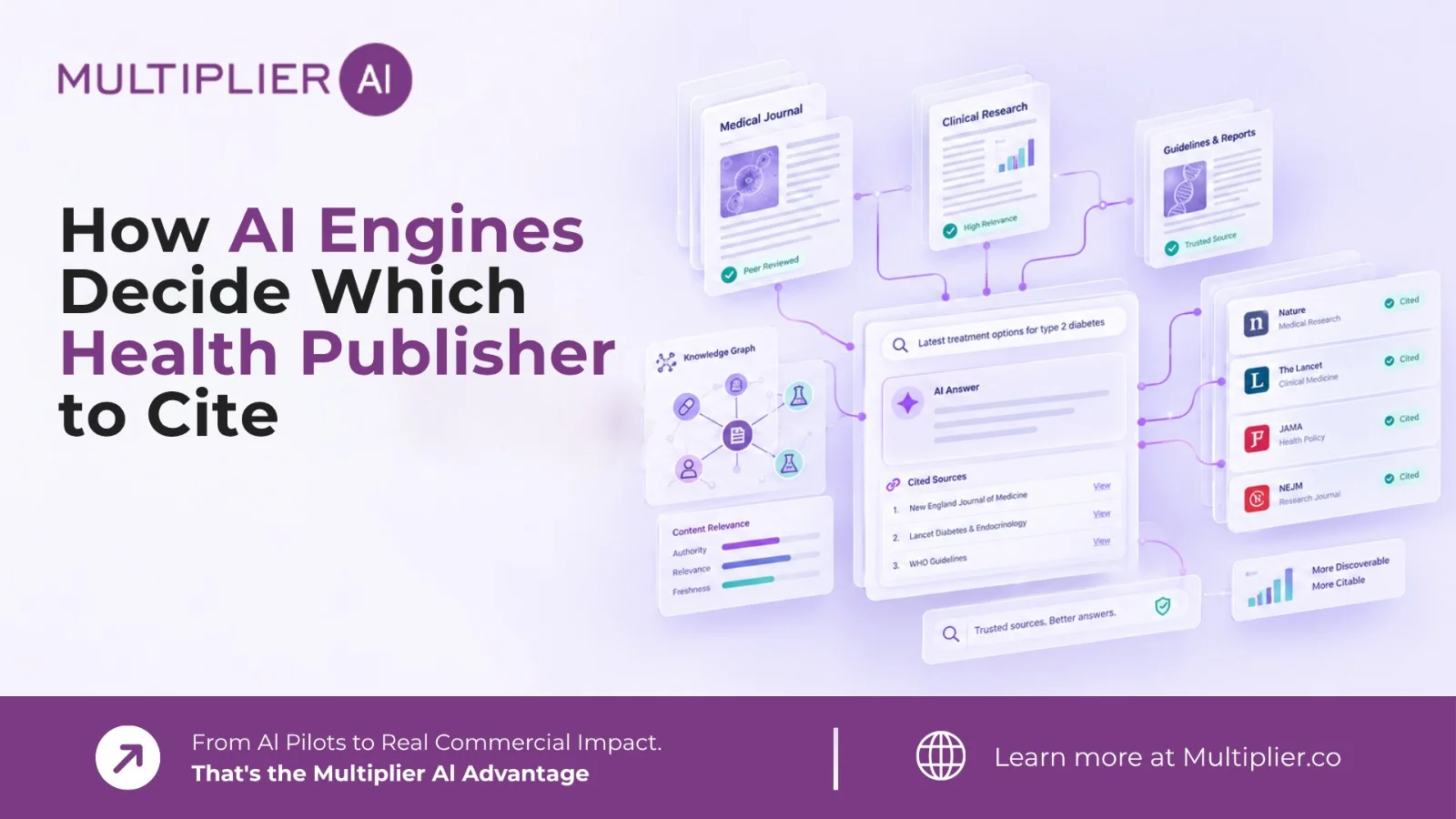
How do health publishers get cited by ChatGPT and Google AI Overviews?
By being the source a model reaches for when a higher-tier source does not cover the question, and by being structurally easy to extract when it does. In health specifically the citation hierarchy is steeper than in any other category: government health bodies and regulators sit at the top, then specialist societies and clinical guidelines, then peer-reviewed literature, then academic medical centres and large health publishers. A publisher is realistically competing for the fourth tier, not the first, and strategies built on displacing a guideline body will fail. What does move the needle is the part of the question space the higher tiers do not cover well — lived experience, practical management, what to expect, how to talk to a clinician, cost and access — combined with the signals that make content extractable: a direct answer near the top, verifiable citations, a named and credentialled medical reviewer with a visible review date, and clean machine-readable structure. The published GEO research found that citing authoritative sources improved a page's own visibility by roughly 27% and that fluency improvements were worth roughly 28%, both of which a health publisher is already set up to do better than almost anyone.
The structural position of a health publisher
It is worth being blunt about where a publisher sits, because a great deal of GEO advice sold to publishers implies a position they do not occupy.
| Tier above you | Why it outranks you in health answers | What this means for strategy |
|---|---|---|
| Government health bodies and regulators | Treated as definitive, rarely contradicted, and institutionally stable | Not contestable. Align with them rather than against them — contradiction is the fastest route to being disregarded |
| Specialist societies and clinical guidelines | The reference standard for treatment and comparison questions | Cite them, interpret them, make them legible to a lay reader. Interpretation is a real job the guideline itself does badly |
| Peer-reviewed literature | Rising in weight as the research-summary use case grows among clinicians | Primary-source citation is a GEO activity. A page that links the study beats a page that describes it |
| Academic medical centres | Institutional authority plus patient-facing writing, which is exactly a publisher's format | Your closest competitor and your most realistic benchmark. Study what they cover and where they stop |
The strategic consequence is that a health publisher's route into a citation runs through the questions the tiers above do not answer well. Guideline bodies do not write about what a scan actually feels like, how to phrase a question to a specialist, what a diagnosis means for work, or what happens if you cannot afford the first-line option. Those are publisher questions, they are high-volume, and they are where the hierarchy flattens.
The full taxonomy — all seven tiers with observed citation frequency per tier, measured rather than asserted — is being built in the how AI engines decide which health publisher to cite analysis. This page states the position; that one measures it.
What makes health content extractable
Four properties, and a health publisher already produces three of them as a matter of editorial standard. The gap is almost never quality. It is that the quality is invisible to a machine.
| Property | What it looks like | Does a health publisher already do it? |
|---|---|---|
| A direct answer, early, in plain language | The question restated and answered within the first two sentences of a section, before the context and the caveats | Partly. House style in health publishing frequently front-loads caveats, which is clinically responsible and structurally costly |
| Verifiable citation to primary sources | Links to the guideline, the trial, the regulator — not to another article about them | Usually yes in the editorial process, frequently not in the published page. The references exist and are often not linked |
| Visible, credentialled human review with a date | A named reviewer, their credentials, the date reviewed, and the relationship between reviewer and content made explicit | Yes, and this is the underexploited asset. The cost is already incurred; the structure is usually missing |
| Machine-readable structure | Clean headings, structured data, extractable tables, no critical information locked in images or interactive components | Variably. One vendor assessment of web properties found machine readability at roughly 75% for homepages, 74% for category pages and 66% for product pages — retail rather than health, and indicative of how much is lost at the structural layer |
The medical review point deserves emphasis because it is the cheapest material advantage available in this category. Health publishers spend real money having clinicians review content. That spend was incurred to satisfy a quality standard and a legal posture, and it was never structured so that a retrieval system could see it. Turning an existing cost into a visible signal is a structural project, not an editorial one, and it is the subject of the from E-E-A-T to AI citability analysis. The information-architecture side — how a condition hub should be built so that a model can use it — is covered in the condition hub architecture guide.
The post-search playbook — and why health publishers cannot run most of it
Through 2026 a recognisable playbook has emerged, built and described publicly by news and technology publishers. It is genuinely good work and it is worth studying. This is what the named players reported at a September 2026 industry summit.
| Publisher | What they are actually doing | Reported result |
|---|---|---|
| USA Today Company | Prioritising Threads, TikTok and Reddit referrals; licensing deals with Meta and Microsoft; plans to block Google's crawlers once search indexing is no longer needed | Google's share of referral traffic fell from over 70% to roughly 40%. Its president: that traffic is not coming back |
| Reuters | A machine-learning dynamic paywall deciding when a reader is worth more as a subscriber than as an ad impression; block-by-default bot blocking since May | Ad revenue now higher than before the paywall. Bot traffic fell while monetisable traffic held steady |
| The Verge | Restructured the audience team as ‘keeper of the funnel’, shifting from pageviews to registrations, newsletters and subscriptions; strengthened the homepage | Its audience director: Google traffic is now treated as extra |
| Axios | Axios Direct — content feeds built for AI models and agents, in three versions for three customer types | Hit its 2026 revenue goal in early September against late October the prior year, with double-digit growth |
| Politico | Replacing the CMS to treat journalism as structured data, enabling distribution across products and an internal AI authoring tool | Framed as infrastructure; no result reported |
| The New York Times | Selective AI licensing — requiring fair value, a sustainable partnership beyond a one-time payment, and control over use | Few deals signed. Partnerships treated as leverage for better attribution and referrals |
| CNBC | No LLM licensing deals, holding out for compensation. Building direct data partnerships and AI-driven personalisation instead | No licensing revenue, by choice |
| Ziff Davis | Diversify rather than replace — across direct, social, premium ads, affiliate commerce, licensing and proprietary data. Audited archives to sell data; selling AI visibility services | About 35% of revenue tied to web traffic, about 17.5% to search. Success metrics for the visibility services described as varying |
| Future | Selling GEO as a service through a dedicated unit, positioned as an extension of branded content | About a year old, 30-plus clients with renewals. Measures brand visibility and publisher citations; attribution to sales remains unsolved |
Two conclusions from that table before the health-specific argument. First, the reporting from that summit was explicit that AI licensing revenue is not close to offsetting lost referral revenue. Nobody is being made whole by a licence. Second, three of the nine are selling GEO services to other people, which tells you something about where the publishers themselves think the near-term money is.
The structural problem: a health audience does not come back
Look at what the strongest moves in that table have in common. The dynamic paywall, the registration funnel, the subscription conversion, the newsletter business, the homepage investment — every one of them assumes a reader who returns. They are mechanisms for converting a repeat visitor into a known, monetisable relationship.
A health publisher's core audience does not behave that way, and no amount of product work will make it. Someone researching a new diagnosis arrives at the worst week of their year, consumes a great deal very quickly, and leaves when the episode resolves. They do not want a relationship with a website about the condition they hope never to think about again. A person does not subscribe to shingles.
This is not a content-quality problem and it is not fixable by better funnel design. It is the defining economic feature of condition-led publishing and it is why the news-publisher playbook transfers so badly. A general news publisher is converting habit into revenue. A health publisher has no habit to convert, outside a minority chronic-condition and caregiver segment that is genuinely different and should be sized before anything is built for it.
The honest conclusion is that health publishing needs a different answer, and the rest of this page is an attempt at one. It starts from the observation that a health publisher's durable relationship was never with the reader in the first place. It was with the advertiser.
What transfers and what does not
| Move from the news-publisher playbook | Does it transfer to health publishing? | Why |
|---|---|---|
| Dynamic or hard paywall | Largely no | Requires return visits and willingness to pay for information about a condition. Viable for a chronic-condition or professional segment; not for the general condition audience |
| Registration wall to build known-user data | Partially, and with care | Health interests are sensitive personal data in most jurisdictions. A registration wall on a condition page creates a data-protection obligation most publishers have not scoped |
| Newsletter as the core relationship | Yes, for defined segments | Chronic conditions, caregivers and clinicians are genuinely recurring audiences. Build for those three and do not pretend the acute audience is one of them |
| Social and alternative referral diversification | Weaker than for news | Health content performs poorly on the platforms news publishers are shifting to, and medical misinformation moderation makes distribution unpredictable |
| Content licensing to AI developers | Yes, and with better leverage than news has | Medically reviewed health content is high-liability content for a model developer. That is a negotiating asset news publishers do not hold |
| Structured-data CMS investment | Yes — the strongest direct transfer | Health content is the most structurable content on the web: conditions, symptoms, treatments, interactions. The schema vocabulary already exists |
| Selling GEO services to advertisers | Yes, and sooner than most realise | Your pharma and consumer-health advertisers have exactly this problem and no in-house capability. Three publishers are already doing it |
| Blocking crawlers by default | Depends entirely on segment | A decision with revenue on both sides. The framework for pricing it is in the licence, block or optimise analysis |
| Events and commerce | Commerce yes, events partially | Affiliate commerce on health products is established. Events work for clinical and chronic-condition audiences and not for the acute one |
What does work: five moves for a health publisher
These are ordered by how quickly they return something and how little they depend on anyone else's behaviour. None of them is a replacement for search traffic, because nothing is. All five are ways of making the business less dependent on it.
1. Change the dashboard before you change the strategy
If pageviews remain the primary metric, every subsequent decision will be made against a number that no longer describes your position. The replacement is citation share — how often, across a defined and repeated sample of prompts in your subject areas, your property is the source a generative engine draws on and names.
Three things move onto the monthly dashboard alongside it, and all three are leading indicators that most publishers currently review annually or never: advertiser count, registered-user count by segment, and the share of sessions arriving from a named AI referrer. The Ziff Davis disclosure is the argument for the first two — advertisers fell 866 to 797 and subscribers 1.892 million to 1.618 million while revenue fell only 3% in the segment. Revenue was the lagging indicator; the relationships moved first.
Measuring citation share across a library of tens of thousands of pages is a sampling problem rather than a tracking problem, and it has a real method with real sample-size requirements. That method is the subject of the measuring AI visibility across a large content library guide. This page's point is only that the dashboard has to change first, because otherwise you will have no way of knowing whether anything you do next worked.
2. Make the medical review visible to machines
The cheapest unexploited advantage in health publishing. You already pay clinicians to review content. That review is usually represented on the page as a line of text and almost never as structured, machine-readable data linking a credentialled person, their qualifications, a review date and the specific content reviewed.
The published GEO benchmark found that citing authoritative sources improved a page's own visibility by roughly 27% and that fluency improvements were worth roughly 28% — two of the four best-performing methods tested, and both of them things a medically reviewed, professionally edited health property is already structurally good at. The gap between doing it and being seen to do it is a schema and workflow project, not an editorial one, and it is the subject of the medical review workflow and AI citability analysis.
3. Reposition the advertiser proposition from impressions to authority adjacency
This is the most commercially consequential move on the list and the one with the longest lead time, which is why it should start this quarter. A health publisher's durable asset was never the reader relationship — it was the advertiser relationship, built on the ability to reach a condition audience at a defined moment. That ability is weakening, and the advertisers know it, because they are facing the same measurement collapse from the other side.
A pharmaceutical or consumer-health advertiser now has the same problem you do: no rank, no impression log, no referrer, and no idea whether a generative engine mentions their brand when a patient asks about their category. What they want to buy is changing from impressions against a condition audience to presence in the sources that shape what that audience is told. That is a different product, and a publisher with a medically reviewed, heavily cited content estate is unusually well placed to sell it.
| The old proposition | The emerging proposition | What has to be true to sell it |
|---|---|---|
| Impressions against a condition audience | Presence in the content that generative engines draw on for that condition | You can measure your own citation share by condition and show it moving |
| Sponsorship of a condition hub | Co-production of the evidence-grade content in that condition, with the advertiser's unbranded material cited and the relationship disclosed | Editorial independence has to be demonstrable, not asserted — and disclosure has to be explicit |
| Audience demographics and reach | Share of the answer surface in a defined prompt set, reported against a named competitive set | A measurement method you can describe and the advertiser can audit |
| Banner and native inventory | Measurement and visibility services sold alongside, or instead of, media | In-house capability. At least three publishers are already selling exactly this |
One caution that belongs in any conversation of this kind. Co-produced content with a regulated advertiser is subject to promotional rules regardless of where it sits, and the fact that a generative engine paraphrased it does not change whose communication it was. The regulatory position for the advertiser side is set out in the generative engine optimization for healthcare pillar, and a publisher selling into pharma should understand it before building the product.
4. Treat licensing as a distribution negotiation, not a settlement
The evidence from publishers who have done it is consistent and unflattering: AI licensing revenue is not close to offsetting lost referral revenue. One major title has signed few deals and requires fair value, a sustainable partnership beyond a one-time payment, and control over use. Another has signed none and is holding out. A third plans to block the dominant search crawler once it no longer needs the indexing.
What a health publisher has that a news publisher does not is liability exposure as a negotiating asset. Medically reviewed health content is high-risk content for a model developer to get wrong, and the provenance of health information is a live regulatory question in several markets. That is leverage — for attribution terms, for referral commitments and for usage controls, which several publishers now say they value above the cash.
The decision of what to licence, what to block and what to optimise is portfolio-level and differs by content type, and it is not a question this page should answer. The framework that prices the three options against each other is the licence, block or optimise analysis.
5. Commission against prompts, not keywords
The questions people bring to a generative engine are not the queries they typed into a search box. They are longer, they are multi-turn, they narrow toward a decision, and they are frequently about the practical and emotional dimensions of a condition rather than its definition. A commissioning calendar built from a keyword tool is modelling the behaviour that stopped.
The practical starting point is cheap: take your top fifty conditions, write out the ten questions a real person would actually ask an assistant about each, and compare that list against what you have published. The gaps are usually obvious and they are usually in the same places — what to expect, how to cope, what to ask a clinician, what it costs, what happens next. The structured method, with the four-stage and four-persona model behind it, is the subject of the health publisher's prompt map.
GET ACTIONABLE AI AND HEALTHCARE INSIGHTS THAT HELP YOU STAY AHEAD IN A FAST-CHANGING PHARMA WORLD
Is AI traffic worth having?
A fair question, and one where the published evidence is contradictory enough that it needs stating carefully. The volumes are small and the per-visit behaviour appears better.
| Finding | Source and status | How much weight to give it |
|---|---|---|
| AI-referred traffic to US retail sites converted 42% better than paid search and email in March 2026; visitors stayed 48% longer, viewed 13% more pages and had a 12% higher engagement rate | Vendor data from a commercial software company, reported via business press. No sample size, no site count, no methodology published | Directional only, and it is retail rather than health. Quote it with the vendor named and the category stated, or do not quote it |
| AI-assistant traffic to US retail sites grew 393% year on year in Q1 2026, and 693% over the prior holiday period | Same vendor dataset | Growth from a very small base. The same source describes AI as still a small slice of total traffic without giving the figure |
| Machine readability measured at roughly 75% for homepages, 74% for category pages and 66% for product pages | Same vendor dataset | The most actionable figure of the three — a third of pages in that sample were not fully machine-readable, which is a solvable engineering problem |
| Users clicked a traditional result in 8% of visits when an AI summary appeared, against nearly twice that without | Pew Research Center, independent, 68,879 searches by 900 US adults, March 2025 | The counterweight. Better per-visit behaviour on a much smaller volume is not obviously a trade a publisher wins |
The honest synthesis is that AI referral traffic is probably better per visit and far smaller in volume, and that the arithmetic has not yet been published for anyone, let alone for health. A publisher should instrument AI referrers in analytics now, segment them, and measure their own conversion and engagement rather than relying on a retail dataset from a vendor. It takes a week to set up and it replaces an argument with a number.
A twelve-month operating plan
The sequence matters more than the speed. The common failure is to start with content, because content is what a publisher knows how to make, and to discover a year later that there was no measurement in place to tell whether it worked.
| Quarter | What gets done | What gets deliberately deferred |
|---|---|---|
| Q1 — instrument and baseline | Add AI referrers to analytics and segment them. Put advertiser count, registered users by segment and citation share on the monthly dashboard. Establish a baseline citation-share measurement across your top conditions, multi-run and multi-engine. Audit machine readability across page templates | All content strategy. You cannot evaluate a strategy against a baseline you have not taken, and the baseline takes a quarter to be credible |
| Q1–Q2 — structure the asset you already have | Make medical review machine-visible: structured reviewer identity, credentials, review dates, and the link between reviewer and content. Fix the template-level readability failures found in the audit | New commissioning. This is an engineering and workflow project and it competes for the same budget as content — protect it |
| Q2 — open the advertiser conversation | Take citation share by condition to your three largest advertisers. Ask what they are measuring on their side. Most will not have an answer, which is the opportunity | Building a product. Have the conversation before you build; the first three conversations will change the specification |
| Q2–Q3 — segment the audience honestly | Size the genuinely recurring audience — chronic conditions, caregivers, clinicians — separately from the acute one. Build registration, newsletter and membership propositions only for the recurring segment | Any paywall or registration wall on acute condition content. It will underperform and it creates a sensitive-data obligation |
| Q3 — commission against prompts | Rebuild the commissioning calendar from a prompt map rather than a keyword list, starting with the top fifty conditions and the gap categories the map exposes | Wholesale archive rewriting. Commission forward; remediate the archive only where measurement shows a gap |
| Q3–Q4 — decide the crawler and licensing position | Make the licence, block or optimise decision segment by segment, with the measurement from Q1 to price it. Negotiate for attribution and referral terms, not only cash | Making the decision ideologically or all at once. It is a portfolio decision and the answer differs by content type |
| Q4 — re-measure and report | Second full citation-share measurement against the Q1 baseline, with variance stated. Report advertiser and registered-user movement alongside it | Claiming causation. Two measurements a year apart in a channel with run-to-run variance is a trend, not proof |
What we do not know
A page that only reports findings is incomplete. These are the things this analysis genuinely cannot tell you, and a publisher making a large decision should know which part of the picture is missing.
| The open question | Why it is open | What would settle it |
|---|---|---|
| How much of the visibility decline is AI and how much is the core update | They happened in the same period and no published analysis separates them. The December 2025 core update ran eighteen days during the steepest part of several declines | Your own segmented data — click-through by query type, split by whether an AI summary was present, before and after the update window |
| Whether health is worse affected than other categories | The widely quoted 33% publisher decline is cross-category and does not break out health. Health-specific figures come from a single chart | A category-segmented study with published method. It does not currently exist, which is itself an opportunity for whoever publishes it first |
| Whether AI referral traffic monetises as well per visit as the engagement data suggests | The conversion figures are retail, vendor-produced and without published sample sizes. No health-specific equivalent has been published | Your own instrumentation. A quarter of segmented AI referrer data from your own property answers it definitively for you |
| Whether licensing revenue can ever be material for a health publisher | Current reporting says it is not close to offsetting referral losses, and deal terms are confidential | Disclosure. In the meantime, treat any projection of licensing revenue as a hope rather than a forecast |
| How large the genuinely recurring health audience is | Nobody has published a segmentation of acute versus chronic versus caregiver versus clinician audiences with retention by segment | Your own cohort analysis, and it is the single most valuable piece of internal research a health publisher could commission this year |
Conclusion: the relationship, not the ranking
The temptation when a traffic chart falls is to treat it as a ranking problem, because ranking problems have known solutions and fifteen years of institutional muscle behind them. The evidence says it is not a ranking problem. A publisher whose visibility line stayed flat throughout the period sits inside the segment that took a $54.8 million impairment, and the operating numbers that moved first were advertiser count and subscriber count rather than revenue. Position in a search result stopped being the business before most publishers stopped measuring it.
The second temptation is to copy the playbook that news and technology publishers are visibly executing, and that one is more dangerous because the playbook is good. Dynamic paywalls, registration funnels, structured-data CMS investment, AI content feeds, selective licensing — these are serious responses by serious operators, and several of them will work. But the strongest of them convert a returning reader into a known relationship, and a health publisher's core audience does not return. A person who spent four days reading everything you had about a diagnosis is not a lapsed subscriber. They are someone who got better.
What a health publisher actually holds is a different asset than a news publisher holds, and it is more durable than it currently looks. It is a medically reviewed, heavily cited content estate in a subject area where accuracy carries legal weight, serving advertisers who need to reach condition audiences and who are themselves losing the ability to measure whether they do. Three of those four things are strengthening, not weakening. The one that is weakening is the delivery mechanism.
So the work is to make the asset legible and to change what is sold against it. Make medical review machine-visible, because the cost is already incurred and the signal is currently invisible. Move the dashboard to citation share, because otherwise nothing that follows can be evaluated. Size the recurring audience honestly and build relationship products only for it. Take citation share by condition to the advertisers, because they have the same problem and no capability. And treat licensing as a distribution negotiation where attribution and referral terms matter more than the cheque, because on the current evidence the cheque does not close the gap.
None of that restores the traffic. The most useful sentence any publisher said publicly in 2026 was the blunt one: that traffic is not coming back. A strategy built on its return is not a strategy, and the publishers who accept that first will have two years of head start on the ones who do not.
Frequently Asked Questions For GEO for Medical Publishers
Most likely because the questions your pages answered are now answered inside the search result, compounded by an eighteen-day Google core update that ran from 11 to 29 December 2025. Pew Research Center's independent analysis of 68,879 searches by 900 US adults found that when an AI summary appeared users clicked a traditional result in 8% of visits, against nearly twice that without one, and ended the session on 26% of pages with summaries versus 16% without. The first thing to do is change what you measure — citation share, advertiser count and registered users rather than pageviews. The second is to make your medical review process machine-visible, because it is a paid-for asset that is currently invisible. The one response that will not work is trying to recover the lost positions.
By competing where the citation hierarchy flattens and by being structurally easy to extract. In health, government bodies, specialist societies, clinical guidelines and peer-reviewed literature sit above publishers and are not realistically displaceable. What those tiers cover badly is the practical and experiential layer — what to expect, how to cope, what to ask a clinician, what it costs, what happens next — and that is publisher territory. On the structural side: a direct answer early in each section, links to primary sources rather than to articles about them, a named and credentialled reviewer with a visible review date, and clean machine-readable markup. The published GEO benchmark found citing authoritative sources worth roughly 27% and fluency improvements roughly 28%, both of which a professionally edited health property is already good at.
Directionally severe and precisely uncertain. Published visibility-index figures show one major US health publisher down roughly 43% and another roughly 52% between mid-2024 and January 2026, but those values were read off a chart whose index vendor is unnamed. The firmer evidence is financial: a $54.8 million goodwill impairment taken entirely against one owner's Health and Wellness segment for the quarter ended 30 June 2026, with segment advertising revenue falling from $82.5m to $79.8m, health advertisers from 866 to 797 and subscription customers from 1.892 million to 1.618 million. Use the public figures for context and your own analytics for magnitude.
Nobody has published an analysis that separates them, and anyone telling you confidently is telling you what they believe. The December 2025 core update ran for eighteen days during the steepest part of several declines, and the growth of AI summaries was happening throughout the same period. The company that took the health-media impairment did not attribute it to AI search — its risk disclosures reference content piracy and developments related to artificial intelligence, which is a legal-risk framing rather than a traffic-causation statement. Your own data can answer this for your property: segment click-through by query type according to whether an AI summary was present, before and after the update window.
Probably nothing, and the more likely explanation is that they had less to lose. A property that was not holding high-visibility positions across a broad condition footprint cannot lose them. The important point is that it did not help: the parent company of that property is the one that recorded the $54.8 million impairment. Flat visibility did not protect the segment. The useful inference runs the other way too — if a flat line did not protect a business, a falling line does not condemn one. What determines the outcome is whether you hold relationships that do not route through a search result.
For your recurring audience, possibly. For your acute condition audience, almost certainly not. Paywalls and registration funnels convert habit into revenue, and the general health audience has no habit to convert — someone researching a new diagnosis arrives once and leaves when the episode resolves. The genuinely recurring segments are chronic conditions, caregivers and clinicians, and they should be sized before anything is built for them. There is also a compliance dimension most publishers have not scoped: a registration wall on a condition page creates a record of a named person's interest in a health topic, which is sensitive personal data in most jurisdictions.
Probably better per visit and much smaller in volume, and the published evidence is thinner than it looks. Vendor data from a retail dataset reports AI-referred traffic converting 42% better than paid search and email, with visitors staying 48% longer and viewing 13% more pages — but it is retail rather than health, it is vendor-produced, and no sample size is published. Set against that, the independent Pew figures suggest the volume cost is steep. Instrument AI referrers in your own analytics and segment them. A quarter of your own data settles the question for your property better than any published study currently can.
It is a portfolio decision that differs by content type, not a single answer, and the evidence on licensing economics is discouraging. Reporting from a September 2026 publishing summit concluded that AI licensing revenue is not close to offsetting lost referral revenue. One major title has signed few deals and requires fair value plus control over use; another has signed none and is holding out; a third plans to block the dominant search crawler once it no longer needs indexing. A health publisher does hold one negotiating asset news publishers lack: medically reviewed content is high-liability content for a model developer to get wrong. Use it for attribution and referral terms. The framework for pricing the three options is covered separately in this cluster.
Citation share — how often, across a defined and repeated prompt sample in your subject areas, a generative engine draws on and names your property. Alongside it, three leading indicators belong on the monthly dashboard: advertiser count, registered users by segment, and sessions from named AI referrers. The case for the first two is the Ziff Davis disclosure, where advertisers fell 866 to 797 and subscribers 1.892 million to 1.618 million while segment revenue fell only about 3%. The relationships moved a long way before the revenue did. Measuring citation share across a large library is a sampling problem with real sample-size requirements, covered in its own guide in this cluster.
By recognising that they have the same problem and no capability to solve it. A pharmaceutical or consumer-health advertiser now faces the same measurement collapse from the other side: no rank, no impression log, no referrer, and no visibility into whether a generative engine mentions their brand when a patient asks about their category. The proposition shifts from impressions against a condition audience to presence in the content that shapes what that audience is told — which requires that you can measure your own citation share by condition and show it moving. At least three publishers are already selling AI visibility services commercially, one through a dedicated unit about a year old with more than thirty clients. Attribution to sales remains unsolved for all of them, and saying so is part of selling it credibly.
A credible baseline takes a quarter and a readable trend takes a year. Generative answers vary between runs, so a change between two single measurements is as likely to be variance as effect. The fastest-returning work is the structural kind — making medical review machine-visible and fixing template-level readability failures — because it improves an asset you already own rather than requiring new content. The slowest is the advertiser repositioning, which is why it should start in the same quarter as the measurement even though it will not close until much later.
GET ACTIONABLE AI AND HEALTHCARE INSIGHTS THAT HELP YOU STAY AHEAD IN A FAST-CHANGING PHARMA WORLD
Let's Discuss Your Requirements