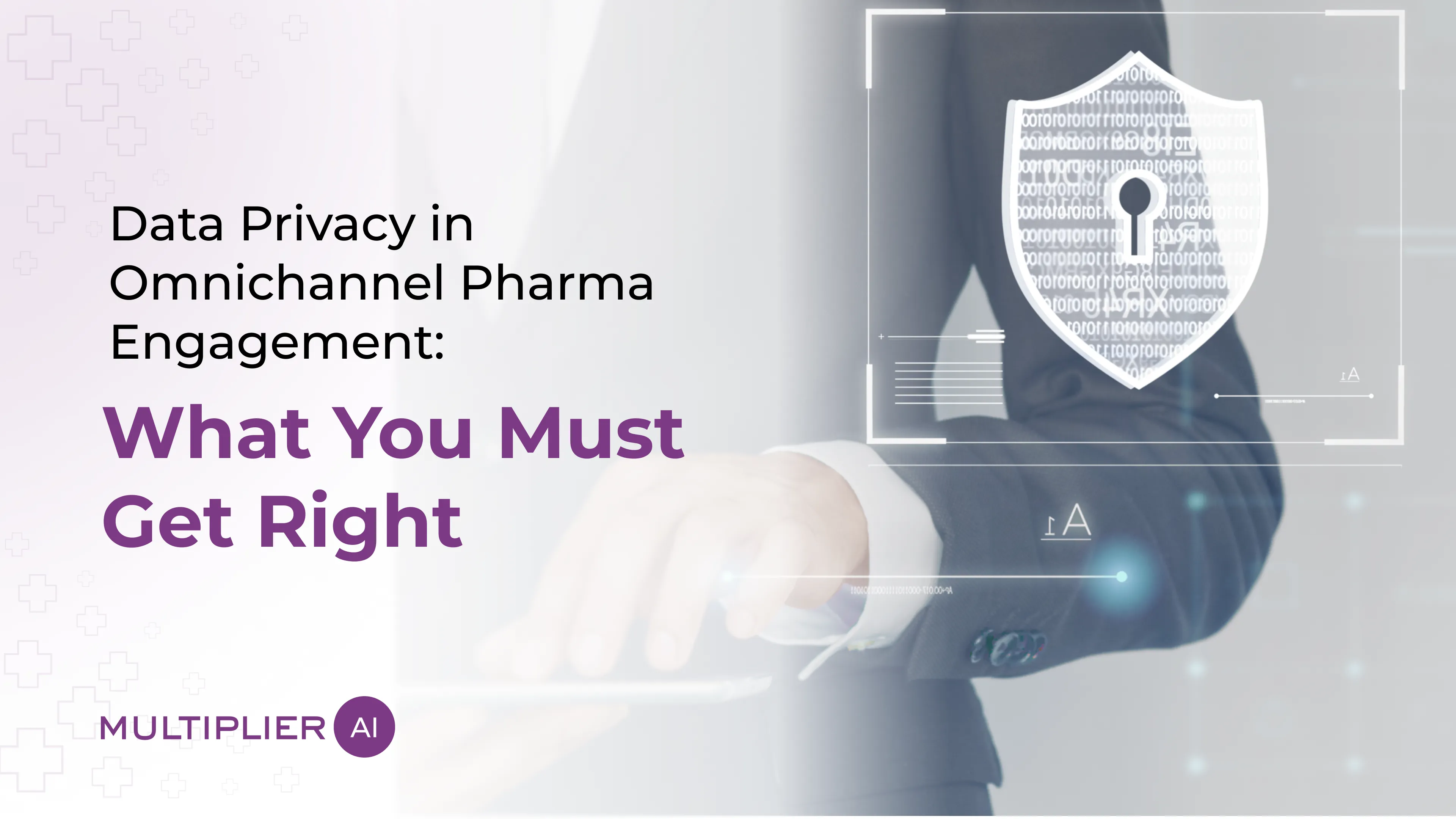
Data Privacy in Omnichannel Pharma Engagement: What You Must Get Right
Pharma engagement has entered a new phase where data sits at the center of every meaningful interaction. Understanding how healthcare professionals engage, what content they consume, when they respond, and how their preferences evolve is now essential for delivering relevant communication. Without data, omnichannel strategies remain generic. Omni channel customer engagement in healthcare becomes more effective when personalization is supported by transparent, permissioned, and privacy-safe data usage. With data, they become precise, adaptive, and effective. This is why pharma data privacy omnichannel strategies are becoming essential for teams that want to personalize HCP engagement without weakening trust, consent, or compliance.
However, this shift has elevated the importance of data privacy. What was once treated as a regulatory requirement is now a strategic concern. Every piece of data collected, every interaction tracked, and every insight generated carries implications for how trust is built and maintained. For pharma companies, the challenge is not simply to comply with regulations. It is to create systems where data can be used responsibly to enhance engagement without compromising privacy. This requires a fundamental shift in how data is managed.
What Is Pharma Data Privacy in Omnichannel Engagement?
Pharma data privacy in omnichannel engagement means collecting, storing, analyzing, and activating HCP or patient-related data responsibly across channels such as field visits, email, WhatsApp, websites, webinars, CRM systems, digital campaigns, and AI workflows.
It requires consent, transparency, purpose limitation, data minimisation, secure processing, role-based access, audit trails, and clear governance so pharma companies can personalize engagement without compromising privacy or trust. In short, it is the discipline that lets a pharma brand be both highly personalized and fully respectful of the HCP's data at the same time.
The Hidden Risk in Personalization Efforts
As organizations push toward more personalized engagement, they often expand their data collection efforts. They track digital interactions, analyze behavior patterns, and integrate multiple data sources to build detailed profiles. A Hyper Personalized Content Platform should therefore be connected with consent, channel permissions, and governance controls when teams use doctor behavior signals for personalized communication across email, WhatsApp, and social channels. While this enables more relevant communication, it also increases exposure to privacy risks. The risk is not always obvious. It is not just about unauthorized access or data breaches — it is also about how data is used, how transparent organizations are, and whether individuals feel that their information is being handled appropriately.
For example, overly intrusive personalization can create discomfort. If communication feels too tailored without clear consent, it can undermine trust. This highlights an important point. Effective personalization is not just about what is possible. It is about what is appropriate. HCP data privacy in pharma requires teams to balance relevance with transparency, permission, purpose limitation, and channel-level preference management. Different channels carry different risk profiles, as the table below shows.
Table 1: Omnichannel Data Sources and Privacy Risks
| Data Source | What It Captures | Privacy Risk if Poorly Governed |
| CRM records | Field interactions, notes, HCP preferences | Uncontrolled access or outdated consent |
| Email campaigns | Opens, clicks, topic interest | Communication without valid consent |
| WhatsApp engagement | Direct message interaction and response | Informal use without clear permission |
| Webinar platforms | Attendance, questions, content interest | Overuse of engagement data |
| Website behavior | Pages viewed and content consumed | Over-personalization without transparency |
| Digital ads | Retargeting and audience behavior | Use beyond original purpose |
| Field notes | HCP concerns, competitor mentions, context | Sensitive notes used without governance |
| AI models | Pattern detection and recommendations | Hidden data usage or lack of explainability |
Understanding the Regulatory Landscape
Data privacy in pharma is governed by a complex set of regulations. Frameworks such as GDPR in Europe, HIPAA in the United States, the DPDP Act in India, and other regional regulations define how data can be collected, stored, and used. These regulations share common principles. Consent, transparency, purpose limitation, and data security are central themes, and organizations are required to clearly define how data is used and ensure that it is handled responsibly. For pharma companies, this creates a need for structured governance. Compliance is not optional. Omnichannel compliance in pharma requires every engagement channel to follow approved consent, privacy, content, and audit rules. However, simply meeting regulatory requirements is not enough. Organizations need to integrate these principles into their operational models. Pharma compliance data usage should be governed across CRM, email, WhatsApp, field, webinar, digital, and AI systems.
Core Privacy Principles Pharma Teams Must Apply
Most privacy regulations differ by geography, but they share common operating principles. Pharma teams should focus on consent, transparency, purpose limitation, data minimisation, security, access control, and auditability. These principles matter because omnichannel engagement depends on continuous data collection and activation. If the same HCP data is used across email, WhatsApp, field visits, webinars, CRM systems, and AI models without clear governance, personalization can quickly become privacy risk. A privacy-safe omnichannel model should make every data use explainable, permissioned, limited to a defined purpose, and traceable.
Table 2: Core Privacy Principles for Pharma Omnichannel Engagement
| Privacy Principle | What It Means in Pharma Engagement |
| Consent | HCPs or users must clearly understand and agree to specific communication or data use |
| Transparency | Teams must explain what data is collected and why |
| Purpose limitation | Data collected for one purpose should not be reused for unrelated engagement |
| Data minimisation | Only necessary data should be collected and used |
| Accuracy | HCP profiles, preferences, and consent records should remain current |
| Security | Data must be protected from unauthorized access or misuse |
| Role-based access | Only approved teams should access specific data types |
| Auditability | Data use, consent changes, and engagement actions should be traceable |
| Preference management | Channel choices and opt-outs should be respected across systems |
Moving from Compliance to Trust
While compliance ensures that legal requirements are met, trust determines how data practices are perceived. Healthcare professionals are increasingly aware of how their data is used — they expect transparency and control. Building trust requires going beyond minimum requirements. Organizations need to communicate clearly about how data is collected and used. A clear privacy policy helps users understand how data is collected, processed, protected, and used across engagement systems. They need to provide options for managing preferences and ensure that these preferences are respected. Trust is built through consistency. When data practices align with expectations, engagement improves. When they do not, even compliant practices can create resistance.
Table 3: Compliance vs Trust in Pharma Data Privacy
| Area | Compliance View | Trust View |
| Consent | Required permission record | Clear and respectful choice |
| Privacy notice | Legal disclosure | Understandable explanation |
| Data use | Meets regulation | Feels appropriate to the HCP |
| Personalization | Technically allowed | Relevant without being intrusive |
| Preference management | Opt-out mechanism | Real control across channels |
| Audit trail | Proof of compliance | Proof of accountability |
| Communication | Legally permissible | Expected, useful, and respectful |
Designing Privacy into Omnichannel Systems
To manage data privacy effectively, organizations need to embed it into the design of their systems. This approach is often referred to as privacy by design. Instead of treating privacy as an afterthought, it becomes a core component of how systems are built and operated. For example, data collection processes should be designed to capture only what is necessary. Access controls should ensure that data is available only to those who need it. A GenAI Doctor Data Platform can help teams connect doctor profiles, CRM activity, digital presence, segmentation, doctor consent, and preferred-channel communication into a controlled HCP intelligence layer. Systems should be structured to prevent unauthorized use. AI systems also need to be designed with privacy in mind — ensuring that data used for analysis is anonymized where possible and that outputs do not reveal sensitive information. By integrating privacy into system design, organizations can reduce risk and improve efficiency.
Table 4: Privacy by Design in Omnichannel Pharma Systems
| System Layer | Privacy-by-Design Requirement |
| Data collection | Capture only necessary and permitted data |
| Consent layer | Store channel-wise, purpose-wise consent records |
| CRM layer | Keep preferences, consent, and interaction history updated |
| AI layer | Use governed data and avoid exposing sensitive information |
| Content layer | Activate only approved and permissioned communication |
| Channel layer | Respect email, WhatsApp, digital, and field preferences |
| Access layer | Apply role-based access and approval workflows |
| Audit layer | Log data use, consent changes, and engagement actions |
Practical Privacy Architecture for Omnichannel Pharma
A practical privacy architecture for omnichannel pharma engagement should include five connected layers: consent, data governance, channel governance, AI governance, and audit governance.
- The consent layer — defines who can be contacted, through which channel, and for what purpose.
- The data governance layer — controls what information is collected, stored, enriched, and retained.
- The channel governance layer — ensures that email, WhatsApp, field, webinar, and digital campaign activity follows the correct permissions.
- The AI governance layer — controls which data AI systems can use and how recommendations are generated.
- The audit governance layer — records every important data action, permission change, and engagement activation.
When these layers work together, pharma teams can personalize engagement without losing privacy control.
The Role of Consent in Modern Engagement
Consent is a cornerstone of data privacy. In the context of omnichannel engagement, it plays a critical role in defining what is permissible. Consent needs to be clear, informed, and specific. Healthcare professionals should understand what they are agreeing to and how their data will be used, including the benefits of data usage such as improved relevance and efficiency. Managing consent is an ongoing process. A DPDP-Compliant HCP Marketing framework helps pharma teams manage explicit consent tracking, purpose limitation, data minimisation, immutable audit trails, and role-based access before activating omnichannel HCP engagement. Preferences may change over time, and systems need to be able to adapt. Omnichannel privacy can break down when pharma CRMs fail at consent tracking, because teams may not know which channels, permissions, or purposes apply to each HCP. Consent withdrawal under DPDP must cascade across CRM, email, WhatsApp, ads, and analytics systems so outdated permissions do not remain active in omnichannel workflows. This requires maintaining accurate records and ensuring that updates are reflected across all channels. Respecting consent is not just a legal requirement. Consent enforcement at the point of engagement ensures that email, WhatsApp, field, digital, and CRM actions do not proceed unless the HCP's consent and channel permissions are valid. It is a key factor in maintaining trust.
Table 5: Consent Management Checklist
| Consent Requirement | Why It Matters |
| Specific consent | Ensures data is used only for defined purposes |
| Channel-wise consent | Separates email, WhatsApp, phone, ads, and digital permissions |
| Consent timestamp | Shows when permission was captured |
| Consent source | Shows where and how permission was obtained |
| Consent withdrawal | Allows users to revoke permission |
| Preference update | Keeps communication choices current |
| System cascade | Ensures consent changes update across CRM and channels |
| Audit trail | Provides defensible proof of consent management |
Purpose Limitation, Data Minimisation, and Preference Management
Consent alone is not enough. Pharma teams also need to ensure that data is used only for the purpose for which it was collected, and only to the extent necessary.
Purpose limitation means that data collected for one reason should not automatically be reused for another. Purpose limitation under DPDP is especially important when HCP data collected from one channel is reused for another campaign, audience segment, or AI-driven recommendation. For example, data captured for webinar registration should not be used for unrelated promotional outreach unless the purpose and permission allow it. Data minimisation means teams should collect and use the smallest amount of data required to achieve the engagement objective. Preference management ensures that HCP choices about channel, frequency, and topic are respected across systems. DPDP-compliant consent collection across email, WhatsApp, and ads is important when omnichannel pharma engagement uses multiple communication channels and audience signals. Together, these controls prevent personalization from becoming excessive or intrusive.
Balancing Data Utility and Privacy
One of the biggest challenges in data privacy is balancing utility and protection. On one hand, more data enables better insights and more effective engagement. On the other hand, increased data usage raises privacy concerns. Finding the right balance requires careful consideration. Organizations need to evaluate the value of data against the associated risks, identifying which data points are essential and which are not. Data minimisation under DPDP helps pharma teams use only the doctor or engagement data that is necessary for a defined omnichannel purpose. AI can support this process — by analyzing patterns, it can help determine which data contributes most to outcomes, allowing organizations to focus on high-value data while minimizing unnecessary collection. This approach improves both efficiency and privacy.
Table 6: Balancing Data Utility and Privacy
| Data Use Question | Why It Matters |
| Is this data necessary? | Supports data minimisation |
| Was it collected for this purpose? | Supports purpose limitation |
| Is consent valid for this channel? | Prevents unauthorized outreach |
| Can aggregated data be used instead? | Reduces individual-level privacy risk |
| Who needs access? | Supports role-based access |
| How long should it be retained? | Prevents uncontrolled data lifecycle risk |
| Can the output expose sensitive context? | Protects against inappropriate AI outputs |
| Is the action auditable? | Supports compliance and accountability |
GET ACTIONABLE AI AND HEALTHCARE INSIGHTS THAT HELP YOU STAY AHEAD IN A FAST-CHANGING PHARMA WORLD
Ensuring Data Security Across Systems
Data privacy is closely linked to data security. Protecting data from unauthorized access is a fundamental requirement. This involves implementing technical measures such as encryption, access controls, and monitoring systems, and establishing processes for managing incidents and responding to potential breaches. Security is not a one-time effort. Retention and deletion under DPDP should be part of omnichannel privacy design so outdated or unnecessary HCP data does not remain active across systems. It requires continuous monitoring and improvement. As systems evolve, new risks may emerge, so organizations need to stay proactive.
Integrating Privacy into AI-Driven Workflows
AI plays a central role in modern pharma engagement. AI pharma compliance becomes essential when omnichannel personalization depends on HCP data, automated recommendations, approved content, and privacy-safe activation. However, its use raises additional privacy considerations. AI systems rely on data to generate insights and drive decisions, and ensuring that this data is handled responsibly is critical. This includes defining clear rules for data usage, ensuring that models do not expose sensitive information, and maintaining transparency in how decisions are made. GPT & LLM Based Tools should operate inside governed AI workflows where approved data sources, privacy rules, review triggers, and audit logs control how insights and recommendations are generated. Explainability is important — users need to understand how AI systems operate and how they use data, which builds confidence and supports adoption. AI data governance pharma workflows should define approved data sources, access controls, explainability, review triggers, and audit logs before AI recommendations are activated. By integrating privacy into AI workflows, organizations can leverage technology while maintaining trust.
Table 7: AI Data Governance Controls in Pharma
| AI Governance Control | Why It Matters |
| Approved data sources | Prevents AI from using unauthorized information |
| Data minimisation | Reduces unnecessary data exposure |
| Role-based model access | Limits who can run or view AI outputs |
| Explainability | Helps users understand why recommendations are made |
| Sensitive output checks | Prevents exposure of private or inappropriate insights |
| Human review triggers | Escalates high-risk recommendations |
| Model monitoring | Detects drift, misuse, or unexpected behavior |
| Audit logging | Tracks data used, output generated, and action taken |
Making Privacy Actionable for Teams
Data privacy is often seen as a centralized function, but it needs to be operationalized across teams. Field teams, marketing teams, and data teams all interact with data in different ways. Each of these groups needs to understand their role in maintaining privacy — following guidelines for data usage, respecting consent, and ensuring that communication aligns with approved practices. Training is essential. Teams need to be equipped with the knowledge and tools to manage data responsibly. When privacy becomes part of everyday workflows, compliance improves naturally.
Table 8: Team Responsibilities for Privacy-Safe Engagement
| Team | Privacy Responsibility |
| Marketing | Use only consented audiences and approved communication purposes |
| Field teams | Respect HCP preferences and avoid informal misuse of data |
| Medical affairs | Handle scientific and HCP context responsibly |
| Data teams | Maintain data quality, access rules, and governance |
| Compliance / legal | Define privacy policies, review controls, and audit requirements |
| CRM / admin teams | Maintain consent, preferences, and data lifecycle rules |
| Digital teams | Ensure campaigns respect channel permissions |
| Leadership | Sponsor privacy as a strategic trust capability |
Measuring Privacy Effectiveness
Evaluating data privacy requires more than checking compliance. Organizations need to assess how effectively their practices support both protection and engagement. This includes tracking adherence to policies, monitoring incidents, and evaluating how data usage impacts trust and engagement. Feedback from HCPs can also provide valuable insights — understanding how data practices are perceived helps identify areas for improvement. By measuring effectiveness, organizations can refine their approach.
Table 9: Privacy Effectiveness Metrics
| Metric | Why It Matters |
| Consent completeness | Shows whether records are usable and defensible |
| Channel permission accuracy | Confirms outreach matches approved channels |
| Opt-out processing time | Measures how quickly preferences are respected |
| Data minimisation score | Tracks whether unnecessary data collection is reduced |
| Access violation count | Measures role-based access effectiveness |
| Audit trail completeness | Shows whether data use is traceable |
| Privacy incident rate | Tracks operational risk |
| Preference update accuracy | Ensures CRM and channel systems stay aligned |
| HCP complaint rate | Shows whether data use feels intrusive |
| Engagement trust score | Measures whether personalization supports trust |
“In pharma, privacy isn't the brake on personalization — it's what makes personalization safe to scale. Get consent, purpose, and audit right, and data becomes an asset of trust rather than a source of risk.”
Build Privacy-Safe Omnichannel Engagement With Multiplier AI Omnichannel personalization only works when privacy is built into the operating model. Multiplier AI helps pharma teams connect consent, doctor data, channel preferences, personalized content, AI recommendations, and audit-ready governance — so teams can improve engagement while protecting trust and compliance. It runs on identity-resolved doctor data validated at 99% accuracy, with explicit consent tracking, purpose limitation, data minimisation, and immutable audit trails built in. |
How Multiplier AI Supports Privacy-Safe Omnichannel Engagement
Multiplier AI helps pharma teams make omnichannel engagement more privacy-safe by combining compliant HCP data workflows, consent-aware activation, doctor intelligence, personalized content, and AI governance.
The DPDP-Compliant HCP Marketing platform supports explicit consent tracking, purpose limitation, data minimisation, immutable audit trails, secure usage, and role-based access. The GenAI Doctor Data Platform helps teams connect doctor profiles, CRM activity, digital presence, segmentation, doctor consent, and preferred-channel communication into a controlled intelligence layer. The Hyper Personalized Content Platform supports personalized messaging across email, WhatsApp, and social channels while using doctor behavior signals responsibly. GPT and LLM-based tools can support structured insight generation and AI-assisted recommendations within governed workflows. Together, these capabilities help pharma teams balance personalization, privacy, compliance, and trust.
Overcoming Common Challenges
Implementing strong data privacy practices is not without challenges. Data integration can create complexity — bringing together information from different sources increases the need for consistent governance. There is also the challenge of balancing innovation and control. Teams may feel constrained by privacy requirements, which can slow down experimentation. Addressing these challenges requires clear communication and alignment. Privacy should be positioned as an enabler rather than a barrier — the control that lets teams personalize with confidence instead of hesitation.
What Success Looks Like
When data privacy is managed effectively, the benefits are clear. Organizations are able to use data to drive meaningful engagement while maintaining trust. HCPs feel confident that their information is handled responsibly. Teams operate with clarity — they understand how to use data and what boundaries exist. From a business perspective, this leads to better outcomes: engagement improves, and risks are reduced.
Conclusion
Data privacy is no longer just a regulatory requirement in pharma. It is a strategic capability that supports effective engagement and long-term trust. By integrating privacy into system design, aligning practices with expectations, and leveraging AI responsibly, organizations can achieve both compliance and personalization. The key is balance. Using data effectively while protecting it is what defines success in modern omnichannel engagement.
Frequently Asked Questions For Pharma Data Privacy in Omnichannel Engagement: What to Get Right
Pharma data privacy in omnichannel engagement means collecting, storing, analyzing, and activating HCP or patient-related data responsibly across field, email, WhatsApp, CRM, digital, webinar, and AI workflows.
Data privacy is important because omnichannel personalization depends on data. If data is collected or used without clear consent, transparency, and governance, it can damage trust and create compliance risk.
Pharma teams should follow consent, transparency, purpose limitation, data minimisation, security, role-based access, preference management, and auditability.
Consent should be clear, specific, channel-wise, purpose-based, time-stamped, and updated across CRM, email, WhatsApp, digital, and field systems when preferences change.
Purpose limitation means data collected for one defined purpose should not be reused for unrelated engagement, campaigns, segmentation, or AI recommendations without proper permission and governance.
Data minimisation means collecting and using only the data necessary for a defined engagement purpose, instead of collecting excessive HCP or patient-related information.
AI increases the need for governance because it can analyze large volumes of data, generate recommendations, and activate personalization. Teams must control data sources, access, outputs, and audit logs.
Privacy by design means privacy controls are built into data collection, consent, CRM, AI, channel activation, access control, and audit workflows from the beginning.
Teams should track consent completeness, channel permission accuracy, opt-out processing time, audit trail completeness, access violations, privacy incidents, and HCP complaint rates.
Multiplier AI supports privacy-safe engagement through DPDP-Compliant HCP Marketing, GenAI Doctor Data Platform, Hyper Personalized Content Platform, and GPT & LLM Based Tools.
GET ACTIONABLE AI AND HEALTHCARE INSIGHTS THAT HELP YOU STAY AHEAD IN A FAST-CHANGING PHARMA WORLD
Let's Discuss Your Requirements