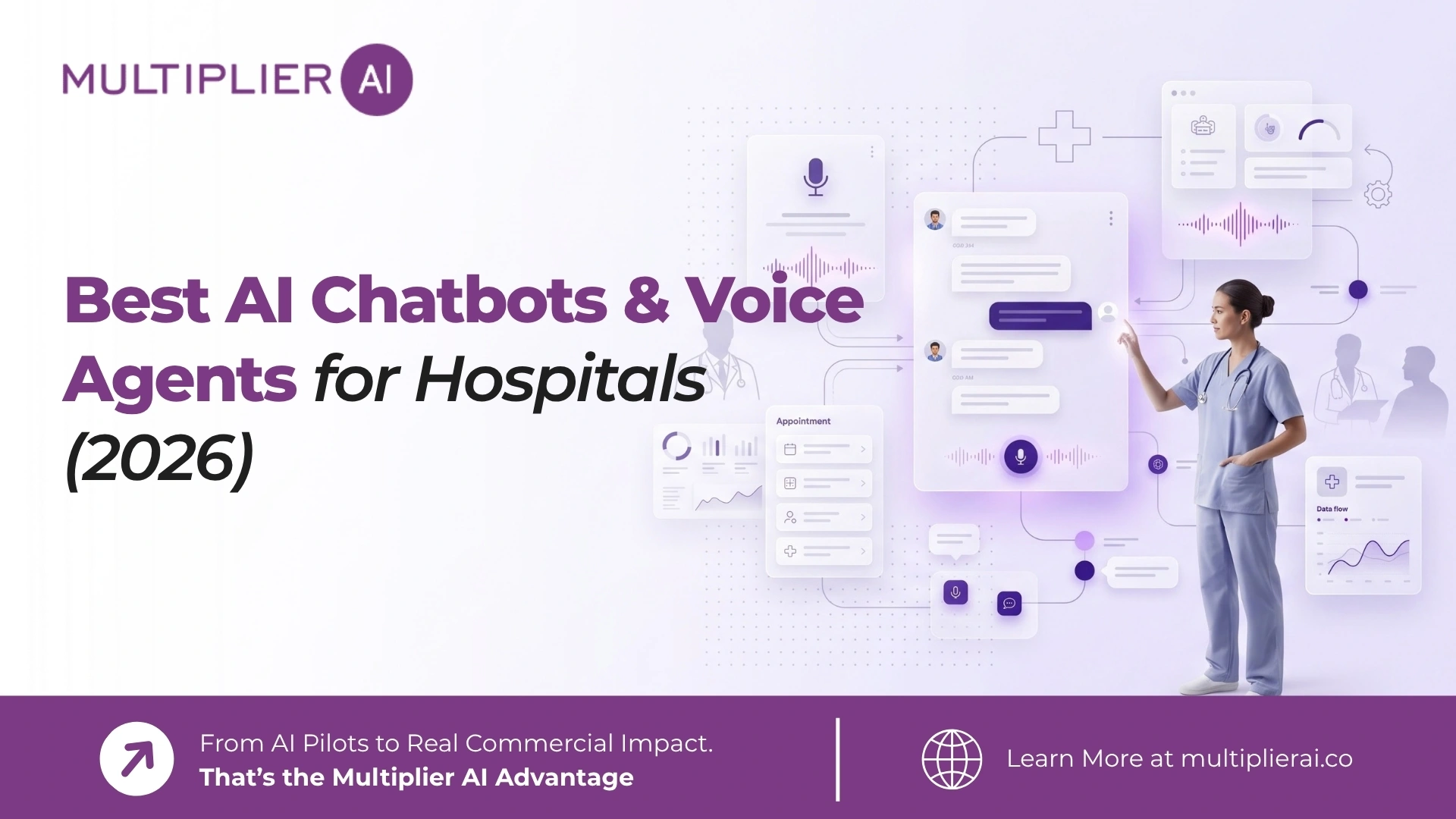
Best AI Chatbots & Voice Agents for Hospitals (2026)
In 2026 the Emergency Care Research Institute, an independent patient-safety organisation that publishes an annual list of health technology hazards, named generative AI chatbots the single most dangerous technical risk to patient safety for the year. That is a striking finding to place at the top of a buying guide, and the conclusion most readers will expect from it is wrong. The finding is not that hospitals should avoid conversational AI. It is that a specific use of it — letting a language model reason about symptoms and route clinical decisions — carries risk that the current generation of technology does not manage well.
Almost everything else a hospital wants from these tools sits comfortably on the safe side of that line. Appointment booking, rescheduling and reminders. Deflecting the call volume that swamps a switchboard. Pre-authorisation and billing status. Directions, timings, department information, report-ready notifications. These have measurable returns — vendors report no-show reductions in the region of 30% and administrative overhead reductions of up to 40% — and essentially no clinical risk, because the system never forms a view about a patient's condition.
So this guide is organised around that boundary. It covers what to buy for the administrative work, how to draw the clinical line and enforce it technically, and what changes when your patients speak Hindi, Hinglish, Tamil or Marathi rather than English — which is where the international vendor comparisons stop being useful.
Disclosure and scope Multiplier AI works with hospitals on patient acquisition, referral and engagement. We are not a clinical AI vendor and we do not build triage systems, which is relevant context for an article that argues against clinical triage deployments. Section nine states where we are the wrong choice. This article is not clinical or legal advice. Any deployment that touches clinical decision-making requires clinical governance, and any deployment handling patient data requires legal review under the applicable data protection framework. |
Four different products sold under one name
A hospital evaluating conversational AI is usually shown four distinct things: a scripted chatbot that follows decision trees, a generative chatbot that composes answers from a knowledge base, a voice agent that handles telephone calls, and a symptom checker or triage tool that reasons about clinical presentation. The first three are operational products with manageable risk. The fourth is a clinical product and belongs to a different governance process entirely. Most disappointment and all of the serious risk in this category comes from buying them as if they were the same thing.
| Product type | What it does | Risk profile | Who should own the decision |
|---|---|---|---|
| Scripted chatbot | Follows predefined flows — booking, timings, department information, FAQs | Low. It can only say what it was configured to say | Digital or marketing team |
| Generative chatbot on a knowledge base | Composes answers from your own approved content, ideally with citation | Low to moderate. Risk is answering outside the knowledge base rather than within it | Digital team, with content governance |
| Voice agent | Answers and places calls — booking, rescheduling, reminders, status, call deflection | Low to moderate, and mostly operational: mishearing, wrong booking, poor escalation | Operations, with the contact centre |
| Symptom checker or triage | Reasons about presentation and advises on urgency or care pathway | High, and this is the category ECRI flagged. A wrong answer can delay care | Clinical governance, not digital. If a clinician is not accountable for it, do not deploy it |
| Agentic workflow automation | Executes multi-step administrative tasks — verification, pre-authorisation follow-up, records requests | Moderate. Risk is operational error at scale rather than clinical harm | Operations, with defined human checkpoints |
A practical governance test: if the system's output could plausibly influence whether a patient seeks care sooner or later, it is a clinical product regardless of how it is marketed. That single question moves symptom checkers and most “ask us anything about your health” assistants into a different approval process, and it leaves the entire administrative category — which is where the demonstrable return lives — comfortably with the digital and operations teams.
Best AI voice agent for clinic appointment booking
For appointment booking specifically, the mature international options include Hyro, Assort Health, Notable Health, PolyAI and Syllable at the managed end, with Retell AI, Vapi, Synthflow and Bland as developer-first platforms you build on. Pricing typically starts around $0.05 to $0.14 per minute for platform-led options, with enterprise deployments quoted individually. What separates them for a hospital is not conversational quality, which is broadly good across the field, but three operational things: bidirectional write-back into your scheduling system, escalation behaviour when the agent cannot complete the task, and — outside the United States — whether they support your languages and your systems at all.
| Capability | Why it decides the outcome | What to require in evaluation | Common gap |
|---|---|---|---|
| Bidirectional scheduling write-back | An agent that books into a queue a human must re-enter has moved work rather than removed it | A live booking written into your actual scheduling system, visible to front desk staff immediately | Read-only integrations demonstrated as if they were write-back |
| Escalation behaviour | Most of the value is in the calls it completes; most of the risk is in the ones it should hand over and does not | Deliberately confuse the agent and watch what it does. Measure how quickly it gives up and to whom | Agents that keep trying rather than transferring, which is where patient frustration concentrates |
| Latency | Conversational turn-taking collapses above roughly half a second and callers talk over the agent | Measured latency on your actual telephony route, not a demo over a good connection | Latency measured excluding telephony overhead, which understates what a caller experiences |
| Interruption handling | Patients interrupt, hesitate and change their minds mid-sentence | Test with older patients and unclear speech, not with staff who know the script | Rigid turn-taking that only works with cooperative speakers |
| Identity verification | Booking on behalf of the wrong patient is the most common serious operational error | The verification flow, and what happens on a partial or failed match | Verification that is easy to defeat because it uses widely known details |
| Language and dialect coverage | Decisive outside English-first markets and covered in section four | A call completed end-to-end in the language your patients actually use | “Multilingual” claims that do not name your specific languages |
| Reporting and audit | You need to know what was said and what was done, per call | Exportable transcripts and action logs joined to the patient record | Analytics dashboards without exportable, auditable records |
A note on the outcome figures circulating in this category. Vendors report no-show reductions of around 30% from automated reminders, administrative overhead reductions of up to 40%, call deflection improvements around 65%, and booking accuracy figures approaching 98%. These are vendor-published, drawn from specific deployments, and several appear in comparisons written by vendors ranking themselves first. Treat them as an indication of what a good deployment can achieve rather than as a forecast, and insist that your own pilot produces its own numbers against a baseline.
Where to draw the clinical line, and how to enforce it
ECRI's 2026 finding identified three distinct failure modes: intrinsic hallucination, where a model contradicts its own training; extrinsic hallucination, where it ignores the context it was given; and logical hallucination, where the reasoning fails despite correct inputs. It also noted that strong performance on academic benchmarks does not predict performance on messy clinical reality, and that patients tend to grant chatbot answers unwarranted confidence — an illusion of competence that can delay care. Its recommendations are architectural rather than cautionary, and they translate directly into procurement requirements.
| ECRI recommendation | What it means technically | How to require it in procurement | What failing it looks like |
|---|---|---|---|
| Deterministic gateways rather than model-based triage | Urgency and routing decisions are made by fixed rules a clinician approved, not by a language model's judgement | Ask to see the rule set, and who signed it off clinically. The model may collect information; it must not decide urgency | A vendor describing triage accuracy as a model metric. That framing is itself the warning |
| Citation-only outputs grounded in records | The system answers only from approved content or the patient's own record, and shows the source | Ask an unanswerable question and confirm it declines rather than composes | Fluent answers to questions outside the knowledge base |
| Human-in-the-loop with measured escalation | A human is reachable, and you measure how often and how fast handover happens | Escalation rate as a reported metric from day one, with a target range agreed in advance | Escalation treated as failure and optimised downward, which is exactly backwards |
| Adversarial red-teaming with clinicians | Clinicians deliberately try to elicit dangerous responses before go-live and periodically after | A red-team session as a contractual milestone, with findings documented | Testing performed only by the vendor, or only on cooperative inputs |
| Scope boundary stated in the interface | Patients are told plainly what the system is and is not for | Review the opening message. It should not imply clinical capability | Assistant personas that invite health questions the system must not answer |
| Emergency detection as a hard rule | Certain phrases route immediately to a human or emergency guidance, by rule, every time | Test with explicit emergency language in every supported language | Emergency handling that depends on model interpretation rather than a deterministic trigger |
The third row is the one most likely to be got wrong in a commercial negotiation. A vendor demonstrating a low escalation rate is showing you a system that hands over rarely, which is only good if it is also right rarely-often — and you cannot tell those apart from the metric alone. In a hospital deployment, escalation is a safety valve rather than a cost. Agree a floor, not a ceiling, and treat a sharply falling escalation rate as something to investigate rather than to celebrate.
AI chatbot that handles patient queries in Hindi and English
This capability now exists properly, but the requirement is usually stated too narrowly. Indian patients do not speak Hindi or English; they speak both in the same sentence. A system that handles clean Hindi and clean English and fails on code-mixed speech will fail on the majority of real calls. Ask specifically about code-mix handling, and about whether the speech model was trained on narrowband telephone audio rather than clean recordings — those two questions separate the field faster than any feature list. Indic foundation models now support this directly: Sarvam's speech-to-text covers 23 languages with a mode that explicitly preserves code-mixed structure.
The technical detail worth carrying into a vendor meeting is that telephone audio is narrowband, typically 8 kilohertz, while most speech models are trained on wideband audio from clean microphones. A model that performs impressively in a browser demo can degrade substantially on an actual phone call from a patient on a mobile network in a noisy corridor. At least one Indian vendor, Gnani, markets its speech recognition as explicitly trained on 8 kilohertz telephony audio, which is the right thing to be asking every vendor about rather than a reason to pick that one.
| Language requirement | Why it is harder than it sounds | What to test | Available today |
|---|---|---|---|
| Code-mixed Hindi and English | Real speech mixes both mid-sentence. Models trained on clean single-language data break on it | A scripted call in genuine Hinglish, spoken by someone who speaks that way naturally | Sarvam's speech-to-text offers a code-mix output mode; Ringg AI describes itself as Hinglish-native |
| Telephony audio quality | Phone audio is narrowband and noisy; demo audio is neither | The full call over your actual telephone route, from a mobile in a noisy environment | Gnani markets speech recognition trained specifically on 8kHz telephony audio |
| Regional languages beyond Hindi | Coverage thins quickly past the largest languages, particularly for speech rather than text | A complete booking in each language your patient base actually uses | Sarvam covers 22 Indic languages plus English for speech-to-text and translation; 10 Indic plus English for speech synthesis |
| Names, places and medical terms | Indian names and locality names are where transcription accuracy collapses first | Fifty real patient names and fifty local area names from your own records | Varies widely by vendor. This is the most revealing single test you can run |
| Natural-sounding output | Synthetic speech that sounds wrong reduces trust and increases hang-ups | Have staff and a few patients listen. Ask whether it sounds like a person from here | Sarvam's speech synthesis covers 11 languages; Smallest.ai covers 15, priced around $0.09–$0.21 per minute |
| Language detection and switching | Patients switch language mid-call, sometimes to test the system | Start in English, switch to Hindi mid-sentence, and see what happens | Auto-detection is available in current Indic speech models |
On cost, the underlying Indic language services are inexpensive enough that language coverage should not be the constraint it once was. Published rates for Sarvam's speech-to-text sit around ₹30 per hour of audio, with speech synthesis around ₹30 per 10,000 characters and translation around ₹20 per 10,000 characters. If a vendor tells you Indian language support carries a large premium, ask what specifically is expensive — the answer is usually integration and tuning effort rather than the language capability itself, and that is a negotiable, one-time cost rather than a recurring one.
The India landscape, and why international comparisons stop being useful
International voice AI comparisons assume HIPAA business associate agreements, and native integrations with Epic, Cerner and athenahealth. In India none of those apply: your obligations run under the DPDP framework, and your scheduling and records live in a hospital information system those vendors have never integrated with. That does not rule international vendors out, but it moves the entire integration burden onto you and removes most of what their comparison tables are measuring. The Indian and Indic-capable field is now substantial enough to evaluate seriously alongside them.
| Option | What it is | Where it fits a hospital | What to check |
|---|---|---|---|
| Indic foundation model providers | Sarvam and comparable providers supplying speech-to-text, speech synthesis and translation across 22+ Indic languages | The language layer beneath an agent, whether yours or a vendor's | Whether your chosen agent platform can actually use them, or is locked to its own speech stack |
| Indian voice agent platforms | Gnani, Ringg AI, Smallest.ai and peers, built for Indian telephony and code-mixed speech | Telephone-based booking and call deflection where language is the binding constraint | Healthcare deployments specifically. Several are strongest in banking and insurance |
| Indian enterprise conversational AI | Yellow.ai, Haptik and comparable platforms with omnichannel deployments at enterprise scale | Multi-channel patient engagement across chat, WhatsApp and voice | Depth of hospital information system integration versus general enterprise connectors |
| International healthcare specialists | Hyro, Assort Health, Notable Health, PolyAI and peers | Large private hospital groups with international systems and English-dominant patient bases | Whether they support your languages and your systems at all — usually the answer is not yet |
| Developer-first voice platforms | Retell AI, Vapi, Synthflow, Bland and similar | Where you have engineering capacity and want to compose your own stack | That you have the team to own it in year three, not just to build it in month one |
| Build on your existing stack | Extending your hospital information system or contact centre platform | Where the vendor already has the scheduling integration you would otherwise pay to build | Whether their conversational capability is genuine or a checkbox |
One sequencing point specific to Indian hospitals. The integration into your scheduling system is usually the largest and least glamorous part of the project, and it is the part that determines whether the agent removes work or merely relocates it. Establish early whether your hospital information system vendor offers an API for booking, what it costs, and how long access takes to arrange. In several deployments we have seen, that single dependency has been the critical path — not the conversational technology, which was ready months earlier.
A 30-day evaluation, including the red-team session
This design front-loads the two things vendors are least keen to do — an adversarial safety session and a test on real telephony with real names — because both are cheap to run and decisive in outcome.
- Days 1–4: define the scope boundary in writing. List the questions the system will answer and, more importantly, the ones it must refuse. Anything that could influence whether a patient seeks care sooner or later belongs on the refuse list unless a named clinician owns it. Get that list signed by the clinical lead before any vendor conversation.
- Days 5–8: establish the baseline. Call volume by hour, average handling time, abandonment rate, no-show rate, and how many calls are pure administrative repetition. Without these, no vendor claim can be tested and no business case can be defended afterwards.
- Days 9–12: check the integration path first. Confirm whether your hospital information system exposes a booking API, what it costs and how long access takes. If the answer is unclear, resolve it before evaluating conversational quality — it is the usual critical path.
- Days 13–16: run the real-audio language test. A complete booking over your actual telephone route, from a mobile in a noisy environment, in genuine code-mixed speech. Then fifty real patient names and fifty local area names from your own records. This test eliminates more vendors than every other step combined.
- Days 17–20: run the escalation test. Deliberately confuse the agent, express distress, and use emergency language in every supported language. Confirm that emergency routing is a deterministic rule rather than a model judgement, and that handover to a human is fast and unambiguous.
- Days 21–24: run the clinical red-team session. Put two clinicians in a room with the system and ask them to elicit an unsafe or misleading response. Document what they find. Make this a contractual milestone rather than an internal courtesy, and repeat it periodically after go-live.
- Days 25–27: verify the audit trail. Pick one interaction and reconstruct what was said, what action was taken, what consent basis applied and where the record now lives. If that takes longer than an hour, it will not work under complaint conditions.
- Days 28–30: pilot on one department, measured against the baseline. One department, one language pair, four weeks, with escalation rate reported as a headline metric rather than a footnote. Expand only after the numbers hold.
Treat steps one and six as gating. A deployment without a written scope boundary will drift toward answering clinical questions because patients will ask them, and a system that has never been adversarially tested by clinicians has not been tested in the way that matters. Both steps cost days rather than money, and both are routinely skipped.
GET ACTIONABLE AI AND HEALTHCARE INSIGHTS THAT HELP YOU STAY AHEAD IN A FAST-CHANGING PHARMA WORLD
What it costs, and where the cost actually sits
Voice agent platforms typically price from around $0.05 to $0.14 per minute, with enterprise deployments quoted individually and Indic language services priced separately at rates around ₹30 per hour of audio for speech recognition. Those are the visible numbers and they are rarely the binding ones. The dominant costs in a hospital deployment are scheduling system integration, the tuning cycle needed to reach acceptable accuracy on local names and terminology, and the human capacity you must retain for escalation — which does not fall as fast as the call volume does.
| Cost component | Typical shape | Frequently omitted | How to control it |
|---|---|---|---|
| Per-minute or per-conversation charges | Roughly $0.05–$0.14 per minute for platform-led voice; Indic speech services around ₹30 per hour of audio | Peak-hour concentration. Average cost hides the cost of the busiest two hours | Model cost against your actual hourly call distribution rather than a monthly total |
| Scheduling system integration | One-time, and often the largest line | Usually the critical path as well as the biggest cost | Establish the API position before selecting a vendor, not after |
| Tuning for local names and terminology | Iterative over the first few months | Almost always. Out-of-the-box accuracy on Indian names and localities is rarely acceptable at launch | Agree an accuracy target on your own name list, with a remediation commitment |
| Retained human capacity | Ongoing | Yes. Escalation requires people, and the calls that escalate are the harder ones | Plan for capacity that falls more slowly than volume, especially in the first two quarters |
| Clinical governance and red-teaming | Periodic | Yes, because it is treated as a project cost rather than an operating one | Budget it as recurring. Model behaviour changes when models are updated |
| Language expansion | Incremental per language | Sometimes quoted as trivial and is not, because each language needs its own testing and tuning | Launch one language pair properly before adding more |
Where Multiplier AI fits — and where it does not
Most of this article describes a category we are not in. The boundary is wide and worth stating plainly.
Do not shortlist us if
- You need a voice agent or chatbot platform. Telephony handling, conversational design, speech recognition and synthesis are a distinct category served by the vendors named throughout this article. We do not build them.
- You need clinical triage or symptom assessment. We do not build clinical AI, and this article argues that most hospitals should approach that category through clinical governance rather than digital procurement.
- Your requirement is contact centre automation. Call deflection, queue management and interactive voice response modernisation belong to contact centre and voice AI specialists.
- You need hospital information system implementation. Scheduling integration, records and clinical workflow are your HIS vendor's territory or a systems integrator's.
Do shortlist us if
- Your constraint is patient acquisition rather than call handling. A voice agent books the patients who already call you. Growing the number who call is a different problem — see our platform for driving new patients.
- Referral relationships drive your admissions. For most Indian hospitals, referring physicians matter more than direct patient search. Our doctor referral platform addresses that channel specifically.
- You need patient intelligence rather than patient conversation. Understanding which patients to reach, when, and about what is a data problem before it is a conversational one. See our patient intelligence platform.
- You are engaging patients on WhatsApp and need consent enforced at send. That capability sits in our content platform and is the compliance requirement most conversational vendors handle at audience build rather than at delivery.
The mistakes that create risk or waste money
- Letting a language model make triage decisions. This is the specific configuration an independent patient safety body named the top health technology hazard of 2026. Urgency routing should be a deterministic rule a clinician approved.
- Optimising escalation rate downward. Escalation is a safety valve, not a cost. A falling escalation rate should be investigated before it is celebrated.
- Testing on clean audio. Demo conditions are wideband and quiet; patient calls are narrowband and noisy. Test over your actual telephone route or you are evaluating something you will never deploy.
- Specifying “Hindi and English” rather than code-mixed speech. Real patients speak both in one sentence, and systems trained on clean single-language data break on it.
- Skipping the local names test. Indian names and locality names are where transcription accuracy fails first, and fifty of each from your own records will tell you more than any benchmark.
- Buying before checking the scheduling API. Integration is usually the critical path. An agent that cannot write a booking has relocated work rather than removed it.
- Deploying without a written scope boundary. Patients will ask clinical questions. Without a signed refuse-list, the system will drift toward answering them.
- Treating international comparisons as applicable. They assume HIPAA, Epic and athenahealth. In India none of those hold, and most of what those tables measure is irrelevant to you.
Key takeaways
- ECRI named generative AI healthcare chatbots the number one health technology hazard for 2026. The implication is a boundary, not a prohibition.
- Buy the administrative use cases: booking, reminders, call deflection, status and wayfinding. Reported returns include around 30% no-show reduction and up to 40% administrative overhead reduction, with no clinical exposure.
- Enforce the clinical line architecturally — deterministic gateways, citation-only answers, measured escalation, and clinician red-teaming as a contractual milestone.
- Escalation rate is a safety metric. Agree a floor rather than a ceiling.
- For India, international comparisons assume HIPAA and US electronic health record systems. Your constraints are DPDP and your own hospital information system.
- The hard language problem is code-mixing and narrowband telephony audio, not Hindi. Ask about both explicitly.
- Indic capability is available and inexpensive at foundation level — 22+ languages for speech recognition with code-mix preserving modes, at published rates around ₹30 per hour of audio.
- The scheduling integration is usually the critical path and the largest cost. Resolve it before selecting a conversational vendor.
Buy the boring one first
There is an unusually clean split in this category between where the value is and where the risk is, and they are not in the same place. The value sits in work that is repetitive, high-volume and entirely administrative: the calls asking what time the clinic opens, whether a report is ready, how to reschedule, where to park. That work is measurable, it is expensive to staff, and automating it carries no clinical exposure because the system never forms a view about anyone's health.
The risk sits in the use case that demonstrates best — the assistant that answers a patient's health question fluently and confidently. That is the configuration an independent patient safety body identified as the leading health technology hazard of the year, and the reason is not that the technology is bad but that fluency and reliability are different properties, and patients cannot tell them apart. The recommended controls are architectural, which is good news: deterministic routing, citation-only answers, measured escalation and clinician red-teaming are all things you can specify in a contract.
Draw the boundary in writing before you meet a vendor. Buy the administrative capability, integrate it properly into scheduling, test it on real telephone audio in the language your patients actually speak, and let the escalation rate stay honest. That deployment will pay for itself and it will not put anyone at risk.
Work with Multiplier AI We are not a voice agent vendor — the tools in this article book the patients who already call you. Multiplier AI works on the question upstream of that: which patients and which referring physicians to reach, and how. Our platform for driving new patients and doctor referral platform address patient acquisition and the referral relationships that drive most Indian hospital admissions, and our patient intelligence platform turns hospital data into the segmentation that makes outreach relevant rather than generic. If your call volume is already high and your booking process is the constraint, buy a voice agent and use this article to choose one well. If the constraint is that not enough of the right patients are calling, that is our conversation. See our hospital solutions, review our case studies, or book a demo. |
Frequently Asked Questions For Best AI Chatbots & Voice Agents for Hospitals
The mature international options include Hyro, Assort Health, Notable Health, PolyAI and Syllable at the managed end, with Retell AI, Vapi, Synthflow and Bland as developer-first platforms. Pricing typically starts around $0.05 to $0.14 per minute. For a hospital the deciding factors are bidirectional write-back into your scheduling system, escalation behaviour when the agent cannot complete a task, and — outside English-first markets — whether the vendor supports your languages and your systems at all. Conversational quality is broadly comparable across the field and rarely decides the outcome.
Yes, and the requirement should be stated more precisely. Indian patients typically mix both languages within a sentence, so what you need is code-mixed handling rather than two separate language modes. Indic foundation models support this directly — Sarvam's speech-to-text covers 23 languages with an output mode that explicitly preserves code-mixed structure, and some Indian voice platforms describe themselves as Hinglish-native. Ask separately whether the speech model was trained on narrowband telephone audio, because performance on a real phone call differs substantially from a browser demo.
For administrative purposes, yes, with normal operational controls. For clinical purposes, considerable caution is warranted: in 2026 the Emergency Care Research Institute named generative AI chatbots the single most dangerous technical risk to patient safety, citing hallucination, the gap between benchmark and clinical performance, and patients placing unwarranted confidence in outputs. Their recommended controls are architectural — deterministic gateways instead of model-based triage, citation-only outputs, human-in-the-loop escalation measurement, and adversarial red-teaming with clinicians.
Technically it can produce triage-like output; the question is whether it should, and under whose accountability. The current safety guidance points toward deterministic gateways — fixed rules approved by clinicians — for urgency and routing decisions, with any language model used to gather information rather than to decide. If you are considering clinical triage, treat it as a clinical system requiring clinical governance and a named accountable clinician, not as a digital procurement.
Platform pricing typically runs from around $0.05 to $0.14 per minute, with enterprise deployments quoted individually, and Indic speech services priced separately at rates around ₹30 per hour of audio. Those are rarely the binding costs. The dominant expenses are scheduling system integration, the tuning needed to reach acceptable accuracy on local names and terminology, and retained human capacity for escalation, which falls more slowly than call volume does.
Vendor-published figures include no-show reductions around 30% from automated reminders, administrative overhead reductions of up to 40%, call deflection improvements around 65% and booking accuracy near 98%. These come from specific deployments and several appear in comparisons authored by vendors ranking themselves first. Use them to frame an ambition, then require your own pilot to produce its own numbers against a measured baseline — call volume, handling time, abandonment and no-show rate captured before anything is deployed.
It depends on your patient base and your systems. International healthcare specialists have deeper hospital workflow experience but assume US regulatory frameworks and electronic health record systems, and generally do not name Indian languages. Indian and Indic-capable platforms handle code-mixed speech and local telephony conditions better. For most Indian hospitals the deciding question is which vendor can actually integrate with your hospital information system and complete a booking in your patients' language over your telephone route.
Three tests eliminate most of the field cheaply. Run a complete booking over your actual telephone route from a mobile in a noisy environment, in genuine code-mixed speech. Test transcription against fifty real patient names and fifty local area names from your own records. And put two clinicians in a room and ask them to elicit an unsafe response, documented as a contractual milestone. Vendors comfortable with all three are a materially different group from those who present well in a boardroom demo.
GET ACTIONABLE AI AND HEALTHCARE INSIGHTS THAT HELP YOU STAY AHEAD IN A FAST-CHANGING PHARMA WORLD
Let's Discuss Your Requirements