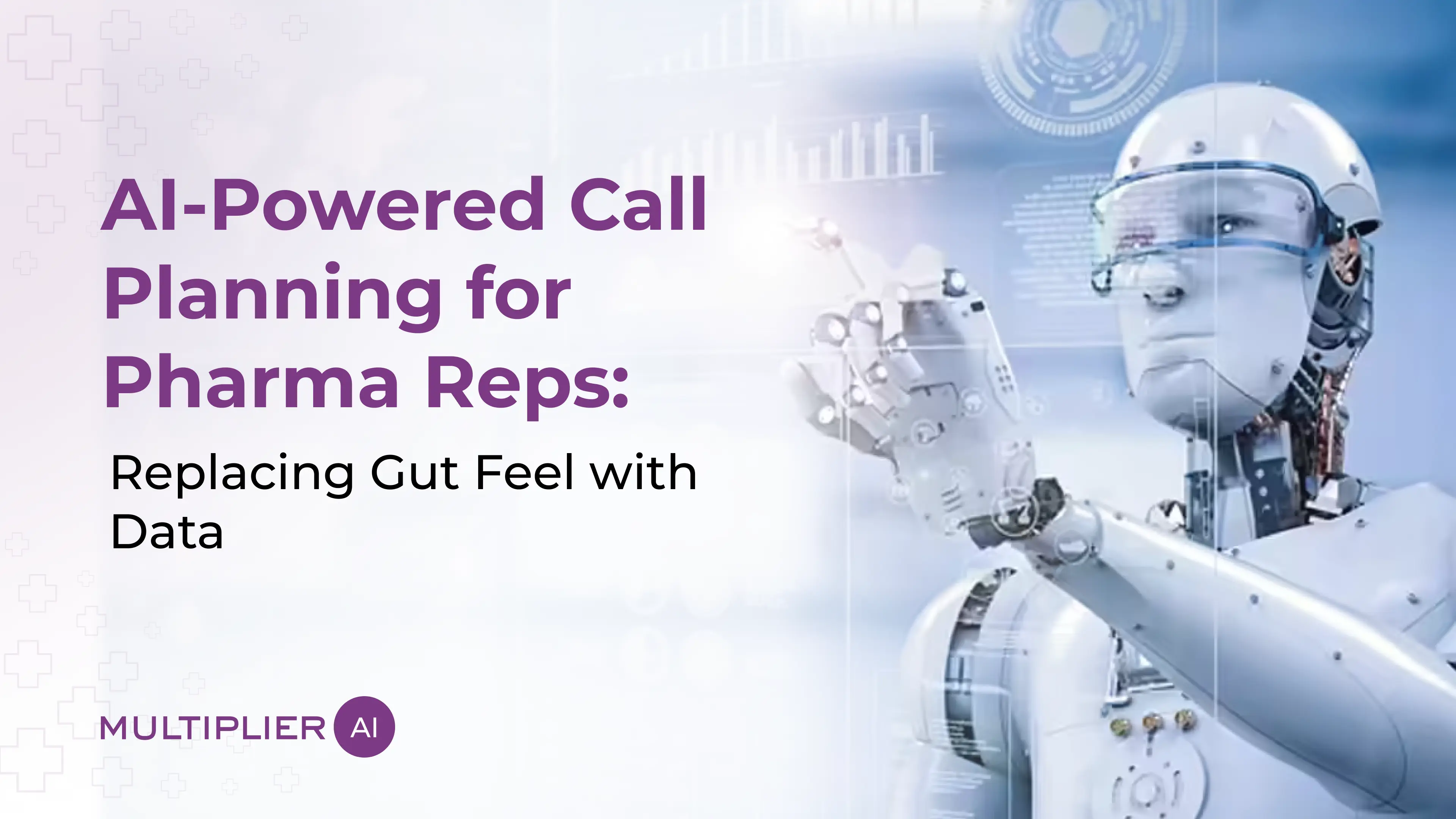
AI-Powered Call Planning for Pharma Reps: Replacing Gut Feel with Data
What Is AI-Powered Call Planning in Pharma?
AI-powered call planning in pharma is the process of using real-time HCP data, CRM interactions, digital engagement signals, prescription trends, and machine learning models to help pharma representatives prioritize doctor visits, choose the right timing, and prepare more relevant HCP conversations.
In simple terms, it replaces guesswork with data-driven field execution. Instead of asking reps to decide only from memory or past habits, AI-powered call planning recommends which HCP to engage, why they matter now, and what context should guide the conversation.
What AI-powered call planning actually changes
AI-powered call planning shifts the foundation of how decisions are made. Instead of asking reps to rely on memory or instinct, it introduces a system that continuously analyzes data and translates it into clear recommendations.
This is one of the practical ways AI in pharma sales can move field teams from manual planning to data-led execution.
The change is not about adding another tool or dashboard. It is about moving from static planning to dynamic decision making. Each day, instead of starting with a fixed list of doctors, the rep begins with a prioritized set of opportunities based on current signals. These signals could include recent engagement with digital campaigns, changes in prescribing behavior, or patterns observed across similar profiles.
What makes this powerful is the ability to connect multiple data points and interpret them in context. A doctor opening an email might not seem significant on its own, but when combined with increased interest in a therapeutic area and recent inactivity in prescriptions, it becomes a strong indicator that a well-timed interaction could be effective.
This approach ensures that actions are not just planned, but justified. Every visit or interaction has a reason behind it, supported by data rather than assumption.
Why traditional planning struggles in the current landscape
Traditional call planning models were designed for a different era. They worked well when engagement channels were limited and behavior was relatively predictable. Today, those assumptions no longer hold.
Doctors are exposed to a constant stream of information, both from pharma companies and other sources. Their attention is fragmented, and their availability is inconsistent. A plan created at the beginning of the month cannot account for changes that happen throughout the weeks that follow.
Another limitation is the reliance on broad segmentation. Grouping doctors by specialty or prescription volume may provide a starting point, but it does not capture individual behavior. Two doctors with similar profiles on paper can behave very differently in practice. One might prefer digital engagement, while another responds better to in-person visits. One might be actively exploring new treatments, while another remains resistant to change.
When planning does not account for these differences, interactions become generic. Over time, this reduces effectiveness and weakens relationships.
How AI improves the quality of decisions in the field
The real value of AI-powered call planning lies in its ability to improve decision quality without increasing complexity for the rep. Instead of overwhelming users with data, it simplifies decision making by presenting clear priorities.
At the beginning of the day, the rep can see which doctors are most likely to engage and why. The system might highlight that a particular doctor has recently interacted with educational content related to a specific therapy and is showing increased prescribing potential. It might also suggest the best time to visit and the type of message that is most relevant.
This recommendation becomes more powerful when connected with a Hyper Personalized Content Platform that helps reps match the right approved content to each HCP conversation.
This level of guidance reduces uncertainty. Reps no longer have to second guess whether they are making the right choice. They can focus their energy on execution rather than planning.
Over time, this leads to more consistent performance across teams. Experienced reps still bring value through their relationships and communication skills, but newer reps can also perform effectively because they are supported by data-driven insights.
What is happening behind the scenes
Although the experience for the rep feels simple, the underlying system is continuously processing large amounts of information. Data from multiple sources is combined to create a unified view of each doctor. This includes historical interactions, engagement patterns, and prescribing trends.
A reliable Doctor Mobile and Email Platform can strengthen call planning by giving reps access to accurate doctor contact data and verified communication channels.
Machine learning models analyze this data to identify patterns that are not immediately visible. For example, the system might learn that certain types of content are more effective for specific segments or that engagement tends to increase after a particular sequence of interactions.
These patterns are then used to generate predictions. Instead of reacting to past events, the system anticipates future behavior. It estimates the likelihood of engagement and suggests actions that are most likely to produce a positive outcome.
The most important aspect of this process is continuous learning. Every interaction provides new data, which is fed back into the system to improve future recommendations. This creates a cycle where performance improves over time.
How AI Call Planning Supports Next Best Action
AI-powered call planning and Next Best Action are closely connected. Call planning helps reps decide which HCPs should be prioritized for field engagement, while Next Best Action helps determine the most relevant follow-up, message, channel, or timing for that HCP.
For example, if a physician recently attended a webinar, downloaded clinical content, and has shown renewed interest in a therapy area, the call planning system may prioritize that physician for outreach. A Next Best Action engine can then recommend whether the rep should schedule a visit, share a specific approved clinical resource, invite the physician to another educational session, or pause communication if recent outreach has been too frequent.
This connection is important because field execution should not stop at prioritization. Reps need guidance on what to do next. By combining AI-powered call planning with Next Best Action, pharma companies can move from static visit planning to guided, data-driven field execution.
Making AI call planning actionable in real teams
The success of AI-powered call planning depends on how it is implemented within the organization. Technology alone is not enough. It needs to be supported by the right processes and mindset.
The first step is ensuring that data is reliable. Inaccurate or outdated information can lead to poor recommendations, which quickly erodes trust. Organizations need to invest in maintaining clean and consistent data across systems.
Once the data foundation is in place, the focus should shift to integration. AI recommendations should be available within the tools that reps already use, rather than requiring them to switch between multiple platforms. This reduces friction and encourages adoption.
Training also plays a critical role. Reps need to understand not just how to use the system, but why it works. When they see the logic behind recommendations, they are more likely to trust and follow them.
Another important element is feedback. After each interaction, outcomes should be captured and fed back into the system. This allows the models to learn and adapt, ensuring that recommendations remain relevant.
CRM Integration and Rep Workflow Adoption
AI-powered call planning becomes valuable only when recommendations are available inside the tools that sales representatives already use. If reps need to open a separate dashboard or manually compare data across systems, adoption will remain low.
The best implementation approach is to surface recommendations inside the CRM, rep call planning dashboard, or territory planning workflow. A rep should be able to see which HCPs are prioritized, why they are prioritized, what signal triggered the recommendation, and what action should be considered next.
This also helps managers coach field teams more effectively. Instead of only reviewing call volume, managers can review whether reps are acting on high-priority recommendations, whether outcomes are improving, and whether the AI model is learning from field feedback.
GET ACTIONABLE AI AND HEALTHCARE INSIGHTS THAT HELP YOU STAY AHEAD IN A FAST-CHANGING PHARMA WORLD
Compliance and Governance in AI-Powered Call Planning
AI-powered call planning must be designed with strong governance. Pharma field execution is not only about recommending the most commercially useful action. It must also ensure that every recommendation is appropriate, compliant, and aligned with approved communication rules.
The system should consider consent status, channel permissions, approved content availability, frequency limits, and role-based access before recommending an action. If a physician has opted out of a channel or if a specific type of communication is not permitted, the recommendation should automatically reflect that restriction.
For this reason, AI call planning should be connected with a DPDP-Compliant HCP Marketing framework that respects consent, channel permissions, and approved engagement workflows.
Governance also requires transparency. Sales representatives should understand why a recommendation appears, which signals were used, and what action is allowed. This improves trust and reduces the risk of inappropriate engagement.
AI-powered call planning should therefore be treated as a controlled commercial intelligence workflow, not just a productivity tool.
The impact on performance and outcomes
When implemented correctly, AI-powered call planning leads to noticeable improvements in performance. Engagement rates increase because interactions are more relevant and better timed. Reps spend less time on low-value activities and more time on meaningful conversations.
From a business perspective, this translates into better resource utilization and stronger return on investment. Instead of increasing the number of calls, organizations can focus on improving the effectiveness of each interaction.
Over time, this also enables more strategic decision making. Leaders can identify which segments are responding well, which strategies are working, and where adjustments are needed. This level of insight is difficult to achieve with traditional planning methods.
A shift toward more meaningful interactions
One of the most important outcomes of AI-powered call planning is the improvement in the quality of interactions. When reps approach doctors with relevant information at the right time, conversations become more valuable.
Doctors are more likely to engage when they feel that the interaction is tailored to their needs. This builds trust and strengthens relationships, which are critical in the pharma industry.
Rather than reducing the role of the rep, AI enhances it. By removing the burden of planning, it allows reps to focus on building connections and delivering value.
How Multiplier AI Enables AI-Powered Call Planning
To move from theory to execution, pharmaceutical organizations need a platform that can unify HCP data, interpret real-time engagement signals, and deliver recommendations directly to field teams.
Multiplier AI helps pharma commercial teams build this foundation by integrating CRM data, digital engagement signals, external healthcare datasets, physician profiles, and AI-driven insights into a single intelligence layer. This allows teams to prioritize HCP visits, improve call preparation, identify timely engagement opportunities, and support field reps with actionable recommendations.
With Multiplier AI, call planning can move beyond static lists and territory assumptions. Sales teams can work from current physician intelligence, understand why an HCP is being prioritized, and engage with more relevant context.
What comes next
As AI continues to evolve, call planning will become even more dynamic and integrated. Systems will not only recommend actions but also coordinate activities across channels. Field visits, digital campaigns, and content delivery will work together as part of a unified strategy.
Personalization will also deepen. Instead of segment-level targeting, interactions will be tailored to individual preferences and behaviors. This will further increase engagement and effectiveness.
Organizations that adopt these capabilities early will have a significant advantage. They will be able to respond faster to changes, allocate resources more effectively, and build stronger relationships with healthcare professionals.
Conclusion
The shift from intuition-based planning to data-driven decision making is already underway in pharma. The complexity of the current environment makes it impossible to rely on traditional methods alone.
AI-powered call planning provides a way to bridge the gap between data and action. It enables reps to make better decisions, improves the quality of interactions, and drives measurable results.
For organizations looking to improve performance without increasing effort, this is not just an innovation. It is a necessary evolution.
Frequently Asked Questions For AI-Powered Call Planning for Pharma Reps: Replace Guesswork with Data
AI-powered call planning in pharma uses HCP data, CRM interactions, digital engagement signals, prescription trends, and machine learning models to help pharma reps prioritize doctor visits and prepare more relevant conversations.
Traditional call planning often depends on fixed lists, rep experience, or historical assumptions. AI-powered call planning uses real-time physician signals and predictive insights to guide which HCPs should be prioritized and why.
Common data sources include CRM history, digital campaign engagement, webinar activity, prescription trends, HCP profiles, campaign responses, and consent or channel preference data.
AI helps reps identify which doctors are most likely to engage, what topics are relevant, when follow-up may be useful, and which interaction is likely to create value.
No. AI supports pharma reps by improving planning and prioritization. The rep still brings relationship-building, communication skills, local context, and professional judgment.
It improves HCP engagement by making interactions more timely, relevant, and aligned with physician interests, preferences, and recent behavior.
AI call planning helps determine which HCPs should be prioritized, while Next Best Action recommends the most relevant follow-up, channel, content, or timing for that HCP.
Key challenges include poor HCP data quality, fragmented CRM and digital systems, low rep adoption, lack of model transparency, incomplete feedback loops, and compliance requirements.
Yes. AI-powered call planning is most effective when recommendations appear inside CRM systems, call planning dashboards, or territory workflows that reps already use.
Multiplier AI helps pharma teams unify HCP data, validate records, integrate CRM and digital signals, generate physician intelligence, and deliver actionable recommendations for smarter field execution.
GET ACTIONABLE AI AND HEALTHCARE INSIGHTS THAT HELP YOU STAY AHEAD IN A FAST-CHANGING PHARMA WORLD
Let's Discuss Your Requirements