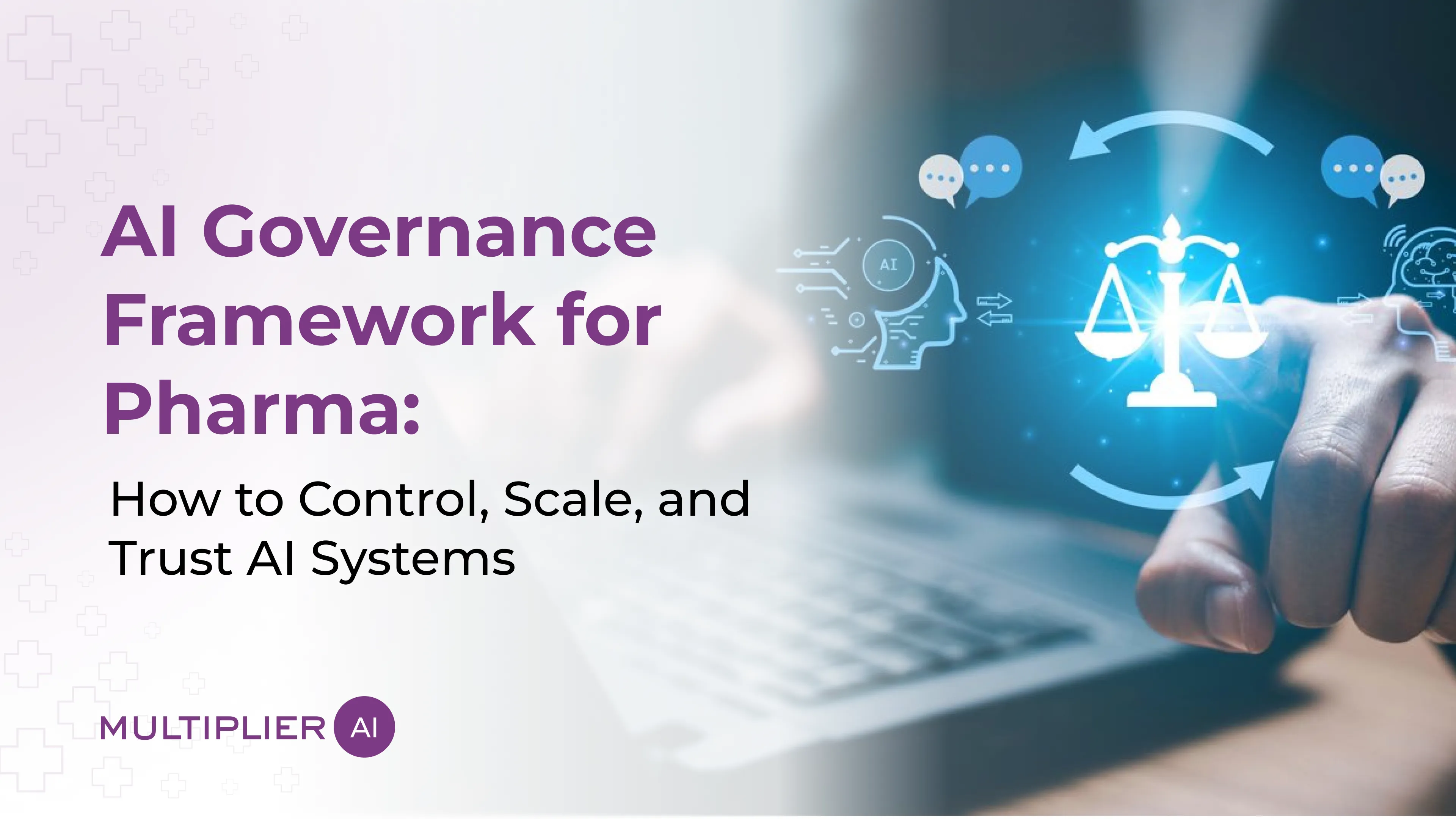
AI Governance Framework for Pharma: How to Control, Scale, and Trust AI Systems
AI is no longer a side experiment inside pharma companies. It is now entering commercial operations, medical affairs, regulatory workflows, content creation, HCP engagement, competitive intelligence, field planning, and analytics. As these systems become part of daily decision-making, pharma leaders need more than enthusiasm for AI. They need confidence that every AI use case is controlled, explainable, compliant, and aligned with business priorities.
This is why an AI governance pharma framework has become essential. It gives organizations a practical way to decide which AI use cases can move forward, which data can be used, how models should be validated, how outputs should be reviewed, and who remains accountable when AI influences a decision. The purpose of governance is not to slow innovation. The purpose is to make innovation reliable enough to scale.
For pharma companies, this matters because AI does not operate in a low-risk environment. A recommendation may influence HCP prioritization. A generated message may become part of a campaign. A predictive model may affect resource allocation. A summarization tool may shape medical or commercial interpretation. Without governance, these actions can create privacy, compliance, accuracy, trust, and reputational risks.
What Is an AI Governance Framework for Pharma?
An AI governance framework for pharma is a structured operating model that defines how artificial intelligence systems are developed, approved, deployed, monitored, audited, and improved across commercial, medical, regulatory, compliance, and data teams. It helps pharma companies manage AI risk, protect HCP and patient-related data, maintain transparency, assign accountability, and scale AI responsibly.
In simple terms, AI governance tells every team what AI can do, what it cannot do, which data it can use, which outputs need human review, and who owns the final decision. It creates the control layer needed to scale AI without losing trust.
A strong governance framework should feel practical, not theoretical. It should help a marketing team understand whether AI-generated content needs MLR review. It should help a data team know which model validation checks are mandatory. It should help a field team understand why a recommendation was generated. It should also help leadership see whether AI is producing business value without creating unmanaged risk.
Highlights
The central idea is simple: pharma AI governance is the operating discipline that allows AI to move from scattered pilots to trusted enterprise adoption. The strongest frameworks combine business ownership, data discipline, model validation, compliance controls, human oversight, explainability, and auditability.
| Highlight | Why It Matters |
| AI governance is now a leadership priority | AI affects content, HCP engagement, analytics, targeting, medical workflows, and operational decisions. |
| Governance must cover more than models | Data, content, decisions, workflows, compliance, audit trails, and business value also need control. |
| Human oversight remains essential | AI can recommend, summarize, and assist, but accountable teams must own high-risk decisions. |
| Compliance should be built into workflows | Controls work best when consent, MLR rules, review triggers, and audit trails are embedded from the start. |
| Governance enables scale | Clear standards make AI repeatable across teams without each function creating its own risk model. |
Why AI Governance Is Now a Board-Level Priority
AI governance is a board-level priority because AI systems are starting to influence decisions that affect business performance, regulatory exposure, HCP trust, and operational accountability. In pharma, the risk is not only whether a model works technically. The larger question is whether the organization can explain, monitor, and defend how AI was used.
A pharma company may use AI to identify high-priority HCPs, personalize content, summarize medical insights, detect market signals, support field planning, or automate campaign recommendations. Each use case may appear manageable in isolation. The risk grows when multiple teams adopt AI independently without shared standards for data, validation, compliance, and oversight.
Global governance discussions are moving in the same direction. NIST positions AI risk management as a framework for managing risks to individuals, organizations, and society. WHO guidance for health AI emphasizes ethics, human rights, transparency, and accountability. FDA and OECD guidance also reinforce the need for trustworthy, monitored, and human-centered AI systems. Pharma companies should use these principles as reference points while building their own operating model.
The Problem with Fragmented AI Adoption
Fragmented AI adoption happens when different teams experiment with AI independently. Marketing may use generative AI for content. Analytics may build predictive models. Field operations may test next-best-action tools. Medical affairs may use AI for summarization. These pilots can create speed, but they can also create inconsistency.
The problem is not experimentation. The problem is experimentation without shared rules. If teams use different datasets, different review standards, different approval processes, and different levels of human oversight, leadership eventually loses visibility. No one can easily answer which AI systems are live, what data they use, how outputs are validated, or what risk controls are in place.
A pharma AI governance model solves this by standardizing data usage, model validation, human oversight, compliance review, auditability, and risk monitoring across use cases.
| Area | Fragmented AI Adoption | Governed AI Adoption |
| Ownership | Unclear or team-specific | Defined roles and accountability |
| Data usage | Inconsistent across teams | Standardized, permissioned, and auditable |
| Model development | Built independently | Validated through common standards |
| Compliance | Applied late or manually | Embedded into workflows |
| Risk visibility | Limited | Monitored continuously |
| Scaling | Difficult and inconsistent | Repeatable across use cases |
| Trust | Depends on individual teams | Supported by transparency and auditability |
Core Components of a Pharma AI Governance Model
A pharma AI governance model should govern the full AI operating environment, not only the algorithm. This means it must cover the data being used, the model being developed, the content being generated, the decisions being influenced, the compliance rules being applied, and the audit trail being maintained.
What the Framework Should Control
Before an AI use case moves into production, teams should be able to answer eight questions: what data is being used, what the model is intended to do, who validates it, who approves it, what risks exist, what audit trail is maintained, who can override it, and how business impact will be measured.
| Governance Component | What It Controls |
| Data governance | Approved data sources, consent, quality, access, retention, and privacy |
| Model governance | Model purpose, development standards, validation, monitoring, and retirement |
| Content governance | Approved claims, templates, MLR rules, source traceability, and content risk |
| Decision governance | Human oversight, escalation rules, approval workflows, and accountability |
| Compliance governance | Regulatory, MLR, privacy, and internal policy alignment |
| Risk governance | Bias, misuse, drift, privacy risk, and incident response |
| Audit governance | Logs of data use, model outputs, approvals, overrides, and actions |
| Business governance | Alignment with commercial, medical, and leadership priorities |
Defining Clear Ownership and Responsibilities
AI governance works only when ownership is clear. In pharma, AI systems usually involve leadership, data science, commercial teams, medical affairs, MLR, legal, compliance, IT, CRM owners, and sometimes external vendors. Each function must know its role before AI is scaled.
This does not mean every team has equal ownership of every AI decision. It means every stage of the AI lifecycle should have a defined owner. Someone must approve the use case. Someone must approve the data. Someone must validate the model. Someone must review compliance risk. Someone must monitor performance. Someone must be accountable when AI outputs influence action.
| Stakeholder | Governance Responsibility |
| Leadership | Defines AI strategy, risk appetite, funding, and governance expectations |
| Data team | Manages data quality, model development, validation, and monitoring |
| Compliance/legal | Reviews regulatory, privacy, ethical, and audit requirements |
| MLR team | Governs claims, templates, review triggers, and HCP-facing outputs |
| Commercial team | Uses AI insights responsibly for targeting, messaging, and field action |
| Medical affairs | Validates scientific interpretation and medical context |
| IT/security | Manages infrastructure, access controls, cybersecurity, and system security |
| CRM/admin team | Maintains consent, preference, engagement, and workflow data |
| AI governance committee | Reviews high-risk use cases, exceptions, incidents, and scaling decisions |
AI Oversight Model for Pharma Teams
An AI oversight model for pharma should be risk-based. Not every AI use case needs the same review depth. A low-risk internal summarization tool may need logging, user guidance, and periodic checks. A model that influences HCP prioritization, medical interpretation, or HCP-facing communication needs stronger validation, human approval, and compliance oversight.
Low-Risk, Medium-Risk, and High-Risk Use Cases
The practical way to manage oversight is to classify AI use cases by potential impact. Internal productivity tools can move faster with lighter controls. AI tools that influence HCP engagement, claims, medical insights, personalization, or patient-related workflows need a more formal governance path. High-risk use cases should never move into production without clear ownership, validation evidence, escalation rules, and auditability.
The most important principle is simple: AI can support decisions, but accountable humans must remain responsible for decisions that affect HCP engagement, medical interpretation, compliance, or patient-related outcomes.
Practical AI Governance Committee Structure
A pharma AI governance committee should not become a bottleneck for every small AI activity. Its value is highest when it governs high-risk use cases, cross-functional systems, vendor tools, HCP-facing outputs, autonomous workflows, sensitive data use, and models that influence important business decisions.
The committee should include representation from leadership, commercial, medical, compliance, legal, data science, IT/security, CRM, and MLR teams. Its role is to review new AI use cases, assign risk levels, approve governance requirements, monitor incidents, review model performance, and decide when AI systems should be scaled, restricted, or retired.
Establishing Standards for Data Usage
Data governance is the foundation of AI governance. If the data is inaccurate, outdated, incomplete, or used beyond its permitted purpose, the AI output will be unreliable or risky. In pharma, this is especially important because AI often uses HCP engagement data, CRM records, consent status, content behavior, field activity, and other sensitive business signals.
The governance framework should define which data sources are approved, who can access them, how consent is validated, how data quality is checked, how long data is retained, and what business purpose each dataset can support. For example, HCP engagement data may be used for personalization only when it respects consent, channel permissions, and privacy expectations.
A DPDP-Compliant HCP Marketing framework can help pharma teams govern explicit consent, purpose limitation, data minimisation, immutable audit trails, and role-based access before AI-driven HCP engagement is activated. A GenAI Doctor Data Platform can also support governed HCP intelligence by connecting CRM activity, doctor insights, KOL signals, segmentation, doctor consent, and preferred-channel communication into a controlled data layer.
| Data Governance Standard | Why It Matters |
| Approved data sources | Prevents unauthorized or unreliable data use |
| Consent validation | Ensures HCP communication respects permissions |
| Purpose limitation | Prevents unrelated reuse of data across AI use cases |
| Data minimisation | Reduces unnecessary data exposure |
| Data quality checks | Improves model reliability |
| Role-based access | Limits sensitive data access to approved users |
| Retention rules | Prevents uncontrolled data lifecycle risk |
| Audit logging | Tracks how data is used in AI workflows |
Ensuring Transparency and Explainability
Transparency does not require every user to understand the technical model architecture. It means users should understand why an AI output was generated, what data influenced it, what limitations apply, and whether the output requires review before action.
For example, if an AI model prioritizes certain HCPs for outreach, the user should understand whether the recommendation was influenced by specialty, engagement history, content behavior, prescribing relevance, channel preference, or consent status. This level of explainability helps users trust the system without blindly depending on it.
GPT & LLM Based Tools should therefore operate inside governed workflows where approved data sources, recommendation logic, review triggers, and audit logs make AI-assisted insights easier to understand, validate, and control.
| Explainability Requirement | Why It Matters |
| Recommendation rationale | Explains why an AI output was generated |
| Data source visibility | Shows what information influenced the output |
| Confidence signal | Helps users judge reliability |
| Model limitation statement | Prevents overdependence on AI |
| Review status | Shows whether output is approved, draft, or requires review |
| Human override option | Allows users to challenge AI outputs |
| Audit record | Tracks inputs, outputs, approvals, and actions |
Integrating Compliance into AI Workflows
Compliance should not sit outside AI workflows as a final manual checkpoint. In pharma, compliance must be embedded into the way AI systems generate, recommend, personalize, and activate outputs. This is especially important for content generation, HCP-facing communication, omnichannel decisioning, and personalized engagement.
An AI compliance framework pharma teams can trust should include approved data sources, MLR rules, consent validation, source traceability, version control, and human review triggers. When these controls are built into the workflow, teams can scale AI without depending only on manual policing after the fact.
A Hyper Personalized Content Platform should use governed content, approved audience logic, channel permissions, and review workflows so personalization can scale without losing control. This is where governance becomes an enabler: it lets teams move faster because the rules are clear.
| Compliance Control | What It Prevents |
| Approved claim library | Unsupported or exaggerated claims |
| MLR-approved templates | Uncontrolled content variation |
| Review triggers | High-risk outputs bypassing human review |
| Consent validation | Outreach without permission |
| Channel permission checks | Communication through unauthorized channels |
| Source traceability | Unverifiable AI-generated content |
| Version control | Use of outdated content or models |
| Audit trails | Lack of accountability during review or investigation |
GET ACTIONABLE AI AND HEALTHCARE INSIGHTS THAT HELP YOU STAY AHEAD IN A FAST-CHANGING PHARMA WORLD
Monitoring Performance and Managing Risk
AI risk management in pharma should be continuous. A model that performs well during testing can become less reliable if the data changes, user behavior changes, market conditions shift, or the model is used outside its intended purpose.
Risk management should monitor bias, drift, data misuse, content risk, over-automation, poor explainability, weak auditability, and user misuse. It should also define what happens when something goes wrong. Incident management is part of governance because teams need a clear path to investigate, pause, fix, or retire AI systems.
| AI Risk | Example in Pharma | Control |
| Bias | Certain HCP segments are over-prioritized or ignored | Bias testing and segment impact review |
| Data misuse | HCP data used beyond consent or purpose | Consent checks and purpose limitation |
| Inaccurate output | AI generates misleading recommendation | Validation and human review |
| Non-compliant content | AI creates unsupported claim language | MLR-approved content rules |
| Lack of explainability | Users cannot understand why output was generated | Recommendation rationale and confidence signal |
| Model drift | Performance changes over time | Continuous monitoring |
| Over-automation | Teams act on AI without judgment | Human oversight triggers |
| Poor auditability | Outputs cannot be traced later | Audit logs and version control |
Building Scalable Processes for AI Adoption
Governance must be scalable. If every AI use case requires a completely new approval process, teams will avoid governance. If governance is too loose, the organization loses control. The right approach is to standardize the repeatable parts while allowing flexibility for different use cases.
A scalable model should include a common intake form, risk classification method, approved data standards, validation checklist, compliance review triggers, deployment controls, and feedback loop. This gives teams a clear path from idea to production without starting from scratch every time.
| Scaling Layer | What Should Be Standardized |
| Use case intake | Business objective, risk score, owner, and expected impact |
| Data approval | Approved sources, access rules, and consent status |
| Model validation | Accuracy, bias, drift, and performance tests |
| Compliance review | Claims, templates, privacy, and regulatory checks |
| Deployment process | User access, training, workflow integration, and monitoring |
| Feedback loop | User feedback, issue escalation, and improvement cycle |
| Governance review | Periodic review of high-risk and scaled use cases |
Best Practices for Pharma AI Governance
The best AI governance programs are practical, visible, and connected to how teams already work. They do not rely on policy documents alone. They translate governance into workflow rules, review checkpoints, dashboards, approval paths, and measurable controls.
Recommended Implementation Steps
- First, create a central inventory of AI use cases across commercial, medical, regulatory, analytics, and operations.
- Second, classify each use case by risk.
- Third, define approved data sources and consent rules.
- Fourth, build validation and review requirements based on risk level.
- Fifth, embed compliance checks into the workflow. Sixth, monitor model performance and business impact over time.
This step-by-step approach helps organizations move from informal experimentation to governed adoption without overwhelming teams with unnecessary process.
Common Mistakes to Avoid
A common mistake is treating AI governance as a legal document instead of an operating system. Policies matter, but they are not enough. Teams need practical decision rules that show what can be used, what needs approval, and what must be escalated.
Another mistake is focusing only on model accuracy while ignoring data consent, content governance, user behavior, audit trails, and downstream decisions. In pharma, an accurate model can still create risk if it uses the wrong data, recommends the wrong channel, or generates a message that bypasses MLR review.
The third mistake is over-automation. AI may identify patterns faster than humans, but humans must remain accountable for high-impact decisions. Governance should make clear when AI can recommend and when a person must approve.
Aligning Governance with Business Strategy
AI governance should not operate as a separate compliance layer disconnected from business goals. It should help leadership answer whether AI is improving decision quality, reducing operational risk, accelerating compliant execution, and creating measurable value.
For commercial teams, value may come from better HCP prioritization, more relevant engagement, stronger campaign efficiency, or improved sales productivity. For medical teams, value may come from better insight summarization, scientific engagement support, and faster understanding of field feedback. For compliance teams, value may come from clearer audit trails, better consent enforcement, and fewer uncontrolled workflows.
| Metric | Why It Matters |
| Approved AI use cases | Shows governance-enabled adoption |
| High-risk use case review rate | Confirms risky AI is reviewed properly |
| Model validation completion | Measures model readiness before deployment |
| Compliance exception rate | Tracks governance failures |
| Human override rate | Shows whether users can challenge outputs |
| Audit trail completeness | Confirms traceability |
| Model drift incidents | Tracks ongoing model reliability |
| Consent validation rate | Measures privacy-safe activation |
| Business impact score | Shows whether governed AI delivers value |
How Multiplier AI Supports Governed AI Adoption
Multiplier AI helps pharma teams adopt AI with stronger governance across doctor data, HCP engagement, personalized content, compliance workflows, and AI-assisted insights.
The DPDP-Compliant HCP Marketing platform supports explicit consent tracking, purpose limitation, data minimisation, immutable audit trails, secure data usage, and role-based access. The GenAI Doctor Data Platform helps teams connect CRM activity, doctor insights, KOL signals, segmentation, doctor consent, and preferred-channel communication into a governed HCP intelligence layer.
GPT and LLM-based tools support structured insight generation, campaign analysis, and AI-assisted recommendations within controlled workflows. The Hyper Personalized Content Platform helps teams scale personalized communication using governed content, audience logic, and channel rules. Together, these capabilities help pharma organizations move from fragmented AI experimentation to controlled, auditable, and scalable AI adoption.
Overcoming Challenges in Implementation
Building AI governance is not only a technology exercise. It requires organizational alignment, change management, documentation discipline, and cross-functional trust. Some teams may worry that governance will slow them down. Others may not understand why AI outputs need review when the tool appears to work well.
The solution is to position governance as an enabler. Governance gives teams confidence to use AI because they know what is allowed, what needs review, and how risk is managed. It also protects leadership by creating visibility into where AI is being used and how it is being controlled.
What Success Looks Like
A successful AI governance framework gives pharma organizations confidence. Teams know which AI systems are approved. Data use is controlled. Outputs are explainable. Compliance checks are embedded. Human oversight is clear. Audit trails are complete.
The organization can scale AI across commercial, medical, regulatory, and operational teams without creating uncontrolled risk. The strongest outcome is trust: leadership trusts the system, users trust the output, compliance trusts the process, and customers trust that engagement is relevant, respectful, and responsible.
Conclusion
AI is transforming pharma, but its long-term value depends on how well it is governed. A strong AI governance framework gives organizations the structure needed to control risk, scale innovation, and build trust in AI-supported decisions.
The goal is not to restrict AI adoption. The goal is to create the conditions for responsible adoption. When data, models, content, compliance, and decisions are governed from the start, pharma companies can use AI with greater confidence across commercial, medical, regulatory, and operational workflows.
Final CTA
AI governance becomes scalable when data, models, content, compliance, and decision workflows are controlled from the start. Multiplier AI helps pharma teams combine consent-aware HCP data, governed doctor intelligence, AI-assisted insights, personalized content, role-based access, and audit-ready workflows so AI systems can scale with confidence, compliance, and trust.
Frequently Asked Questions For AI Governance Pharma Framework: Control, Scale, and Trust AI
An AI governance framework for pharma is a structured operating model that defines how AI systems are developed, approved, deployed, monitored, audited, and improved across pharma teams.
AI governance is important because AI can influence HCP engagement, content generation, targeting, analytics, medical insights, and commercial decisions. Without governance, these systems can create compliance, trust, privacy, and strategic risks.
A pharma AI governance model should include data governance, model governance, content governance, decision governance, compliance governance, risk governance, audit governance, and business governance.
AI governance should be shared across leadership, data teams, compliance, legal, MLR, medical affairs, commercial teams, IT/security, CRM teams, and an AI governance committee.
AI risk management in pharma involves identifying, monitoring, and controlling risks such as bias, data misuse, inaccurate outputs, non-compliant content, model drift, over-automation, and poor auditability.
Pharma companies should validate AI models by testing accuracy, bias, performance, data quality, compliance alignment, explainability, and business relevance before deployment.
Human oversight ensures that AI recommendations are interpreted with commercial, medical, regulatory, ethical, and contextual judgment before action is taken.
AI governance supports compliance by embedding approved content, MLR rules, consent checks, source traceability, privacy controls, review triggers, and audit trails into AI workflows.
Pharma companies can scale AI responsibly by standardizing use case intake, data approval, model validation, compliance review, deployment, feedback, and governance review processes.
Multiplier AI supports governed AI adoption through DPDP-Compliant HCP Marketing, GenAI Doctor Data Platform, GPT and LLM-based tools, and Hyper Personalized Content Platform.
GET ACTIONABLE AI AND HEALTHCARE INSIGHTS THAT HELP YOU STAY AHEAD IN A FAST-CHANGING PHARMA WORLD
Let's Discuss Your Requirements