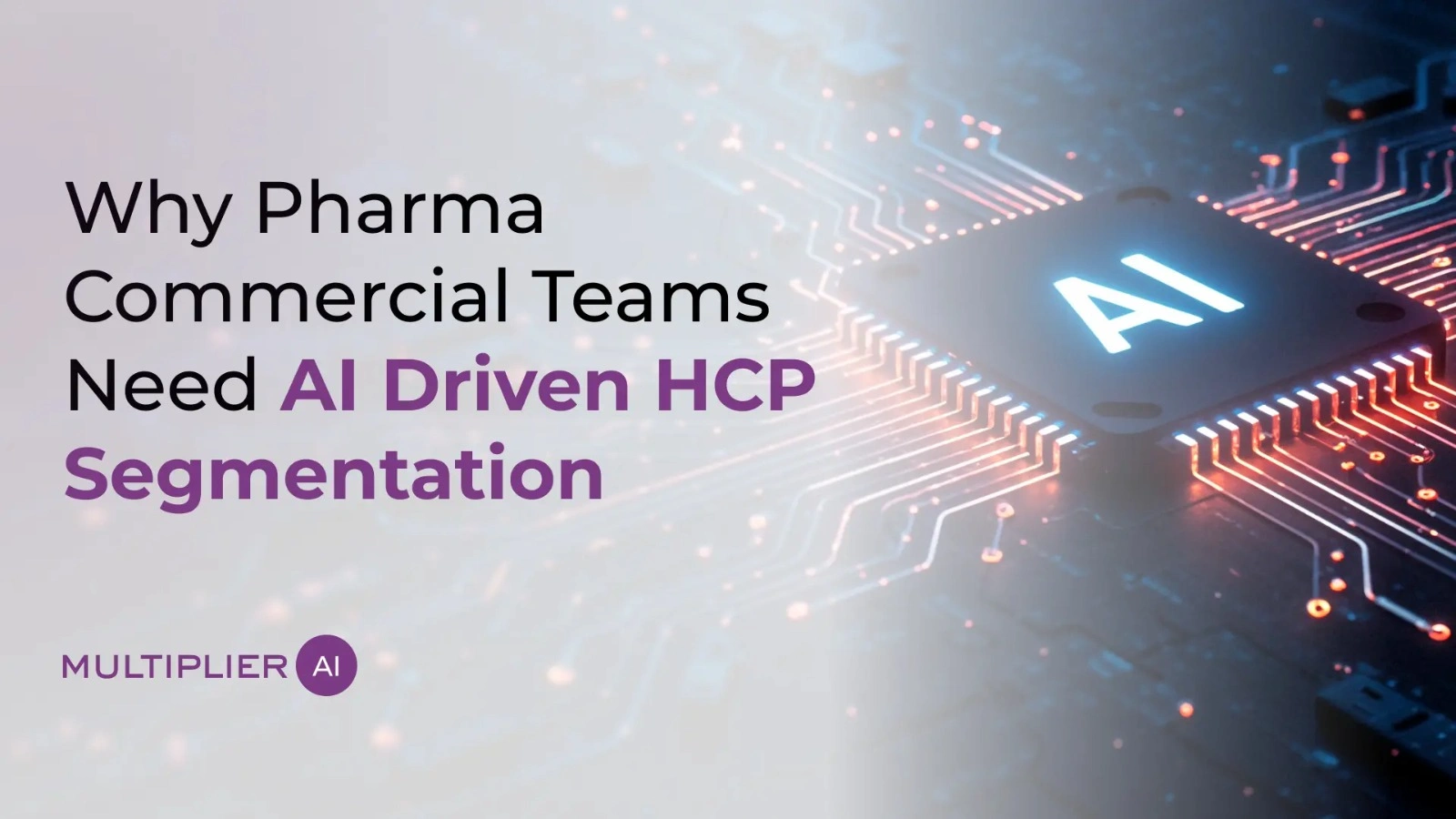
Why Pharma Commercial Teams Need AI-Driven HCP Segmentation
The Problem With Traditional HCP Segmentation in Pharma (3 Limitations)
For decades, pharma companies have categorized physicians using three simple variables: specialty, prescription volume, and geography. While practical in the past, these models miss almost everything that matters in modern engagement.
Traditional HCP segmentation has 3 structural limitations:
- Static data quickly becomes outdated — physician behavior evolves, but segments don't. A doctor who rarely prescribed a therapy last year may begin adopting it after new clinical evidence appears, and static models miss the shift.
- Behavioral patterns are ignored — the model knows what doctors prescribe, not how they decide. Two physicians may prescribe the same treatments but engage with information in completely different ways.
- Communication preferences vary widely — some physicians prefer face-to-face conversations with reps, others prefer digital channels like webinars or email updates. Traditional segmentation cannot distinguish.
What Is AI-Driven HCP Segmentation? (Definition + How It Works)
AI-driven HCP segmentation is the use of machine learning to group healthcare professionals by behavior, not just demographics. Models analyze prescribing history, digital engagement, content consumption, conference attendance, CRM interactions, and campaign response data to identify physicians who share engagement patterns, content preferences, and adoption tendencies — whether or not they share a specialty.
Instead of assigning physicians to simple buckets, AI models surface hidden behavioral patterns. For example, an AI model might identify a segment of physicians who frequently attend clinical webinars, respond well to peer research summaries, and adopt new therapies early — while another segment of the same specialty prefers concise email updates and rarely meets with reps. Same specialty, completely different engagement strategy.
“Specialty tells you what a doctor practices. Behavior tells you how to actually reach them.”
This is what “behavior, not just demographics” means in practice — and why behavioral segmentation in pharma now defines competitive advantage in commercial operations.
6 Key Data Sources Used in AI-Driven HCP Segmentation
AI-driven HCP segmentation pulls from 6 core data sources:
- CRM interaction data — visits, meetings, conversation topics, rep notes. Provides insight into engagement frequency and current relationship state.
- Digital marketing analytics — email opens, webinar attendance, content downloads, page-time. Identifies physicians actively consuming scientific information online.
- Prescription data — Rx trends, brand share, adoption-curve signals. Reveals early adopters, cautious prescribers, and stable-pattern HCPs.
- Medical conference participation — attendance, speaking, abstract submissions. Strong signal of clinical-innovation orientation.
- Publication and research activity — clinical trials, peer-reviewed authorship, citations. Identifies KOLs and emerging thought leaders.
- Channel preference signals — when, where, and how each HCP responds best. The most underused — and most valuable — input.
Combining these sources lets AI models build profiles that are 5-10x richer than traditional specialty + Rx-volume views.
4 Benefits of AI-Driven HCP Segmentation for Pharma Teams
AI-driven HCP segmentation delivers 4 measurable benefits for pharma commercial teams:
- Improved targeting — fewer wasted touches, more high-relevance contacts. Reps focus on physicians who actually move when engaged.
- More relevant communication — content matches each HCP's interest and channel preference. Tools like the Multiplier AI Hyper Personalized Content Platform turn segments into modular, personalized content at scale.
- Optimized marketing budgets — investment concentrates on physicians most likely to engage. Targeted campaigns require fewer resources than broad outreach.
- Stronger physician relationships — personalized engagement compounds into long-term trust. Physicians notice when communication respects their time and clinical interests.
By the Numbers — AI HCP Segmentation
- Pharma teams using AI-driven HCP segmentation report 20-35% lift in email engagement vs static specialty + Rx-volume targeting.
- Behavioral micro-segments outperform demographic segments by 2-3x on click-through rate.
- Up to 40% of marketing spend in static segmentation programs reaches the wrong HCPs.
- Continuous (real-time) segmentation models outperform annual-refresh models within 90 days.
Real-World Example: AI-Driven Segmentation for a New Cardiovascular Therapy
Consider a pharma company launching a new cardiovascular therapy.
With traditional segmentation, the company would target cardiologists with high prescription volumes and deliver largely identical messaging.
With AI-driven HCP segmentation, the company identifies 3 distinct behavioral groups among the same cardiologists:
- Clinical-evidence followers — actively read research, attend cardiology conferences, respond to detailed efficacy data.
- Guideline-driven prescribers — prefer concise treatment-guideline summaries delivered through digital channels.
- Peer-influenced adopters — wait for case studies and outcomes from peers before adopting new therapies.
A blanket campaign treats all three the same. AI-driven HCP segmentation tailors content, channel, and timing to each — and engagement compounds. The clinical-evidence group gets full publication summaries via medical webinars; the guideline-driven group gets a 2-minute treatment-guideline video in their preferred channel; the peer-influenced group gets KOL-led case study content. Same therapy. Three campaigns. Measurably better adoption.
Challenges in Implementing AI-Driven HCP Segmentation (and How to Avoid Them)
AI-driven HCP segmentation does not fail because of algorithms. It fails because the data and consent foundations underneath the model are broken. Three failure modes show up repeatedly in pharma commercial environments:
- Bad data leads to wrong segments — outdated affiliations, duplicate records, and inconsistent specialty data quietly distort every cluster the model produces. Platforms like the Multiplier AI GenAI Doctor Data Platform solve this with continuous identity resolution and real-time enrichment.
- No consent makes data unusable — even high-quality engagement data cannot be activated without recorded consent and channel preferences, especially under DPDP Act 2023 and similar regimes.
- CRM gaps create broken inputs — when CRM, MLR, and digital engagement systems are not connected, segmentation models receive partial signals and produce unreliable recommendations.
Related reading: see our companion guides on the hidden cost of bad doctor data, DPDP-compliant consent collection, and HCP data quality at scale.
Beyond data and consent, three implementation challenges show up in every rollout:
- Data integration — pharma data lives in CRM, MLR, marketing automation, external panels, and conference databases. Stitching these together is foundational, not optional.
- Privacy and compliance — healthcare data is sensitive and tightly regulated. Solutions like DPDP-Compliant HCP Marketing build the audit trails and consent logic AI segmentation depends on.
- Organizational adoption — commercial teams need training to interpret AI-generated segments and act on them in the field. Without it, the model gets built but never used.
GET ACTIONABLE AI AND HEALTHCARE INSIGHTS THAT HELP YOU STAY AHEAD IN A FAST-CHANGING PHARMA WORLD
How to Implement AI-Driven HCP Segmentation: 5-Step Framework
Pharma teams can roll out AI-driven HCP segmentation with this 5-step framework:
- Audit your HCP data foundation — measure duplicate rate, missing-field percentage, consent coverage, and last-update freshness. Establish a baseline.
- Unify the data layer — connect CRM, MLR, marketing automation, prescription data, and conference data into a single HCP master.
- Define segmentation goals — be specific. “Find cardiologists likely to adopt Therapy X within 6 months,” not “segment our HCPs better.
- Build, validate, and ship the model — train AI on the unified dataset, validate against real engagement outcomes, deploy into the CRM and marketing stack.
- Measure and iterate — track 5-6 KPIs (engagement lift, click-through rate, channel-fit accuracy, segment stability, Rx adoption velocity, opt-out rate). Refine the model on the new data.
How to Measure AI HCP Segmentation Success
- Engagement lift — % uplift in opens, clicks, attended webinars vs control segment.
- Channel-fit accuracy — % of HCPs reached through their predicted preferred channel.
- Segment stability — how often HCPs move between segments (volatile = unreliable model).
- Rx adoption velocity — time-to-first-Rx after first targeted touch, vs control.
- Opt-out / unsubscribe rate — should fall, not rise, on a well-built segmentation.
- Rep adoption rate — % of reps actively working off the AI segments in the field.
The Future of AI-Driven HCP Segmentation in Pharma
The next wave of AI-driven HCP segmentation will move from periodic to continuous. Three capabilities will define it:
- Real-time engagement signals — every email open, content view, and rep interaction updates the segment in near real time.
- Predictive physician behavior models — moving from descriptive (“what they do”) to predictive (“what they will do next”).
- Automated campaign optimization — segments don't just inform campaigns; they reshape them mid-flight.
Instead of an annual segmentation refresh, AI HCP segmentation will become a live system — one that learns from every interaction and adapts continuously. The pharma teams that ship this capability will compete on engagement quality, not just media spend.
Conclusion
AI-driven HCP segmentation is a real shift in how pharmaceutical commercial teams approach physician engagement.
Traditional segmentation models — built on specialty, Rx-volume, and geography — cannot capture how modern physicians actually behave. AI changes that. By analyzing engagement, prescribing, content, channel, and conference signals together, AI surfaces the behavioral clusters that drive real outcomes.
The result is sharper targeting, more relevant communication, more efficient marketing spend, and stronger physician relationships. As data availability continues to grow, AI segmentation will move from optional capability to commercial table-stakes — and the teams that build their data foundation now will win the next generation of pharma marketing.
Build AI-Driven HCP Segmentation on a Solid Data Foundation
Strong segmentation starts with clean, consented, unified physician data. Book a discovery call to see how the Multiplier AI GenAI Doctor Data Platform helps your commercial team build AI-driven HCP segmentation that actually drives engagement.
Frequently Asked Questions For Why Pharma Commercial Teams Need AI-Driven HCP Segmentation
HCP segmentation is the process of grouping healthcare professionals based on shared characteristics such as specialty, prescribing patterns, or engagement behavior.
AI analyzes large datasets to identify hidden behavioral patterns that traditional segmentation methods cannot detect.
AI models use data such as prescribing history, CRM interactions, digital engagement metrics, and medical conference participation.
AI will not replace representatives. Instead it helps them prioritize the most relevant physicians and deliver more meaningful conversations.
Traditional segmentation groups physicians by demographics — specialty, Rx-volume, geography. AI-driven HCP segmentation groups physicians by behavior — how they engage, which channels they use, which content they consume, and how they make prescribing decisions. Two physicians with the same specialty often belong to completely different AI segments.
A first useful segmentation can typically be built within 60-90 days, assuming clean, consented HCP data is in place. The model then improves continuously as new engagement and prescribing data flow in.
Yes — but only when built on a consent-first data foundation. Each HCP's preferences, consent records, and channel choices must be respected at every step. Pharma teams should never treat AI segmentation as a workaround for missing consent.
It removes wasted reach. Marketing investment concentrates on physicians most likely to engage with a given message in their preferred channel — which lifts engagement rates, click-through rates, and downstream Rx adoption while reducing media spend on the wrong audience.
GET ACTIONABLE AI AND HEALTHCARE INSIGHTS THAT HELP YOU STAY AHEAD IN A FAST-CHANGING PHARMA WORLD
Let's Discuss Your Requirements