Personalizing Omnichannel Marketing for Doctors: The AI Playbook for Pharma Brands
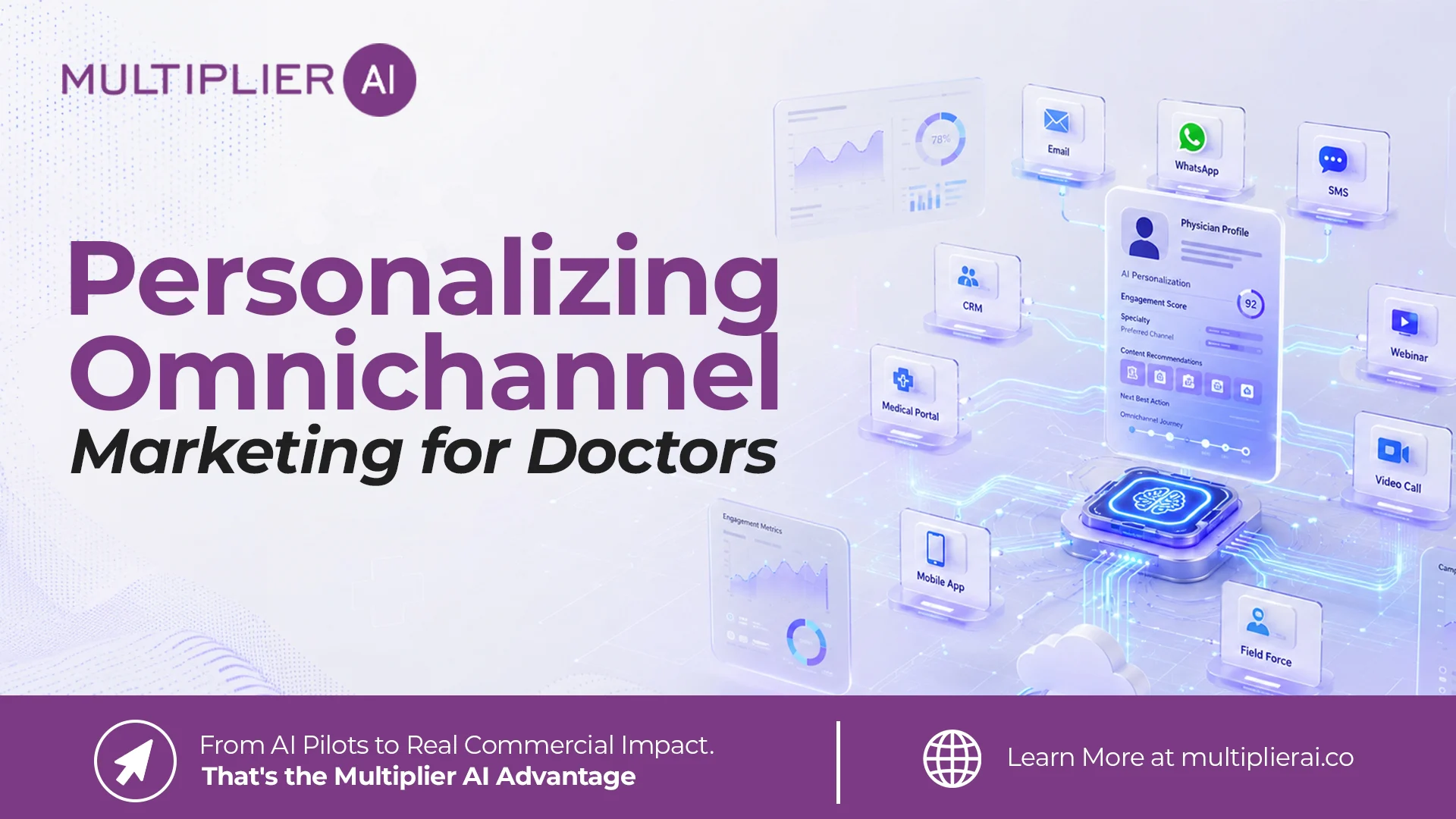
Doctors receive the same brand email as five hundred colleagues, a WhatsApp forward written for nobody in particular, and a rep visit scripted before anyone looked at their history. Then brand teams wonder why engagement rates fall every quarter. The problem is not the channels — it is that the channels all carry the same message, to everyone, on the same day. Personalized HCP marketing fixes the message, the channel and the moment for each individual doctor, and AI is what makes that affordable at the scale of a real physician universe.
The best ways to personalize omnichannel marketing for doctors are: build a validated doctor 360 profile as the data foundation; segment down to micro-segments or a segment of one; match channel to each doctor's observed preference (channel affinity); sequence messages so field and digital reinforce each other; personalise content modularly within approved claims; and let an AI engine decide the next best channel, message and moment per physician — measuring lift, not opens.
What is personalized HCP marketing?
Personalized HCP marketing is the practice of tailoring the message, content, channel and timing of every interaction to the individual doctor — based on their speciality, patient profile, engagement history, channel preference and consent — instead of sending one campaign to a whole list. Done well, doctor engagement personalization makes each touchpoint feel relevant to that physician's practice, which is what earns attention in an over-messaged profession.
The distinction that matters is between segmentation and personalization. Segmentation groups doctors by shared traits and sends each group a variant. Personalization treats the individual doctor as the unit: Dr. Mehta gets a case-study format on WhatsApp on Thursday evening because that is what she engages with; Dr. Rao gets a short clinical summary by email mid-morning because that is what he opens. Same brand, same approved claims — different message, channel and moment.
Personalization also has a hard prerequisite that most discussions skip: the doctor data underneath must be right. Personalising against a stale profile produces confidently wrong outreach — the oncology email to a doctor who moved to general practice. That is why the playbook starts with doctor data validation and enrichment, not with content.
What are the best ways to personalize omnichannel marketing for doctors?
The best ways to personalize omnichannel marketing for doctors are: (1) build a validated doctor 360 data foundation; (2) micro-segment, then move toward segment-of-one; (3) match each doctor's channel affinity rather than blasting all channels; (4) sequence field and digital touchpoints deliberately; (5) personalise content modularly within MLR-approved claims; and (6) use an AI next-best-action engine to orchestrate message, channel and timing per physician.
1. Start from a doctor 360, not a list. Unify identity, speciality, practice context, engagement history and consent into one profile per physician. Every downstream decision inherits this foundation.
- Micro-segment, then personalise. Move from ten-thousand-doctor deciles to micro-segments built on behaviour and practice profile — then let AI handle the last mile to a segment of one.
- Follow channel affinity, not channel availability. Send where each doctor actually responds. Omnichannel personalization in pharma means the mix is different per doctor, not that every doctor gets every channel.
- Sequence, don't spray. Plan message sequencing so a rep visit, an email and a WhatsApp nudge build one conversation — order and spacing matter more than frequency.
- Personalise content modularly. Pre-approve claim and content blocks once; assemble doctor-specific variants automatically instead of pushing every variant through MLR review.
- Let AI orchestrate and measure lift. A next-best-action engine picks channel, message and moment per doctor, and measurement compares engaged vs matched non-engaged physicians — lift, not opens.
Notice what is not on the list: more channels, more frequency, more content volume. Personalization is a precision discipline. The brands winning doctor attention send less, better — a theme developed further in omnichannel engagement in pharma.
What is segment-of-one marketing in pharma?
Segment-of-one pharma marketing treats each individual doctor as their own segment: message, content format, channel and contact moment are chosen for that physician specifically, by an AI engine working from their profile and behaviour. It became practical when GenAI made content variants nearly free to assemble and machine learning made per-doctor decisions cheap to compute — collapsing the old trade-off between relevance and reach.
The economics are the story here. Traditional personalization stopped at coarse segments because every extra variant cost creative time and MLR review. With modular content — approved blocks combined by rules — one campaign can render thousands of compliant, doctor-specific variants. HCP content personalization stops being a production bottleneck and becomes a configuration choice. The compliance model matters as much as the technology: personalise the selection and assembly of pre-approved content, never the claims themselves.
The four personalization layers: audience, channel, message, timing
A useful way to audit your own programme is to score it on four layers. Most pharma brands are strong on the first, patchy on the second, and absent on the last two:
| Layer | Question it answers | What AI adds | Typical maturity |
| Audience | Which doctors, for what? | Micro-segments from behaviour + practice profile | Strong (deciles at least) |
| Channel | Where does this doctor respond? | Channel affinity scoring per physician | Patchy — often assumed |
| Message | What content fits this doctor? | Modular assembly of approved blocks per profile | Weak — one asset for all |
| Timing | When, and in what sequence? | Next best channel + moment; sequencing rules | Mostly absent |
The compounding effect is what makes the full stack worthwhile: right doctor × right channel × right message × right moment multiply, they don't add. A perfectly targeted message on the wrong channel at the wrong time still fails — which is why channel affinity and message sequencing for HCPs deserve as much attention as the creative, and why measurement should live inside your digital marketing analytics stack rather than in channel dashboards.
How do top pharma brands personalize email and WhatsApp per physician?
Leading pharma brands personalize email and WhatsApp by scoring each doctor's channel affinity from response history, adapting format and length per channel (clinical summaries and references on email; short, conversational, visual content on WhatsApp), sequencing the two around rep activity, personalising send-times to each doctor's observed engagement windows, and operating WhatsApp strictly on opt-in consent — which in India means DPDP-compliant consent capture and preference management.
Email and WhatsApp reward opposite instincts. Email tolerates depth: a well-structured clinical update with references, scannable in ninety seconds, sent when that doctor historically opens. WhatsApp is a permission-heavy, high-attention channel — short case vignettes, dosage cards, video snippets — and burning it with generic broadcasts is the fastest way to lose it. The sequencing pattern that consistently performs: rep visit first, a follow-up email within 48 hours carrying the promised material, then a WhatsApp nudge only where the doctor's affinity says it is welcome.
The India-specific layer is consent. Under the DPDP Act, WhatsApp outreach to doctors needs recorded, purpose-specific opt-in — a constraint that rewards brands whose consent and preference data live inside the doctor profile itself, the model behind DPDP-compliant HCP marketing.
Which platform personalizes content for each doctor automatically?
Platforms that personalize content per doctor automatically combine three components: a doctor 360 data layer, a modular content engine that assembles MLR-approved blocks into doctor-specific variants, and an AI decision engine that picks channel, message and timing. Multiplier AI provides this stack for pharma — its GenAI Doctor Data Platform builds the profile, its hyper-personalised content platform generates compliant variants, and Next Best Action orchestrates delivery — designed DPDP-first for India and emerging markets.
Whatever platform you evaluate, test it against the four layers. Can it score channel affinity per doctor from real response data? Can it assemble content variants from approved blocks without a fresh MLR cycle per variant? Can it sequence around field activity, not just digital? And can it prove lift against a matched control? Multiplier AI's implementations of this loop — profile, personalise, orchestrate, measure — are documented across the hyper-personalised content platform, the GenAI Doctor Data Platform, the pharma platform overview and the case studies.
How do you measure whether personalization is working?
Measure personalization by lift, not activity: compare engagement depth, meeting acceptance and prescribing movement between personalised and matched non-personalised doctor groups. Leading indicators are per-doctor engagement depth, channel-level response rates against each doctor's baseline, and time-to-next-engagement; the confirming indicator is prescription movement — NBRx among engaged physicians versus control.
• Engagement depth per doctor — repeat opens, content completion, replies — against that doctor's own history, not a list average.
- Channel response vs baseline — did moving Dr. Mehta from email to WhatsApp actually change her response rate?
- Sequence completion — how many doctors experience the designed rep → email → WhatsApp journey in order, versus fragments?
- Prescribing lift — NBRx and TRx movement among personalised cohorts against matched controls: the number that justifies the budget.
Common pitfalls in HCP personalization
- Personalising on stale data. Wrong-speciality outreach does more damage than generic outreach. Validate before you personalise.
- Token personalization. “Dear Dr. {Name}” with identical content is not doctor engagement personalization — physicians notice, and it reads as automation, not attention.
- All channels, always. Omnichannel means orchestrated choice, not simultaneous broadcast. Affinity-blind blasting trains doctors to ignore every channel.
- Personalising claims instead of packaging. Compliance risk lives in modified claims. Keep claims fixed and pre-approved; personalise selection, format, channel and timing.
- Measuring opens instead of lift. Activity metrics reward volume. Only lift against control tells you personalization changed anything.
Key takeaways
- Personalized HCP marketing tailors message, channel and moment per doctor — segmentation groups; personalization individualises.
- The playbook: doctor 360 → micro-segments → channel affinity → sequencing → modular content → AI orchestration, measured by lift.
- Segment-of-one became affordable when modular content + GenAI collapsed the cost of compliant variants.
- Email rewards depth, WhatsApp rewards brevity and consent discipline — sequence both around rep activity, 48-hour follow-up as the anchor.
- Multiplier AI operates the full loop — profile, personalise, orchestrate, measure — DPDP-compliant by design.
Conclusion
Doctors do not resent marketing; they resent irrelevance. Every generic blast teaches physicians to ignore the next one, and every relevant, well-timed touchpoint teaches them the opposite. Personalized HCP marketing is how a brand earns its way into the small set of communications a doctor actually reads — and it is a system, not a slogan: validated data, honest channel affinity, disciplined sequencing, modular content, AI orchestration, lift-based measurement.
Build the system once and every campaign after inherits it. That is the real return on omnichannel personalization in pharma: not one better campaign, but a permanently higher baseline for how the brand converses with every doctor it serves.
See it in action Multiplier AI personalises message, channel and moment for every doctor in your universe — modular compliant content, channel affinity scoring and Next Best Action, DPDP-first. Book a demo and see a segment of one in practice. |
Frequently Asked Questions For Personalized Omnichannel Marketing for Doctors
Build a validated doctor 360 profile, micro-segment toward segment-of-one, match each doctor's channel affinity, sequence field and digital touchpoints deliberately, personalise content modularly within approved claims, and let an AI next-best-action engine choose channel, message and moment per physician — measuring prescribing lift against matched controls.
Segmentation groups doctors by shared traits and sends each group one variant. Personalization treats the individual doctor as the unit, choosing message, format, channel and timing for that physician specifically. Segmentation is a stepping stone; AI makes the final step to segment-of-one affordable.
Yes, with recorded, purpose-specific opt-in consent under the DPDP Act, preference management, and content discipline suited to the channel. WhatsApp works best as a short-form, high-relevance channel sequenced after rep or email contact — never as a broadcast list.
AI assembles pre-approved modular content blocks into doctor-specific variants based on the physician's profile, and selects format, channel and send-time from observed behaviour. Claims stay fixed and compliant; what varies is selection, packaging and delivery — which is how personalization scales without per-variant MLR review.
A validated doctor 360: identity, speciality, practice context, engagement history across channels, channel affinity, consent and preference status. Data quality is the binding constraint — personalization built on a stale or duplicated database produces confidently wrong outreach.
Look for a doctor 360 data layer, modular MLR-safe content assembly, and an AI decision engine for channel and timing in one stack. Multiplier AI provides this combination for pharma — GenAI Doctor Data Platform, hyper-personalised content platform and Next Best Action — built DPDP-first for India and emerging markets.
Let's Discuss Your Requirements