
Menu
DPDP-Compliant Consent Collection Across Email, WhatsApp, and Ads

Consent collection becomes significantly more complex when pharma marketing moves beyond a single channel. While many teams focus on capturing consent at a high level, real compliance challenges emerge during execution across email, WhatsApp, and digital advertising.
Each channel has different expectations, different risk profiles, and different operational realities. Under the Digital Personal Data Protection Act 2023, treating consent as uniform across channels is no longer defensible.
This article explains how pharma companies can design and operate DPDP-compliant consent collection across email, WhatsApp, and ads, without fragmenting workflows or slowing down engagement at scale.
Why Channel-Specific Consent Matters Under DPDP ?
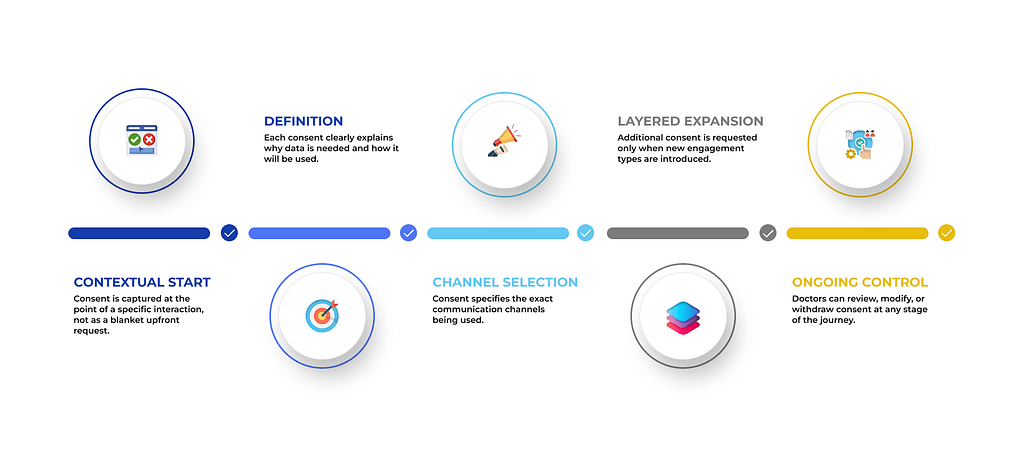
DPDP requires consent to be explicit, informed, and purpose specific. What is often missed is that consent must also be contextually aligned to how communication actually happens.
Email, WhatsApp, and digital ads are fundamentally different engagement environments. Doctors experience them differently, respond to them differently, and perceive intrusion differently.
A doctor may be comfortable receiving email communication but not instant messages. Another may accept WhatsApp updates but not targeted digital ads.
DPDP reflects this reality by requiring clarity around how data will be used and through which channels communication will occur.
The Common Mistake of Blanket Consent
Many pharma companies rely on blanket consent language such as “I agree to receive communication.”
This approach fails DPDP requirements because it does not specify channel, purpose, or frequency. It also creates confusion during audits, because teams cannot demonstrate that consent covered the actual method of communication used.
Blanket consent becomes especially risky when engagement spans multiple channels.
Consent Collection for Email Marketing in Pharma
Email remains one of the most widely used channels for doctor engagement.
DPDP-compliant email consent must clearly state that the doctor agrees to receive communication via email. It must explain the purpose of communication, such as scientific updates, educational content, or brand information.
Consent should be captured through a clear affirmative action, such as a checkbox that is not preselected. The consent record should include timestamp, purpose, and channel.
Email consent should not be assumed based on the availability of an email address.
Managing Email Consent at Scale
At scale, email consent must be managed centrally.
CRMs and marketing platforms should validate email consent before sending campaigns. Consent withdrawal must be respected immediately.
Unsubscribing from emails should be simple and automated. Manual suppression lists do not scale and increase risk.
DPDP expects systems to enforce consent, not rely on human discipline.
Consent Collection for WhatsApp Engagement
WhatsApp is one of the highest risk channels under DPDP because of its immediacy and personal nature.
Doctors may tolerate email marketing but view WhatsApp messages as intrusive if not explicitly agreed upon. DPDP requires clear consent for WhatsApp communication.
Consent for WhatsApp must explicitly mention WhatsApp as a channel. Consent captured for email or phone calls does not automatically extend to messaging apps.
Capturing WhatsApp Consent Correctly
WhatsApp consent should be captured through digital flows wherever possible.
This may include opt-in during portal registration, digital forms, or confirmation messages where the doctor explicitly agrees to receive WhatsApp communication.
Verbal consent captured by field teams must be recorded digitally and stored centrally to be defensible.
WhatsApp consent must also be purpose specific. Promotional messages require different consent from purely informational updates.
Handling WhatsApp Opt-Outs and Withdrawals
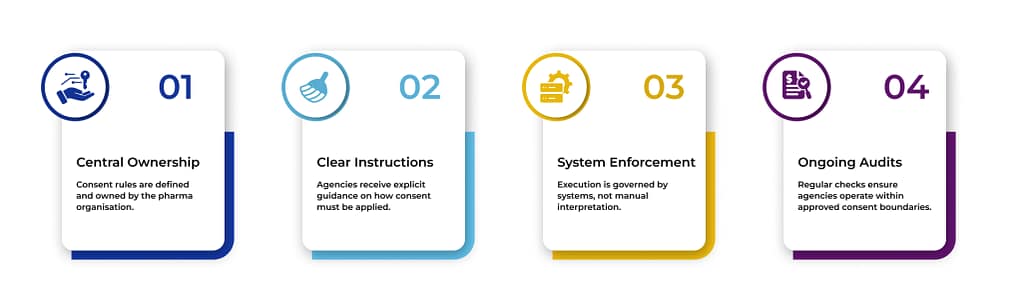
DPDP requires that consent withdrawal be easy.
Doctors should be able to opt out of WhatsApp communication through simple actions, such as replying with a keyword or clicking a link.
Once withdrawn, WhatsApp messaging must stop immediately. Delayed suppression increases compliance risk.
At scale, this requires automation rather than manual intervention.
Consent for Digital Advertising and Targeted Ads
Digital advertising introduces a different consent challenge.
Targeted ads often rely on behavioural data, cookies, or audience matching. Under DPDP, using personal data for targeted advertising requires explicit consent for that purpose.
Doctors must be informed if their data is being used to personalise ads or target them across platforms.
Assuming consent for ads based on consent for email or WhatsApp is not compliant.
Managing Consent for Ads Without Overcomplicating Execution
One concern many teams have is that explicit consent for ads will limit reach.
The solution is clarity, not avoidance.
Consent language should explain that data may be used to personalise digital content or advertisements. Doctors should be given the choice to agree or decline.
Those who consent represent a compliant, high intent audience. Those who decline should not be targeted using personal data.
This approach reduces risk while maintaining engagement quality.
Integrating Consent Across Channels
The real challenge is not collecting consent per channel. It is integrating it.
Consent records must be linked to the doctor profile centrally. Systems must understand which channels and purposes are allowed for each individual.
This allows campaigns to be executed confidently without manual checks.
This is why DPDP-compliant HCP marketing architectures are critical for multi-channel engagement. They treat consent as a shared control signal across systems.
Preventing Cross-Channel Consent Leakage
One of the biggest risks in multi-channel engagement is consent leakage.
This happens when consent captured for one channel is incorrectly applied to another. For example, email consent triggering WhatsApp outreach or ad targeting.
Preventing leakage requires system-level controls. Campaign tools must respect channel-specific consent automatically.
Relying on process discipline alone does not scale.
Handling Legacy Consent Across Channels
Most pharma companies have legacy consent records that are not channel specific.
These records must be reviewed and refreshed. Teams can run re-consent campaigns asking doctors to confirm preferred channels.
This process should be phased to avoid engagement disruption.
Role of Field Teams in Multi-Channel Consent
Field teams often influence doctor preferences around communication channels.
They should be trained to explain channel options clearly and capture consent digitally. Field input should feed directly into central consent systems.
Manual notes or offline records undermine compliance at scale.
Measuring Consent Coverage by Channel
Consent coverage should be tracked separately for email, WhatsApp, and ads.
This helps teams identify gaps and design targeted consent refresh programs. It also improves audit readiness.
Consent metrics should be treated as operational KPIs, not just compliance indicators.
Why Channel-Specific Consent Improves Trust ?
Doctors value control over how they are contacted.
Clear consent by channel reduces complaints, improves engagement quality, and strengthens trust. Over time, this leads to better response rates and lower attrition.
DPDP-compliant consent is not just a regulatory requirement. It is an engagement quality lever.
Frequently Asked Questions on Channel-Specific Consent Under DPDP
Does DPDP require channel-specific consent?
⌄
Yes. Consent should clearly cover the channel used for communication.
Is email consent enough for WhatsApp marketing?
⌄
No. WhatsApp requires explicit consent as a separate channel.
Can doctors withdraw consent for one channel only?
⌄
Yes. Consent can be withdrawn for a specific channel without affecting others.
Does DPDP apply to digital ads targeting doctors?
⌄
Yes. Using personal data for targeted ads requires consent.
How should WhatsApp opt-outs be handled?
⌄
Opt-outs should be automated and enforced immediately across systems.
Do CRMs support channel-level consent?
⌄
Most require enhancements or integrations to support DPDP-level consent.
Who is responsible for enforcing channel-specific consent?
⌄
The pharma company, as the data fiduciary, remains responsible.
Closing Perspective and CTA
DPDP-compliant consent collection across email, WhatsApp, and ads is not about adding friction. It is about designing engagement systems that respect doctor preferences and regulatory expectations simultaneously.
Pharma companies that implement channel-specific, purpose-bound consent will be able to scale engagement confidently without hidden compliance risk.
If you are evaluating how to operationalise DPDP-compliant HCP marketing across email, WhatsApp, and digital advertising, this page explains how consent-first, multi-channel engagement is being implemented in practice.