
For years, reusing doctor data across campaigns was considered efficient pharma marketing. Once a doctor was added to a database, the data was reused for multiple purposes, channels, and initiatives. Educational campaigns fed promotional outreach. Conference registrations triggered digital marketing. Engagement history informed analytics and AI models.
Under the Digital Personal Data Protection Act 2023, this behaviour becomes one of the highest risk areas for pharma companies.
Purpose limitation is a foundational principle of DPDP. It requires that personal data be collected and used only for a clearly defined purpose and not reused beyond that purpose without fresh justification and consent.
This article explains purpose limitation in a pharma context, why reusing doctor data is now risky, and how pharma organisations must redesign engagement workflows to remain compliant at scale.
Purpose limitation under DPDP means that personal data must be collected for a specific, lawful purpose and processed only for that purpose.
Data cannot be reused simply because it is available. Each use must align with the purpose communicated to the data principal at the time of consent.
If the purpose changes, expands, or evolves, new consent may be required.
This principle forces organisations to think carefully about why data is collected and how it will be used over time.
Pharma marketing involves multiple overlapping objectives.
Educational outreach, brand promotion, medical updates, market research, and analytics often rely on the same doctor data. Historically, this overlap encouraged reuse.
DPDP recognises that such reuse can undermine individual control over data.
Doctors may consent to one type of engagement but not another. Reusing data without respecting this distinction violates purpose limitation.
Several common practices create risk under DPDP.
Doctor data collected during conference registrations is reused for promotional campaigns without explicit consent. Email consent for educational updates is used to trigger WhatsApp messages. Engagement analytics data is fed into AI models without clear consent for such processing.
Each of these cases represents purpose expansion without renewed consent. Under DPDP, intent does not matter. Alignment with consent does.
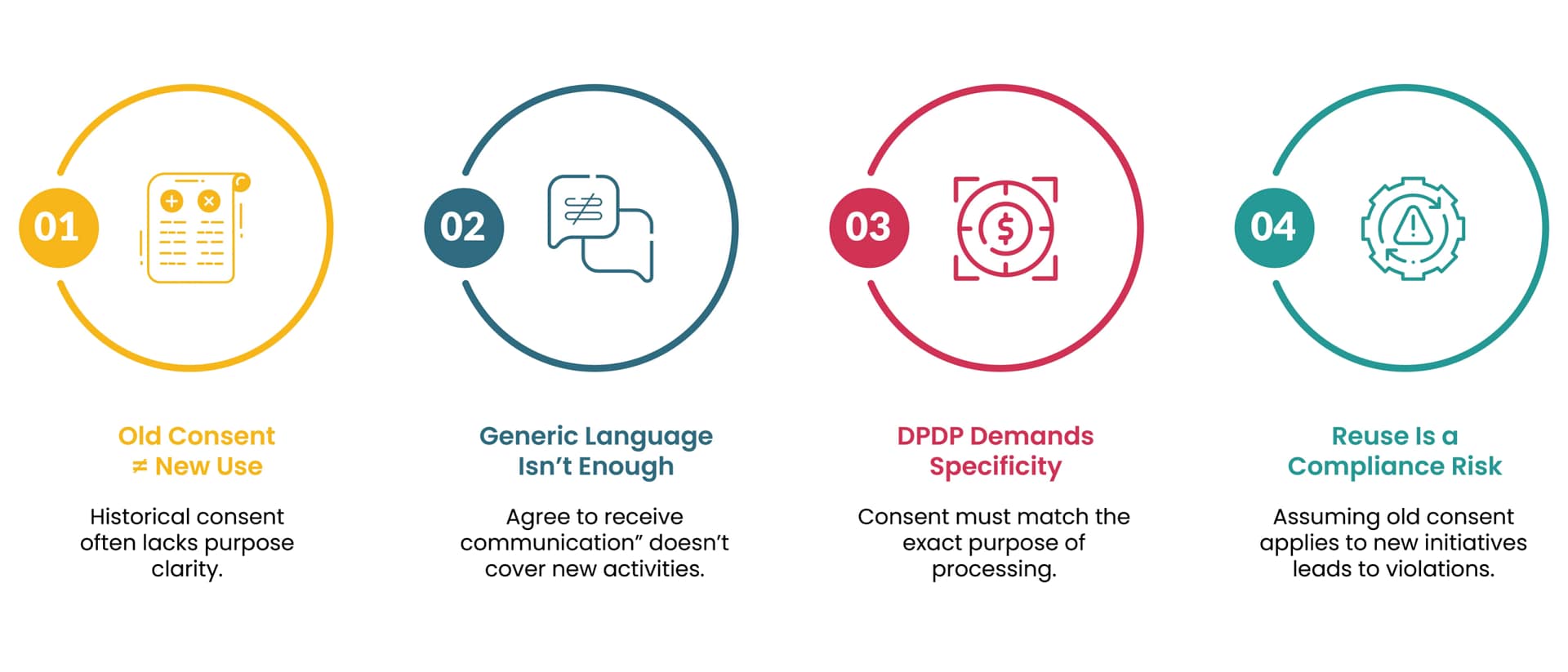
Many pharma companies rely on historical consent to justify reuse.
Consent captured years ago rarely specifies detailed purposes. It often uses generic language such as agreeing to receive communication.
DPDP requires purpose specificity. Historical consent that lacks clarity cannot justify reuse for new purposes.
Assuming that old consent covers new initiatives is a common compliance failure.
Channel expansion is a frequent trigger for purpose violations.
A doctor may consent to receive email communication for educational content. That consent does not automatically extend to WhatsApp or digital ads.
Using the same data across new channels without fresh consent violates purpose limitation. Pharma teams must treat channel changes as potential purpose changes.
Analytics often operate in the background, making purpose violations less visible.
Doctor engagement data collected for communication is often reused for analytics, profiling, or performance scoring. If consent does not clearly cover analytics use, this reuse is risky.
DPDP applies equally to analysis and outreach. Processing includes analysing data, not just sending messages.
AI systems amplify purpose drift.
Data collected for one purpose is often reused to train models for another. Engagement data feeds prediction models. Behavioural data informs targeting algorithms.
Without explicit consent covering AI processing, this reuse violates purpose limitation. Pharma companies must scrutinise AI use cases carefully.
Internal sharing of doctor data across teams can also violate purpose limitation.
Marketing teams may share data with analytics teams. Medical teams may access engagement data for insights. Commercial teams may reuse data for targeting.
If these uses go beyond the original purpose, they require fresh consent or justification. Internal use is not exempt under DPDP.
Purpose limitation is difficult because it requires clarity and discipline.
Many organisations lack clear purpose definitions. Data flows are complex. Systems are interconnected.
Legacy architectures were built for reuse, not restriction. DPDP forces organisations to rethink these architectures
The solution begins at collection.
Consent language should clearly define the purpose. Data collection forms should align with that purpose.
Avoid collecting data for vague future use. If future use is anticipated, it should be disclosed and consented to explicitly.
Clear upfront definition reduces downstream risk.
Doctors often engage for multiple reasons.
Rather than reusing data, organisations should manage multiple consents tied to different purposes. This allows flexibility without violating DPDP.
Purpose specific consent models require more sophistication but provide stronger compliance.
Purpose limitation must be enforced at execution, not just defined at collection.
Before data is used, systems should validate that the purpose of use matches consent.
Campaign tools, analytics platforms, and AI systems must respect purpose boundaries automatically.
Manual checks do not scale.
This is where DPDP-compliant HCP marketing architectures become essential. They enforce purpose limitation across execution layers.
Legacy data reuse is one of the biggest DPDP risks.
Organisations must audit how doctor data is currently reused. High risk reuse should be paused until consent is refreshed.
Re consent campaigns can be used to legitimise reuse where appropriate. Ignoring legacy reuse is not safe.
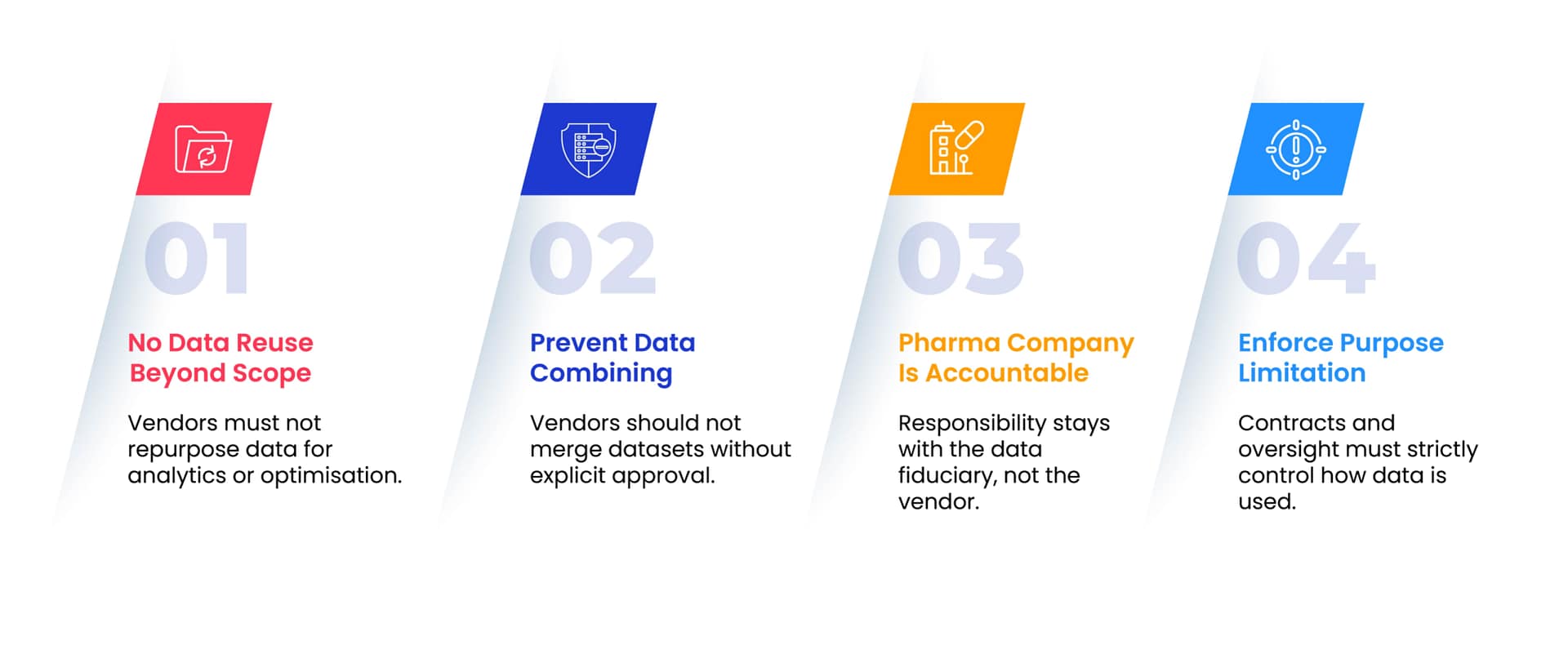
Vendors often reuse data beyond initial scope.
Agencies may use data for analytics. Platforms may retain data for optimisation. Vendors may combine datasets.
As data fiduciary, the pharma company remains responsible.
Vendor contracts and oversight must enforce purpose limitation strictly.
Auditors will examine whether data use aligns with stated purpose.
They may ask how consent language maps to actual use. They may review campaign logs and analytics workflows.
Being able to demonstrate purpose enforcement strengthens compliance posture.
Purpose limitation requires a cultural shift.
Teams must stop viewing data as a reusable asset and start viewing it as purpose bound permission.
This requires leadership support, training, and system redesign.
Doctors value transparency.
Using data only for agreed purposes reduces complaints and improves trust. Over time, this leads to more sustainable engagement.
Compliance and trust are aligned outcomes.
Purpose limitation under DPDP challenges long standing pharma marketing practices. Reusing doctor data without clear purpose alignment is no longer efficient. It is risky.
Pharma companies that redesign data use around purpose specific consent and execution will be able to operate confidently and compliantly.
If you are evaluating how to implement DPDP-compliant HCP marketing with strict purpose limitation enforcement, this page explains how compliant engagement models are being implemented in real pharma environments.