
Author: Tharun

  • Multiplier AI Unveils Its GenAI-Powered Medical Writing Platform

    Multiplier AI Unveils Its GenAI-Powered Medical Writing Platform

    What is a Medical Writing?

    Medical writing  is the foundation of effective communication in clinical research and medical affairs. It encompasses a wide range of documents — from Clinical Study Reports (CSRs) to regulatory submissions, scientific publications, and patient education materials.

    A Medical Writing Platform leverages advanced tools and technology (increasingly, AI) to streamline this traditionally manual, time-consuming process. These platforms help ensure accuracy, compliance with global regulations, and faster document turnaround — all while maintaining scientific integrity.

    With the rise of AI in clinical research, medical writing is no longer just about writing. It’s about data interpretation, contextual understanding, and automation at scale.

    Learn more about
    medical writing and its evolving role in the life sciences industry.

    Why is an AI medical writing platform important now?

    The need for clear, compliant, and quicker documentation in clinical research is increasing quickly. This makes an AI medical writing platform essential. Traditional medical writing takes a lot of time and often faces delays.

    In contrast, AI-driven platforms simplify the process by producing first drafts, summarizing research data, and checking regulatory compliance in real time. With growing pressure on pharmaceutical and life sciences organizations to speed up submissions and cut costs, using an AI medical writing platform promotes efficiency, accuracy, and scalability. This helps teams meet global regulatory standards while saving valuable time.

    Our Solution

    Multiplier AI’s Medical Writing Platform ​

    Purpose-Built for the Life Sciences Industry

    Traditional medical writing processes, often manual and resource-intensive, are struggling to keep pace.

    At Multiplier AI, we identified major pain points faced by clinical research organizations, pharmaceutical companies, and medical writers:

    • Accelerated Clinical Timelines
    • Growing Documentation Demands
    • Evolving Regulatory Expectations
    • Limited Access to Skilled Medical Writers

    We responded with a solution tailored to this environment:
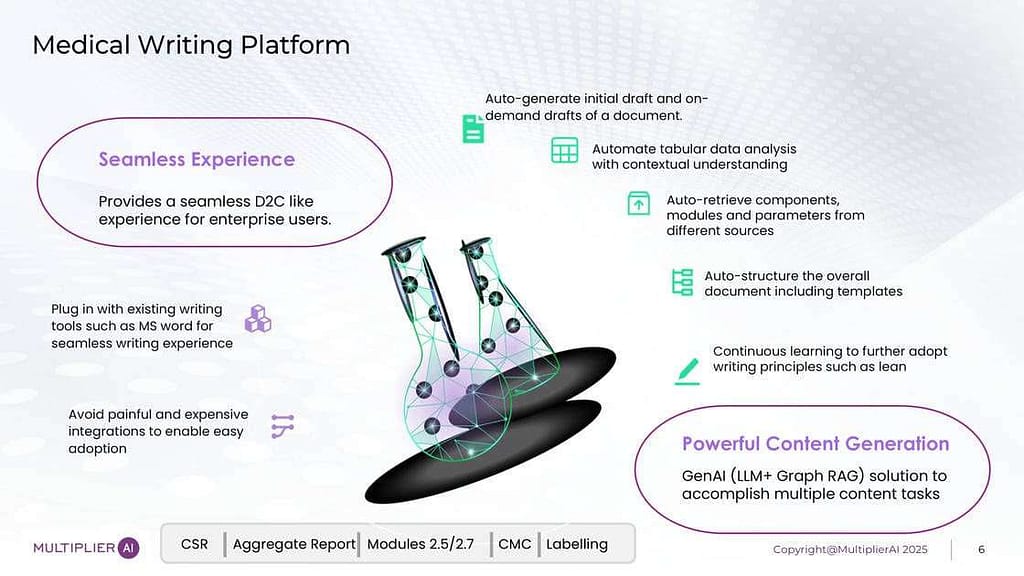
    Multiplier AI medical writing platform with AI-powered draft generation, data analysis, and regulatory report automation.

    A Gen AI–powered Medical Writing Platform designed specifically for regulatory and medical writing experts working in clinical research and life sciences.

    This platform doesn’t just speed up content creation — it introduces a new standard of accuracy, traceability, and compliance. It empowers writing teams with intelligent automation, built-in validation, and collaboration tools to meet today’s demands without compromising on scientific or regulatory quality.

    Core Capabilities

    Capability Description
    AI-Powered Draft Generation Automatically generate CSRs, IBs, protocols, and narratives
    Medical Research Summarization Use NLP to distill literature and trial data
    Built-in Regulatory Compliance Checker Pre-submission validation ensures documents meet global standards
    Smart Review Assistant Flags missing data, inconsistencies, and language issues
    Collaboration Suite Enables seamless teamwork between writers, reviewers, and SMEs

    This isn’t just automation — it’s augmented clinical intelligence.

    Advantages of Multiplier AI’s AI Medical Writing Platform

    While other companies offer strong services, here’s what sets Multiplier AI apart:

    Feature Multiplier AI Other Medical Writing Platforms
    AI-Powered Drafting ✔️
    Real-Time Review Assistance ✔️
    Built for CROs & Biotechs ✔️ ✔️
    End-to-End Platform (Not just services) ✔️
    Native Compliance Checker ✔️

    Our AI Medical Writing Platform is not just a  writing tool, but a strategic enabler for pharma, CROs, and biotechs to accelerate go-to-market timelines and reduce medical writing overhead by up to 40%.

    Use Cases and Early Results

    Case Study 1: Enhancing Efficiency for a Global Biopharma Company

    Challenge: A global biopharmaceutical firm was facing delays in preparing clinical narratives and study summaries across regions. Manual writing and review processes led to bottlenecks and compliance concerns.

    Solution: Multiplier AI’s AI medical writing platform was deployed to generate high-quality first drafts, automate compliance checks, and streamline review workflows across teams.

    The Impact

    • 35% reduction in documentation turnaround time

    •  90% accuracy in first drafts, minimizing revisions

    • Faster delivery to trial sponsors and regulatory teams

    Result
    Improved operational efficiency and compliance — without compromising scientific quality.

    Why Now? The Future of Medical Writing is AI-Augmented

    As regulatory bodies continue to accept automation and real-world data becomes central to drug development, the future of medical writing in clinical research will be powered by Clinical AI.

    With AI overview panels now visible in search engines like Google and Bing, your business needs an edge. Multiplier AI gives you just that.

    Whether you’re a biotech startup or a global CRO, this is your moment to scale efficiently — without compromising scientific rigor.

    Recent research on PubMed highlights the growing role of artificial intelligence in medical writing — emphasizing how AI-driven tools can enhance efficiency while preserving human expertise. (Source: PubMed)

    Why is medical writing important in pharma and clinical research?
    Medical writing ensures clinical trial results and research data are presented in a structured, regulatory-compliant, and easily understandable format for authorities, doctors, and patients.
    What is an AI medical writing platform?
    An AI medical writing platform is a software solution that uses artificial intelligence to help generate, review, and manage clinical and regulatory documents faster and more accurately.
    How does Multiplier AI’s AI medical writing platform stand out?
    Our platform combines AI-powered draft generation, compliance verification, and team collaboration tools, helping organizations achieve up to 35% faster document delivery.
    What are the benefits of using an AI medical writing platform?
    It reduces turnaround time, improves draft accuracy, ensures regulatory compliance, and allows medical writing teams to focus on high-value scientific insights.

    See It in Action

    Ready to Transform Your Medical Writing Workflow?

    Want to learn how Multiplier AI can elevate your medical writing workflow?

    Fill out the form below to schedule a personalized demo or get in touch with our team.


  • 5 Ways by which Artificial Intelligence can Boost Pharmaceutical Industry?

    5 Ways by which Artificial Intelligence can Boost Pharmaceutical Industry?

    AI in Pharmaceutical Industry

    5 Ways By Which Artificial Intelligence Can Boost Pharmaceutical Industry

    Artificial Intelligence (AI) was first applied drug product development in 1990s, by using neural networks to predict the features of immediate release of the oral tablets. Later Artificial Intelligence enhances the process control by ensuring the consistent product quality and by predicting the quality deviations. AI in pharmaceutical industry also analyzes the real world data for detecting the adverse drug reactions and maintaining the safety of pharmaceutical products.

    How Artificial Intelligence can Boost Pharmaceutical Industry

    There are numerous ways in which AI can boost pharmaceutical industry by leveraging the pharmaceutical company marketing in the following ways:

     1. Clinical Trial Optimization

     Artificial Intelligence in pharma helps in identifying the suitable candidates by analyzing the health records and genetic data of the biomarkers and aids in the development of the targeted therapies and also improving the diagnostic accuracy accordingly. AI tracks the patient’s progress and for the best outcomes adjust the protocols in the real time.AI detects and addresses anomalies or protocol deviations promptly by reducing trial risk. With the predictive analytic AI identifies bottlenecks or dropouts risks by allowing proactive interventions.

     2. Predicting Drug Efficiency

    Artificial Intelligence plays a very crucial role in predicting drug efficacy with in the pharmaceutical industry. AI evaluates the genetic variations and patterns in the patient’s outcome. AI predicts efficacy based on the datasets of successful and failed drugs as well. Molecular docking simulations predicts that how a drug interacts with the target. After this AI identifies the biomarker who correlates with the positive responses to the particular drug. From the dynamic adjustments in the trial protocols AI monitors the clinical trials and then maximize efficacy.

    3. Drug Discovery and Design

    AI in the pharmaceutical industryanalyzes the algorithms that can identify the potential drug candidates with the vast datasets of molecular and genetic information. With the pharmaceutical marketing strategy, AI predicts the efficacy and designs the new drug molecules with the desired properties and thus contributes in accelerating the speedy discovery phase by reducing the cost on Research and Development.

    4. Supply Chain Management

    The pharmaceutical marketing strategyuses artificial intelligence to forecast the inventory needs and then manages the stock levels accordingly. It also supports in improving the logistics for the on time delivery of the desired products and reduces its cost with the further delays, for this it improves production planning by preventing shortages or over production. AI also inspects manufacturing and distribution processes to ensure compliance with Good Manufacturing Practices. It also automates documentation for compliance with the local and international regulations.

    5. Drug Repurposing

    AI helps in identifying the new applications for the existing drugs by the identification of different patterns in the biological pathways. AI also evaluates the interaction of existing drug molecules with the different disease targets and predicts the drug binding with the different alternatives. Pharmaceutical company marketing focuses on powering the AI to construct complex biological network to identify the pathways between drug and disease. It identifies potential synergistic effects when repurposing drugs in combination therapies.

    AI allows pharmaceutical companies to optimize the existing assets while addressing emerging healthcare challenges.

    Optimize Digital Marketing and Improve sales in Pharma

    As much as traditional methods of marketing are successful strategies to maintain strong relationships with customers, it’s time to move on, if you haven’t already, to digital marketing.

    Digital marketing is a powerful tool to reach a global audience through social media, blogs and websites. Brands can also leverage platforms like GoogleMeet for webinars, one-on-one meetings with HCPs and KOLs, etc. SEO and targeted content marketing help to attract and retain interested users by providing educational and informative content at the tip of their hands. 

    1. Digital Technologies

    Incorporating technologies like AI-driven tools can optimize interaction and target marketing strategies by providing real-time insights and recommendations. Consider the example of Multiplier AI tools, if provided data, they can segment data based on similarities and aid in refining sales strategies by providing deep insights and market predictions. Other tools like virtual assistants and Chatbots powered by AI allow to improve customer engagement by providing quick responses and even using previous interactions and user data to give personalized responses. Virtual Reality can also be leveraged for training sales reps and influencing investors and clients. 

    2. Train the Staffs

    Sales Representatives should be well-educated on the product they are about to sell and know about the HCP they are targeting, regulations, market trends, etc. Provide training to improve their skills by giving scenario-based training, etc. Track their performance and offer them regular feedback to improve if there are any shortcomings.

    3. Personalized Content Marketing

    HCPs and Patients value information, so provide them with transparent information to build trust and loyalty. Content can be in any form: podcasts, blog, YouTube video, Instagram posts, etc. Use AI, for instance, Multiplier AI, to segment data based on content preference and channel reference and use the insight to target content. This enhances customer engagement and thus helps in improving sales in pharma.

    Improving sales in the pharmaceutical industry is not a one-step process, it is an amalgamation of data-driven insights, digital marketing, etc in compliance with industry regulations. By adopting these strategies and leveraging AI tools pharma companies can boost their sales.